
You work for a pharmaceutical company that has developed a new drug. The patent on
the drug will last for 17 years. You expect that the drug will produce cash flows of $10
million in its first year and that this amount will grow at a rate of 4% per year for the
next 17 years. Once the patent expires, other pharmaceutical companies will be able to
produce generic equivalents of your drug and competition will drive any future profits
to zero. If the interest rate is 12% per year, then the present value of producing this drug
is closest to:
A) $71 million
B) $90 million
C) $170 million
D) $105 million
Suppose that the market portfolio is equally likely to increase by 24% or decrease by
8%. Security “X” goes up on average by 29% when the market goes up and goes down
by 11% when the market goes down. Security “Y” goes down on average by 16% when
the market goes up and goes up by 16% when the market goes down. Security “Z” goes
up on average by 4% when the market goes up and goes up by 4% when the market
goes down.
The expected return on security “Y” is closest to:
A) 0%
B) 4%
C) 10%
D) 15%
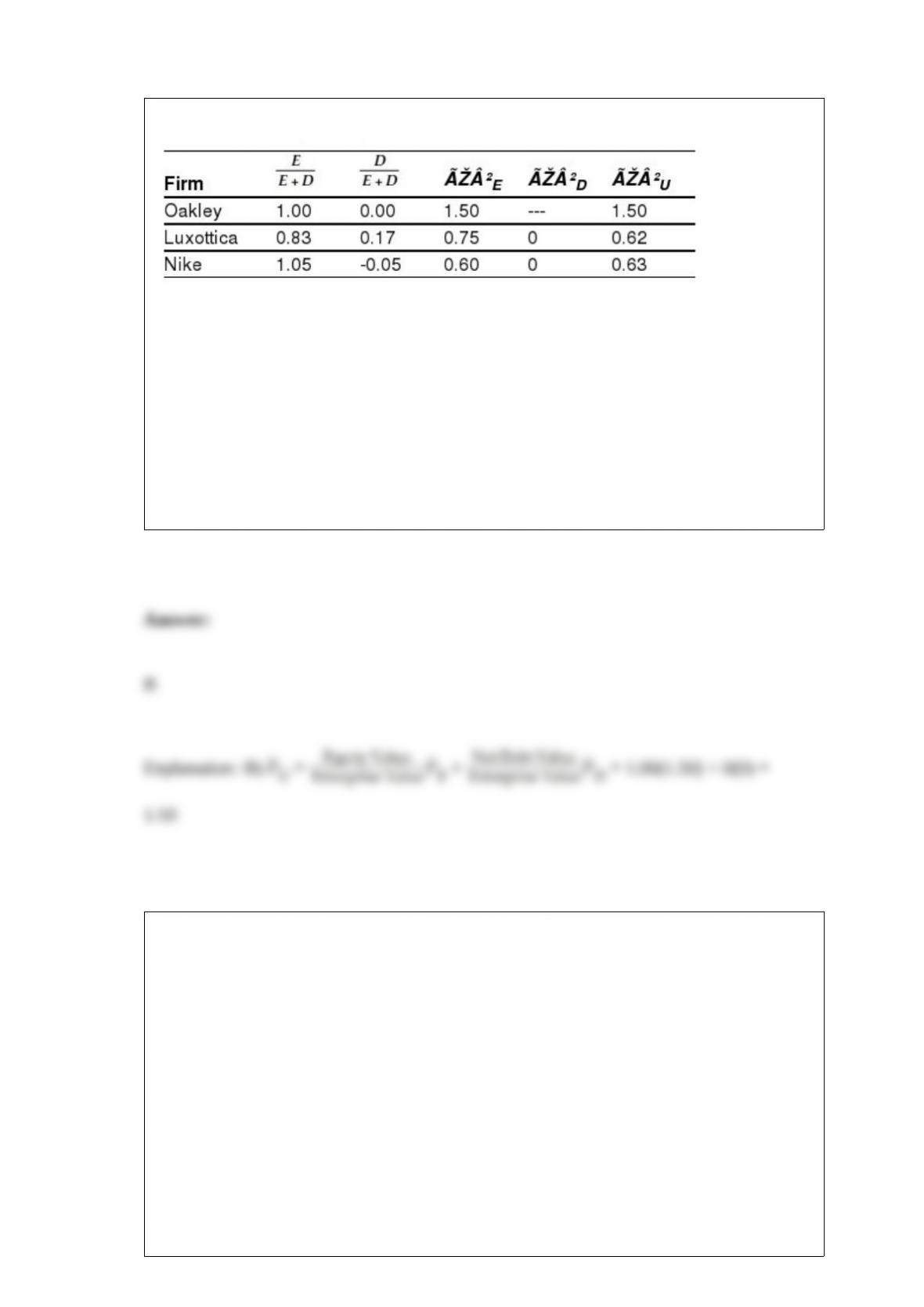
Capital Structure and Unlevered Beta Estimates for Comparable Firms
The unlevered beta for Oakley is closest to:
A) 0.70
B) 1.50
C) 1.00
D) 0.60
Which of the following statements is FALSE?
A) The tradeoff theory weighs the costs of debt that result from shielding cash flows
from taxes against the benefits from the effects of financial distress associated with
leverage.
B) Leverage has costs as well as benefits.
C) According to the tradeoff theory, the total value of a levered firm equals the value of
the firm without leverage plus the present value of the tax savings from debt, less the
present value of financial distress costs.
D) Firms have an incentive to increase leverage to exploit the tax benefits of debt. But
with too much debt, they are more likely to risk default and incur financial distress
costs.
Which of the following statements regarding arbitrage and security prices is
INCORRECT?
A) We call the price of a security in a normal market the no-arbitrage price for the
security.
B) In financial markets it is possible to sell a security you do not own by doing a short
sale.
C) When a bond is underpriced, the arbitrage strategy involves selling the bond and
investing some of the proceeds.
D) The general formula for the no-arbitrage price of a security is Price(security) =
PV(All cash flows paid by the security).
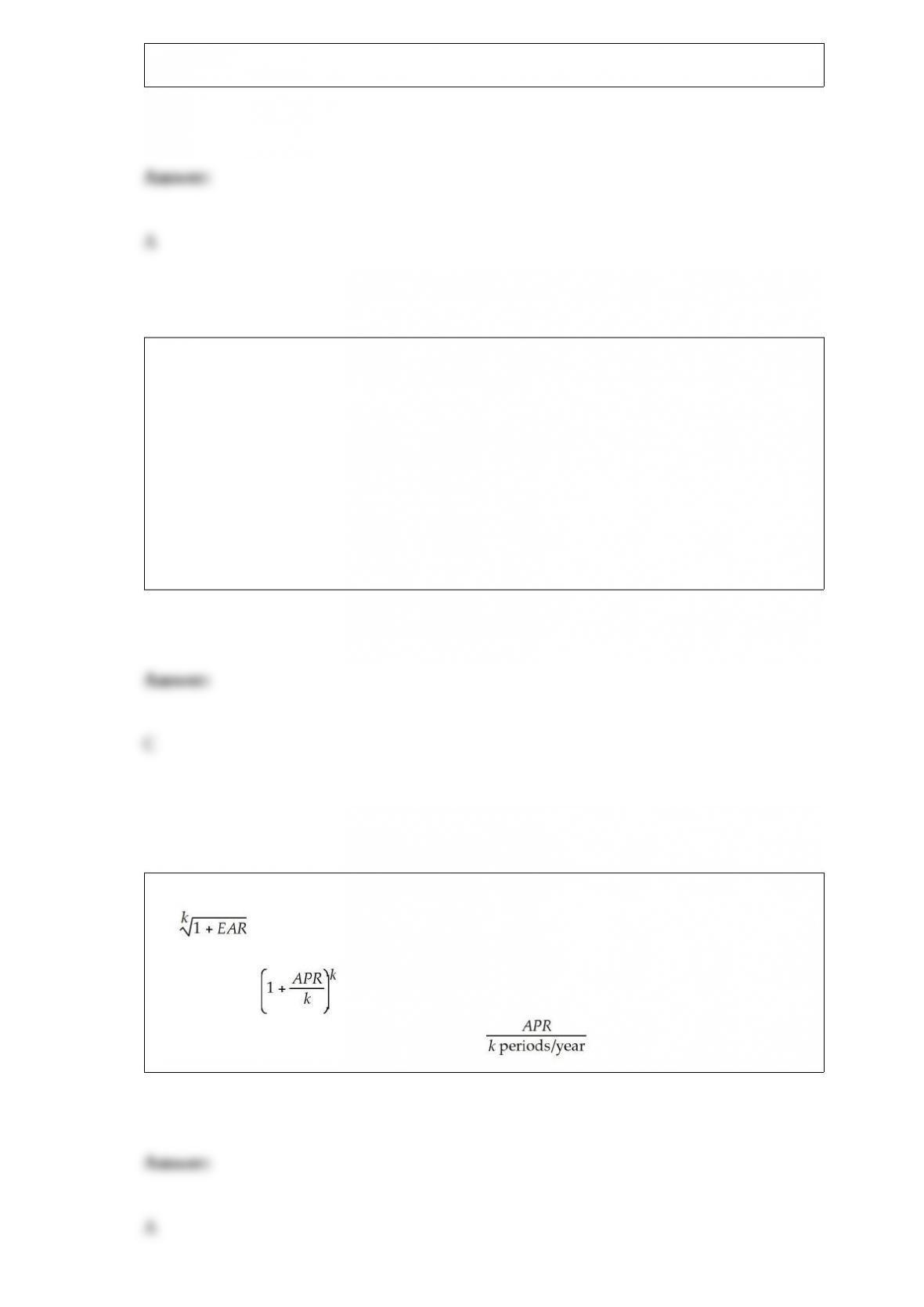
Which of the following equations is INCORRECT?
A) – 1= APR
B) Equivalent n-Period Discount Rate = (1 + r)n– 1
C) 1 + EAR =
D) Interest Rate per Compounding Period =

The Sisyphean Company’s common stock is currently trading for $25.00 per share. The
stock is expected to pay a $2.50 dividend at the end of the year and the Sisyphean
Company’s equity cost of capital is 14%. If the dividend payout rate is expected to
remain constant, then the expected growth rate in the Sisyphean Company’s earnings is
closest to:
A) 8%
B) 6%
C) 4%
D) 2%
The owner of the Krusty Krab is considering selling his restaurant and retiring. An
investor has offered to buy the Krusty Krab for $350,000 whenever the owner is ready
for retirement. The owner is considering the following three alternatives:
1. Sell the restaurant now and retire.
2. Hire someone to manage the restaurant for the next year and retire. This will require
the owner to spend $50,000 now, but will generate $100,000 in profit next year. In one
year the owner will sell the restaurant for $350,000.
3. Scale back the restaurant’s hours and ease into retirement over the next year. This will
require the owner to spend $40,000 on expenses now, but will generate $75,000 in
profit at the end of the year. In one year the owner will sell the restaurant for $350,000.
If the interest rate is 7%, the NPV of alternative #1 is closest to:
A) $350,000
B) $357,000
C) $375,500
D) $400,000

You are trying to decide between three mutually exclusive investment opportunities.
The most appropriate tool for identifying the correct decision is:
A) NPV.
B) profitability index.
C) IRR.
D) incremental IRR.
Consider the following four alternatives:
1. $132 received in two years.
2. $160 received in five years.
3. $200 received in eight years.
4. $220 received in ten years.
The ranking of the four alternatives from most valuable to least valuable if the interest
rate is 7% per year would be:
A) 1, 2, 3, 4
B) 4, 3, 2, 1
C) 3, 4, 2, 1
D) 3, 1, 2, 4
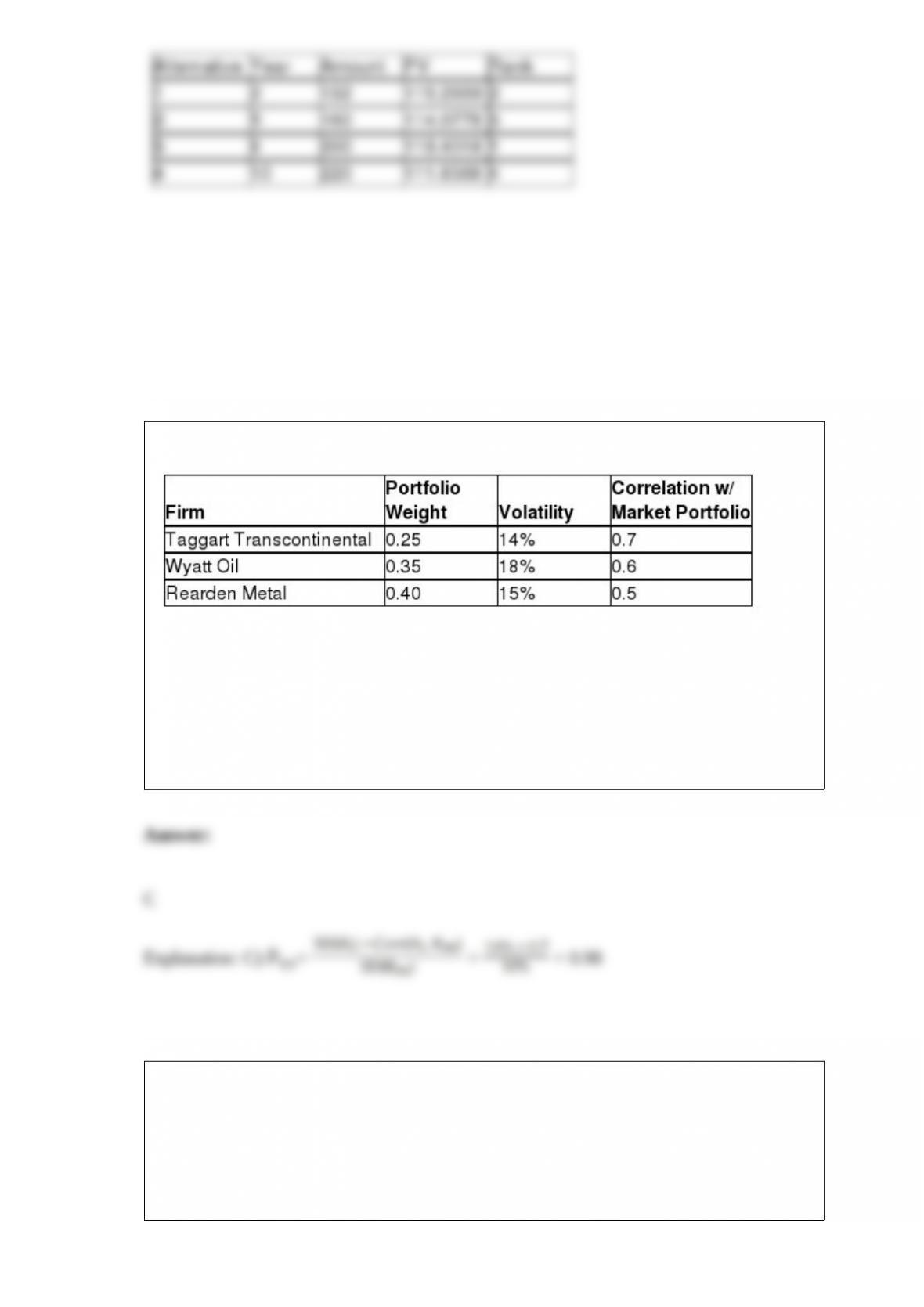
The volatility of the market portfolio is 10%, the expected return on the market is 12%,
and the risk-free rate of interest is 4%.The beta for Taggart Transcontinental is closest
to:
A) 0.75
B) 0.80
C) 1.00
D) 1.10
You are offered an investment that pays 8% APR compounded continuously. The
effective annual rate for this investment is closest to:
A) 7.70%
B) 8.00%
C) 8.33%
D) 8.50%

If a firm’s excess cash holdings are greater than its debt, using net debt as the measure
of leverage will result in:
A) its unlevered beta and cost of capital equalling zero.
B) its unlevered beta and cost of capital being greater than its equity beta and cost of
capital.
C) the risk of the firm’s equity being increased by its cash holdings in excess of its
operating needs.
D) the risk of the firm’s debt being increased by its cash holdings in excess of its
operating needs.
You are saving for retirement. To live comfortably, you decide that you will need $2.5
million dollars by the time you are 65. If today is your 30th birthday, and you decide,
starting today, and on every birthday up to and including your 65th birthday, that you
will deposit the same amount into your savings account. Assuming the interest rate is
5%, the amount that you must set aside each and every year on your birthday is closest
to:
A) $71,430
B) $27,680
C) $26,100
D) $26,260

Suppose you invest $15,000 in Merck stock and $25,000 in Home Depot stock. You
receive an actual return of -8% for Merck and 12% for Home Depot. What is the actual
return on your portfolio?
A) 4.50%
B) 4.00%
C) 10.00%
D) 2.00%
Frank Dewey Esquire from the firm of Dewey, Cheatum, and Howe, has been offered
an upfront retainer of $30,000 to provide legal services over the next 12 months to
Taggart Transcontinental. In return for this upfront payment, Taggart Transcontinental
would have access to 8 hours of legal services from Frank for each of the next 12
months. Frank’s normal billable rate is $250 per hour for legal services.
Assuming that Dewey’s cost of capital is 12% EAR, then the NPV of his retainer offer
is closest to:
A) -$7,500
B) -$7,400
C) $6,000
D) $7,400
Consider the following information regarding corporate bonds:
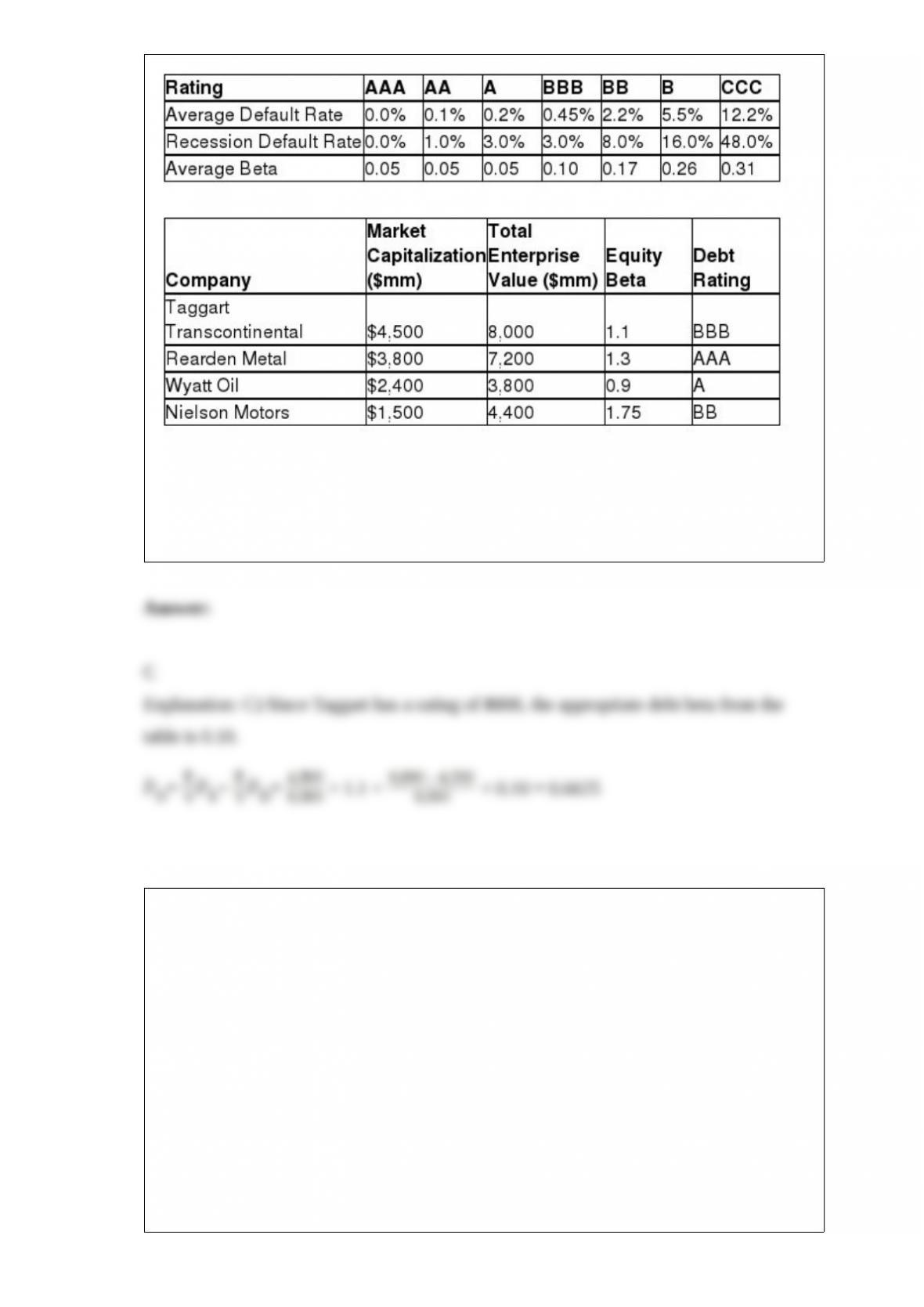
Your estimate of the asset beta for Taggart Transcontinental is closest to:
A) 0.42
B) 0.59
C) 0.66
D) 0.71
Wyatt Oil has assets with a market value of $600 million, $70 million of which are
cash. It has debt of $250 million, and 20 million shares outstanding. Assume perfect
capital markets.
If Wyatt Oil distributes the $70 million as a dividend, then its debt-to-equity ratio after
the dividend will be closest to:
A) 0.7
B) 0.9
C) 1.0
D) 1.1

An American Depository Receipt (ADR) is a security issued by a U.S. bank and traded
on a U.S. stock exchange that represents a specific number of shares of a foreign stock.
Siemens AG has an ADR that trades on the NYSE and is equivalent to one share of
Seimens AG trading on the Frankfurt Stock Exchange in Germany. If Seimens trades
for $95.19 on the NYSE and for €64.10 on the Frankfurt Stock Exchange, then under
the law of one price, the current exchange rate is closest to:
A) $0.6744/€
B) €0.6734/$
C) €1.4850/$
D) $1.5274/€
In November 2009, Perrigo Co. (PRGO) had a share price of $39.20. They had 91.33
million shares outstanding, a market-to-book ratio of 3.76. In addition, PRGO had
$845.01 million in outstanding debt, $163.82 million in net income, and cash of
$257.09 million.
Perrigo’s book value of equity is closest to:
A) $952.16 million
B) $3,580.14 million
C) $4,168.06 million
D) $4,425.15 million
At an annual interest rate of 7%, the present value of this timeline in year 0 is closest to:
A) $3,080
B) $3,600
C) $3,770
D) $4,035
Which of the following statements is FALSE?
A) The principal or face value of a bond is the notional amount we use to compute the
interest payments.
B) Payments are made on bonds until a final repayment date, called the term date of the
bond.
C) The coupon rate of a bond is set by the issuer and stated on the bond certificate.
D) The promised interest payments of a bond are called coupons.
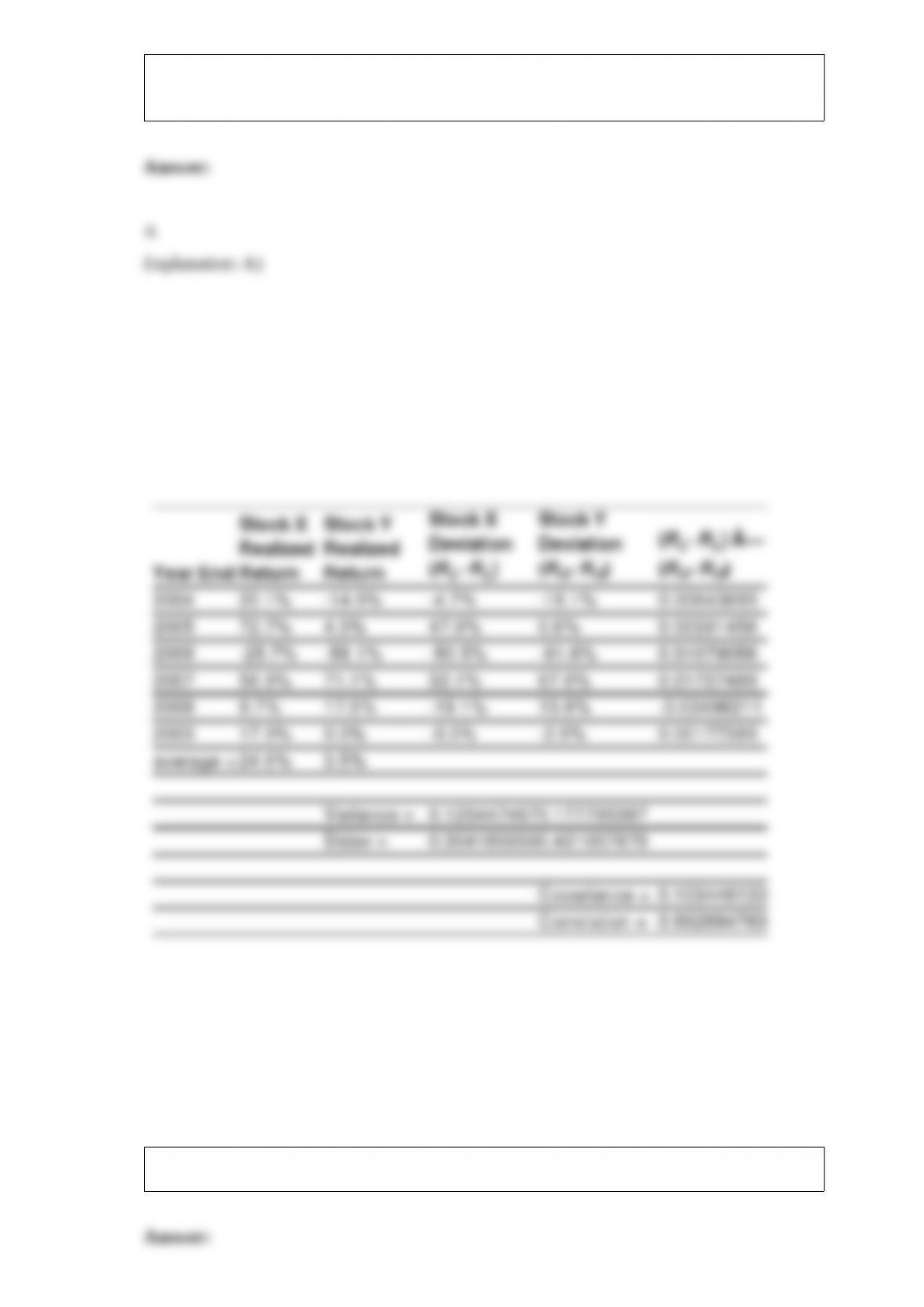
Consider the following returns:
The covariance between Stock X’s and Stock Y’s returns is closest to:
A) 0.10
B) 0.29
C) 0.12
D) 0.69
What is the purpose of the sensitivity analysis?
Kinston Industries is considering investing in a machine that will cost $125,000 and
will last for three years. The machine will generate revenues of $120,000 each year and
the cost of goods sold will be 50% of sales. At the end of year three the machine will be
sold for $15,000. The appropriate cost of capital is 10% and Kinston is in the 35% tax
bracket.
Assume that Kinston’s new machine will be depreciated straight line to a salvage value
of $5,000 at the end of year three. What is the after-tax salvage value of this project?
What is the conservation of value principle?
Consider the following expected returns, volatilities, and correlations:
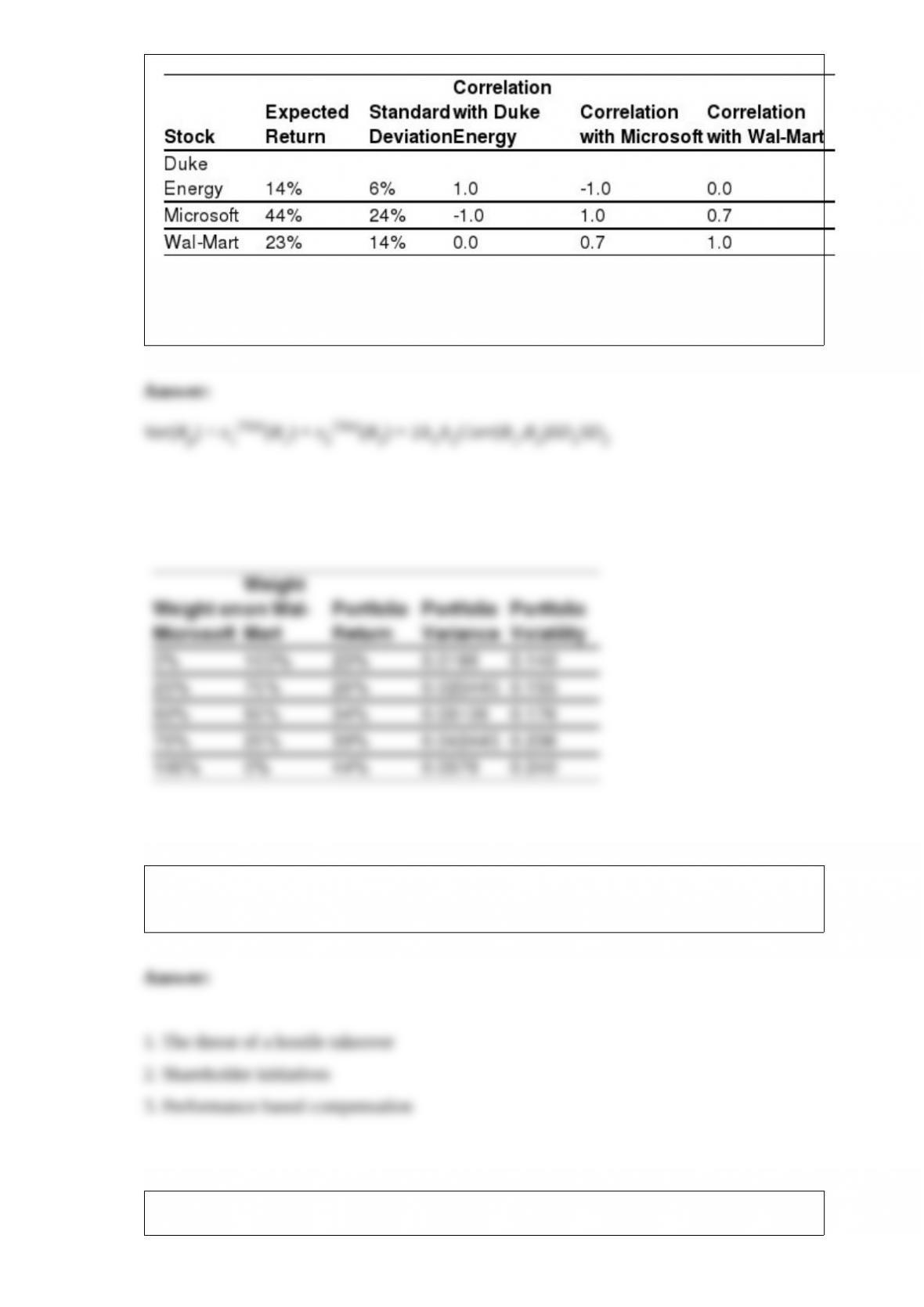
Consider a portfolio consisting of only Microsoft and Wal-Mart stock. Calculate the
volatility of such a portfolio when the weight on Microsoft stock is 0%, 25%, 50%,
75%, and 100%
What strategies are available to shareholders to help ensure that managers are motivated
to act in the interest of the shareholders rather than their own interest?
Iota Industries Market Value Balance Sheet ($ Millions) and Cost of Capital
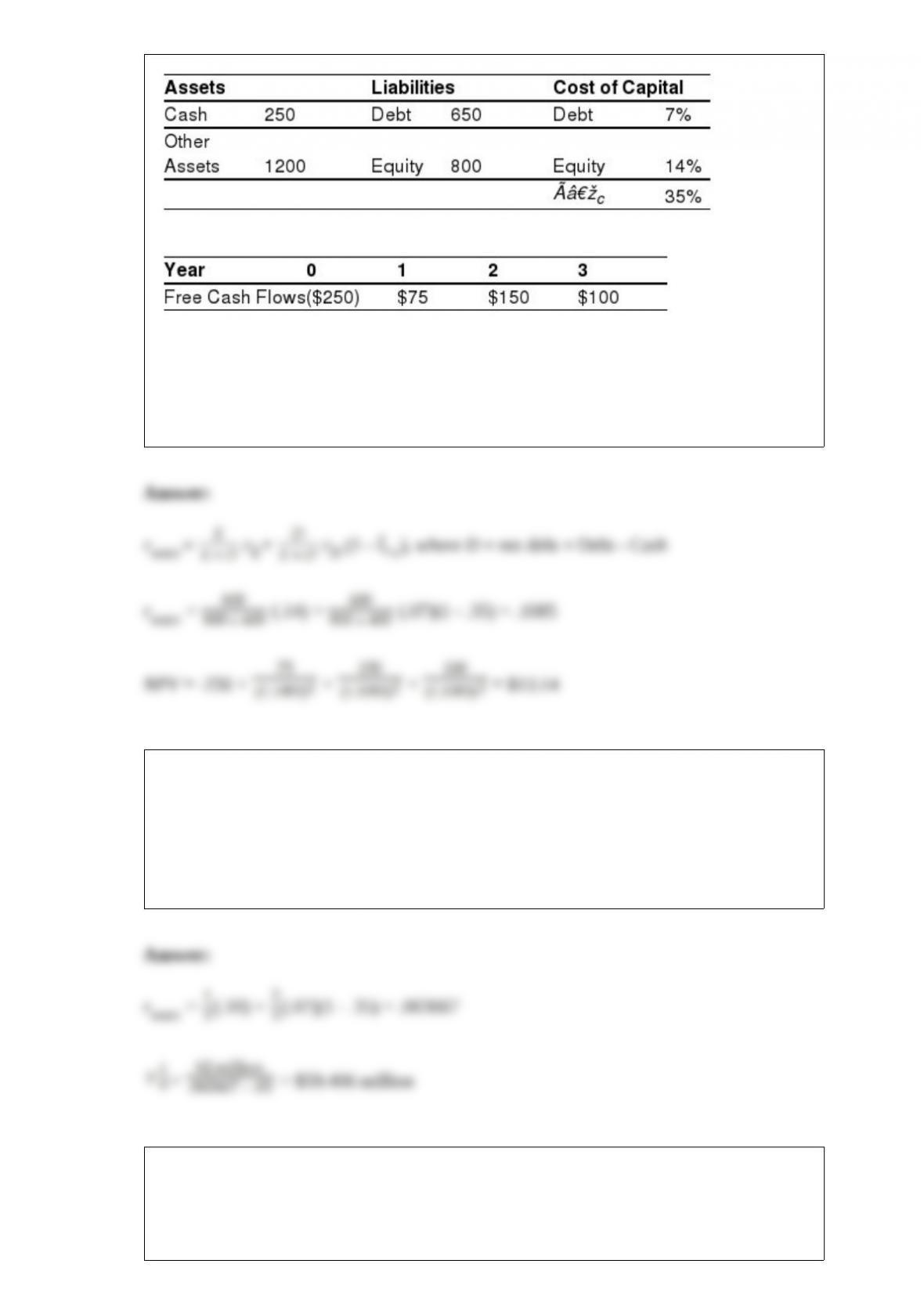
Iota Industries New Project Free Cash Flows
Assume that this new project is of average risk for Iota and that the firm wants to hold
constant its debt to equity ratio.
Calculate the NPV for Iota’s new project.
Suppose Luther Industries is considering divesting one of its product lines. The product
line is expected to generate free cash flows of $2 million per year, growing at a rate of
3% per year. Luther has an equity cost of capital of 10%, a debt cost of capital of 7%, a
marginal tax rate of 35%, and a debt-equity ratio of 2. If this product line is of average
risk and Luther plans to maintain a constant debt-equity ratio, what after- tax amount
must it receive for the product line in order for the divestiture to be profitable?
Consider two firms: firm Without has no debt, and firm With has debt of $10,000 on
which it pays interest of 5% per year. Both companies have identical projects that
generate free cash flows of $1000 or $2000 each year. Suppose that there are no taxes,
and after paying any interest on debt, both companies use all remaining cash free cash
flows to pay dividends each year.Suppose you own 10% of the equity of With. What is
another portfolio you could hold that would provide you with the same exact cash
flows?
Consider a project with free cash flows in one year of $90,000 in a weak economy or
$117,000 in a strong economy, with each outcome being equally likely. The initial
investment required for the project is $80,000, and the project’s cost of capital is 15%.
The risk-free interest rate is 5%.
Suppose that to raise the funds for the initial investment the firm borrows $45,000 at the
risk free rate and issues new equity to cover the remainder. In this situation, calculate
the value of the firm’s levered equity from the project. What is the cost of capital for the
firm’s levered equity?
Describe the key steps in the flow to equity method for valuing a levered investment.