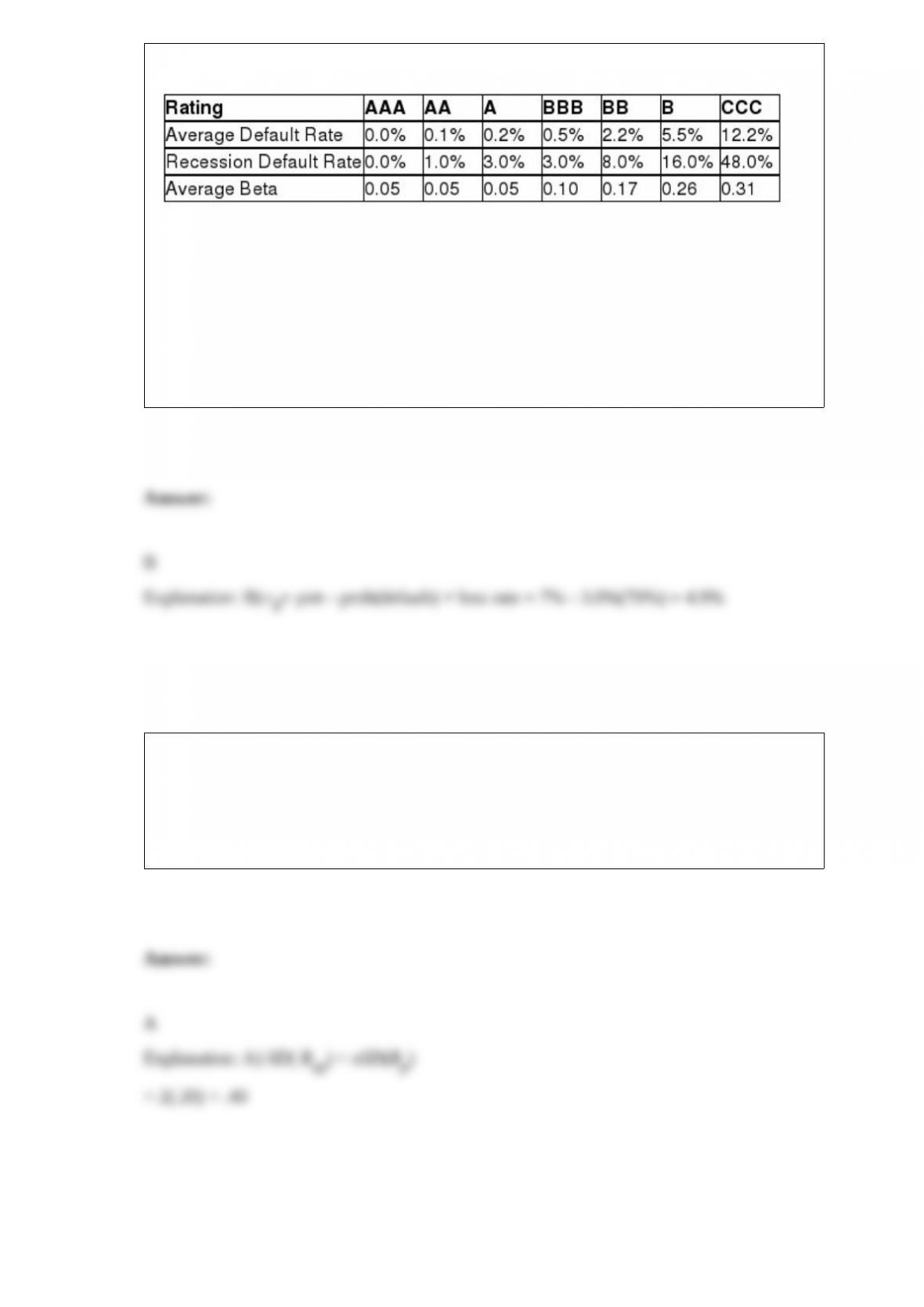
Consider the following information regarding corporate bonds:
Wyatt Oil has a bond issue outstanding with seven years to maturity, a yield to maturity
of 7.0%, and a BBB rating. The bondholders’ expected loss rate in the event of default
is 70%. Assuming the economy is in recession, then the expected return on Wyatt Oil’s
debt is closest to:
A) 3.5%
B) 4.9%
C) 5.5%
D) 7.0%
The volatility of your of your investment is closest to:
A) 40%
B) 20%
C) 30%
D) 24%

Shepard Industries expects free cash flow of $10 million each year. Shepard’s corporate
tax rate is 35%, and its unlevered cost of equity is 10%. The firm also has outstanding
debt of $40 million and it expects to maintain amount of debt permanently.
The value of Shepard Industries without leverage is closest to:
A) $114 million
B) $50 million
C) $100 million
D) $64 million
Estimated 2005 Income Statement and Balance Sheet Data for Ideko Corporation
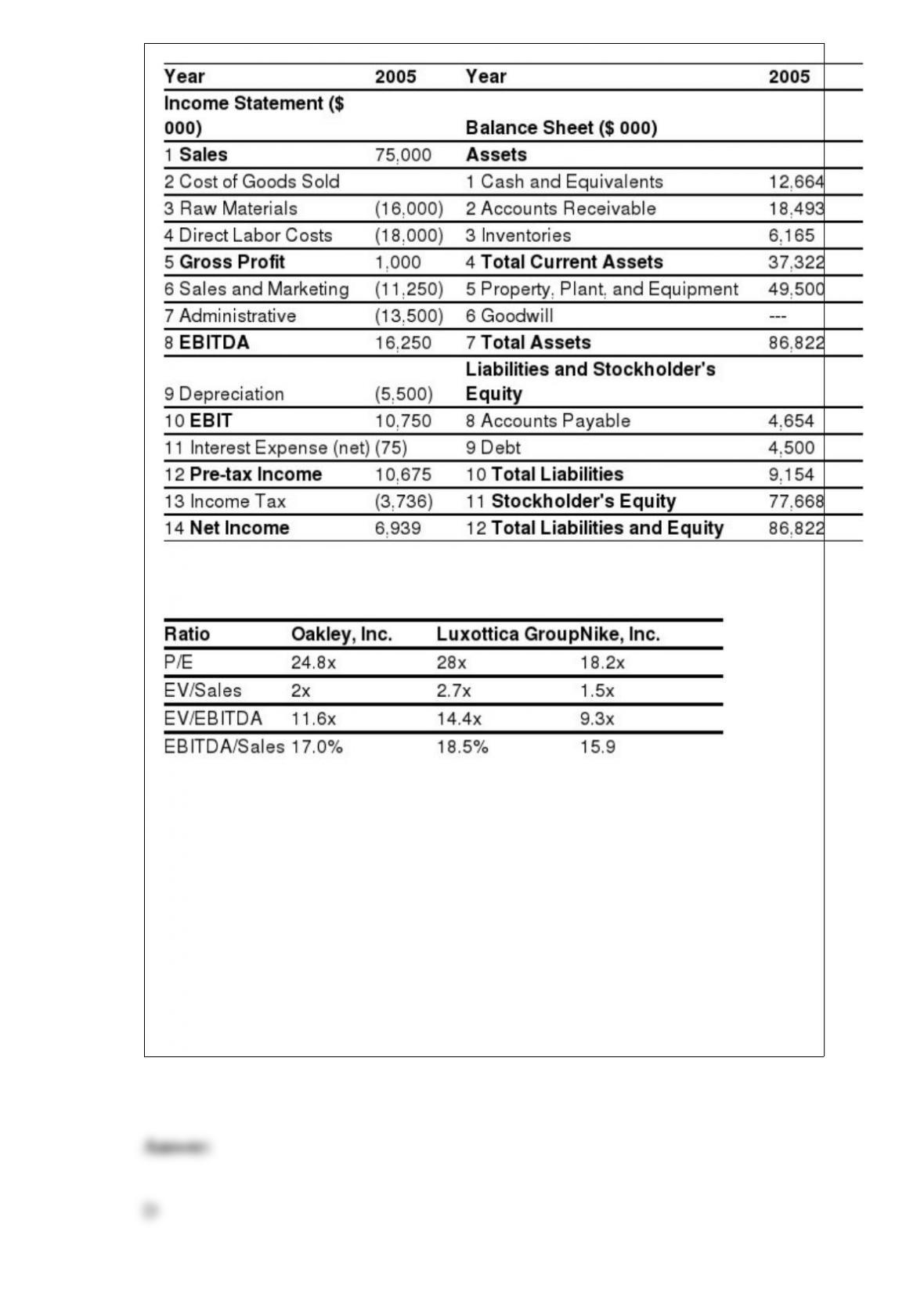
The following are financial ratios for three comparable companies:
Based upon the average EV/EBITDA ratio of the comparable firms, if Ideko holds $6.5
million of cash in excess of its working capital needs, then Ideko’s target market value
of equity is closest to:
A) $155 million
B) $157 million
C) $165 million
D) $193 million

Consider two firms, With and Without, that have identical assets that generate identical
cash flows. Without is an all-equity firm, with 1 million shares outstanding that trade
for a price of $24 per share. With has 2 million shares outstanding and $12 million
dollars in debt at an interest rate of 5%.
Assume that MM’s perfect capital markets conditions are met and that you can borrow
and lend at the same 5% rate as with. You have $5000 of your own money to invest and
you plan on buying With stock. Using homemade (un)leverage, how much do you need
to invest at the risk-free rate so that the payoff of your account will be the same as a
$5000 investment in Without stock?
A) $5000
B) $0
C) $2,500
D) $4,000
Temporary Housing Services Incorporated (THSI) is considering a project that involves
setting up a temporary housing facility in an area recently damaged by a hurricane.
THSI will lease space in this facility to various agencies and groups providing relief

services to the area. THSI estimates that this project will initially cost $5 million to
setup and will generate $20 million in revenues during its first and only year in
operation (paid in one year). Operating expenses are expected to total $12 million
during this year and depreciation expense will be another $3 million. THSI will require
no working capital for this investment. THSI’s marginal tax rate is 35%.Assume that
THSI’s cost of capital for this project is 15%. The NPV of this temporary housing
project is closest to:
A) $435,000
B) -$650,000
C) $1,960,000
D) -$435,000
The beta for the risk free investment is closest to:
A) 1
B) 0
C) Unable to answer this question without knowing the risk free rate
D) Unable to answer this question without knowing the markets volatility
Consider an equally weighted portfolio that contains 20 stocks. If the average volatility
of these stocks is 35% and the average correlation between the stocks is .4, then the
volatility of this equally weighted portfolio is closest to:
A) .17
B) .41
C) .14
D) .37
Consider the following information regarding corporate bonds:
Rearden Metal has a bond issue outstanding with ten years to maturity, a yield to
maturity of 8.6%, and a B rating. The corresponding risk-free rate is 3% and the market
risk premium is 6%. Assuming a normal economy, the expected return on Rearden
Metal’s debt is closest to:
A) 0.6%
B) 1.6%
C) 4.6%
D) 6.0%
The excess return if the difference between the average return on a security and the
average return for:
A) Treasury Bonds.
B) a portfolio of securities with similar risk.
C) a broad based market portfolio like the S&P 500 index.
D) Treasury Bills.
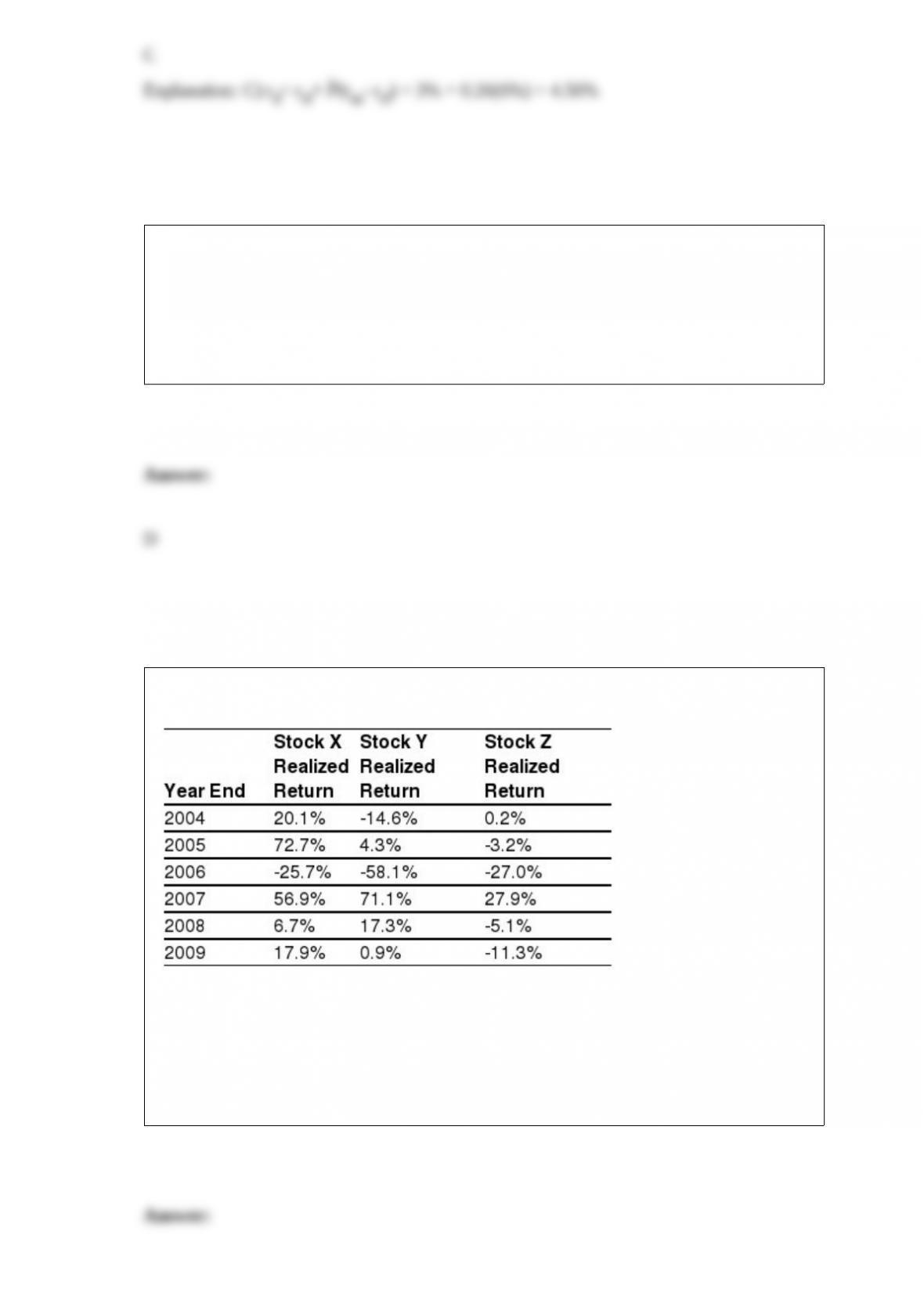
Consider the following returns:
The variance on a portfolio that is made up of equal investments in Stock X and Stock
Z stock is closest to:
A) 0.62
B) 0.05
C) 0.12
D) 0.06
You own your own firm and you need to raise $50 million to fund an expansion.
Following the expansion, your firm will be worth $75 million in its unlevered form.
You want to go ahead with the expansion, but you are concerned that you may not be
able to maintain ownership of over 50% of your firm’s equity. In other words, you are
concerned that if you use equity to finance the expansion, you may lose control of your
firm.
Assume that capital markets are perfect except for the existence of corporate taxes and
that your firm pays 40% of earnings in taxes. If you want to maintain ownership of at
least a 50%, then the minimum amount of debt that you must issue to fund the
expansion is closest to:
A) $19 million
B) $18 million
C) $16 million
D) $20 million

Which of the following statements is FALSE?
A) One difficulty when trying to estimate beta for a security is that beta depends on the
correlation and volatilities of the security’s and market’s returns in the future.
B) It is common practice to estimate beta based on the expectations of future
correlations and volatilities.
C) One difficulty when trying to estimate beta for a security is that beta depends on
investors expectations of the correlation and volatilities of the security’s and market’s
returns.
D) Securities that tend to move less than the market have betas below 1.
Suppose that the risk-free rate is 5% and the market portfolio has an expected return of
13% with a volatility of 18%. Monsters Inc. has a 24% volatility and a correlation with
the market of .60, while California Gold Mining has a 32% volatility and a correlation
with the market of -.7. Assume the CAPM assumptions hold.Monsters’ required return
is closest to:
A) 10.0%
B) 13.0%
C) 11.5%
D) 15.5%

Which of the following statements is FALSE?
A) Because only the tax consequences of depreciation are relevant for free cash flow,
we should use the depreciation expense that the firm will use for tax purposed in our
free cash flow forecasts.
B) A firm generally identifies its marginal tax rate by determining the tax bracket that it
falls into based on its overall level of pre-tax income.
C) Free Cash Flow = (Revenues – Costs) × (1 – Ï„c) – Capital Expenditures – ΔNWC +
Ï„c× Depreciation.
D) Net working capital is the difference between current liabilities and current assets.
Omicron Technologies has $50 million in excess cash and no debt. The firm expects to
generate additional free cash flows of $40 million per year in subsequent years and will
pay out these future free cash flows as regular dividends. omicrons unlevered cost of
capital is 10% and there are 10 million shares outstanding. Omicron’s board is meeting
to decide whether to pay out its $50 million in excess cash as a special dividend or to
use it to repurchase shares of the firm’s stock.
Assume that you own 2500 shares of Omicron stock and that Omicron uses the entire
$50 million to pay a special dividend. Suppose you are unhappy with Omicron’s
decision and would prefer that Omicron used the excess cash to repurchase shares. The
number of shares that you would have to buy in order to undo the special cash dividend
that Omicron paid is closest to:
A) 125
B) 275
C) 250
D) 310
Your son is about to start kindergarten in a private school. Currently, the tuition is
$12,000 per year, payable at the start of the school year. You expect annual tuition
increases to average 6% per year over the next 13 years. Assuming that your son
remains in this private school through high school and that your current interest rate is
6%, then the present value of your son’s private school education is closest to:
A) $106,230
B) $156,000
C) $137,900
D) This problem cannot be solved.

Which of the following statements is FALSE?
A) Bond traders typically quote bond prices rather than bond yields .
B) Treasury bills are zero-coupon bonds.
C) Zero-coupon bonds always trade at a discount.
D) The yield to maturity is typically stated as an annual rate by multiplying the
calculated YTM by the number of coupon payment per year, thereby converting it to an
APR.
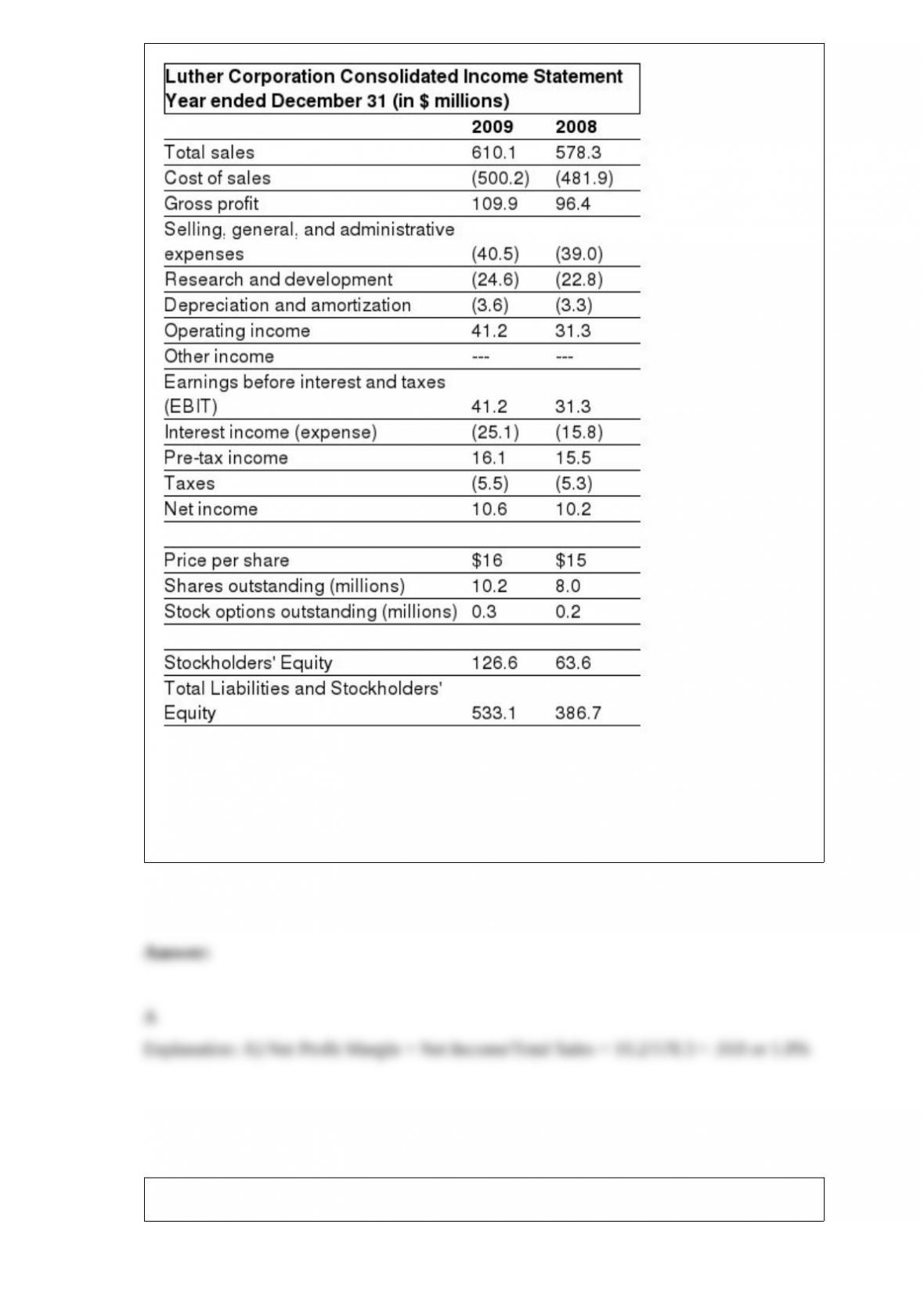
Luther’s Net Profit Margin for the year ending December 31, 2008 is closest to:
A) 1.8%
B) 2.7%
C) 5.4%
D) 16.7%
Consider the following probability distribution of returns for Alpha Corporation:
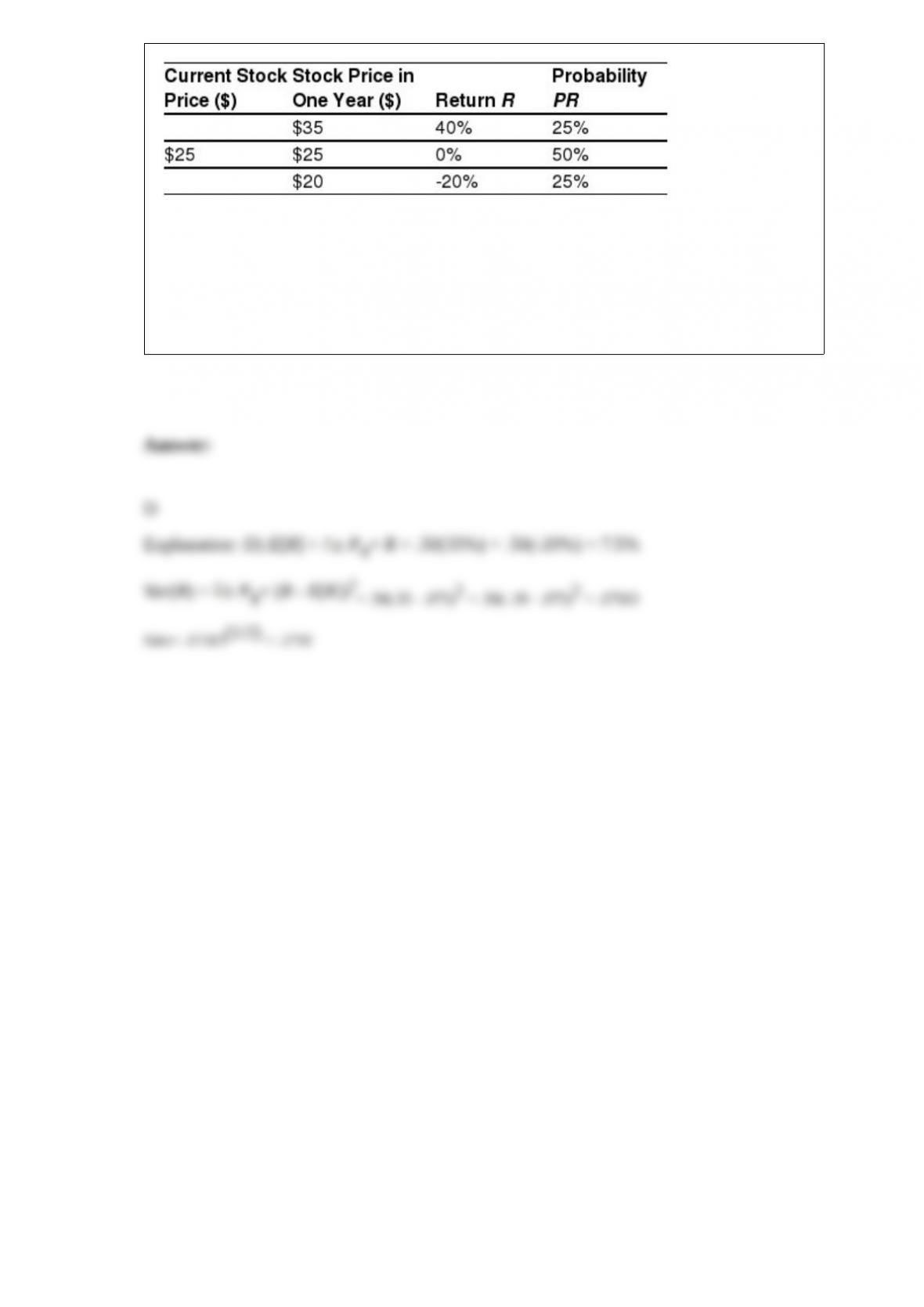
Suppose an investment is equally likely to have a 35% return or a -20% return. The
standard deviation on the return for this investment is closest to:
A) 38.9%
B) 0%
C) 19.4%
D) 27.5%