
Which of the following statements is incorrect?
A. The quicker a company collects money from its customers the greater its liquidity,
all else equal.
B. The more quickly a company turns over its inventory, the greater its liquidity, all else
equal.
C. The lower a company’s depreciation the greater its liquidity, all else equal.
D. The greater a company’s profit margin the greater its liquidity, all else equal.
Reported operating income for Horace Corporation was $145,000, and reported interest
expense was $45,000. Times interest earned for Horace Corporation, after necessary
adjustments, was:
A. 2.22.
B. 3.22.
C. 4.22.
D. 4.48.
Which of the following statements is correct?
I. Tax loss carrybacks result in deferred tax assets.
II. Tax loss carryforwards result in deferred tax assets.

III. The tax valuation account is used to adjust deferred tax liabilities if it is “more
likely than not” that they will not result in increased future taxes.
A. I only
B. II only
C. III only
D. I and II
Return on equity for 2006 is:
A. 20.41%.
B. 19.75%.
C. 17.54%.
D. 18.12%.
Look Good Corporation has current assets of $1.1 million and current liabilities of $1
million. It is close to year-end, and it would like to increase its current ratio. Which of
the following will achieve this?
A. Encourage customers to pay their bills more quickly.
B. Increase short-term borrowings by $0.1 million.
C. Sell building for $0.2 million in cash.

D. Liquidate some of its trading marketable securities.
Using the treasury stock method, calculate the number of extra shares being recognized
in the diluted EPS calculation resulting from options.
A. 500,000
B. 358,975
C. 333,333
D. 285,714
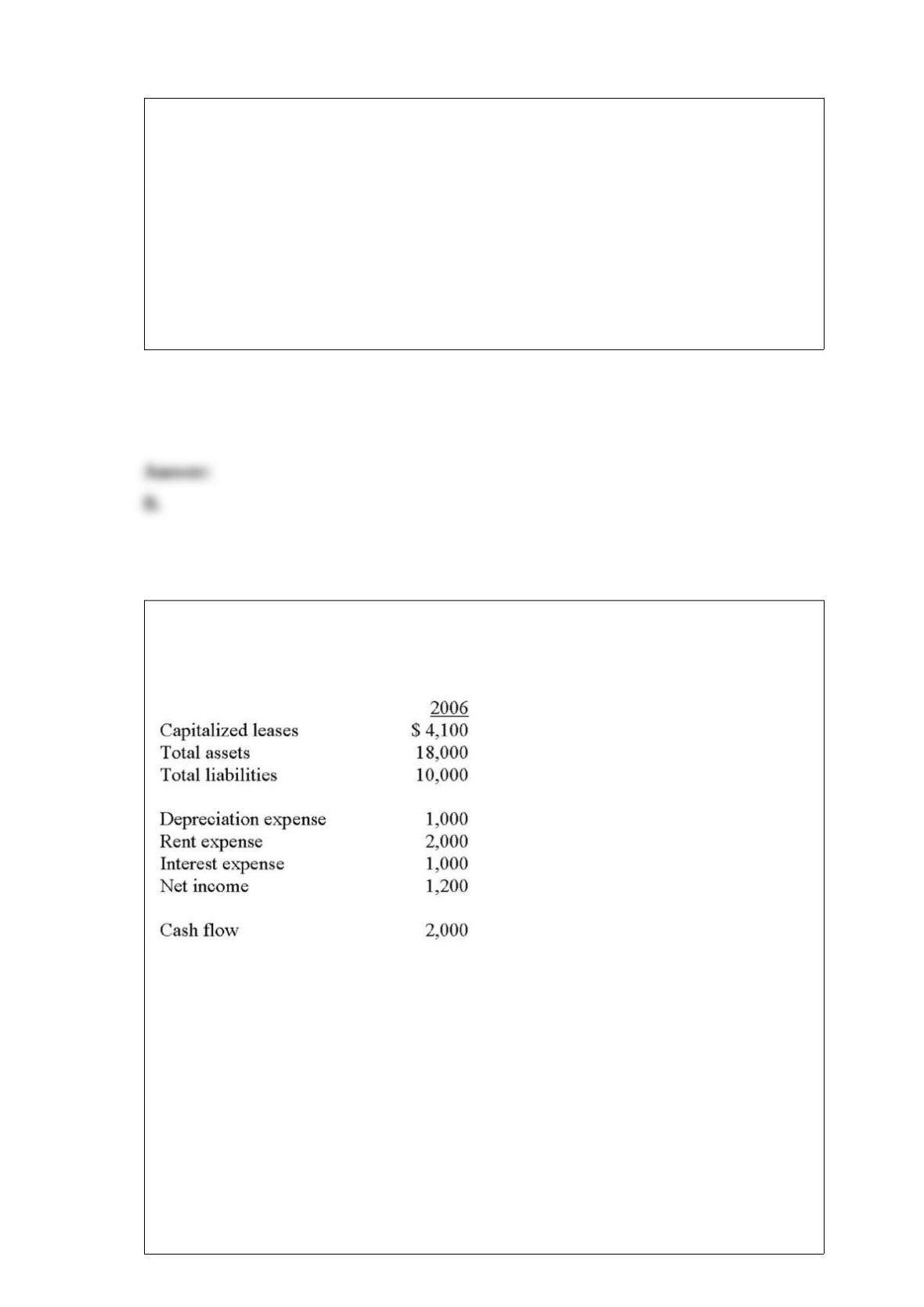
What cash is paid for purchases in the month of March?
A. $5,520.62
B. $4,757.50
C. $4,559.50
D. $2,095.50
The reasonableness and feasibility of short-term cash forecasts can be evaluated by
preparing:
A. bank reconciliation statements.
B. pro forma financial statements.
C. responsibility reports.
D. interest coverage computations.
Synthetic Leases
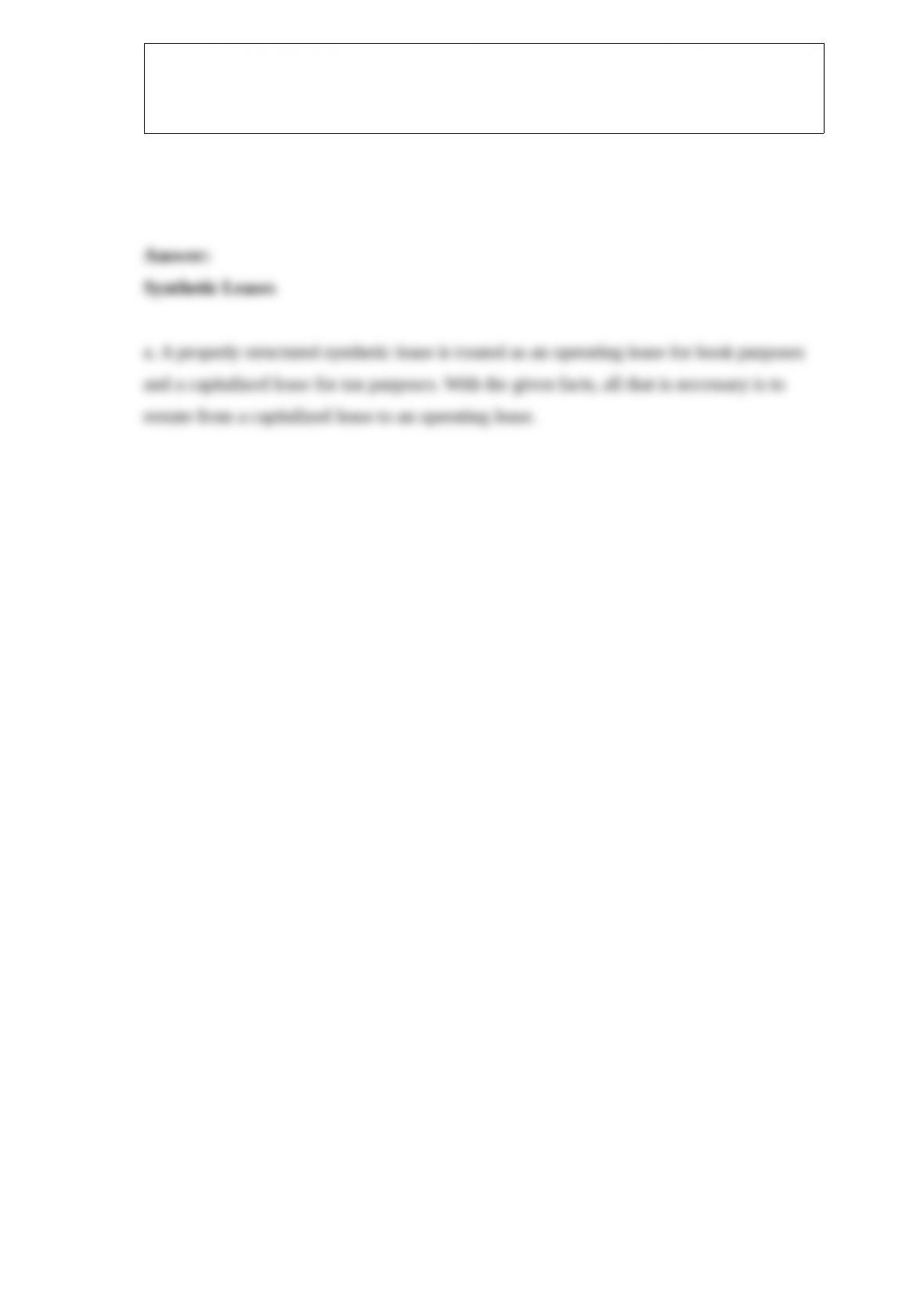
Following is selected financial information for Universal Skyhook:
Skyhook installed a new giant forging machine on January 1, 2006. It was financed as a
five-year capitalized lease with year-end payments of $1,002 with an implied 8%
interest rate. After the lease period, the scrap value will just about cover the cost to
remove the machine. Skyhook had no tax expense in 2006 and uses straight-line
depreciation for book and tax purposes.
a. The company is examining financing alternatives for another machine and has
received a synthetic lease proposal from a bank. To better understand this structure, the
CEO asks you how the above 2006 numbers would have changed had Skyhook used a
synthetic lease for the forging machine.
b. How would you interpret your results and what would your recommendation be?
c. Would your recommendation change if Skyhook had a tax rate of 36% and used
accelerated depreciation for tax purposes?
Ratios
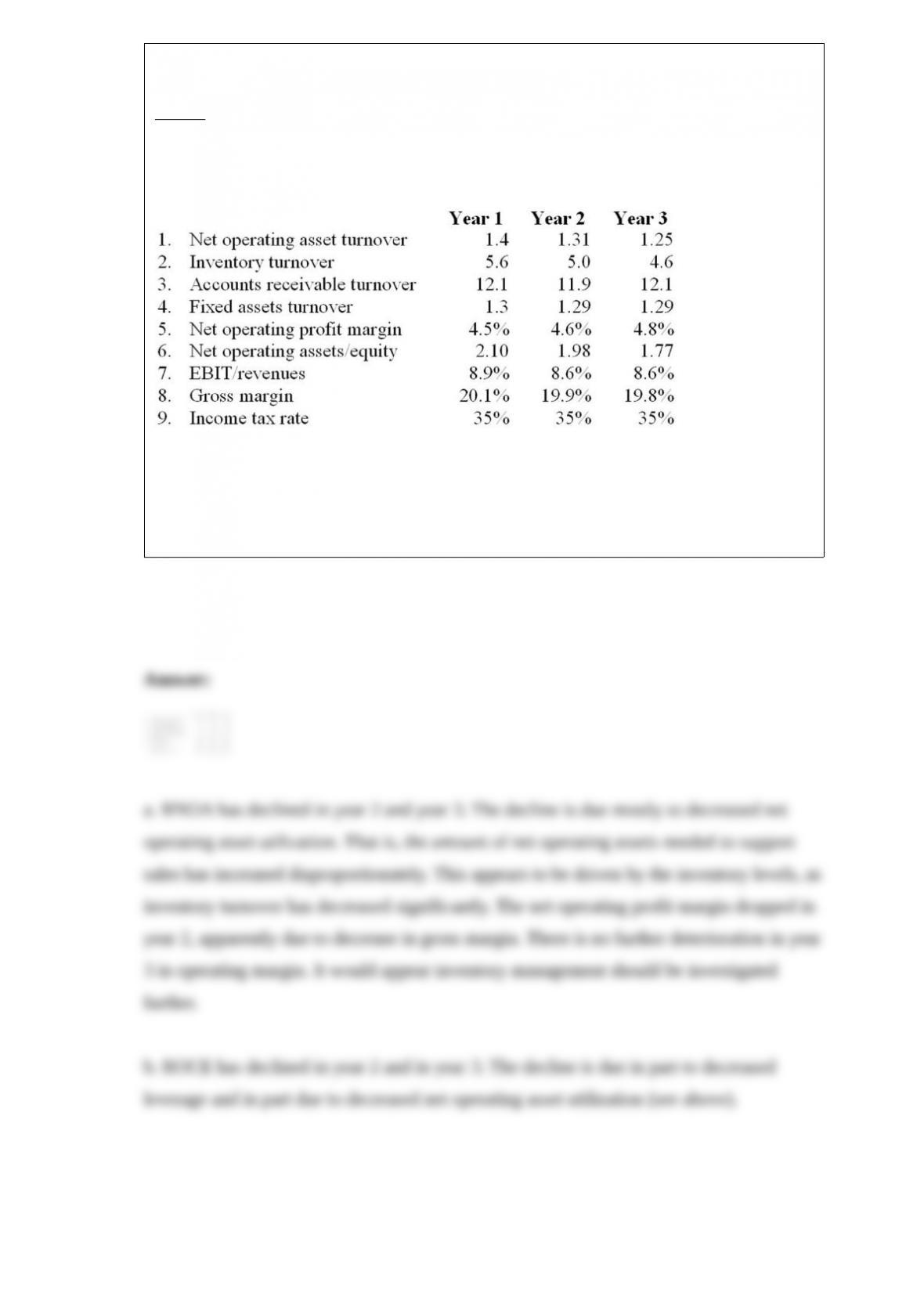
Below are selected ratios for Manufacturers Corporation. Use this information answer
the following questions.
a. Calculate return on net operating assets for all three years. Identify reasons for any
changes.
b. Calculate return on equity for all three years. Comment on changes.

Depreciation expense would be:
A. lower using conversion method than temporal method.
B. lower using temporal method than current rate method.
C. lower using current rate method than conversion method.
D. lower using all-current rate method than temporal method.
Days in inventory at the end of Year 2 is closest to:
A. 60.0 days.
B. 69.0 days.
C. 66.0 days.
D. 54.0 days.
Limitations of the Statement of Cash Flows
GAAP requires that the Statement of Cash flows (SCFs) is prepared in a specific
manner. For the following items, discuss in which section (operating, investing, or
financing) of the SCFs they are found, where they might more appropriately be placed
and why?
a. Dividends received
b. Interest paid
c. Income taxes
The capitalization of interest cost during construction:
A. increases future net income.
B. decreases future depreciation expense.
C. increases net income during construction phase.
D. decreases assets during construction phase.
Working Capital Management
Consider each of the following situations independently of each other. For each of the
situations provide one example of when the underlying circumstances may be such that
the observed trend is unfavorable and one example of when the underlying
circumstances are favorable.
a. Current ratio increases from one period to the next
b. Accounts receivable turnover increases from one period to the next
c. Accounts payable turnover increases from one period to the next

The net deferrals are included in the balance sheet as part of:
A. assets.
B. current liabilities.
C. shareholders’ equity.
D. long-term liabilities.
If the acquisition is completed as of 12/31/06, what will the reported earnings per share
be for the year ended 12/31/06 assuming purchase accounting is used?
A. $2.00
B. $2.33
C. $2.50
D. $2.80
Acquisitions
Growth Corporation is trading at $102 per share on 11/1/06 when it makes a bid of
0.667 shares of Growth Corp. for each outstanding share of Target Corp. Target has 40
million shares outstanding, and Growth Corp. has approximately 30 million shares
outstanding. Target closed at $50 per share on 10/31/06.
On 11/19/06, Bidder Corp. makes a bid of 2.5 shares of Bidder’s stock for each share of
Target. Bidder is trading at $29 on 11/19/06 with 90 million shares outstanding.
The fair market value of Target’s net identifiable assets is $1,020 million at the time of
the offers. Target’s expected earnings for 2006 are $250 million.
Growth Corporation’s earnings for 2006 are expected to be $125 million. Bidder
Corporation’s earnings for 2006 are expected to be $330 million.
a. How much of a percentage premium over the market price was Growth Corporation
prepared to pay for Target?
b. Assuming the stock market is efficient, why would one company be prepared to pay a
premium over current market value to acquire another company?
Liquidity of a company is generally defined as a measure of:
A. the ability of a company to pay its employees in a timely manner.
B. the ability to pay interest and principal on all debt.
C. the ability to pay dividends.
D. the ability to pay current liabilities.
Which of the following items is deducted from net income to arrive at cash flow from
operations when using the indirect method?
A. Depreciation expense
B. Amortization expense

C. Decrease in accounts receivable
D. Decrease in accounts payable
Which of the following would affect the comparison of financial statements across two
different firms?
I. Different accounting principles
II. Different sizes of the companies
III. Different reporting periods
IV. Different industries
A. I, III, and IV
B. I and IV
C. I and II
D. I, II, III, and IV
When conducting comparative analysis by reviewing consecutive balance sheets:
A. all items on the balance sheet in Year t must be divided by their corresponding value
in Year t-1 and subtract 1 to calculate the percentage change.
B. all items on the balance sheet in Year t-1 must be subtracted from their
corresponding value in Year t to calculate the dollar change.
C. all items on the balance sheet in Year t must be divided by net income in Year t-1 to
calculate the percentage change.
D. Both A and B are correct.
Agwen Corporation owns 25% of the shares of Bronwo Corporation, which is traded on
the New York Stock Exchange. Which method is Agwen most likely to use to account
for this investment?
A. Cost method
B. Market method
C. Equity method
D. Consolidation method
Xena Corporation has a foreign subsidiary, Zeta Corporation, located in Japan. At the

end of fiscal 2006, Zeta has:
Assume Xena uses the current rate method for translating Zeta’s financial statements
from the yen into U.S. dollars. If the yen appreciates relative to the dollar, which of the
following is true?
A. Xena will record a foreign currency translation gain on the income statement.
B. Xena will record a foreign currency translation loss on the income statement.
C. Xena will record a foreign currency translation gain in the equity section of the
balance sheet.
D. Xena will record a foreign currency translation loss in the equity section of the
balance sheet.
The relation between a company’s return on common equity (ROCE) and return on net
operating assets (RNOA) reveals information about the company’s success with
financial leverage.
If a company’s current ratio increases from 1.1 to 1.3 from one year to the next, it can
be concluded that:
A. the liquidity has increased.
B. the current assets have increased.
C. the current liabilities have decreased.
D. None of the above
Post-retirement Benefits other than pensions
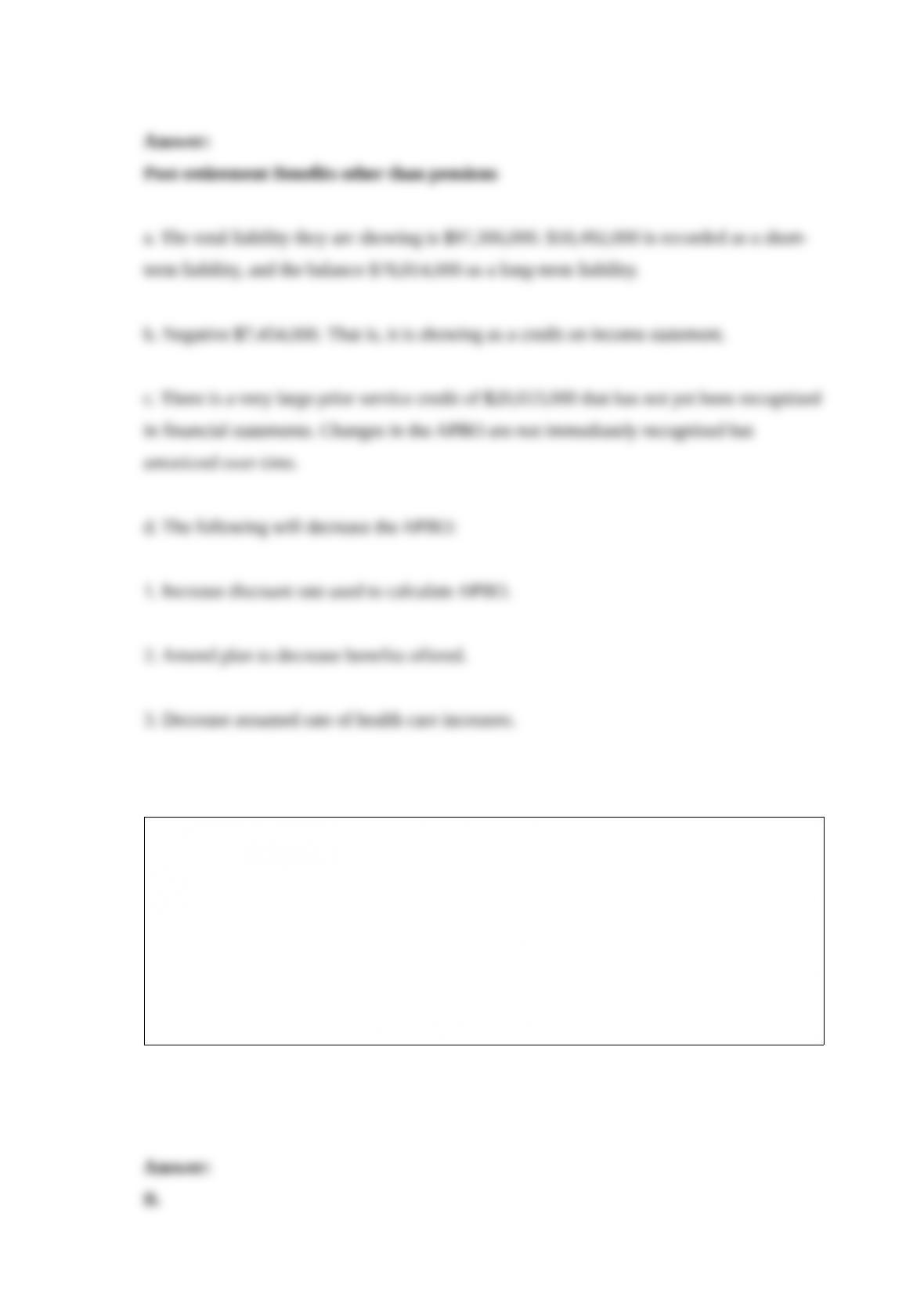
Below is part of Harnischfeger’s footnote on Postretirement Benefits other than
Pensions from its X6 Annual report.
a. What amount is Harnischfeger showing as a liability on their balance sheet with
respect to postretirement benefits other than pensions at the end of fiscal X6?
b. What amount is Harnischfeger showing as an expense on the income statement for
the fiscal year X6?
c. Why is Harnischfeger’s accrued postretirement benefit liability greater than the
APBO?
d. If Harnischfeger wanted to reduce its APBO how might they do it? Provide three
ways.
Which of the following is not included in the definition of earnings persistence?
A. Stability of the earnings
B. Magnitude of the earnings
C. Predictability of the earnings
D. The earnings’ trend

Relevance, one of the desirable qualities of accounting information, implies:
A. the capacity of information should be based on five-year average historical data.
B. the capacity of information to affect a decision.
C. the capacity of information should be based on market expectations.
D. that all companies should use same valuation methods such as LIFO and FIFO.
Which of the following statements concerning contingencies is correct?
I. Gain contingencies are recorded if they are probable and reasonably estimable.
II. Unredeemed frequent flyer mileage is an example of a loss contingency.
III. A loss contingency is a form of off-balance sheet financing.
IV. Loss contingencies are not recognized unless there is a greater than 95% chance
they will be realized.
A. I, II, III, and IV
B. II, III, and IV
C. II and III
D. II only

If a company has a high price-to-book ratio (PB) and low price-to-earnings (PE) ratio,
this suggests that:
A. earnings are expected to grow slowly or decline relative to current level, with low
expected return on common stockholders’ equity (ROCE).
B. earnings are expected to grow quickly relative to current level, but with low
expected ROCE.
C. earnings are expected to grow slowly or decline relative to current level, but with
high expected ROCE.
D. earnings are expected to grow quickly relative to current level, with high expected
ROCE.
If a company increases its expected return on plan assets this year, the effect would be
to:
I. increase plan assets.
II. decrease PBO.
III. decrease pension expense.
IV. decrease minimum liability.
A. I, II, and IV
B. I and IV
C. III and IV
D. III only

When a company is experiencing rapid growth, which of the following statements is the
most correct?
A. Cash flow from operations will be greater than cash flow from investing.
B. The company will likely need more outside financing than if growth was slower.
C. Cash flow from operations will be high due to rapid growth allowing company to
pay down debt.
D. Rapid growth will increase internally generated funds allowing higher dividend
payments in periods of rapid growth.
Which of the following situations is most likely to explain a net operating asset
turnover that is higher than the industry norm?
A. The company has more recently purchased fixed assets.
B. The company uses FIFO while competitors use LIFO.
C. The company uses the accelerated depreciation method while competitors use the
straight line method.
D. The company purchases more credit supplies than competitors.

Which of the following industries would you expect to have the longest operating
cycle?
A. Fast food industry
B. Aerospace industry
C. Discount retail store industry
D. Utility industry