
The stock market is really the entire network of investors, brokers, and exchanges all
connected together.
It is generally best to forecast revenue with unit and price detail.
In Modigliani and Miller’s model with taxes, a firm’s value increases with added
leverage. That increase comes from a “tax shield” created by the fact that interest is tax
deductible. Therefore, debt increases the firm’s value by the amount of that debt times
one minus the tax rate (1 – T).
Excess cash can be invested in marketable securities which earn a modest return but are
almost as liquid as cash itself.

The indirect quote states the price of a unit of foreign currency in US dollars.
Interest rates generally vary with the term of the debt. The relationship is known as the
maturity structure of interest rates.
Call penalties and call premiums are essentially interchangeable terms.
The formulation for establishing the current market price of a bond is:
A.PB= PV(interest payments) + PV(principal repayment).
B.PB= FV(interest payments) + FV(principal repayment).
C.PB= Coupon Payment[PVFA k,n] + Face Value[PVF k,n].
D.a and c

Firms sometimes disguise the cost or layoffs and reorganizations that may be
attributable to poor management as:
A.continuing operations.
B.unusual activities.
C.restructuring charges.
D.None of the above
In general, the options available to management for the disposition of the firm’s
earnings are:
A.retention for investment in business projects.
B.an immediate cash payment to shareholders in the form of a dividend.
C.prepaying taxes for as many as ten years.
D.both a and b
Target managements that resist mergers usually claim the offer is not in the best interest
of stockholders because the price offered is too low. However, they may be:
A.trying to get the acquirer to raise the offer.
B.trying to get the acquirer to offer them bonuses to support the proposal.
C.concerned about their jobs because target managements usually lose power after
mergers.
D.concerned that bondholders are being frozen out of the deal.
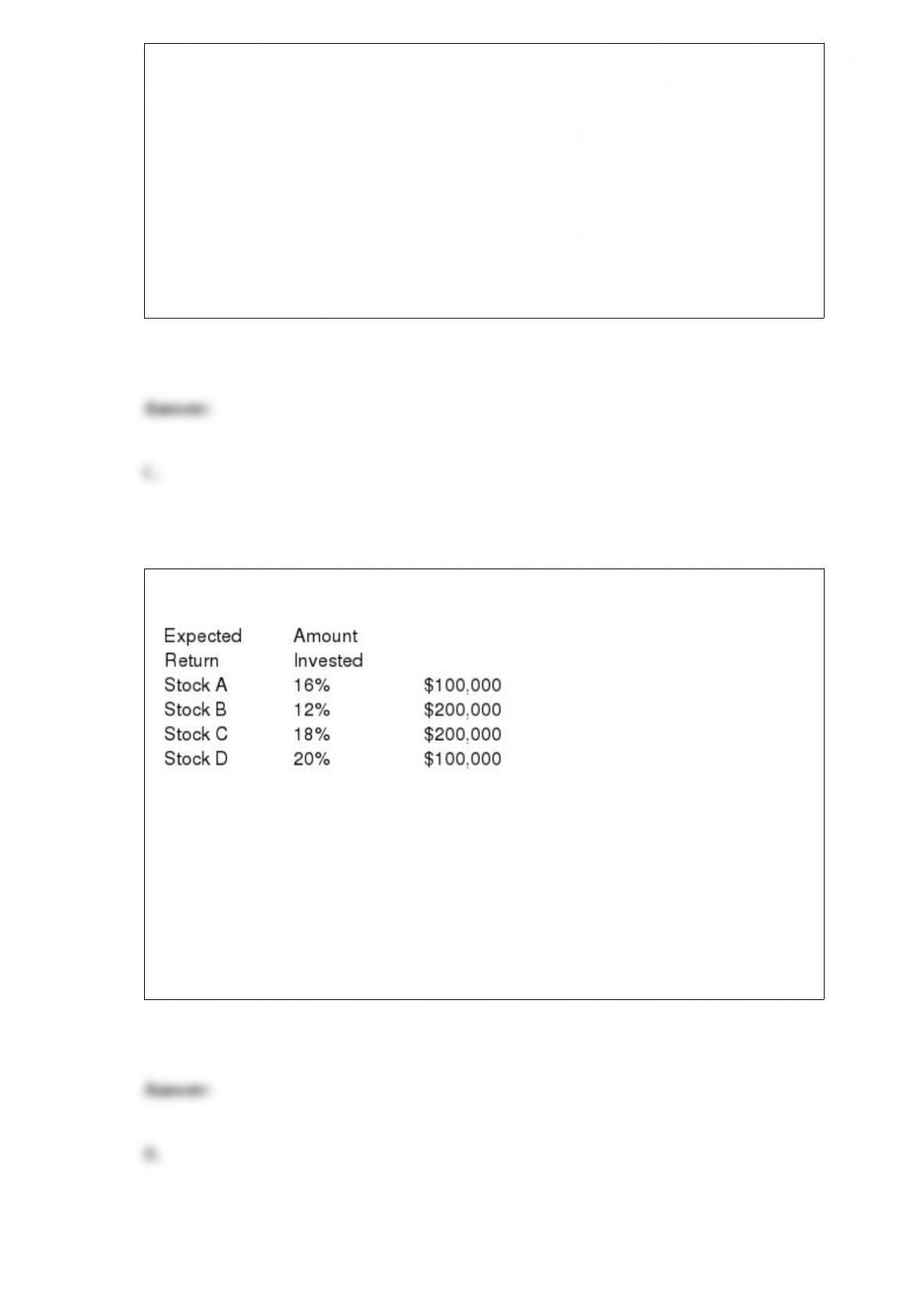
A portfolio is made up of four stocks:
The expected return of the portfolio is:
A.16.50%.
B.16.00%.
C.13.20%.
D.None of the above

The total variability of EPS associated with a change in sales is an indication of
combined leverage best measured by:
A.DOL.
B.DFL.
C.DOL + DFL.
D.DOL x DFL.
Three years ago a piece of equipment was purchased for $10,000. Assuming an
eight-year life and straight-line depreciation, financial statements for the third year will
show:
A.depreciation expense of $3,000 on the income statement, and accumulated
depreciation of $3,000 on the balance sheet.
B.depreciation expense of $1,250 on the income statement, and accumulated
depreciation of $3,000 on the balance sheet.
C.depreciation expense of $1,250 on the income statement, and accumulated
depreciation of $3,750 on the balance sheet.
D.depreciation expense of $1,250 on the income statement, and accumulated
depreciation of $1,250 on the balance sheet.
A junk bond is:
A.a low risk bond that pays high yields.

B.a high-risk bond that pays low yields.
C.a high-risk bond that pays high yields.
D.a low risk bond that pays low yields.
The wave of merger activity associated with hostile takeovers and corporate raiders is:
A.Wave 1, 1897-1904.
B.Wave 2, 1916-1929.
C.Wave 3, 1965-1969.
D.Wave 4, 1981-1989.
Bond ratings assess the:
A.maturity risk of individual bonds.
B.liquidity risk of companies that issue bonds.
C.default risk of individual bonds.
D.the overall risk (DR+LR+MR) of companies that issue bonds.

Which is not a financial asset?
A.Stock
B.Bond
C.Shares in a mutual fund
D.Savings account
Which of the following is not usually a restriction on the payment of dividends?
A.Dividends must be paid from the current year’s net income.
B.Dividends may not be paid if a company is insolvent.
C.Bond indentures may restrict the payment of dividends.
D.If preferred stock has a cumulative feature, no common stock dividends may be paid
until cumulative preferred stock dividends are current.
E.All of the above are restrictions on the payment of dividends.
Accounting accruals are important in:

A.accounting for depreciation.
B.providing for unpaid payroll, rent, interest, and other expenses that relate to the
current accounting period.
C.drawing checks on the last day of the current accounting period to properly reflect
expense in that period.
D.providing for bad debts that may eventually be deemed uncollectible.