
1) Which of the following statements is CORRECT?
a.We should use historical measures of the component costs from prior financings that
are still outstanding when estimating a company’s WACC for capital budgeting
purposes
b.The cost of new equity (re) could possibly be lower than the cost of reinvested
earnings (rs) if the market risk premium, risk-free rate, and the company’s beta all
decline by a sufficiently large amount
c.A firm’s cost of reinvesting earnings is the rate of return stockholders require on a
firm’s common stock
d.The component cost of preferred stock is expressed as rp(1 – T), because preferred
stock dividends are treated as fixed charges, similar to the treatment of interest on debt
e.In the WACC calculation, we must adjust the cost of preferred stock (the market
yield) to reflect the fact that 70% of the dividends received by corporate investors are
excluded from their taxable income
2) With its current financial policies, Flagstaff Inc. will have to issue new common
stock to fund its capital budget. Since new stock has a higher cost than reinvested
earnings, Flagstaff would like to avoid issuing new stock. Which of the following
actions would REDUCE its need to issue new common stock?
a.Increase the percentage of debt in the target capital structure
b.Increase the proposed capital budget
c.Reduce the amount of short-term bank debt in order to increase the current ratio
d.Reduce the percentage of debt in the target capital structure
e.Increase the dividend payout ratio for the upcoming year
3) The company you just started has been offered credit terms of 4/30, net 90 days.
What will be the nominal annual percentage cost of its non-free trade credit if it pays
120 days after the purchase? (Assume a 365-day year.)
a.16.05%
b.16.90%
c.17.74%
d.18.63%
e.19.56%

4) Ranger Inc. would like to issue new 20-year bonds. Initially, the plan was to make
the bonds non-callable. If the bonds were made callable after 5 years at a 5% call
premium, how would this affect their required rate of return?
a.There is no reason to expect a change in the required rate of return
b.The required rate of return would decline because the bond would then be less risky
to a bondholder
c.The required rate of return would increase because the bond would then be more risky
to a bondholder
d.It is impossible to say without more information
e.Because of the call premium, the required rate of return would decline
5) Curtis Corporation’s noncallable bonds currently sell for $1,165. They have a 15-year
maturity, an annual coupon of $95, and a par value of $1,000. What is their yield to
maturity?
a.6.20%
b.6.53%
c.6.87%
d.7.24%
e.7.62%
6) You observe that a firm’s ROE is above the industry average, but its profit margin
and debt ratio are both below the industry average. Which of the following statements is
CORRECT?
a. Its total assets turnover must equal the industry average
b. Its total assets turnover must be above the industry average
c. Its return on assets must equal the industry average
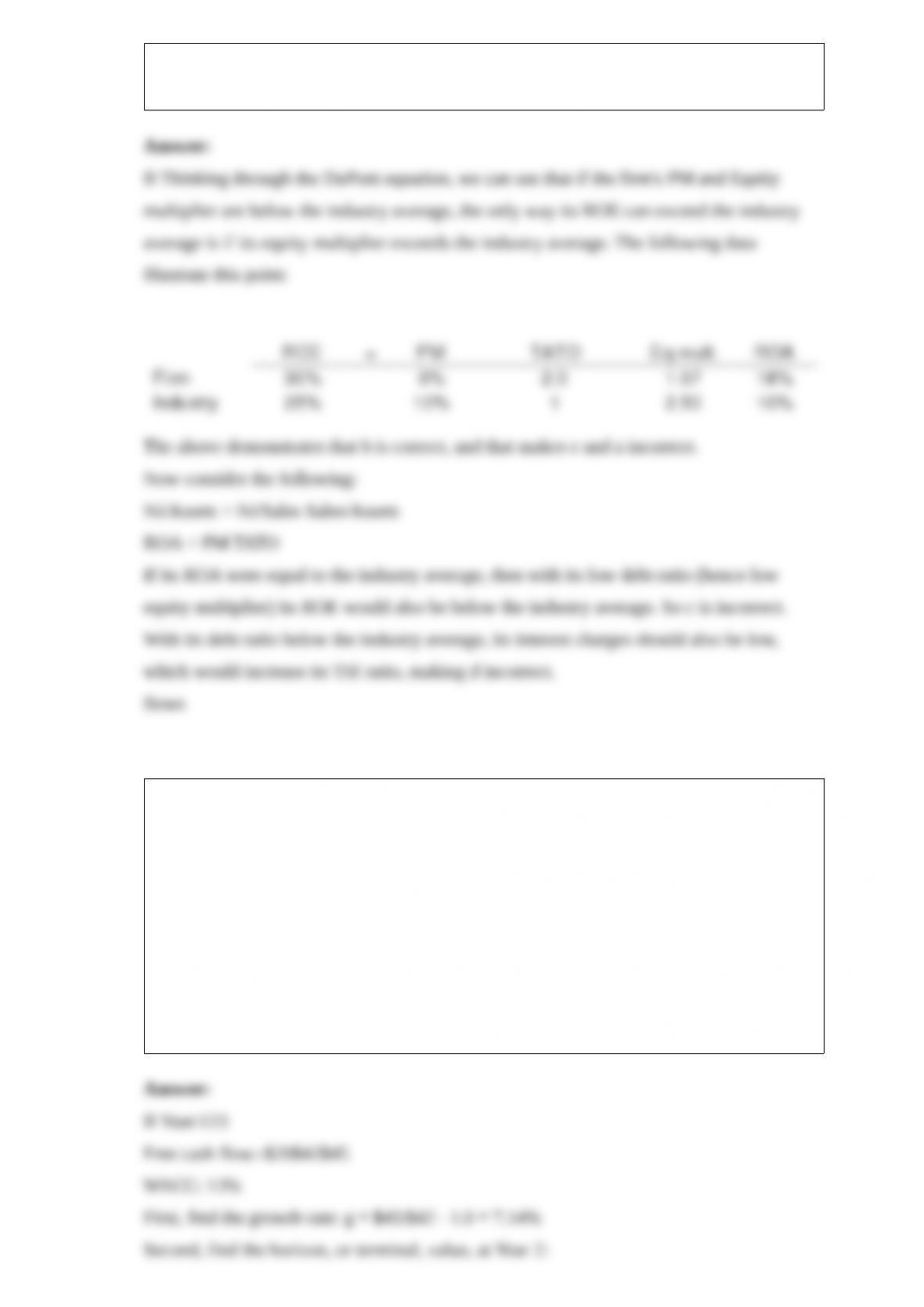
d. Its TIE ratio must be below the industry average
e. Its total assets turnover must be below the industry average
7) The free cash flows (in millions) shown below are forecast by Simmons Inc. If the
weighted average cost of capital is 13% and the free cash flows are expected to
continue growing at the same rate after Year 3 as from Year 2 to Year 3, what is the Year
0 value of operations, in millions?
Year:123
Free cash flow:-$20$42$45
a.$586
b.$617
c.$648
d.$680
e.$714

8) Cazden Motors’ stock is trading at $30 a share. Call options on the company’s stock
are also available, some with a strike price of $25 and some with a strike price of $35.
Both options expire in three months. Which of the following best describes the value of
these options?
a.The options with the $25 strike price will sell for less than the options with the $35
strike price
b.The options with the $25 strike price have an exercise value greater than $5
c.The options with the $35 strike price have an exercise value greater than $0
d.If Cazden’s stock price rose by $5, the exercise value of the options with the $25
strike price would also increase by $5
e.The options with the $25 strike price will sell for $5
9) Which of the following statements is CORRECT?
a.A typical industrial company’s balance sheet lists the firm’s assets that will be
converted to cash first, and then goes on down to list the firm’s longest lived assets last
b.The balance sheet for a given year, say 2012, is designed to give us an idea of what
happened to the firm during that year
c.The balance sheet for a given year, say 2012, tells us how much money the company
earned during that year
d.The difference between the total assets reported on the balance sheet and the debts
reported on this statement tells us the current market value of the stockholders’ equity,
assuming the statements are prepared in accordance with generally accepted accounting
principles (GAAP)
e.For most companies, the market value of the stock equals the book value of the stock
as reported on the balance sheet
10) Bond A has a 9% annual coupon while Bond B has a 6% annual coupon. Both
bonds have a 7% yield to maturity, and the YTM is expected to remain constant. Which
of the following statements is CORRECT?
a.The prices of both bonds will remain unchanged

b.The price of Bond A will decrease over time, but the price of Bond B will increase
over time
c.The prices of both bonds will increase by 7% per year
d.The prices of both bonds will increase over time, but the price of Bond A will increase
by more
e.The price of Bond B will decrease over time, but the price of Bond A will increase
over time
11) Which of the following statements is correct?
a. One advantage of the residual dividend policy is that it leads to a stable dividend
payout, which investors like
b. An increase in the stock price when a company decreases its dividend is consistent
with signaling theory as postulated by MM
c. If the “clientele effect” is correct, then for a company whose earnings fluctuate, a
policy of paying a constant percentage of net income will probably maximize the stock
price
d. Stock repurchases make the most sense at times when a company believes its stock is
undervalued
e. Firms with a lot of good investment opportunities and a relatively small amount of
cash tend to have above average payout ratios
12) Refer to Exhibit 15.4. What is AJC’s current total market value and weighted
average cost of capital?
a.$600,000; 7.5%
b.$600,000; 8.0%
c.$800,000; 7.0%
d.$800,000; 7.5%
e.$800,000; 8.0%

13) Arshadi Corp.’s sales last year were $52,000, and its total assets were $22,000.
What was its total assets turnover ratio (TATO)?
a. 2.03
b. 2.13
c. 2.25
d. 2.36
e. 2.48
14) Krackle Korn Inc. had credit sales of $3,500,000 last year and its days sales
outstanding was DSO = 35 days. What was its average receivables balance, based on a
365-day year?
a.$335,616
b.$352,397
c.$370,017
d.$388,518
e.$407,944
15) Refer to Exhibit 9.1. What is the best estimate of the firm’s WACC?
a.10.85%
b.11.19%
c.11.53%
d.11.88%
e.12.24%
16) The required return for Williamson Heating’s stock is 12%, and the stock sells for
$40 per share. The firm just paid a dividend of $1.00, and the dividend is expected to
grow by 30% per year for the next 4 years, so D4 = $1.00(1.30)4 = $2.8561. After t = 4,
the dividend is expected to grow at a constant rate of X% per year forever. What is the
stock’s expected constant growth rate after t = 4, i.e., what is X?
a.5.17%
b.5.44%
c.5.72%
d.6.02%
e.6.34%

17) You, in analyzing a stock, find that its expected return exceeds its required return.
This suggests that you think
a.the stock should be sold
b.the stock is a good buy
c.management is probably not trying to maximize the price per share
d.dividends are not likely to be declared
e.the stock is experiencing supernormal growth
18) Firm J’s earnings and stock price tend to move up and down with other firms in the
S&P 500, while Firm F’s earnings and stock price move counter cyclically with J and
other S&P companies. Both J and F estimate their costs of equity using the CAPM, they
have identical market values, their standard deviations of returns are identical, and they
both finance only with common equity. Which of the following statements is
CORRECT?
a.J and F should have identical WACCs because their risks as measured by the standard
deviation of returns are identical
b.If J and F merge, then the merged firm MW should have a WACC that is a simple
average of J’s and F’s WACCs
c.Without additional information, it is impossible to predict what the merged firm’s
WACC would be if J and F merged
d.Since J and F move counter cyclically to one another, if they merged, the merged
firm’s WACC would be less than the simple average of the two firms’ WACCs
e.J should have the lower WACC because it is like most other companies, and investors
like that fact
19) Which of the following statements is CORRECT?
a.The most likely explanation for an inverted yield curve is that investors expect
inflation to increase
b.The most likely explanation for an inverted yield curve is that investors expect
inflation to decrease
c.If the yield curve is inverted, short-term bonds have lower yields than long-term
bonds
d.Inverted yield curves can exist for Treasury bonds, but because of default premiums,
the corporate yield curve can never be inverted
e.The higher the maturity risk premium, the higher the probability that the yield curve
will be inverted
20) Which of the following factors would be most likely to lead to an increase in
interest rates in the economy?
a. Households reduce their consumption and increase their savings
b. The Federal Reserve decides to try to stimulate the economy
c. There is a decrease in expected inflation
d. The economy falls into a recession
e. Most businesses decide to modernize and expand their manufacturing capacity, and to
install new equipment to reduce labor costs
21) Stocks A and B have the following data. The market risk premium is 6.0% and the
risk-free rate is 6.4%. Assuming the stock market is efficient and the stocks are in
equilibrium, which of the following statements is CORRECT?
AB
Beta1.100.90
Constant growth rate7.00%7.00%
a.Stock A must have a higher dividend yield than Stock B
b.Stock B’s dividend yield equals its expected dividend growth rate
c.Stock B must have the higher required return
d.Stock B could have the higher expected return
e.Stock A must have a higher stock price than Stock B
22) An investor is considering starting a new business. The company would require
$475,000 of assets, and it would be financed entirely with common stock. The investor
will go forward only if she thinks the firm can provide a 13.5% return on the invested
capital, which means that the firm must have an ROE of 13.5%. How much net income
must be expected to warrant starting the business?
a. $52,230
b. $54,979
c. $57,873
d. $60,919
e. $64,125
23) Refer to Exhibit 3.1. What is the firm’s current ratio?
a. 0.97
b. 1.08
c. 1.20
d. 1.33
e. 1.47
24) Which of the following statements is CORRECT?
a.A portfolio that consists of 40 stocks that are not highly correlated with “the market”
will probably be less risky than a portfolio of 40 stocks that are highly correlated with
the market, assuming the stocks all have the same standard deviations
b.A two-stock portfolio will always have a lower beta than a one-stock portfolio
c.If portfolios are formed by randomly selecting stocks, a 10-stock portfolio will always
have a lower beta than a one-stock portfolio
d.A stock with an above-average standard deviation must also have an above-average
beta
e.A two-stock portfolio will always have a lower standard deviation than a one-stock

portfolio
25) Kenny Electric Company’s noncallable bonds were issued several years ago and
now have 20 years to maturity. These bonds have a 9.25% annual coupon, paid
semiannually, sells at a price of $1,075, and has a par value of $1,000. If the firm’s tax
rate is 40%, what is the component cost of debt for use in the WACC calculation?
a.4.35%
b.4.58%
c.4.83%
d.5.08%
e.5.33%
26) Perpetual preferred stock from Franklin Inc. sells for $97.50 per share, and it pays
an $8.50 annual dividend. If the company were to sell a new preferred issue, it would
incur a flotation cost of 4.00% of the price paid by investors. What is the company’s
cost of preferred stock for use in calculating the WACC?
a.8.72%
b.9.08%
c.9.44%
d.9.82%
e.10.22%

27) To estimate the company’s WACC, Marshall Inc. recently hired you as a consultant.
You have obtained the following information. (1) The firm’s noncallable bonds mature
in 20 years, have an 8.00% annual coupon, a par value of $1,000, and a market price of
$1,050.00. (2) The company’s tax rate is 40%. (3) The risk-free rate is 4.50%, the
market risk premium is 5.50%, and the stock’s beta is 1.20. (4) The target capital
structure consists of 35% debt and the balance is common equity. The firm uses the
CAPM to estimate the cost of common stock, and it does not expect to issue any new
shares. What is its WACC?
a.7.16%
b.7.54%
c.7.93%
d.8.35%
e.8.79%
28) Which of the following statements is CORRECT?
a.If an investor buys enough stocks, he or she can, through diversification, eliminate all
of the diversifiable risk inherent in owning stocks. Therefore, if a portfolio contained all
publicly traded stocks, it would be essentially riskless

b.The required return on a firm’s common stock is, in theory, determined solely by its
market risk. If the market risk is known, and if that risk is expected to remain constant,
then no other information is required to specify the firm’s required return
c.Portfolio diversification reduces the variability of returns (as measured by the
standard deviation) of each individual stock held in a portfolio
d.A security’s beta measures its non-diversifiable, or market, risk relative to that of an
average stock
e.A stock’s beta is less relevant as a measure of risk to an investor with a
well-diversified portfolio than to an investor who holds only that one stock
29) Ullrich Printing Inc. paid out $21,750 of common dividends during the year. It
ended the year with $187,500 of retained earnings versus the prior year’s retained
earnings of $132,250. How much net income did the firm earn during the year?
a.$77,000
b.$80,850
c.$84,893
d.$89,137
e.$93,594
30) Last year Central Chemicals had sales of $205,000, assets of $127,500, a profit
margin of 5.3%, and an equity multiplier of 1.2. The CFO believes that the company
could reduce its assets by $21,000 without affecting either sales or costs. Had it reduced
its assets in this amount, and had the debt-to-assets ratio, sales, and costs remained
constant, by how much would the ROE have changed?
a. 1.81%
b. 2.02%
c. 2.22%
d. 2.44%
e. 2.68%
31) The IRR method is based on the assumption that projects’ cash flows are reinvested
at the project’s risk-adjusted cost of capital.
32) For a zero-growth firm, it is possible to increase the percentage of sales that are
made on credit and still keep accounts receivable at their current level, provided the
firm can shorten the length of its collection period sufficiently.
33) The distributions of rates of return for Companies AA and BB are given below:
State of theProbability of
EconomyThis State OccurringAABB
Boom0.230%-10%
Normal0.610% 5%
Recession0.2-5% 50%
We can conclude from the above information that any rational, risk-averse investor

would be better off adding Security AA to a well-diversified portfolio over Security BB.
34) The standard deviation is a better measure of risk than the coefficient of variation if
the expected returns of the securities being compared differ significantly.
35) For bonds, price sensitivity to a given change in interest rates is generally greater
the longer before the bond matures.
36) The announcement of an increase in the cash dividend should, according to MM,
lead to an increase in the price of the firm’s stock.
37) The cost of perpetual preferred stock is found as the preferred’s annual dividend
divided by the market price of the preferred stock. No adjustment is needed for taxes
because preferred dividends, unlike interest on debt, is not deductible by the issuing
firm.
38) According to the Capital Asset Pricing Model, investors are primarily concerned
with portfolio risk, not the risks of individual stocks held in isolation. Thus, the relevant

risk of a stock is the stock’s contribution to the riskiness of a well-diversified portfolio.