
1) A stock with a beta of 1 has systematic or market risk equal to the “typical” stock in
the marketplace.
2) Available yields on financial securities depend on their financial risk, interest rate
risk, liquidity, and taxability.
3) If a project has multiple internal rates of return, the lowest rate should be used for
decision making purposes.
4) A zero balance account permits divisions to disburse funds while maintaining
centralized control of several bank accounts.
5) Commercial paper is an unsecured form of credit.
6) The vast majority of corporate bond business takes place over the counter.
7) One advantage of zero balance accounts is an increase in disbursing float.

8) A cross rate is the computation of an exchange rate for a currency from the exchange
rates of two other currencies.
9) The profitability index can be helpful when a financial manager encounters a
situation where capital rationing is required.
10) Operating profits or EBIT is used to measure a firm’s profits on assets because it
does not include the firm’s cost of debt financing.
11) The term structure of interest rates usually indicates that longer terms to maturity
have higher expected returns.
12) Capital markets are all the financial institutions that help a business raise long-term
capital.
13) In general, a project’s free cash flows will fall into one of three categories: (1)
incremental costs, (2) sunk costs, and (3) opportunity costs.
14) The less-risky investment is always the more desirable choice.

15) The Boyles Ceramics, Inc. established a line of credit with a local bank. The
maximum amount that can be borrowed under the terms of the agreement is $1,000,000
at an annual rate of 8 percent. A compensating balance averaging 25 percent of the
amount borrowed is required. Prior to the agreement, Boyles had no deposit with the
bank. Shortly after signing the agreement, Boyles needed $240,000 to pay off a note
that was due. Boyles decides to borrow an amount sufficient to pay the $240,000 note
and also to cover the compensating balance. What is the effective annual cost of credit
if the loan is made on a discount basis?
A) 11.94%
B) 11.00%
C) 10.83%
D) 10.57%
16) GPS Inc. wishes to estimate its cost of retained earnings. The firm’s beta is 1.3 . The
rate on 6-month T-bills is 2%, and the return on the S&P 500 index is 15%. What is the
appropriate cost for retained earnings in determining the firm’s cost of capital?
A) 17.0%
B) 19.5%
C) 18.9%
D) 22.1%
17) All of the following are methods available to a corporation that desires to
repurchase stock EXCEPT
A) offering to employees who own an interest in the firm.
B) open market.
C) tender offer to all existing stockholders.
D) offer to one or more major stockholders on a negotiated basis.
18) The Siskiyou Manufacturing Company will collect an estimated $12,000,000 next
year; and it will receive an estimated 20,000 checks. Siskiyou’s bank has offered to set
up a lock-box system that will reduce float time by 4.5 days. The cost of the system will
be $ .15 per check. What is the minimum annual interest rate on its cash balance that
Siskiyou should receive before it would be willing to adopt the lock-box system?
A) 3.25%
B) 2.03%
C) 1.82%
D) 1.07%

19) Plato Industries’ projected sales for the first six months of 2012 are given below:
Jan.$250,000April$300,000
Feb.$340,000May$350,000
Mar.$280,000June$380,000
20% of sales are collected in cash at time of sale, 50% are collected in the month
following the sale, and the remaining 30% are collected in the second month following
the sale. Cost of goods sold is 85% of sales. Purchases are made in the month prior to
the sales, and payments for purchases are made in the month of the sale. Total other
cash expenses are $70,000/month. The company’s cash balance as of February 28, 2012
will be $10,000. Excess cash will be used to retire short-term borrowing (if any). Plato
has no short term borrowing as of February 28, 2012 . Ignore any interest on short-term
borrowing. The company must have a minimum cash balance of $40,000 at the
beginning of each month. Plato’s projected cumulative short-term borrowing as of April
30, 2012?
A) $25,000
B) $33,000
C) $50,000
D) $60,000
20) LRQ Inc. bonds on July 1, 2006 . The bonds had a coupon rate of 5.5%, with
interest paid semiannually. The face value of the bonds is $1,000 and the bonds mature
on July 1, 2021 . What is the intrinsic value of an LRQ Corporation bond on July 1,
2012 to an investor with a required return of 7%?
A) $901.08
B) $902.27
C) $1,000.00
D) $1,104.28
21) Ribbon Industries reported sales of $3 million and net income of $400,000 for 2010
. The retained earnings balance at the end of 2012 is $7 million. Ribbon Industries has a
dividend payout ratio of 30%. If sales are expected to increase by 25% next year, what
will be the projected balance in retained earnings using the percent of sales method?
A) $7,280,000
B) $6,720,000
C) $7,350,000
D) $8,750,000
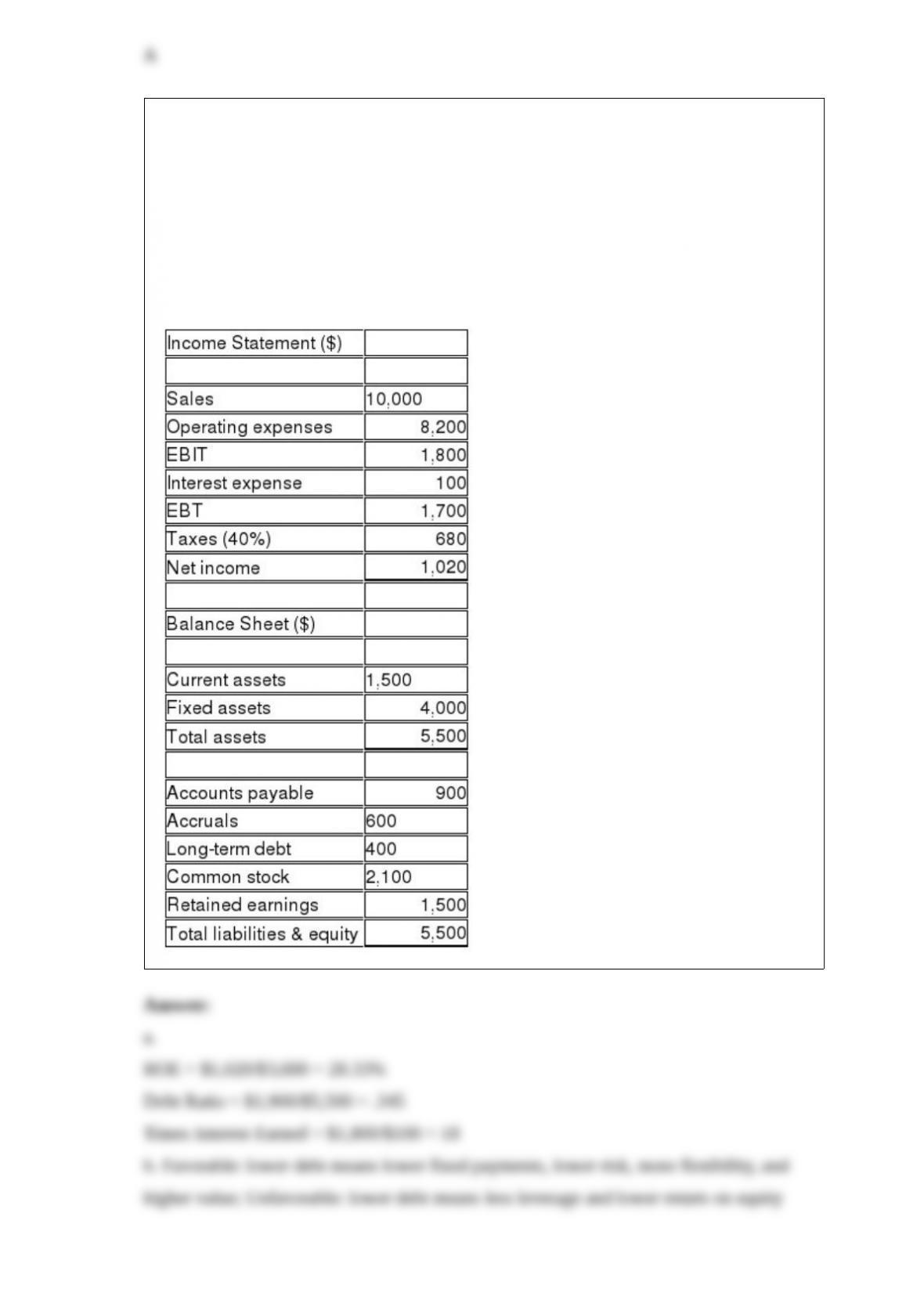
22) a.Using the financial statements for GMT Enterprises for 2010 (given below),
calculate the return on equity, the debt ratio, and the times interest earned ratio.
b.Suppose the industry average debt ratio is 50%. Give one reason why the debt ratio
for GMT Enterprises may be considered favorable, and give one reason why the debt
ratio for GMT Enterprises may be considered unfavorable.
GMT Enterprises
2010 Financial Statements

23) The risk free rate of return is 3% and the expected return on the market portfolio is
14%. Oklahoma Oilco has a beta of 2.0 and a standard deviation of returns of 26%.
Oilco’s marginal tax rate is 35%. Analysts expect Oilco’s net income to grow by 12%
per year for the next 5 years. Using the capital asset pricing model, what is Oklahoma
Oilco’s cost of retained earnings?
A) 18.6%
B) 21.2%
C) 22.8%
D) 25.0%
24) Which of the following methods of evaluating investment projects can properly
evaluate projects of unequal lives?
A) the net present value
B) the payback
C) the internal rate of return
D) the equivalent annual annuity
25) The financial manager selecting one of two projects of differing risk should
A) select the project with the larger risk-adjusted net present value
B) choose the project with the least relative risk
C) choose the project with greater return even if that project has greater risk
D) choose the project with less risk even though that project has less return
26) Which of the following statements is MOST correct?
A) Because the cost of debt is lower than the cost of equity, value-maximizing firms
maintain debt ratios of close to 100%
B) Corporations that are 100% equity financed will have a much lower weighted
average cost of capital because the lack of debt lowers their risk of bankruptcy
C) The source of capital with the lowest after-tax cost is preferred stock, because it is a
hybrid security, part debt and part equity
D) The cost of a particular source of capital is equal to the investor’s required rate of
return after adjusting for the effects of both flotation costs and corporate taxes

27) Balon Plastics, Inc. is trying to decide how best to finance a proposed $10,000,000
capital investment. Under Plan I, the project will be financed entirely with long-term 9
percent bonds. The firm currently has no debt or preferred stock. Under Plan II,
common stock will be sold to net the firm $20 a share; presently, 1,000,000 shares are
outstanding. The corporate tax rate for Roberts is 40 percent.
a.Calculate the indifference level of EBIT associated with the two financing plans.
b.Prepare an EBIT-EPS analysis chart, showing the intersection of the two financing
plan lines.
c.Which financing plan would you expect to cause the greatest change in EPS relative
to a change in EBIT? Why?
d.If EBIT is expected to be $3.1 million, which plan will result in a higher EPS?
28) Why should firms that own and operate multiple businesses that have different risk
characteristics use business-specific, or divisional costs of capital?
A) Not all divisions have equal risk and the firm might accept projects whose returns
are higher than are deemed appropriate
B) Not all business divisions have equal risk and the firm will likely become less risky
in the future
C) Not all lines of business have equal risk and it is likely that the firm will accept
projects whose returns are unacceptably low in relation to the risk involved
D) Use of the same weighted average cost of capital for all divisions may result in too
much money being allocated to the least risky division
29) A corporate bond has a face value of $1,000 and a coupon rate of 9%. The bond
matures in 14 years and has a current market price of $946. If the corporation sells more
bonds it will incur flotation costs of $26 per bond. If the corporate tax rate is 35%, what
is the after-tax cost of debt capital?
A) 5.57%
B) 6.56%
C) 8.18%
D) 7.31%

30) Which of the following transactions will increase a corporation’s operating return
on assets?
A) sell stock and use the money to pay off some long-term debt
B) sell 10-year bonds and use the money to pay off current liabilities
C) negotiate a new contract that lowers raw material costs by 10%
D) increase sales by 10%
31) All of the following are sufficient indications to accept a project EXCEPT (assume
that there is no capital rationing constraint, and no consideration is given to payback as
a decision tool)
A) the net present value of an independent project is positive
B) the profitability index of an independent project exceeds one
C) the IRR of a mutually exclusive project exceeds the required rate of return
D) the NPV of a mutually exclusive project is positive and exceeds that of all other
projects
32) Mix Sweet Shop bakes and sells pies. Mix has annual fixed costs of $880,000 and a
variable cost per pie of $7.50. Each pie sells for $15.50 each. The firm expects to sell
500,000 pies annually. What is the break-even point in pies?
A) 190,440
B) 280,000
C) 200,000
D) 110,000
33) If the market price of a bond decreases, then
A) the yield to maturity decreases
B) the coupon rate increases
C) the yield to maturity increases
D) the coupon rate decreases

34) Your company is considering the replacement of an old delivery van with a new one
that is more efficient. The old van cost $40,000 when it was purchased 5 years ago. The
old van is being depreciated using the simplified straight-line method over a useful life
of 8 years. The old van could be sold today for $7,000. The new van has an invoice
price of $80,000, and it will cost $6,000 to modify the van to carry the company’s
products. Cost savings from use of the new van are expected to be $28,000 per year for
5 years, at which time the van will be sold for its estimated salvage value of $18,000.
The new van will be depreciated using the simplified straight-line method over its
5-year useful life. The company’s tax rate is 35%. Working capital is expected to
increase by $5,000 at the inception of the project, but this amount will be recaptured at
the end of year five. What is the incremental free cash flow for year one?
A) $18,875
B) $19,985
C) $22,305
D) $24,220
35) Which of the following dividend policies will cause dividends per share to fluctuate
the most?
A) constant dividend payout ratio
B) stable dollar dividend
C) small, low, regular dividend plus a year-end extra
D) no difference between the various dividend policies
36) Which of the following will result from a stock repurchase?
A) Earnings per share will rise.
B) Number of shares will increase.
C) Corporate cash is conserved.
D) Ownership is diluted.
37) Assume that Montana Mining, Inc. borrows $5,000,000 for 120 days. The total
interest paid is $150,000. What is the APY, or Effective Annual Rate of interest that
Billings pays?
A) 3.00%
B) 9.00%
C) 9.27%
D) 9.77%

38) The A corporation has an operating profit margin of 20%, operating expenses of
$500,000, and financing costs of $15,000. Therefore
A) the corporation’s gross profit margin is less than 20%
B) the corporation’s net profit margin is greater than 20%
C) the corporation’s gross profit margin is greater than 20%
D) the corporation’s gross profit margin is equal to 20% because gross profit is not
affected by operating expenses or financing costs
39) Finance theory suggests that the current market value of a bond is based upon
which of the following?
A) the future value of interest paid on a bond
B) the sum total of principal and interest paid on a bond
C) the sum of the present value of the bond’s interest payments and the present value of
the principal
D) the present value of a bond’s par value plus the future value of the bond’s present
value
40) Capital market instruments include
A) negotiable certificates of deposit
B) corporate equities
C) commercial paper
D) Treasury bills