
Orchard Farms has a pretax cost of debt of 7.29 percent and a cost of equity of 16.3
percent. The firm uses the subjective approach to determine project discount rates.
Currently, the firm is considering a project to which it has assigned an adjustment factor
of 1.25 percent. The firm’s tax rate is 35 percent and its debt-equity ratio is .48. The
project has an initial cost of $3.9 million and produces cash inflows of $1.26 million a
year for 5 years. What is the net present value of the project?
A. $421,619
B. $446,556
C. $514,370
D. $561,027
E. $478,721
The net present value profile illustrates how the net present value of an investment is
affected by which one of the following?
A. Project’s initial cost
B. Discount rate
C. Timing of the project’s cash inflows
D. Inflation rate
E. Real rate of return
Which of these must be significantly eliminated if interest rate parity is to exist?
A. Absolute purchasing power parity
B. Short-run exposure to exchange rate risk
C. Covered interest arbitrage opportunities
D. Relative purchasing power parity
E. Translation exposure
Which of these represents a transaction motive for holding cash?
A. Buying extra inventory in response to an unexpected sale offered by a supplier
B. Distributing the weekly paychecks
C. Increasing the minimum cash balance for the firm’s main bank account
D. Unexpectedly purchasing a competitor’s firm
E. Holding cash in anticipation that the firm may need to close for a few days if
floodwaters keep rising
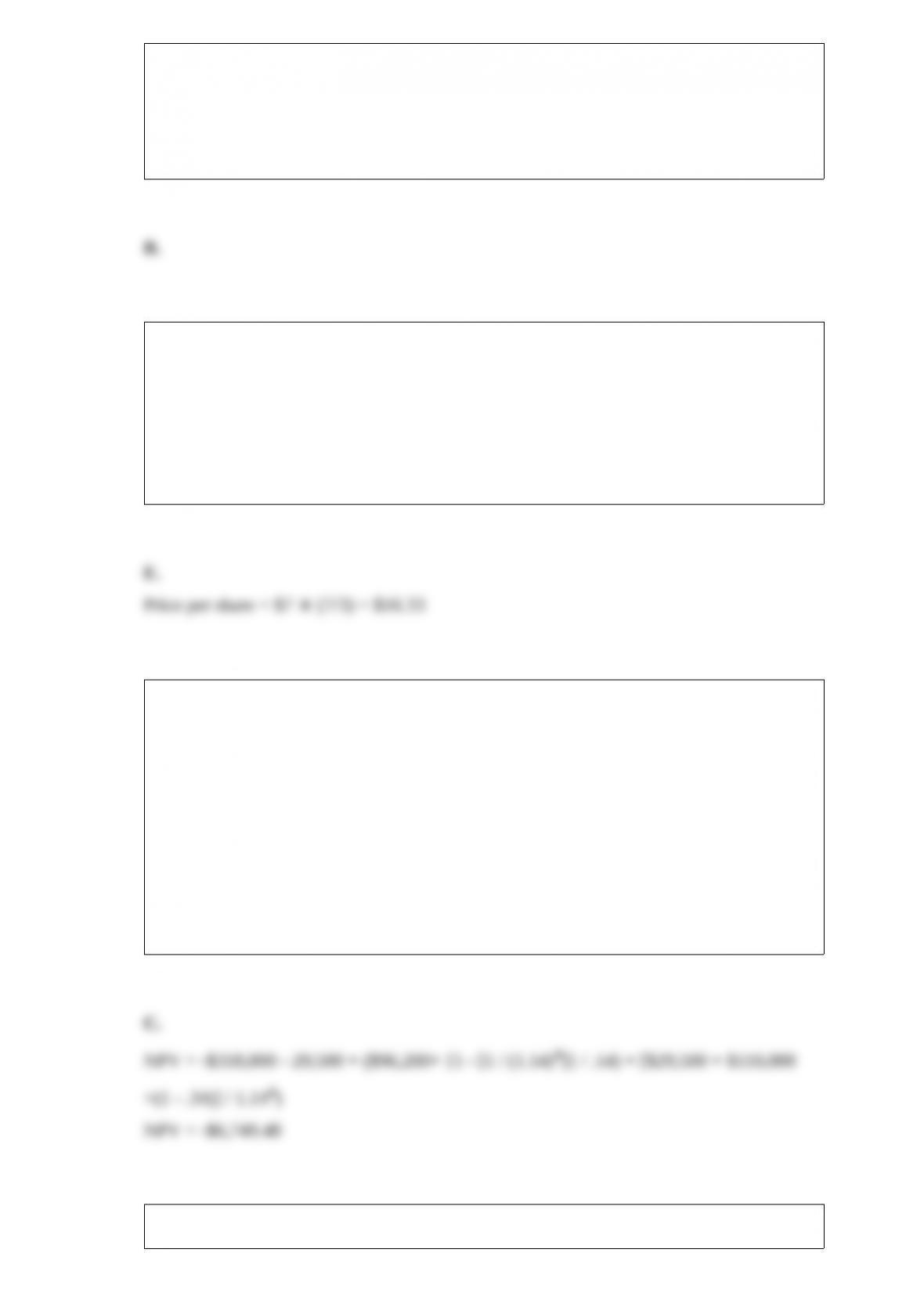
The Meat Market has 16,000 shares of stock outstanding at a price per share of $7.
What will be the price per share if the firm declares a 3-for-7 reverse stock split?
A. $11.80
B. $4.50
C. $3.00
D. $15.00
E. $16.33
A project has an initial requirement of $318,000 for fixed assets and $29,500 for net
working capital. The fixed assets will be depreciated to a zero book value over the
four-year life of the project and have an estimated salvage value of $110,000. All of the
net working capital will be recouped at the end of the project. The annual operating
cash flow is $96,200 and the discount rate is 14 percent. What is the project’s net
present value if the tax rate is 34 percent?
A. $14,265.87
B. $8,048.51
C. -$6,749.48
D. -$7,880.06
E. $17,919.19
The modified internal rate of return is specifically designed to address the problems

associated with:
A. mutually exclusive projects.
B. unconventional cash flows.
C. long-term projects.
D. negative net present values.
E. crossover points.
Which one of the following occupations best fits into the corporate area of finance?
A. Mortgage broker
B. Treasury bill analyst
C. Chief financial officer
D. Insurance risk manager
E. Local bank manager
Keyser Materials has 8 percent coupon bonds on the market with 19 years to maturity.
The bonds make semiannual payments and currently sell for 102 percent of par. What is
the current yield? The YTM? The effective annual yield?
A. 7.84 percent; 7.80 percent; 7.95 percent
B. 7.84 percent; 7.92 percent; 7.95 percent
C. 7.84 percent; 7.92 percent; 7.97 percent
D. 7.80 percent; 7.84 percent; 7.92 percent
E. 7.80 percent; 7.92 percent; 7.95 percent

The Saw Mill has a return on assets of 7.92 percent, a total asset turnover rate of 1.18,
and a debt-equity ratio of 1.46. What is the return on equity?
A. 14.26 percent
B. 13.64 percent
C. 12.28 percent
D. 19.48 percent
E. 12.03 percent
Discount Outlet has net income of $389,100, a profit margin of 2.8 percent, and a return
on assets of 8.6 percent. What is the capital intensity ratio?
A. .33
B. .67
C. 1.49
D. 1.34
E. 3.07
If you accept a job as a domestic security analyst for a brokerage firm, you are most
likely working in which one of the following financial areas?
A. International finance
B. Private placements
C. Corporate finance
D. Capital management
E. Investments
Davidson Interiors declared a dividend to holders of record on Thursday, October 15,
that is payable on Monday, November 2. Suenette purchased 200 shares of Davidson
Interiors stock on Monday, October 12, and Jake purchased 100 shares of this stock on
the following day. Which one of the following statements is correct given this
information?

A. Both Suenette and Jake will receive this dividend.
B. Suenette will receive the dividend but Jake will not.
C. Jake will receive the dividend but Suenette will not.
D. Neither Suenette nor Jake will receive this dividend.
E. You cannot determine who will or will not receive this dividend based on the
information provided.
Kite Flite is considering making and selling custom kites in two sizes. The small kites
would be priced at $12 and the large kites would be $39. The variable cost per unit is $5
and $14, respectively. Jill, the owner, feels that she can sell 1,900 of the small kites and
1,400 of the large kites each year. The fixed costs would be only $1,890 a year and the
tax rate is 34 percent. What is the annual operating cash flow if the annual depreciation
expense is $380?
A. $26,064.12
B. $30,759.80
C. $29,848.20
D. $28,309.40
E. $30,630.60
Christie is buying a new car today and is paying a $500 cash down payment. She will
finance the balance at 6.3 percent interest. Her loan requires 36 equal monthly
payments of $450 each with the first payment due 30 days from today. Which one of
the following statements is correct concerning this purchase?
A. The present value of the car is equal to $500 + (36 x $450).
B. The $500 is the present value of the purchase.
C. The car loan is an annuity due.
D. To compute the initial loan amount, you must use a monthly interest rate.
E. The future value of the loan is equal to 36 x $450.
A security produced returns of 11 percent, 7 percent, 9 percent, 13 percent, and -14
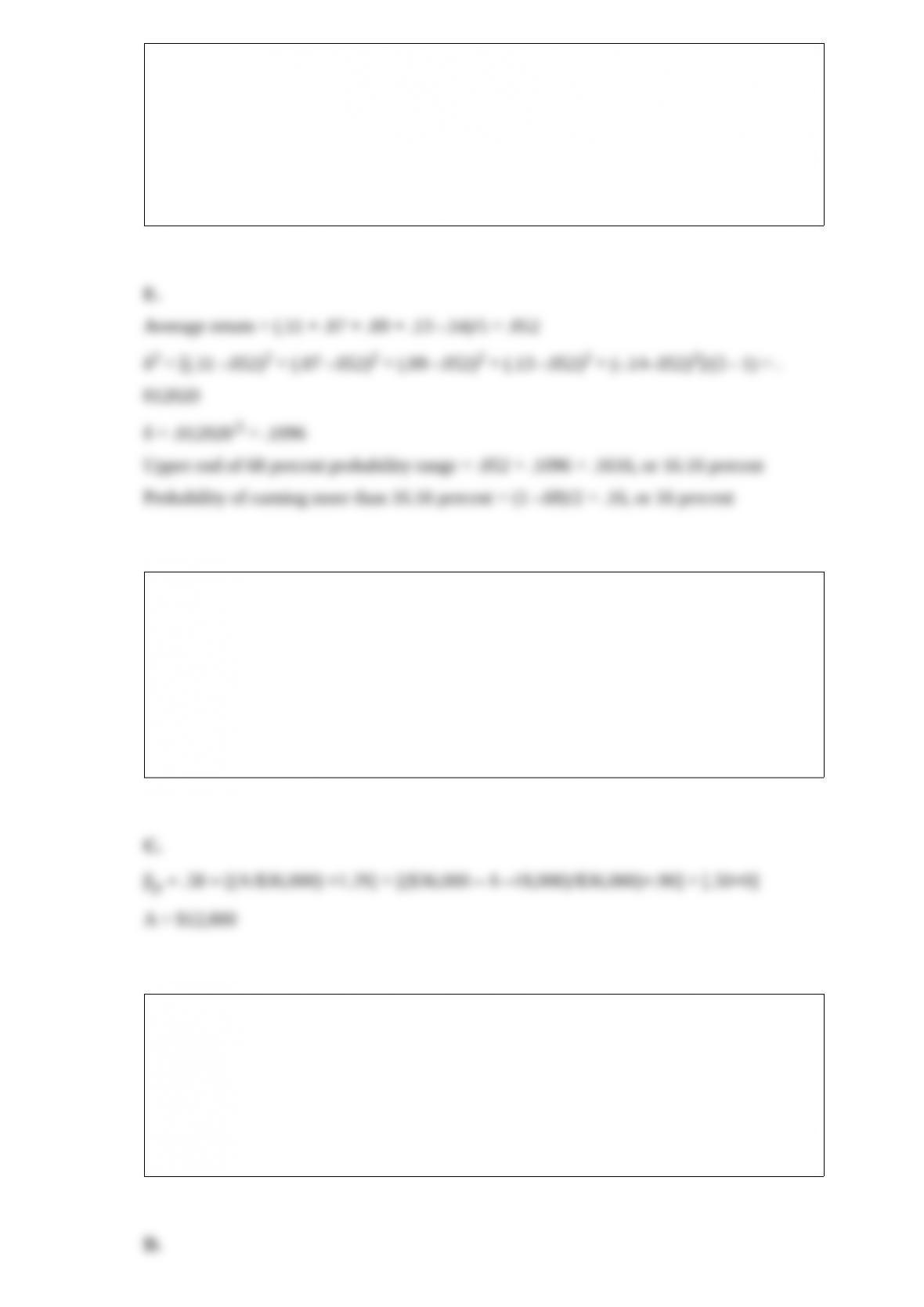
percent over the past five years, respectively. Based on these five years, what is the
probability that this stock will earn more than 16.16 percent in any one given year?
A. .5 percent
B. 1.0 percent
C. 2.5 percent
D. 5.0 percent
E. 16.0 percent
A $36,000 portfolio is invested in a risk-free security and two stocks. The beta of Stock
A is 1.29 while the beta of Stock B is .90. One-half of the portfolio is invested in the
risk-free security. How much is invested in Stock A if the beta of the portfolio is .58?
A. $6,000
B. $9,000
C. $12,000
D. $15,000
E. $18,000
What is the maximum amount an investor can invest in crowdfunding issues in a
12-month period?
A. $10,000
B. $10,000 per security with a maximum of ten separate securities
C. $100,000 per security with a maximum of five separate securities
D. $100,000
E. $1 million spread over a maximum of ten separate securities

Which one of the following terms is defined as the total tax paid divided by the total
taxable income?
A. Average tax rate
B. Variable tax rate
C. Marginal tax rate
D. Absolute tax rate
E. Contingent tax rate
Tomas earned $89 in interest on his savings account last year and has decided to leave
the $86 in his account this coming year so it will earn interest. This process of earning
interest on prior interest earnings is called:
A. discounting.
B. compounding.
C. duplicating.
D. multiplying.
E. indexing.
Which one of the following specifies the length of time that must pass after an initial
public offering (IPO) before insiders are permitted to sell their shares?
A. Lockup period
B. Quiet period
C. Comment period
D. Green Shoe period
E. Rights offer period
Which one of the following features applies to NASDAQ but not the NYSE?
A. Trading in the crowd
B. Multiple market maker system
C. SuperDot
D. Broker market
E. Physical trading floor

Computer Geeks has sales of $618,900, a profit margin of 13.2 percent, a total asset
turnover rate of 1.54, and an equity multiplier of 1.06. What is the return on equity?
A. 18.91 percent
B. 12.67 percent
C. 18.28 percent
D. 22.11 percent
E. 21.55 percent
Credit scoring is the:
A. categorizing of customers into groups based on the length of time it takes each
customer to pay for purchases.
B. compiling of a list of accounts receivables segregated by the length of time each
receivable has been outstanding.
C. evaluation of the opportunity costs of a credit policy.
D. process of quantifying the probability of default when granting credit to customers.
E. tracking of both the number and the size of customer orders over a period of time.
A debenture is:
A. an unsecured bond.
B. a bearer form bond.
C. a bond with a call provision.
D. a bond with a sinking fund provision.
E. a bond secured by a blanket mortgage.
Leon is the owner of a corner store. Which ratio should he compute if he wants to know
how long the store can pay its bills given its current level of cash and accounts
receivable? Assume all receivables are collectible when due.

A. Current ratio
B. Debt ratio
C. Cash coverage ratio
D. Cash ratio
E. Quick ratio
What is the effective annual rate of 14.9 percent compounded quarterly?
A. 14.48 percent
B. 14.67 percent
C. 15.23 percent
D. 15.54 percent
E. 15.75 percent
Which one of the following statements concerning the balance sheet is correct?
A. Total assets equal total liabilities minus total equity.
B. Net working capital is equal total assets minus total liabilities.
C. Assets are listed in descending order of liquidity.
D. Current assets are equal to total assets minus net working capital.
E. Shareholders’ equity is equal to net working capital minus net fixed assets plus
long-term debt.
Today, Sweet Snacks is investing $491,000 in a new oven. As a result, the company
expects its cash flows to increase by $64,000 a year for the next two years and by
$98,000 a year for the following three years. How long must the firm wait until it
recovers all of its initial investment?
A. 3.97 years
B. 4.18 years
C. 4.46 years
D. 4.70 years
E. The project never pays back.
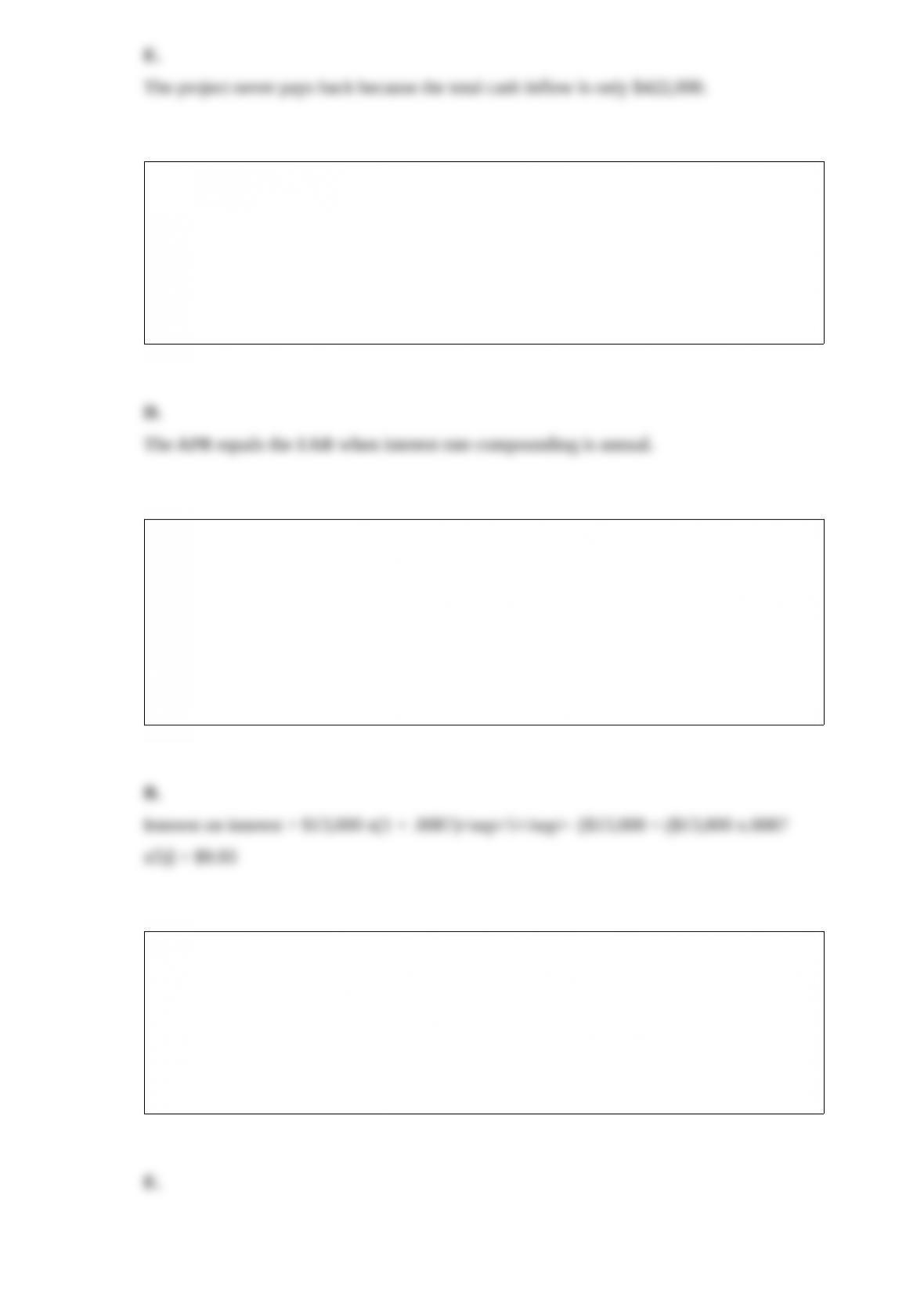
An amortized, 3-year loan has annual payments and an effective annual rate of 14.56
percent. What is the APR?
A. 13.09 percent
B. 13.46 percent
C. 13.90 percent
D. 14.56 percent
E. 14.82 percent
Kevin just deposited $13,000 into his savings account at Traditions Bank. The bank will
pay .87 percent interest, compounded annually, on this account. How much interest on
interest will he earn over the next 5 years?
A. $8.67
B. $9.93
C. $8.92
D. $9.49
E. $9.73
A cost that should be ignored when evaluating a project because that cost has already
been incurred and cannot be recouped is referred to as a(n):
A. fixed cost.
B. forgotten cost.
C. variable cost.
D. opportunity cost.
E. sunk cost.