
A revolving credit agreement is a formal line of credit. The firm must generally pay a
fee on the unused balance of the committed funds to compensate the bank for the
commitment to extend those funds.
a.True
b.False
The fact that long-term debt and common stock are raised infrequently and in large
amounts lessens the need for the firm to forecast those accounts on a continual basis.
a.True
b.False
If a firm’s capital intensity ratio (A0*/S0) decreases as sales increase, use of the AFN
formula is likely to understate the amount of additional funds required, other things
held constant.
a.True
b.False
If one of your firm’s customers is ‘stretching” its accounts payable, this may be a
nuisance but it does not represent a real financial cost to your firm as long as the
customer periodically pays off its entire balance.
a.True
b.False
The prime rate charged by big money center banks at any one time is likely to vary
greatly (for example, as much as 2 to 4 percentage points) across banks due to banks’
ability to differentiate themselves and because different banks operate in different parts
of the country.

a.True
b.False
When we use the AFN equation to forecast the additional funds needed (AFN), we are
implicitly assuming that all financial ratios are constant. If financial ratios are not
constant, regression techniques can be used to improve the financial forecast.
a.True
b.False
Two firms with identical capital intensity ratios are generating the same amount of
sales. However, Firm A is operating at full capacity, while Firm B is operating below
capacity. If the two firms expect the same growth in sales during the next period, then
Firm A is likely to need more additional funds than Firm B, other things held constant.
a.True
b.False
Which of the following statements is most CORRECT?
a.Tax considerations often play a part in mergers. If one firm has excess cash,
purchasing another firm exposes the purchasing firm to additional taxes. Thus, firms
with excess cash rarely undertake mergers.
b.The smaller the synergistic benefits of a particular merger, the greater the scope for
striking a bargain in negotiations, and the higher the probability that the merger will be
completed.
c.Since mergers are frequently financed by debt rather than equity, a lower cost of debt
or a greater debt capacity are rarely relevant considerations when considering a merger.
d.Managers who purchase other firms often assert that the new combined firm will

enjoy benefits from diversification, including more stable earnings. However, since
shareholders are free to diversify their own holdings, and at what’s probably a lower
cost, research of U.S. firms suggests that in most cases, diversification through mergers
does not increase the firm’s value.
e.Research of U.S. firms suggests that managers’ personal motivations have had little, if
any, impact on firms’ decisions to merge.
Deeble Construction Co.’s stock is trading at $30 a share. There are also call options on
the company’s stock, some with an exercise price of $25 and some with an exercise
price of $35. All options expire in 3 months. Which of the following best describes the
value of these options?
a.If Deeble’s stock price rose by $5, the exercise value of the options with the $25
exercise price would also increase by $5.
b.The options with the $25 exercise price will sell for less than the options with the $35
exercise price.
c.The options with the $25 exercise price have an exercise value greater than $5.
d.The options with the $35 exercise price have an exercise value greater than $0.
e.The options with the $25 exercise price will sell for $5.
Which of the following statements is most consistent with efficient inventory
management? The firm has a
a.below-average inventory turnover ratio.
b.low incidence of production schedule disruptions.
c.below-average total assets turnover ratio.
d.relatively high current ratio.
e.relatively low DSO.
Managers always attempt to maximize the long-run value of their firms’ stocks, or the
stocks’ intrinsic values. This is exactly what stockholders desire. Thus, conflicts
between stockholders and managers are not possible.
a.True
b.False
Which of the following statements is CORRECT?
a.Since companies can deduct dividends paid but not interest paid, our tax system
favors the use of equity financing over debt financing, and this causes companies’ debt
ratios to be lower than they would be if interest and dividends were both deductible.
b.Interest paid to an individual is counted as income for federal tax purposes and taxed
at the individual’s regular tax rate, which in 2014 could go up to 39.6%, but qualified
dividends received were taxed at a maximum tax rate of 15% for individuals earning
less than $400,000 and married taxpayers filing jointly earning less than $450,000.
c.The maximum federal tax rate on corporate income in 2014 was 50%.
d.Corporations obtain capital for use in their operations by borrowing and by raising
equity capital, either by selling new common stock or by retaining earnings. The cost of
debt capital is the interest paid on the debt, and the cost of the equity is the dividends
paid on the stock. Both of these costs are deductible from income when calculating
income for tax purposes.
e.The maximum federal tax rate on personal income in 2014 was 50%.
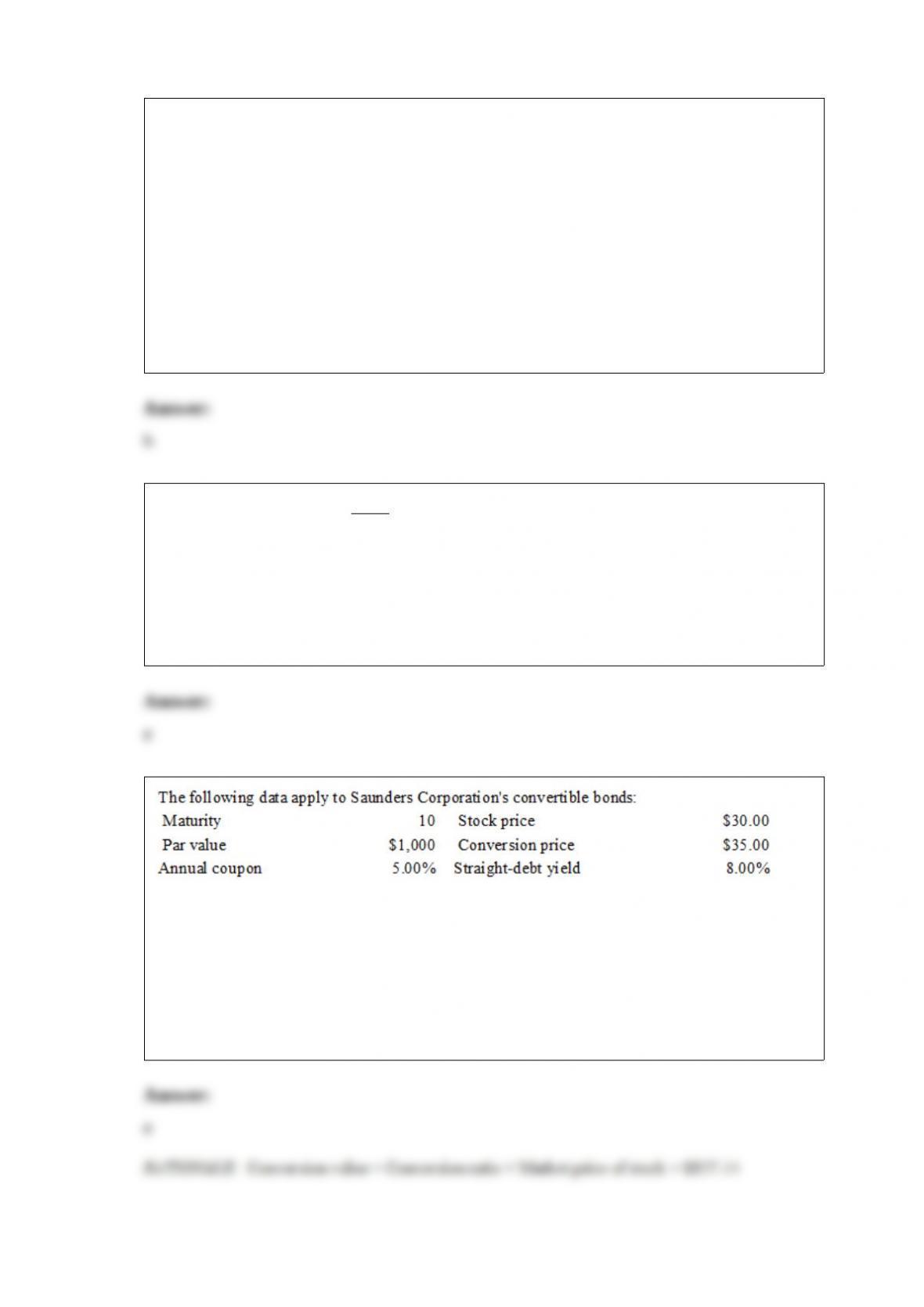
Data for Dana Industries is shown below. Now Dana acquires some risky assets that
cause its beta to increase by 30%. In addition, expected inflation increases by 2.00%.
What is the stock’s new required rate of return?
a.14.00%
b.14.70%
c.15.44%
d.16.21%
e.17.02%
Warnes Motors’ stock is trading at $20 a share. Three-month call options with an
exercise price of $20 have a price of $1.50. Which of the following will occur if the
stock price increases 10% to $22 a share?
a.The price of the call option will increase by $2.
b.The price of the call option will increase by less than $2, but the percentage increase
in price will be more than 10%.
c.The price of the call option will increase by less than $2, and the percentage increase
in price will be less than 10%.
d.The price of the call option will increase by more than $2.
e.The price of the call option will increase by more than $2, but the percentage increase
in price will be less than 10%.
Which of the following is NOT directly reflected in the cash budget of a firm that is in
the zero tax bracket?
a.Payment lags.
b.Payment for plant construction.
c.Cumulative cash.
d.Repurchases of common stock.
e.Writing off bad debts.
What is the bond’s initial conversion value when issued?
a.$698.15
b.$734.89
c.$773.57
d.$814.29
e.$857.14
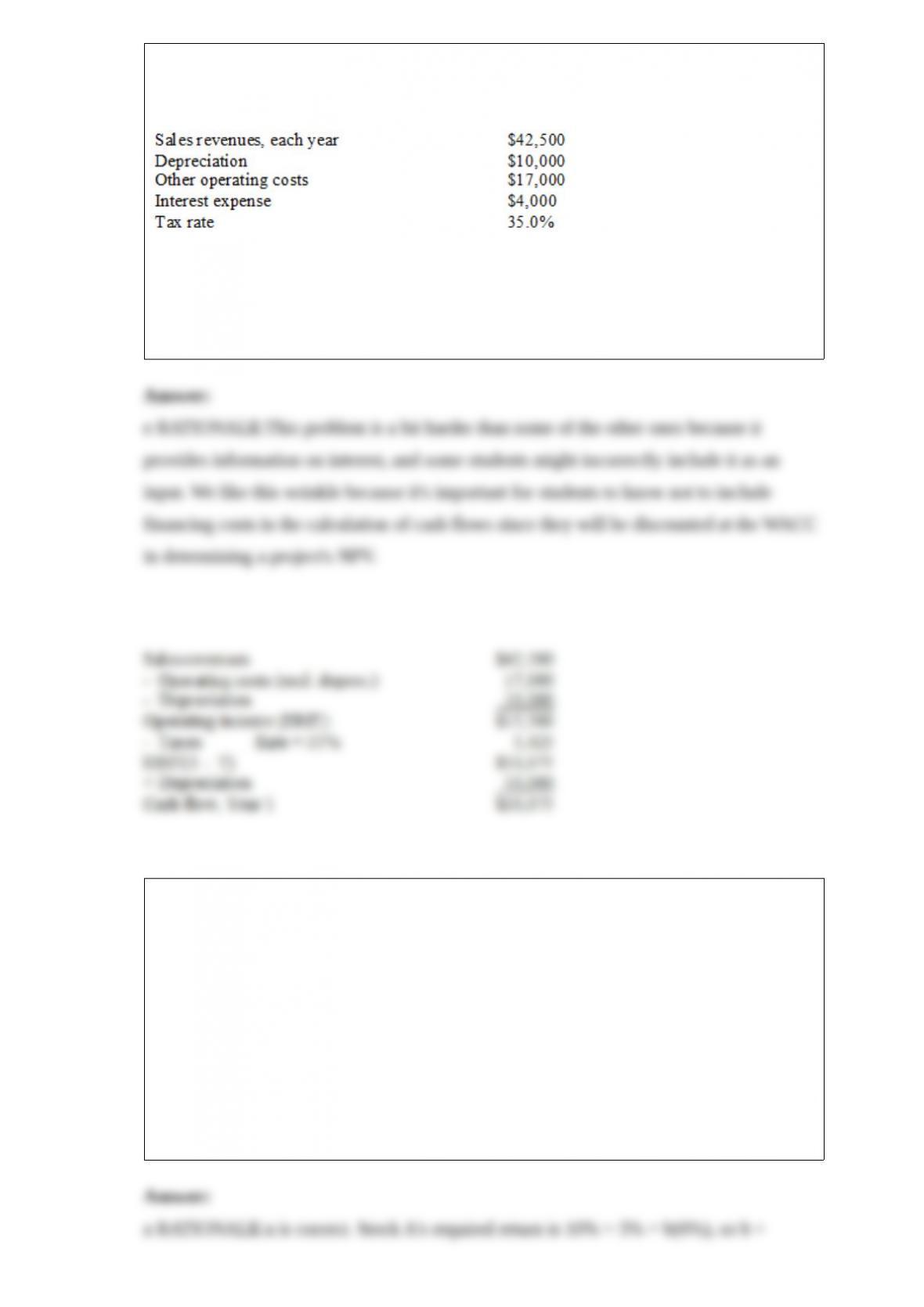
As a member of UA Corporation’s financial staff, you must estimate the Year 1 cash
flow for a proposed project with the following data. What is the Year 1 cash flow?
a.$16,351
b.$17,212
c.$18,118
d.$19,071
e.$20,075
Stock A has an expected return of 10% and a standard deviation of 20%. Stock B has an
expected return of 13% and a standard deviation of 30%. The risk-free rate is 5% and
the market risk premium, rM – rRF, is 6%. Assume that the market is in equilibrium.
Portfolio AB has 50% invested in Stock A and 50% invested in Stock B. The returns of
Stock A and Stock B are independent of one another, i.e., the correlation coefficient
between them is zero. Which of the following statements is CORRECT?
a.Stock A’s beta is 0.8333.
b.Since the two stocks have zero correlation, Portfolio AB is riskless.
c.Stock B’s beta is 1.0000.
d.Portfolio AB’s required return is 11%.
e.Portfolio AB’s standard deviation is 25%.

For a portfolio of 40 randomly selected stocks, which of the following is most likely to
be true?
a.The riskiness of the portfolio is greater than the riskiness of each of the stocks if each
was held in isolation.
b.The riskiness of the portfolio is the same as the riskiness of each stock if it was held
in isolation.
c.The beta of the portfolio is less than the weighted average of the betas of the
individual stocks.
d.The beta of the portfolio is equal to the weighted average of the betas of the
individual stocks.
e.The beta of the portfolio is larger than the weighted average of the betas of the
individual stocks.
Last year Hamdi Corp. had sales of $500,000, operating costs of $450,000, and
year-end assets(which is equal to its total invested capital) of $395,000. The
debt-to-total-capital ratio was 17%, the interest rate on the debt was 7.5%, and the
firm’s tax rate was 35%. The new CFO wants to see how the ROE would have been
affected if the firm had used a 50% debt-to-total-capital ratio. Assume that sales,
operating costs, total assets, total invested capital, and the tax rate would not be
affected, but the interest rate would rise to 8.0%. By how much would the ROE change
in response to the change in the capital structure?
a.1.71%
b.1.90%
c.2.11%
d.2.34%
e.2.58%

Which of the following statements is CORRECT?
a.The term “IPO” stands for Introductory Price Offered, and it is the price at which
shares of a new company are offered to the public.
b.IPO prices are generally established by the market, and buyers of the new stock must
pay the price that prevails at the close of trading on the day the stock is offered to the
public.
c.In a “Dutch auction,” investors who want to buy shares in an IPO submit bids
indicating how many shares they want to buy and the price they are willing to pay. The
company determines how many shares it wants to sell. The highest price that enables
the company to sell the desired number of shares is the price that all buyers must pay.
d.It is possible that the price set in an IPO is so high that investors will refuse to buy the
number of shares that the company wants to sell. In this situation, the IPO is said to be
oversubscribed.
e.It is possible that the price set in an IPO is so low that investors will want to buy more
shares than the company wants to sell. In that case, the company will have to issue
more shares than it wants to sell.
Assume that to cool off the economy and decrease expectations for inflation, the
Federal Reserve tightened the money supply, causing an increase in the risk-free rate,
rRF. Investors also became concerned that the Fed’s actions would lead to a recession,
and that led to an increase in the market risk premium, (rM – rRF). Under these
conditions, with other things held constant, which of the following statements is most
correct?
a.The required return on all stocks would increase by the same amount.
b.The required return on all stocks would increase, but the increase would be greatest
for stocks with betas of less than 1.0.
c.Stocks’ required returns would change, but so would expected returns, and the result
would be no change in stocks’ prices.
d.The prices of all stocks would decline, but the decline would be greatest for high-beta
stocks.
e.The prices of all stocks would increase, but the increase would be greatest for
high-beta stocks.
Wu Systems has the following balance sheet. How much net operating working capital
does the firm have?