A real option’s value may be more than the amount by which its inclusion in a capital
budgeting project increases the project’s expected NPV because the real option may:
A.reduce the project’s risk.
B.increase the amount the firm makes if the project turns out really well.
C.reduce the loss if the project fails badly.
D.a and c
Holding all other variables constant, which of the following would DECREASE annual
after-tax cash flows on a project?
A.A decrease in depreciation expense
B.A decrease in the savings projected due to the project’s improving product quality
C.A decrease in interest expense
D.Both a & b
E.All of the above
A firm is planning to improve collections next year. Management has forecast an ACP
of 45 days which is a substantial improvement over the current ACP. Next year’s sales
are expected to be $120M. Next year’s ending receivables balance should be planned at
(Make calculations using ending balances and a 360-day year.)
A.$10M

B.$15M
C.$16.5M
D.$22M
The biggest difference between the income statement and the balance sheet is:
A.the income statement shows incoming deposits, while the balance sheet shows
account balances from the bank.
B.the income statement is submitted to the government, while the balance sheet is
shown to investors.
C.the income statement is always more accurate than the balance sheet.
D.the balance sheet represents stocks of cash at a point in time, while the income
statement reflects flows of cash over a time period.
A firm markets a product for $30 per unit that has a direct manufacturing cost of $15
per unit. Its contribution margin is:
A.50%.
B.33.33%.
C.$15.
D.None of the above

The process of estimating the level of investor demand and deciding on the price of a
share is known as:
A.registration.
B.red herring.
C.book building.
D.retailing.
Which of the following is the correct formula to calculate ROE?
A.ROE = EBT / Equity
B.ROE = EBIT / Equity
C.ROE = Net income / Equity
D.ROE = Gross profit / Equity

According to finance theory, which of the following approaches can be used to estimate
a firm’s cost of equity?
A.The capital-asset-pricing model approach
B.The dividend growth approach
C.The risk premium approach
D.All of the above
You are considering investing in B & B, Inc.’s stock and your broker has told you that
you can purchase it for $72. You require a return 12% for this type of investment. The
last dividend (D0) that B & B paid was $4 and a 6% constant growth rate is anticipated.
Should you purchase B & B, Inc.?
A.No, because the stock is overpriced by $1.33.
B.No, because the stock is overpriced by $3.33.
C.Yes, because the stock is underpriced by $1.33.
D.Yes, because the stock is underpriced by $3.33.
Zero balance accounts eliminate:
A.concentration banking.
B.wire transfers.

C.preauthorized checks.
D.excess funds at the banks of remote divisions.
The present value factor (PVF) and the future value factor (FVF) are related:
A.exponentially.
B.arithmetically.
C.as reciprocals.
D.as compliments.
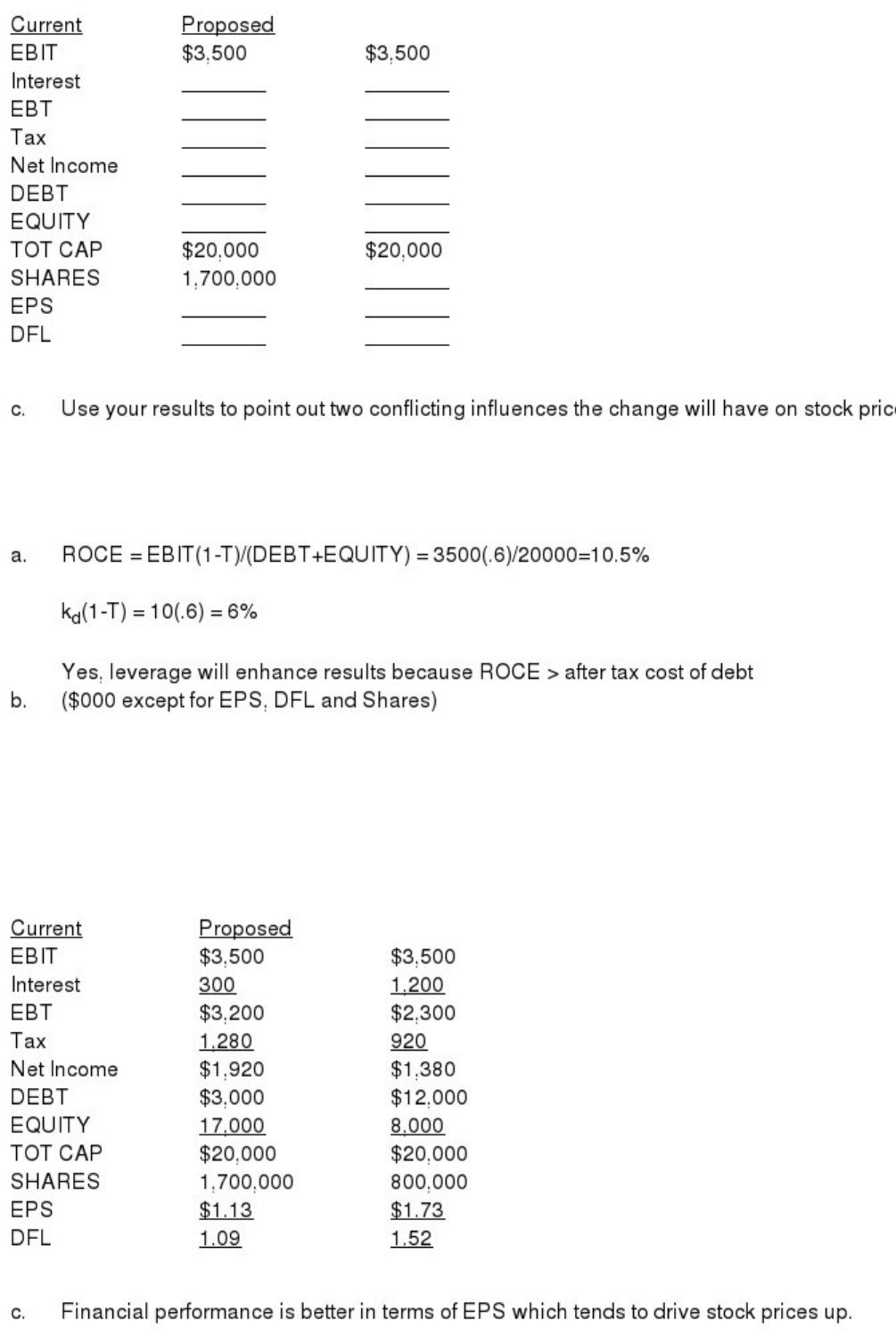
Southern Inc. has EBIT of $3,500,000, and total capital of $20,000,000 that is 15%
debt. There are 1,700,000 shares of stock outstanding which sell at book value. The
firm pays 10% interest on its debt and is subject to a combined state and federal tax rate
of 40%. Southern plans to restructure its capital to 60% debt.