
1) Julie wants to create a $5,000 portfolio. She also wants to invest as much as possible
in a high risk stock with the hope of earning a high rate of return. However, she wants
her portfolio to have no more risk than the overall market. Which one of the following
portfolios is most apt to meet all of her objectives?
A.Invest the entire $5,000 in a stock with a beta of 1.0
B.Invest $2,500 in a stock with a beta of 1.98 and $2,500 in a stock with a beta of 1.0
C.Invest $2,500 in a risk-free asset and $2,500 in a stock with a beta of 2.0
D.Invest $2,500 in a stock with a beta of 1.0, $1,250 in a risk-free asset, and $1,250 in a
stock with a beta of 2.0
E.Invest $2,000 in a stock with a beta of 3, $2,000 in a risk-free asset, and $1,000 in a
stock with a beta of 1.0
2) What is the primary purpose of bond covenants?
A.Meet regulatory requirements
B.Describe repayment terms
C.Protect the lender
D.Define a bond’s rating
E.Increase a bond’s seniority position
3) Currently, you can exchange 100 for $133. The inflation rate in Euroland is expected
to be 2.5 percent. In one year, it is expected that 100 can be exchanged for $136.
Assume relative purchasing power parity exists. What is the expected inflation rate in
the U.S.?
A.3.84 percent
B.4.26 percent
C.4.71 percent
D.5.21 percent
E.5.68 percent
4) If a firm has a 100 percent dividend payout ratio, then the internal growth rate of the
firm is:
A.zero percent

B.100 percent
C.equal to the ROA
D.negative
E.infinite
5) Horseshoe Stables is losing significant market share and thus its managers have
decided to decrease the firm’s annual dividend. The last annual dividend was $0.90 a
share but all future dividends will be decreased by 10 percent annually. What is a share
of this stock worth today at a required return of 15 percent?
A.$3.06
B.$3.24
C.$3.41
D.$3.59
E.$3.95
6) The Egg House just borrowed $260,000 to build a new restaurant. The loan terms
call for equal annual payments at the end of each year. The loan is for 15 years at an
APR of 8 percent. How much of the first annual payment will be used to reduce the
principal balance?
A.$8,311.62
B.$9,575.68
C.$10,211.08
D.$10,554.60
E.$11,420.90
7) You recently sold an antique car you owned and valued greatly. However, you
needed money and agreed to sell the car at a price of $58,000, to be paid in monthly
payments of $1,500 each for 48 months. What interest rate did you charge for financing
the sale?
A.10.33 percent
B.10.44 percent

C.10.60 percent
D.11.03 percent
E.11.33 percent
8) The addition of a risky security to a fully diversified portfolio:
A.must decrease the portfolio’s expected return
B.must increase the portfolio beta
C.may or may not affect the portfolio beta
D.will increase the unsystematic risk of the portfolio
E.will have no effect on the portfolio beta or its expected return
9) The common stock of Contemporary Interiors has a beta of 1.65 and a standard
deviation of 27.4 percent. The market rate of return is 13.2 percent and the risk-free rate
is 4.8 percent. What is the cost of equity for this firm?
A.18.66 percent
B.18.76 percent
C.21.08 percent
D.24.40 percent
E.26.05 percent
10) Which one of the following statements is correct?
A.Peer group analysis is easier when a firm is a conglomerate versus when it has only a
single line of business
B.Peer group analysis is easier when seasonal firms have different fiscal years
C.Peer group analysis is simplified when firms use varying methods of depreciation
D.Comparing results across geographic locations is easier since all countries now use a
common set of accounting standards
E.Adjustments have to be made when comparing the income statements of firms that
use different methods of accounting for inventory

11) Undertaker Enterprises earns $0.17 in profit on every $1 of sales and has $0.67 in
assets for every $1 of sales. The firm pays out 20 percent of its profits to its
shareholders. What is the internal growth rate?
A.6.37 percent
B.7.76 percent
C.8.80 percent
D.25.47 percent
E.29.65 percent
12) One year ago, Peyton purchased 3,600 shares of Broncos stock for $101,124.
Today, he sold those shares for $26.60 a share. What is the total return on this
investment if the dividend yield is 1.9 percent?
A.-3.98 percent
B.-3.40 percent
C.-2.29 percent
D.1.10 percent
E.3.40 percent
13) Which one of the following forms of business organization offers liability
protection to some of its owners but not to all of its owners?
A.Sole proprietorship
B.General partnership
C.Limited partnership
D.Limited liability company
E.Corporation
14) Bermuda Cruises issues only common stock and coupon bonds. The firm has a

debt-equity ratio of 0.65 . The cost of equity is 18.3 percent and the pretax cost of debt
is 9.9 percent. What is the capital structure weight of the firm’s equity if the firm’s tax
rate is 34 percent?
A.46.75 percent
B.49.97 percent
C.52.93 percent
D.59.08 percent
E.60.61 percent
15) Last year, Teresa’s Fashions earned net income of $68,400 and had 12,000 shares of
stock outstanding. The dividends per share were $1.20. What is the dividend payout
ratio?
A.21.05 percent
B.24.07 percent
C.38.60 percent
D.40.21 percent
E.44.14 percent
16) Which one of the following is the minimum required rate of return on a new
investment that makes that investment attractive?
A.Risk-free rate
B.Market risk premium
C.Expected return minus the risk-free rate
D.Market rate of return
E.Cost of capital
17) A loan has an APR of 8.5 percent and an EAR of 8.5 percent. Given this, the loan
must:
A.have a one-year term
B.have a zero percent interest rate
C.charge interest annually
D.must be an interest-only loan
E.require the accrued interest be paid in full with each monthly payment
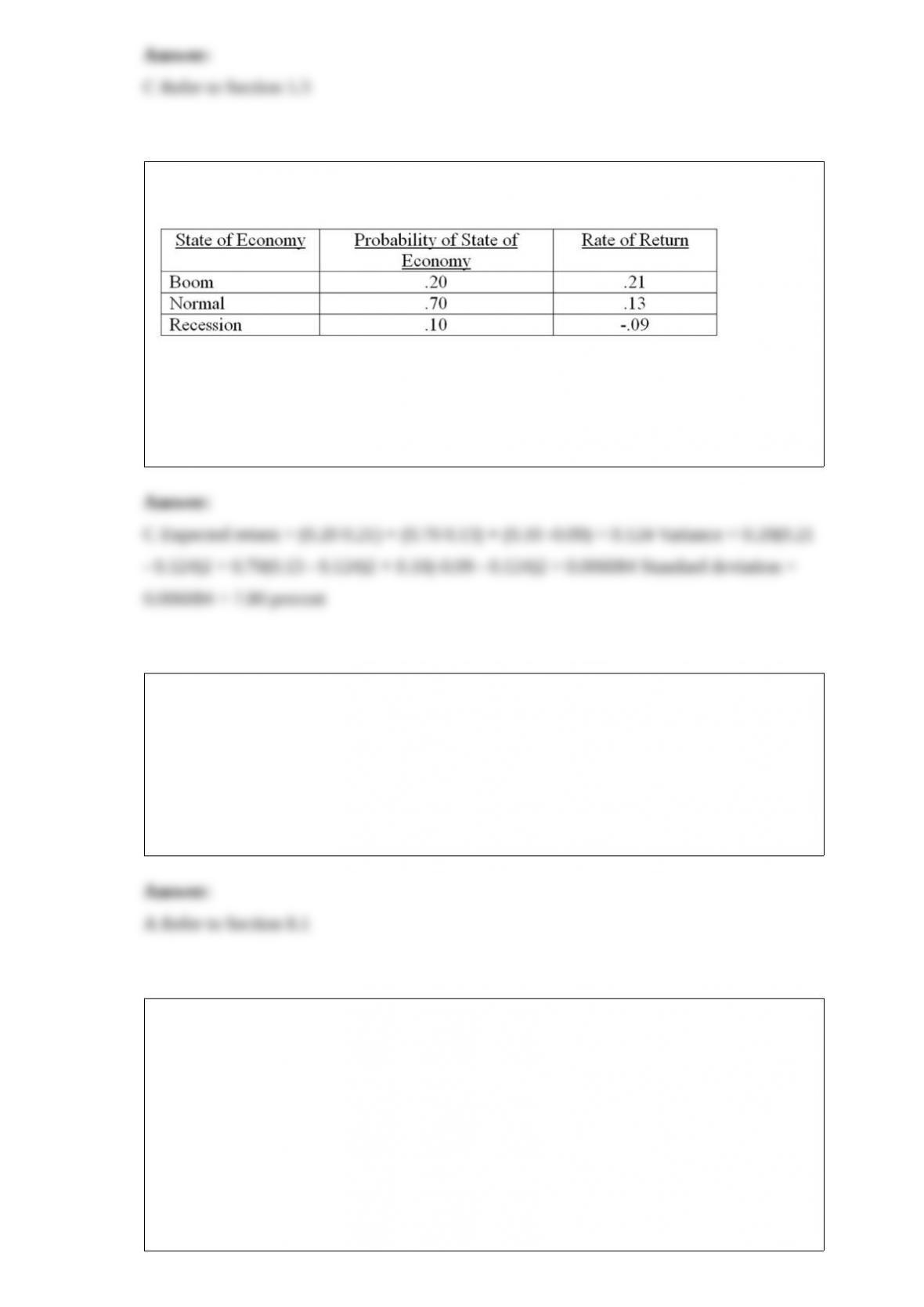
18) Given the following information, what is the standard deviation of the returns on
this stock?
A.7.38 percent
B.7.55 percent
C.7.80 percent
D.7.91 percent
E.8.06 percent
19) The net present value:
A.decreases as the required rate of return increases
B.is equal to the initial investment when the internal rate of return is equal to the
required return
C.method of analysis cannot be applied to mutually exclusive projects
D.is directly related to the discount rate
E.is unaffected by the timing of an investment’s cash flows
20) Which of the following characteristics are most commonly associated with
corporate bonds issued in the U.S.?
I. Registered form
II. Bearer form
III. Quarterly coupon payments
IV. Semiannual coupon payments
A.I and III only
B.I and IV only
C.II and III only

D.II and IV only
E.III only
21) Which of the following can generally be found in a bond’s indenture agreement?
I. Terms of repayment
II. Names of registered shareholders
III. Protective covenants
IV. Total amount of the bond issue
A.I and III only
B.II, III, and IV only
C.I, II, and III only
D.I, III, and IV only
E.I, II, III, and IV
22) Wesson Metals has an outstanding loan that calls for equal annual payments of
$9,768.46 over the life of the loan. The original loan amount was $50,000 at an APR of
8.5 percent. How much of the second loan payment is interest?
A.$3,525.61
B.$3,780.93
C.$4,250.00
D.$5,409.16
E.$5,987.53
23) Better Chocolates has a new project that requires $975,000 of equipment. What is
the depreciation in year 6 of this project if the equipment is classified as seven-year
property for MACRS purposes? The MACRS allowance percentages are as follows,
commencing with year 1: 14.29, 24.49, 17.49, 12.49, 8.93, 8.92, 8.93, and 4.46 percent.
A.$77,294
B.$77,301
C.$82,988

D.$86,970
E.$139,327
24) Which one of the following statements concerning debt issues is correct?
A.Firms often pay higher interest rates on term loans than on public issues of debt
B.The only difference between a term loan and a private placement is the size of the
issue
C.A prospectus is required for equity issues but not for debt issues
D.The flotation costs of issuing debt tend to be more expensive than for issuing equity
E.Direct long-term loans must be registered with the SEC
25) Which one of the following is defined as a bell-shaped frequency distribution that is
defined by its average and its standard deviation?
A.Arithmetic average return
B.Variance
C.Standard deviation
D.Probability curve
E.Normal distribution
26) LaDoris& Mike, Inc. sells earnings forecasts for Chinese securities. Its credit terms
are 1/5, net 15 . Based on experience, 85 percent of all customers take the discount.
What is the average collection period?
A.6.0 days
B.6.5 days
C.7.0 day
D.7.5 days
E.8.0 days

27) If intermediate-term, default-free, pure discount bonds have a higher rate of return
than either the comparable shorter-term or longer-term bonds, the term structure of
interest rates will be:
A.upward sloping
B.flat
C.humped
D.downward sloping
E.double-humped