Which of the following statements is false?
A) Firms with steady, reliable cash flows, such as utility companies, are able to use high
levels of debt and still have a very low probability of default.
B) If there were no costs of financial distress, the value of the firm would continue to
increase with increasing debt until the interest on the debt exceeds the firm’s earnings
before interest and taxes and the tax shield is exhausted.
C) The costs of financial distress reduce the value of the levered firm, VL. The amount
of the reduction decreases with the probability of default, which in turn increases with
the level of the debt D.
D) The tradeoff theory states that firms should increase their leverage until it reaches
the level D* for which VL is maximized.
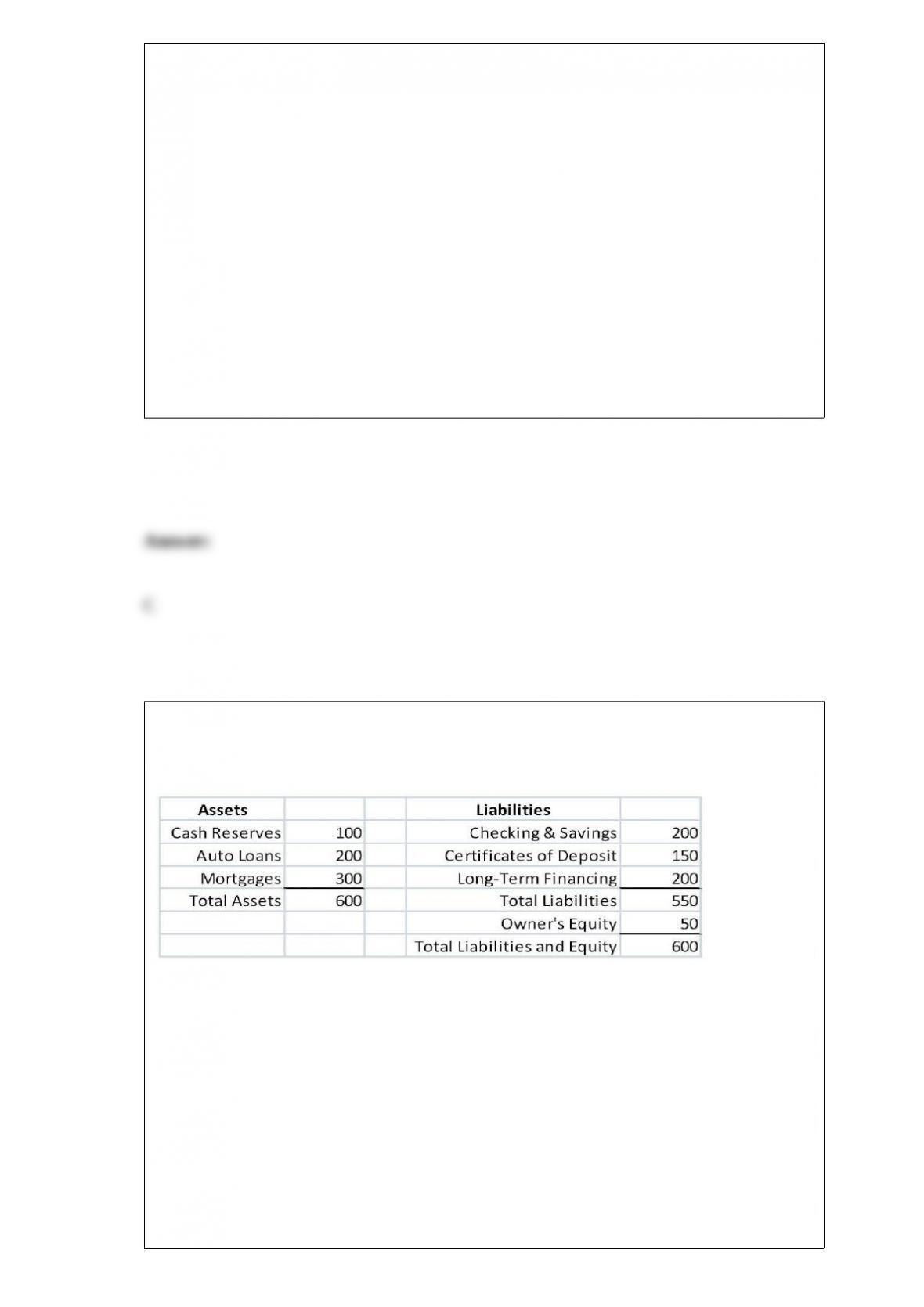
You are a risk manager for Security First Trust Savings and Loan (SFTSL). SFTSL’s
balance sheet is as follows (in millions of dollars):
The duration of the auto loans is three years and the duration of the mortgages is eight
years. Both cash reserves and checking and savings have zero duration. The CDs have a
duration of two years and the long-term financing has a ten year duration.
The duration of SFTSL’s equity is closest to:
A) 6 years
B) 8 years
C) 10 years

D) 14 years
Which of the following is not one of the simplifying assumptions made for the three
main methods of capital budgeting?
A) The firm pays out all earnings as dividends.
B) The project has average risk.
C) Corporate taxes are the only market imperfection.
D) The firm’s debt-equity ratio is constant.

Use the information for the question(s) below.
You founded your own firm three years ago. You initially contributed $200,000 of your
own money and in return you received 2 million shares of stock. Since then, you have
sold an additional 1 million shares of stock to angel investors. You are now considering
raising capital from a venture capital firm. This venture capital firm would invest $5
million and would receive 2 million newly issued shares in return.
he post-money valuation of your firm is closest to:
A) $12.5 million
B) $5.2 million
C) $10.0 million
D) $5.0 million
Use the following information to answer the question(s) below.
Suppose that Merck (MRK) stock is trading for $36.70 per share with 2.11 billion
shares outstanding while Boeing (BA) has 697.5 million shares outstanding and a

market capitalization of $38.223 billion. Assume that you hold the market portfolio.
Merck’s market capitalization is closest to:
A) $38.2 billion
B) $77.4 billion
C) $89.4 billion
D) $115.6 billion
Suppose an investment is equally likely to have a 35% return or a -20% return. The
standard deviation on the return for this investment is closest to:
A) 38.9%
B) 0%
C) 19.4%
D) 27.5%
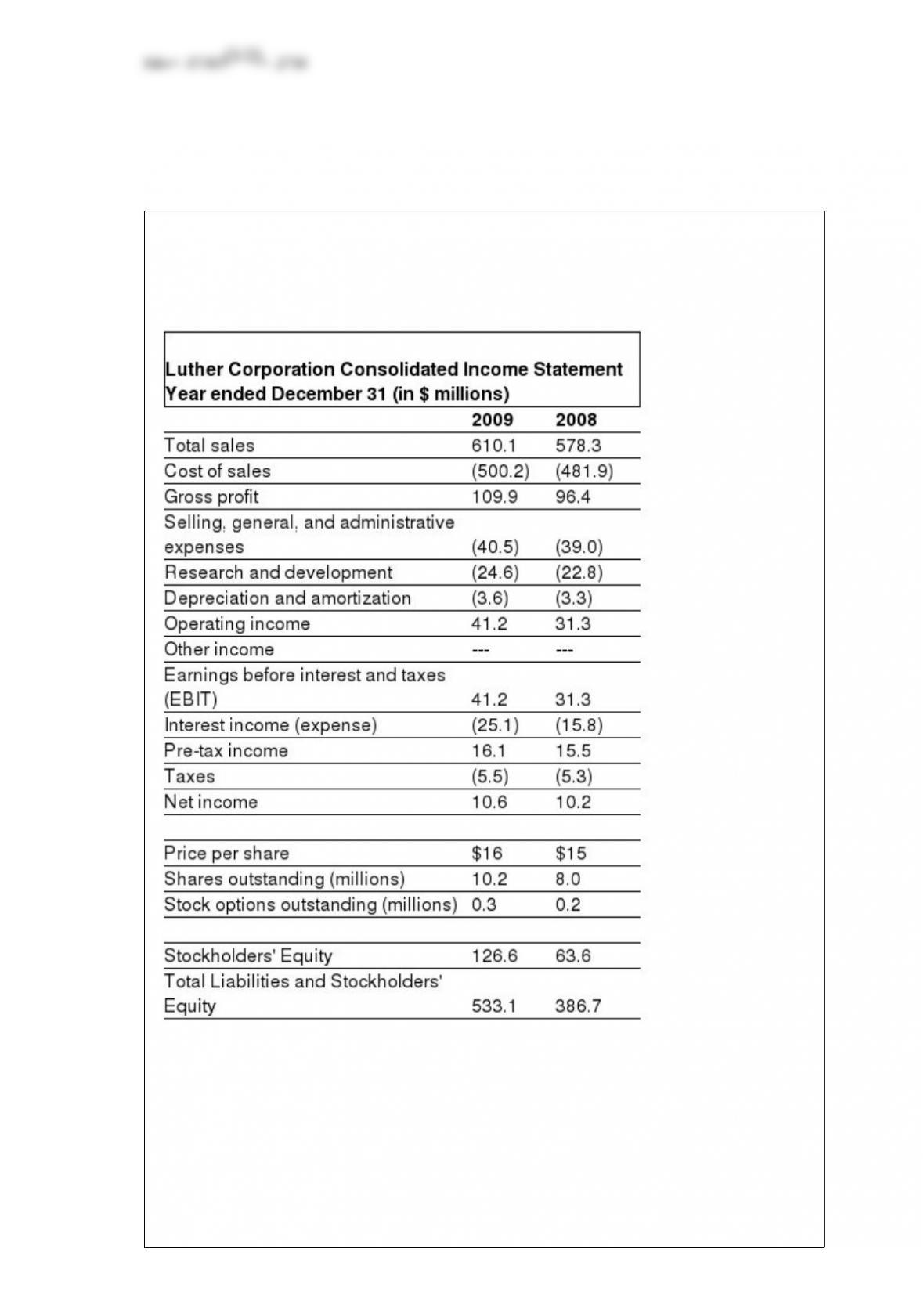
Consider the following income statement and other information:
If ECE reported $15 million in net income, then ECE’s Return on Assets (ROA) is:
A) 5.0%
B) 7.5%
C) 10.0%
D) 15.0%
Use the information for the question(s) below.
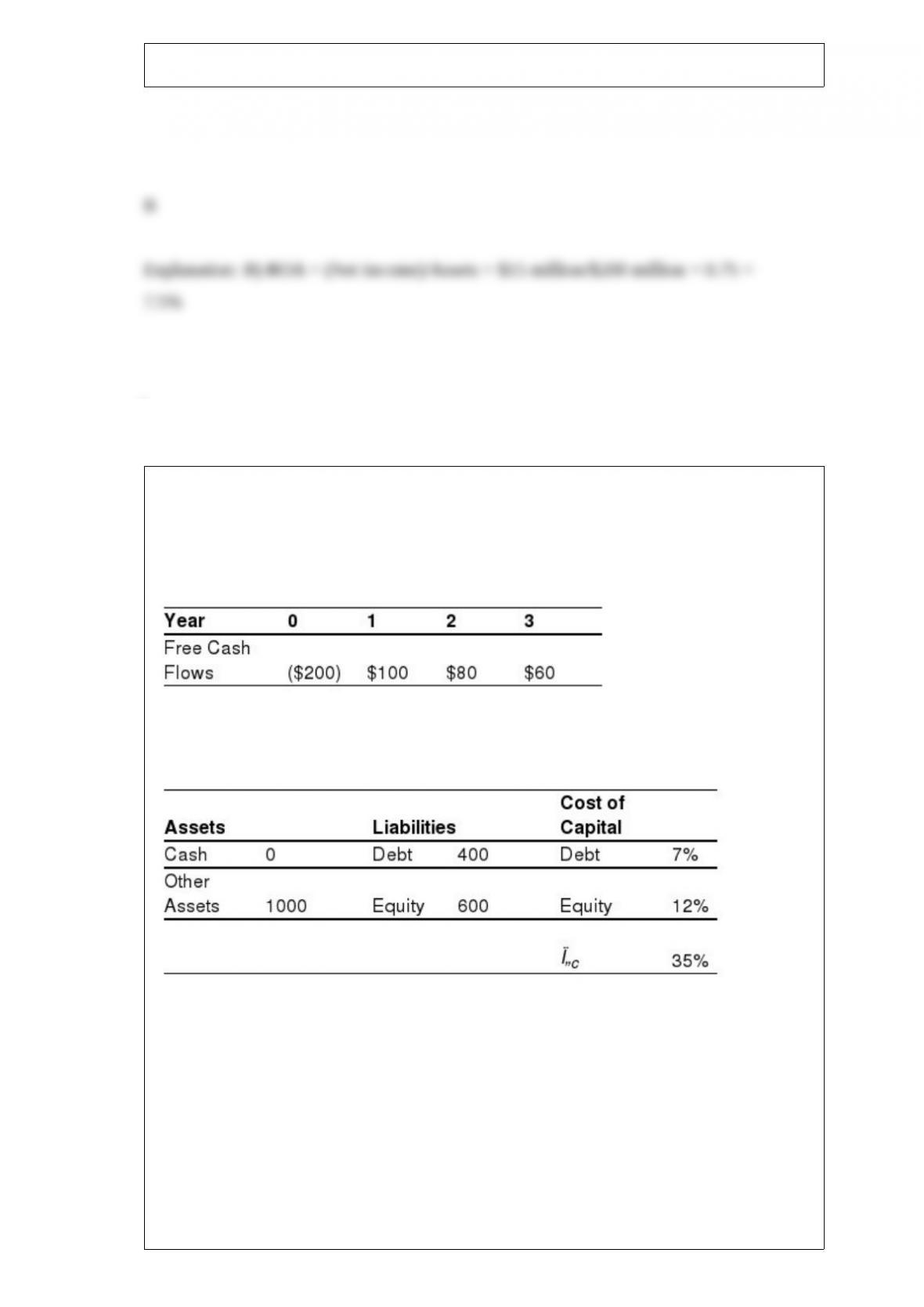
Aardvark Industries is considering a project that will generate the following free cash
flows:
You are also provided with the following market value balance sheet and information
regarding Aardvark’s cost of capital:
Suppose that to fund this new project, Aardvark borrows $120 with the principal to be
paid in three equal installments at the end each year. The present value of Aardvark’s
interest tax shield is closest to:
A) $5.15
B) $5.00
C) $5.90

D) $5.25
The DuPont Identity expresses the firm’s ROE in terms of
A) profitability, asset efficiency, and leverage.
B) valuation, leverage, and interest coverage.
C) profitability, margins, and valuation.
D) equity, assets, and liabilities.
If Moon Corporation has an increase in sales, which of the following would result in no
change in its EBIT margin?
A) A proportional increase in its net income
B) A proportional decrease in its EBIT
C) A proportional increase in its EBIT
D) An increase in its operating expenses
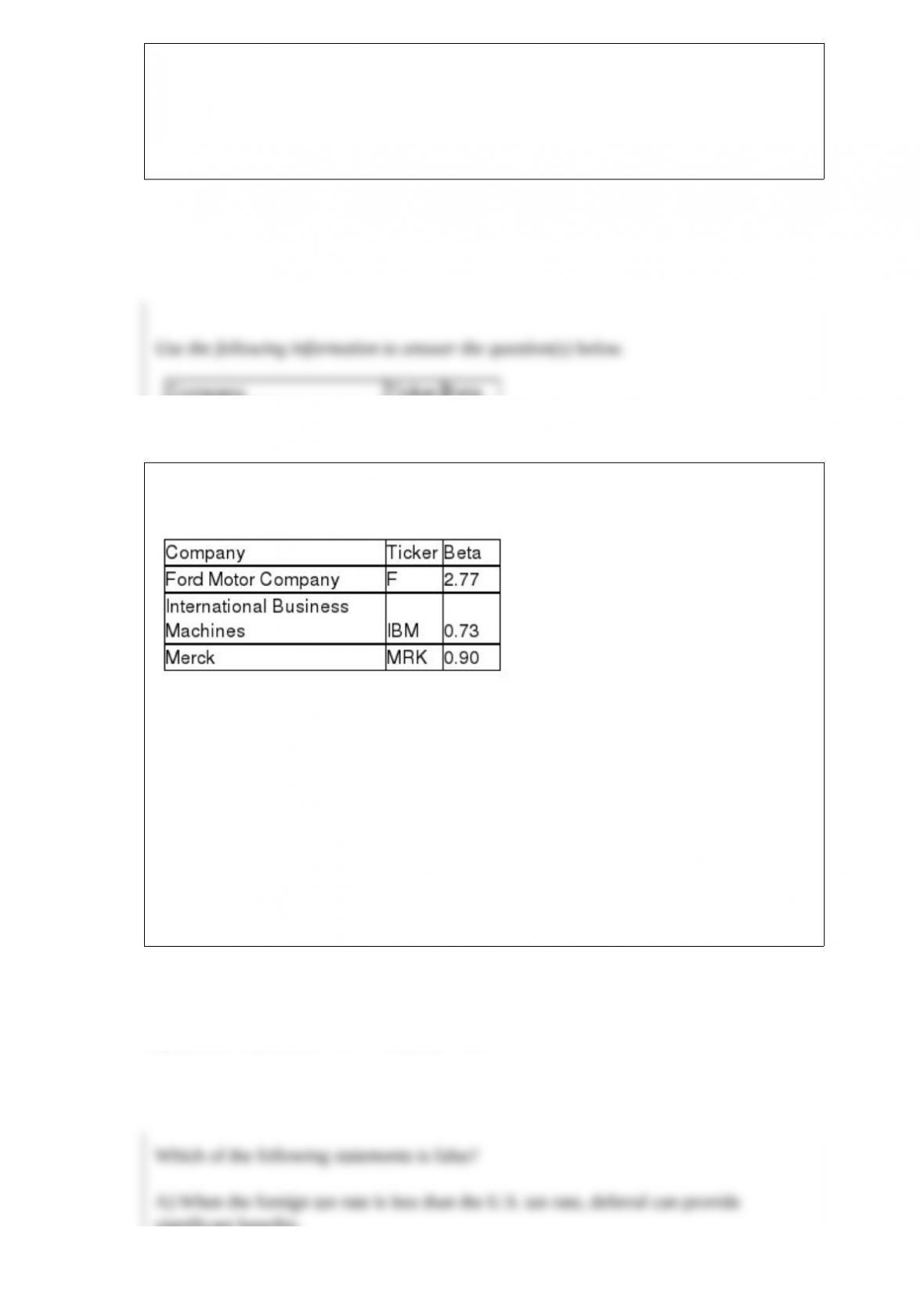
Use the following information to answer the question(s) below.
If the market risk premium is 6% and the risk-free rate is 4%, then the expected return
of investing in Merck is closest to:
A) 5.4%
B) 9.4%
C) 10.0%
D) 10.4%

Which of the following statements is false?
A) When the foreign tax rate is less than the U.S. tax rate, deferral can provide
significant benefits.
B) The U.S. tax liability is not incurred until the profits are brought back home if the
foreign operation is set up as a foreign branch rather than as a separately incorporated
subsidiary.
C) If a company chooses not to repatriate 12.5 million in pre-tax earnings, for example,
it effectively reinvests those earnings abroad and defers its U.S. tax liability.
D) When the foreign tax rates exceed the U.S. tax rates, there are no benefits to deferral
because in such a case there is no additional U.S. tax liability.
Rearden Metal is considering the purchase of a new blast furnace costing a total of $5
million dollars. This furnace will qualify for accelerated depreciation: 20% can be
expense immediately, followed by 32%, 19.2%, 11.52%, 11.52% and 5.76% over the
next five years. However, because of Rearden’s substantial tax loss carry forwards,
Rearden estimates its marginal tax rate to be only 10% over the next five years. Since
Rearden will get very little tax benefit from the depreciation expense, they consider
leasing the furnace instead. Suppose that Rearden and the lessor face the same 8%
borrowing rate, but the lessor has a 40% marginal tax rate. Assume that the furnace is
worthless after five years, the lease term is five years, and a lease would qualify as a
true tax lease.
Assuming that Rearden’s annual lease payments are $1.1 million, then the effective
after-tax lease borrowing rate is closest to:
A) 8.0%
B) 12.8%
C) 15.4%

D) 17.0%
If a stock pays dividends at the end of each quarter, with realized returns of R1, R2, R3,
and R4 each quarter, then the annual realized return is calculated as:
A) Rannual =
B) Rannual = (1 + R1)(1 + R2)(1 +R3)(1 + R4)

C) Rannual = (1 + R1)(1 + R2)(1 +R3)(1 + R4) – 1
D) Rannual = R1 + R2 + R3 + R4
Taggart Transcontinental needs a $100,000 loan for the next 30 days. Taggart has three
alternatives available:
Alternative #1: Forgo the discount on its trade credit agreement that offers terms of 2/5
net 35.
Alternative #2: Borrow the money from Bank A, which has offered to lead the firm
$100,000 for one month at
an APR of 9%. The bank will require a (no-interest) compensating balance of 10% of
the face-value of the loan and will charge a $200 loan origination fee, which means that
Taggart must morrow even more than the $100,000 they need.
Alternative #3: Borrow the money from Bank B, which has offered to lend the firm
$100,000 for one month at an APR of 12%. The loan has a 1% origination fee.
Which alternative should Taggart choose?
A) Alternative #1 since it has the lowest EAR
B) Alternative #2 since it has the lowest EAR
C) Alternative #3 since it has the lowest EAR
D) Alternative #2 since it has the highest actual rate

Use the following information to answer the question(s) below.
Wyatt Oil has assets with a market value of $600 million, $70 million of which are
cash. It has debt of $250 million, and 20 million shares outstanding. Assume perfect
capital markets.
If Wyatt Oil distributes the $70 million as a share repurchase, then the number of shares
outstanding after the repurchase will be closest to:
A) 16.0 million
B) 16.5 million
C) 17.5 million
D) 18.0 million
Use the information for the question(s) below.
Ford Motor Company is considering launching a new line of Plug-in Electric SUVs.
The heavy advertising expenses associated with the new SUV launch would generate
operating losses of $35 million next year. Without the new SUV, Ford expects to earn
pre-tax income of $80 million from operations next year. Ford pays a 30% tax rate on
its pre-tax income.
The amount that Ford Motor Company owe in taxes next year with the launch of the
new SUV is closest to:

A) $13.5 million
B) $31.5 million
C) $56.0 million
D) $24.0 million
Consider the following equation:
= (1 + ) – 1
the term r in this equation refers to
A) the cost of capital for the firm in terms of yen.
B) the risk-free rate of interest on the dollar.
C) the cost of capital in terms of dollars.
D) the risk-free rate of interest on the yen.
The payoff to the holder of a call option is given by:

A) C = max(S – K, 0)
B) C = min(K, 0)
C) C = max(K – S, 0)
D) C = min(K –S, 0)
Consider the following equation:
The term A in this equation refers to
A) the premerger, or standalone, value of the acquirer.
B) new shares to pay for the target.
C) the value of the synergies created by the merger.
D) the premerger (standalone) value of the target.
Which of the following statements is false?
A) The substantial use of stock and option grants in the 1990s greatly increased
managers’ pay-for-performance sensitivity.

B) The optimal level of sensitivity of managers’ compensation to the performance of
their firms depends on the managers’ level of risk aversion, which is hard to measure.
C) While decreasing managers’ risk exposure, increasing the sensitivity of managerial
pay and wealth to firm performance does have some negative effects.
D) In the absence of monitoring, the other way the conflict of interest between
managers and owners can be mitigated is by closely aligning their interests through the
managers’ compensation policy.
Use the information for the question(s) below.
Your firm needs to invest in a new delivery truck. The life expectancy of the delivery
truck is five years. You can purchase a new delivery truck for an upfront cost of
$200,000, or you can lease a truck from the manufacturer for five years for a monthly
lease payment of $4000 (paid at the end of each month). Your firm can borrow at 6%
APR with quarterly compounding.
The monthly discount rate that you should use to evaluate the truck lease is closest to:
A) 0.487%
B) 0.498%
C) 1.500%
D) 1.535%
Suppose that you deposit $10,000 in an account that pays 6% interest and you want to
know how much will be in your account at the end of 10 years. To solve this problem in
Microsoft Excel, you would use which of the following Excel formulas?
A) =FV(.06,10000,0,10)
B) =PV(.06,10000,0,10)
C) =FV(.06,10,0,10000)
D) =PV(.06,10,0,10000)
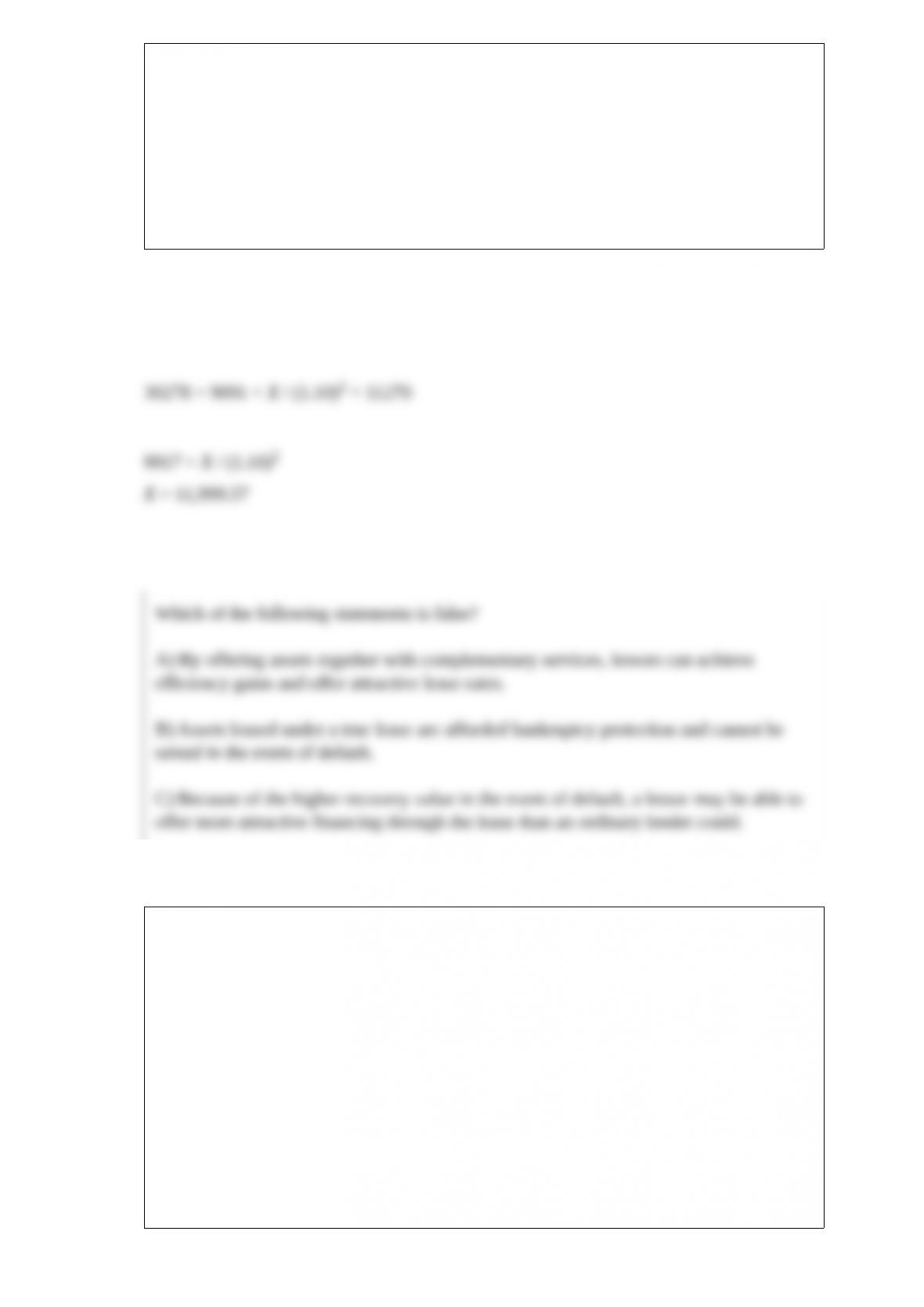
You are offered an investment opportunity that costs you $28,000,has an NPV of $2278,
lasts for three years, has interest rate of 10%, and produces the following cash flows:
The missing cash flow from year 2 is closest to:
A) $12,500
B) $12,000
C) $13,000
D) $10,000
Which of the following statements is false?
A) By offering assets together with complementary services, lessors can achieve
efficiency gains and offer attractive lease rates.
B) Assets leased under a true lease are afforded bankruptcy protection and cannot be
seized in the event of default.
C) Because of the higher recovery value in the event of default, a lessor may be able to
offer more attractive financing through the lease than an ordinary lender could.
D) Lessors often have efficiency advantages over lessees in maintaining or operating
certain types of assets.

Consider the following two projects:
The maximum number of incremental IRRs that could exist for project B over project A
is:
A) 1
B) 2
C) 0
D) 3
Which of the following statements is false?
A) The levered equity return equals the unlevered return, plus an extra “kick” due to

leverage.
B) By holding a portfolio of the firm’s equity and its debt, we can replicate the cash
flows from holding its levered equity.
C) The cost of capital of levered equity is equal to the cost of capital of unlevered
equity plus a premium that is proportional to the market value debt-equity ratio.
D) If a firm is unlevered, all of the free cash flows generated by its assets are available
to be paid out to its equity holders.
Which of the following statements is false?
A) If a company anticipates an ongoing surplus of cash, it may choose to increase its
dividend payout.
B) Seasonal sales can create large short-term cash flow deficits and surpluses.
C) The first step in short-term financial planning is to forecast the company’s future net
working capital.
D) Deficits resulting from investments in long-term projects are often financed using
long-term sources of capital, such as equity or long-term bonds.

Which of the following statements is false?
A) In addition to the evidence that board independence matters for major activities such
as firing CEOs and making corporate acquisitions, researchers have found a strong
connection between board structure and firm performance.
B) Theoretical and empirical research support the notion that the longer a CEO has
served, especially when that person is also chairman of the board, the more likely the
board is to become captured.
C) Most firms that have just gone public either as young companies or as older firms
returning to public status after a leveraged buyout (LBO) choose to start with smaller
boards.
D) Boards tend to grow over time as members are added for various reasons. For
example, boards are often expanded by one or two seats after an acquisition to
accommodate the target CEO and perhaps one other target director.
Use the information for the question(s) below.
KD Industries has 30 million shares outstanding with a market price of $20 per share
and no debt. KD has had consistently stable earnings, and pays a 35% tax rate.
Management plans to borrow $200 million on a permanent basis through a leveraged
recapitalization in which they would use the borrowed funds to repurchase outstanding
shares.
After the recapitalization, the total value of KD as a levered firm is closest to:
A) $470 million
B) $730 million
C) $670 million
D) $530 million
Consider the following two projects:
The internal rate of return (IRR) for project A is closest to:
A) 7.7%
B) 21.6%
C) 23.3%
D) 42.9%

Which of the following statements is false?
A) The incremental IRR need not exist.
B) If a change in the timing of the cash flows does not affect the NPV, then the change
in timing will not impact the IRR.
C) Although the incremental IRR rule can provide a reliable method for choosing
among projects, it can be difficult to apply correctly.
D) When projects are mutually exclusive, it is not enough to determine which projects
have positive NPVs.
Use the information for the question(s) below.
Food For Less (FFL), a grocery store, is considering offering one hour photo
developing in their store. The firm expects that sales from the new one hour machine
will be $150,000 per year. FFL currently offers overnight film processing with annual
sales of $100,000. While many of the one hour photo sales will be to new customers,
FFL estimates that 60% of their current overnight photo customers will switch and use
the one hour service.
The level of incremental sales associated with introducing the new one hour photo
service is closest to:
A) $90,000
B) $150,000
C) $60,000
D) $120,000
Use the table for the question(s) below.
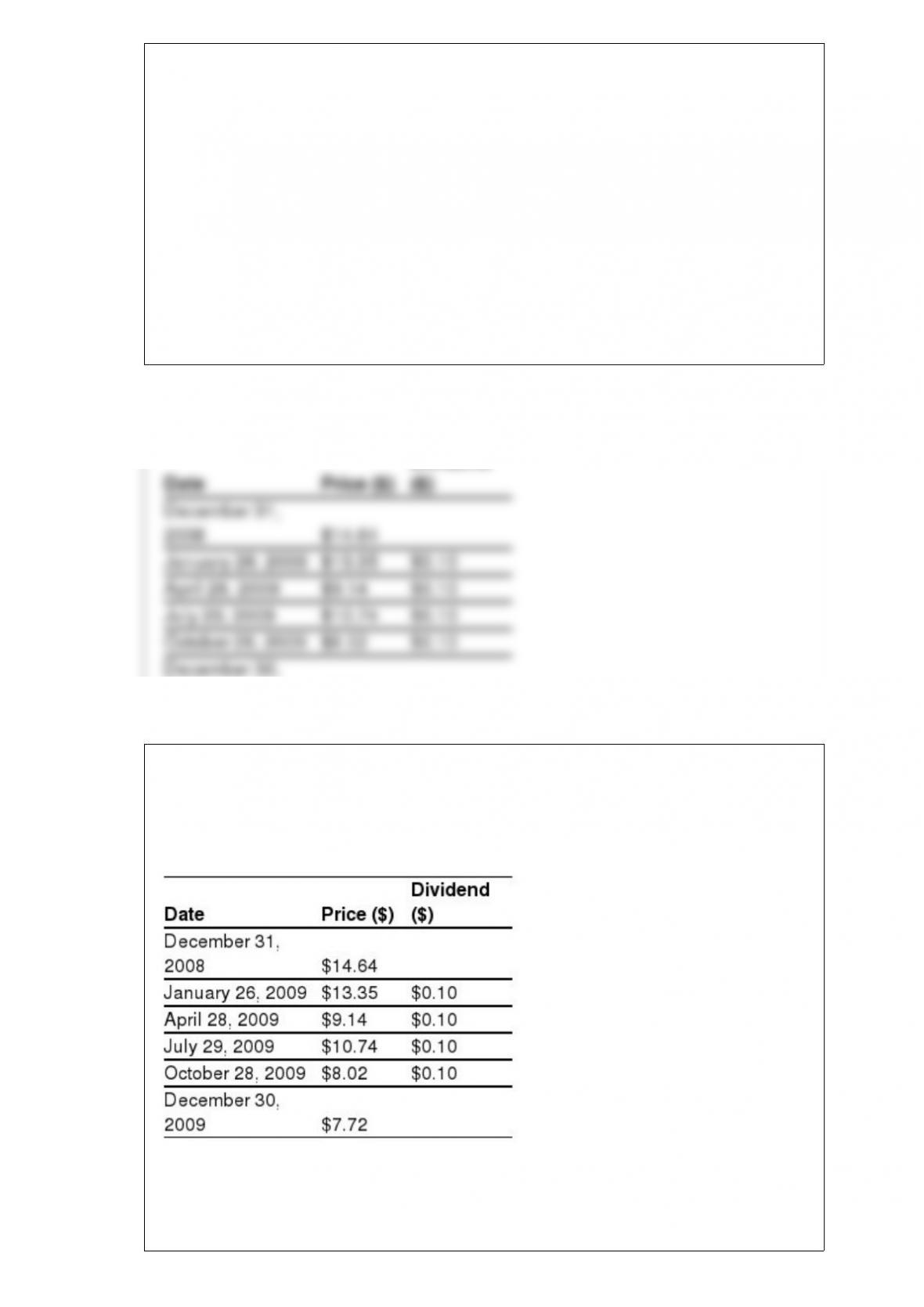
Consider the following Price and Dividend data for General Electric Company:
Assume that you purchased General Electric Company stock at the closing price on
December 31, 2008 and sold it after the dividend had been paid at the closing price on
January 26, 2009. Your dividend yield for this period is closest to:

A) -8.15%
B) 0.75%
C) 0.70%
D) -8.80%
Consider a zero coupon bond with 20 years to maturity. The price will this bond trade if
the YTM is 6% is closest to:
A) $215
B) $312
C) $335
D) $306
