
A project with a negative NPV always has an IRR that’s less than the cost of capital.
Certainty equivalent factors can take any numerical value.
When a new stock is introduced into a portfolio and the “peaks” in its return occur with
the “valleys” in the portfolio’s return, the stock’s return is said to be perfectly negatively
correlated with the portfolio’s, and its addition will reduce the portfolio’s risk.
A stockbroker is licensed to trade securities on behalf of investors.

It would generally be considered wise for a company to invest in a business that is
expected to return 14 percent, when the amount invested is borrowed at 12 percent.
As a general rule, stocks offering higher returns also come with greater probabilities of
loss.
Scholars and financial professionals have concluded that dividends have a positive
effect on stock prices.
Whenever a firm’s ROCE exceeds the after tax cost of debt, EPS and ROE will increase
in response to an increase in financial leverage.

According to the SML, investors are rewarded for bearing market risk and not for
bearing business-specific risk.
Generally, companies hire other company to do some or all of the functions necessary
to run their businesses. This is known as:
A.outsourcing.
B.exporting.
C.job developing.
D.hiring.
A seasoned equity offering refers to:
A.the sale of new shares of an existing stock.
B.the sale of new shares of a newly established corporation.
C.the sale of existing shares to finance seasonal demands.
D.an underpriced issue of new equity shares.

Holding all other variables constant, an increase in net income can be caused by a
decrease in:
A.depreciation expense.
B.the cost ratio.
C.the tax rate.
D.Both a and c
E.a, b, and c are correct.
The cost of capital is used primarily in:
A.negotiations with banks because it reflects the company’s overall borrowing power.
B.setting the firm’s basic risk level.
C.capital budgeting because it reflects what the firm pays for the money it invests.
D.negotiations with investment bankers because it establishes an overall return on
which the market can base prices for the firm’s securities.
The quick ratio is the same as current ratio except it does not consider:
A.cash.
B.accounts payable.
C.supplies.
D.inventory.
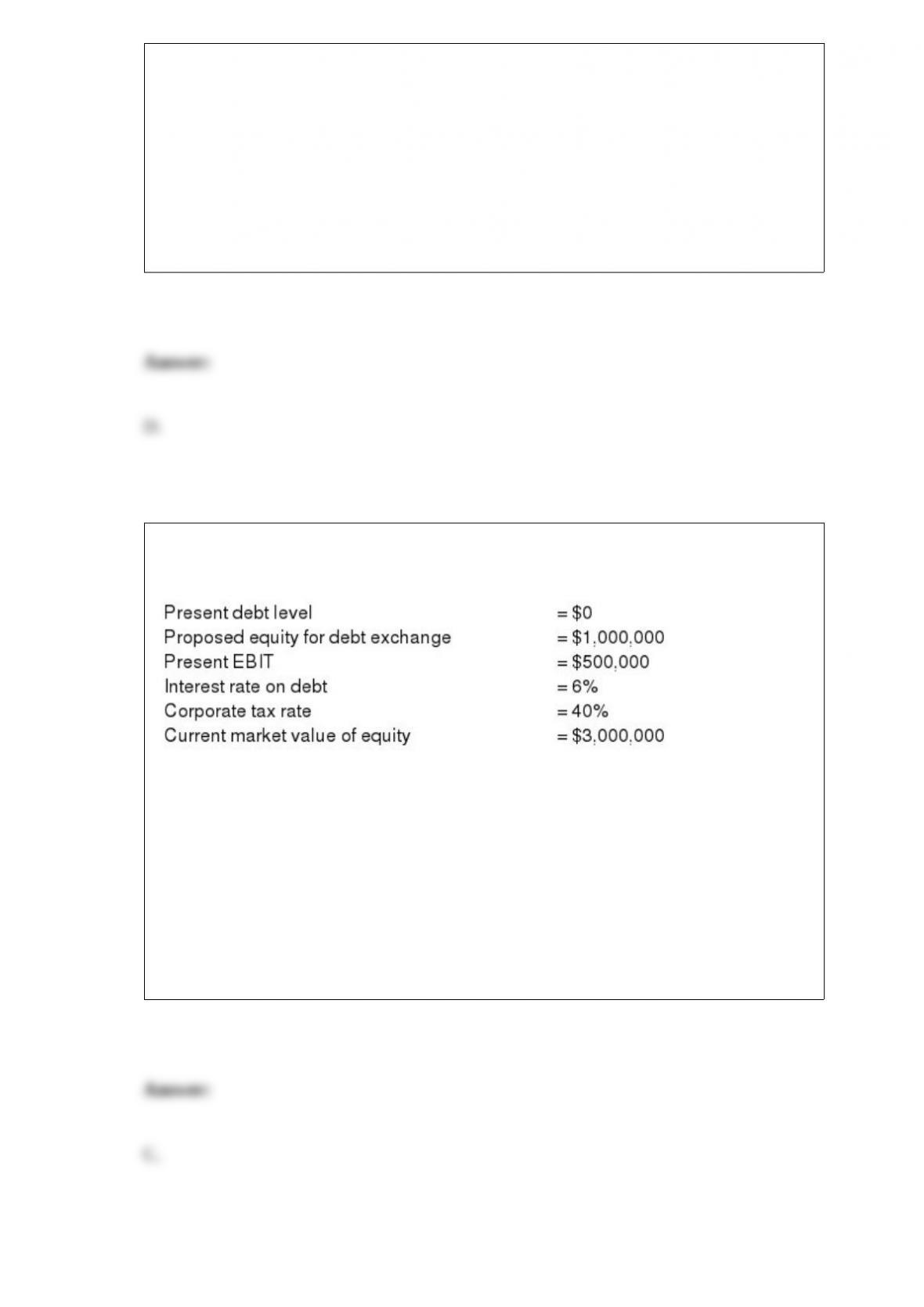
Assume the following selected financial information about a firm that is about to
restructure capital by exchanging equity for debt:
What is the market value of the firm’s equity after the restructuring according to the
Modigliani-Miller model with taxes but without bankruptcy costs?
A.$2,000,000
B.$2,264,000
C.$2,400,000
D.None of the above

The ____ is an absolute measure of risk, and the ____ is a relative measure of risk.
A.systematic risk, unsystematic risk
B.standard deviation, coefficient of variation
C.correlation, covariance
D.security market line, characteristic line
Which of the following is most correct?
A.A project can have more than one internal rate of return.
B.If a project has more than one internal rate of return, it cannot be accurately evaluated
using the IRR method.
C.Multiple IRR’s arise because nth-order equations have “n” solutions, even if some of
them are imaginary.
D.Both a. and c. are correct.
E.All of the above are correct.
Estimating cash flows is the _____ and error-prone part of capital budgeting.
A.most difficult
B.least difficult
C.most likely
D.least likely
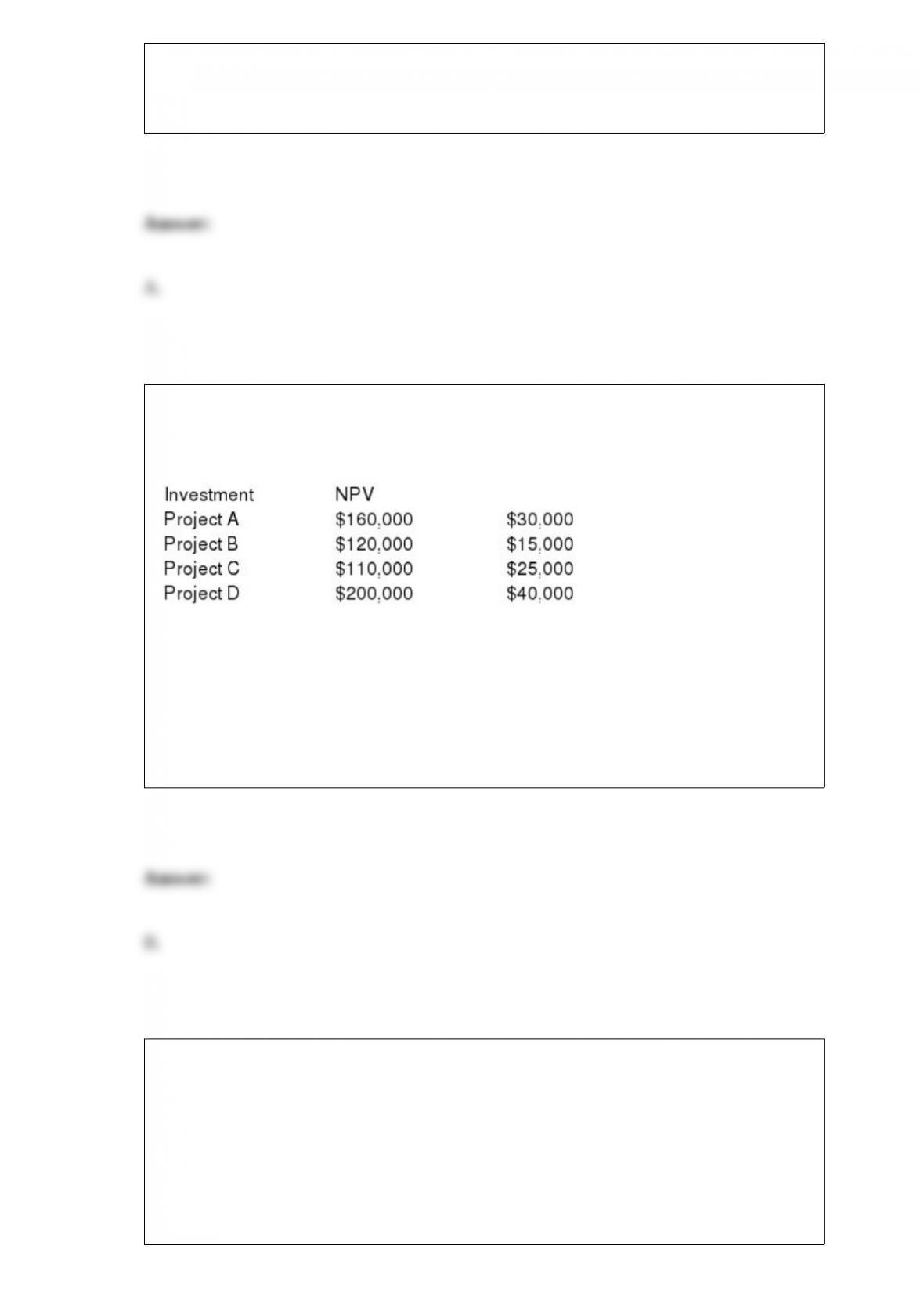
The following projects are all characterized by a single initial cash outflow (the initial
investment) followed by a series of cash inflows. Rank them based on profitability
index.
A.A, C, B, D
B.C, D, A, B
C.D, A, C, B
D.B, D, C, A
_____ mergers are undertaken to make money from the merger itself rather than from
the underlying businesses.
A.Financial
B.Strategic
C.Vertical

D.Horizontal
If a call option with a strike price of $65.00 is in the money then:
A.a put option with the same strike price is also in the money.
B.the intrinsic value of the call is negative.
C.the intrinsic value of a put option with the same strike price is negative.
D.a put option with a strike price of $60.00 is out of the money.
Direct investment is:
A.building significant facilities in another country in order to do business there or in
nearby countries.
B.purchasing the stocks of foreign companies directly from those companies.
C.setting up sales offices in foreign countries.
D.exporting product to other countries.