
DFL equals EBIT / (EBIT – I).
A stock dividend differs from a stock split both in terms of its accounting treatment and
its impact on stockholder wealth.
A revolving credit agreement and a line of credit are nearly identical, with the exception
that the bank becomes legally obligated when it agrees to a line of credit.
Cash from operating activities exceeds a firm’s EAT by an amount equal to the sum of
taxes and interest expense.

In a leveraged firm, the variation in ROE and EPS will always be less than the variation
in the firm’s EBIT because of the lower cost of capital.
A capital structure argument (that leverage increases value) is often used to show that a
large acquisition price premium is justified even though the target has little debt before
the acquisition.
The Securities and Exchange Commission is the governmental body responsible for
enforcing the rules and regulations governing the trading in securities.
The blend or mix of capital components that provide the firm with funds to invest in
projects at any point in time is its capital structure.

Preferred stock is often referred to as a hybrid security having characteristics of both
common stock and bonds.
As long as the borrower adheres to the conditions set forth in a revolving credit
agreement, the bank is obligated to advance funds up to the agreed limit.
A safety stock is an additional supply of inventory intended to be used when the normal
working stock is unexpectedly depleted.
Compounding periods theoretically:
A.cannot be greater than six months.
B.cannot be less than a year.
C.cannot be less than a quarter.

D.can be less than a day.
Apollo Fashions, a clothing importer, signed a contract to buy tweed sports jackets from
an English manufacturer for £100 each. At the time the contract was signed a British
pound was worth $1.52. Apollo immediately entered contracts to sell 5,000 jackets to
retailers at a price of $200 each. When Apollo paid for the jackets the exchange rate
was $1.45 to the pound. What was Apollo’s exchange rate gain or (loss) on the
transaction?
A.$35,000
B.($35,000)
C.$70,000
D.($70,000)
Which of the following interest rates will come closest to doubling invested money in
five years?
A.13%
B.14%
C.15%
D.16%
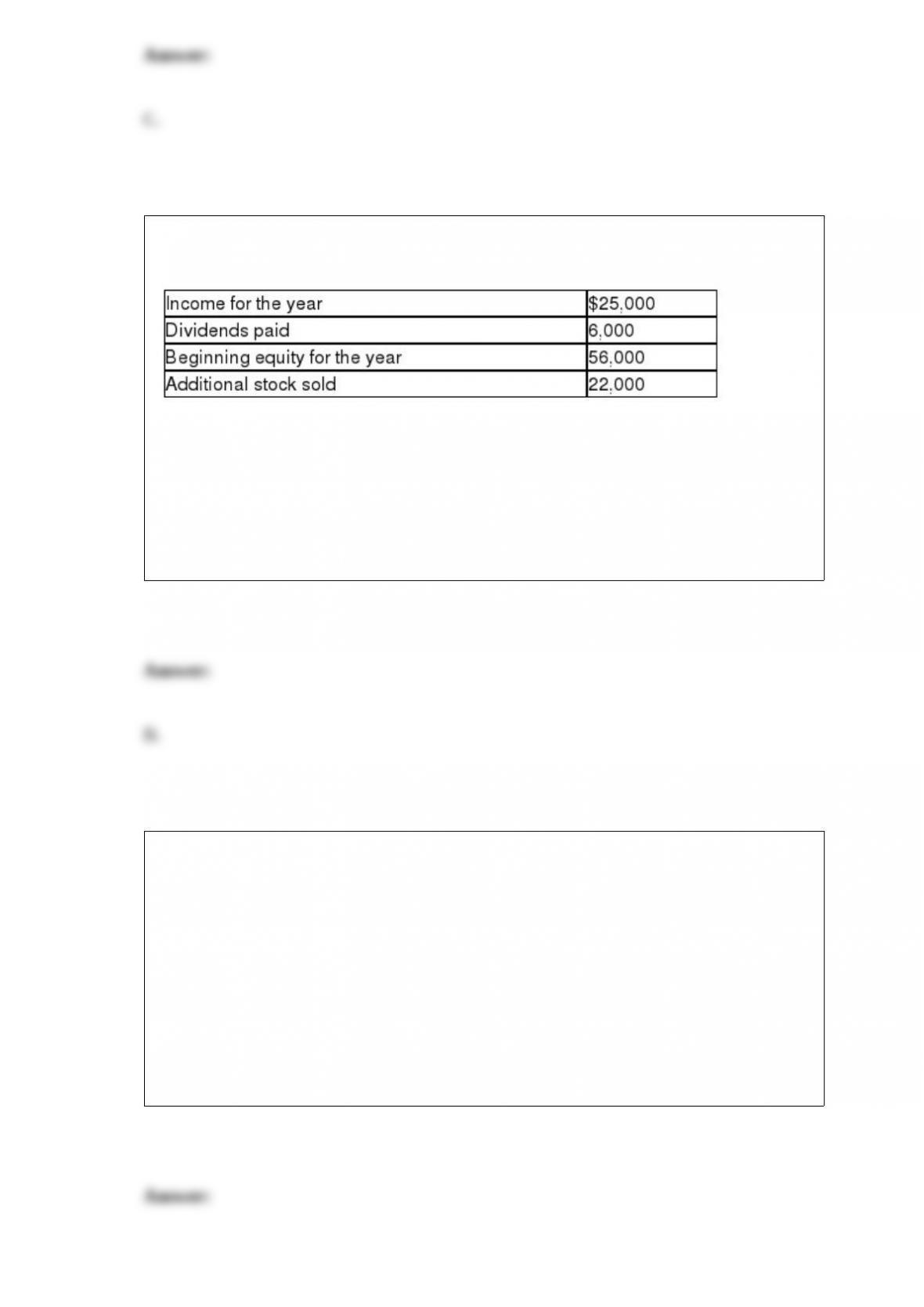
Selected financial statement accounts are as follows. How much is the firm’s ending
equity?
A.$103,000
B.$97,000
C.$19,000
D.$85,000
PDQ, Inc. stock is selling for $80 today. You are expecting a dividend of $3 next year
and you plan to sell the stock for $95 one year from now. Calculate the one-year return
on PDQ stock.
A.3.75%
B.9.50%
C.18.75%
D.22.50%

Stock repurchases:
A.are perfectly okay with the IRS even though they convert ordinary dividend income
into capital gains which are taxed at lower rates.
B.must be accomplished on the open market through brokers to comply with SEC
regulations.
C.may be advisable after a stock market crash if management feels the company’s stock
price is temporarily depressed.
D.All of the above
When the NPV and IRR rules produce conflicting investment decisions, then the:
A.NPV rule is superior.
B.IRR rule is superior.
C.firm should be indifferent between the IRR rule and NPV rule.
D.payback period rule should be used.
E.a and d

Thomson Inc has a $1,000, 6% coupon bond with interest payable semiannually and a
remaining term of 20 years. The market yield on similar bonds is 10%. What percentage
of face value is the bond selling for today?
A.65.68%
B.65.94%
C.60.00%
D.None of the above
Portfolio theory can be dangerous to a small investor because:
A.he or she doesn’t have much money to lose.
B.beta, the theoretical measure of risk, ignores business-specific risk, which is
significant to an investor who doesn’t have a large enough portfolio to diversify it away.
C.it makes investing seem more scientific than it really is.
D.the stock market is very unforgiving.
An asset still in use beyond its life estimate is said to be:
A.a good investment.
B.fully depreciated.
C.fully functional.

D.in poor condition.
Bonds issued last year by Gowen Inc. carried a coupon rate of 7%. Bonds issued today
by Gowen Inc. would carry a coupon rate of 9%. Assume a corporate tax rate of 40%.
What is the after tax cost of debt?
A.4.2%
B.4.8%
C.5.4%
D.7.0%
E.9.0%
Which of the following assets (if any) are not part of a firm’s working capital
investment?
A.Cash
B.Accounts receivable
C.Inventory
D.None of the above