
1) The main role of investment companies in the money market is to
A) trade on behalf of commercial accounts
B) mediate the symmetric information problem between server-lender and
borrower-spenders
C) both A and B of the above
D) neither A nor B of the above
2) The principal-agent problem
A) occurs when managers have more incentive to maximize profits than the
stockholders-owners do
B) would not arise if the owners of the firm had complete information about the
activities of the managers
C) in financial markets helps to explain why equity is a relatively important source of
finance for American businesses
D) all of the above
E) only A and B of the above
3) The Federal Reserve will engage in a matched sale-purchase transaction when it
wants to ________ reserves ________ in the banking system.
A) increase; permanently
B) increase; temporarily
C) decrease; temporarily
D) decrease; permanently
4) When you deposit $50 in currency at the Old National Bank,
A) its assets increase by $50
B) its reserves increase by less than $50 because of reserve requirements
C) its liabilities decrease by $50
D) only A and B of the above occur
5) Which of the following is least likely to accompany financial consolidation and the
development of large, complex banking organizations?
A) More financial institutions will be considered too big to fail

B) The government safety net will be extended to include nonbanking activities
C) Moral hazard problems will become less important
D) Banks will have greater incentives and opportunities to take on more risk
6) Insurance management tools that give policyholders incentives to avoid accidents
insured against include ________.
A) deductibles
B) risk-based premiums
C) coinsurance
D) all of the above
7) That taxpayers were poorly served by thrift regulators in the 1980s is now quite clear.
This poor performance is explained by
A) regulators’ desire to escape blame for poor performance, leading to a perverse
strategy of “regulatory gambling”
B) regulators’ incentives to accede to pressures imposed by politicians, who sought to
keep regulators from imposing tough regulations on institutions that were major
campaign contributors
C) Congress’s unwillingness to appropriate sufficient funds to permit regulators to
examine the many thrift institutions that needed monitoring
D) all of the above
E) only A and B of the above
8) Money market instruments issued by the U.S. Treasury are called
A) Treasury bills
B) Treasury notes
C) Treasury bonds
D) Treasury strips
9) The more modern asset market approach to exchange rate determination
A) emphasizes the role of import and export demand
B) emphasizes stocks of assets
C) emphasizes both of the above

D) emphasizes neither of the above
10) Which of the following are duties of the Board of Governors of the Federal Reserve
System?
A) Setting margin requirements, the fraction of the purchase price of securities that has
to be paid for with cash
B) Setting the maximum interest rates payable on certain types of time deposits under
Regulation Q
C) Regulating credit with the approval of the President under the Credit Control Act of
1969
D) None of the above has been a duty of the Board since the mid-1980s
11) Which type of open market operation is intended to change the level of reserves?
A) Defensive open market operations
B) Reserve requirements
C) Dynamic open market operations
D) Market equilibrium
12) A corporation suffering big losses might be more likely to suspend interest
payments on its bonds, thereby
A) raising the default risk and causing the demand for its bonds to rise
B) raising the default risk and causing the demand for its bonds to fall
C) lowering the default risk and causing the demand for its bonds to rise
D) lowering the default risk and causing the demand for its bonds to fall
13) The Fed’s support of the Depository Institutions Deregulation and Monetary Control
Act of 1980 stemmed in part from its
A) concern over declining Fed membership
B) belief that all banking regulations should be eliminated
C) belief that interest rate ceilings were too low
D) belief that depositors had to become more knowledgeable about banking operations

14) If municipal bonds were to lose their tax-free status, then the demand for Treasury
bonds would shift ________, and the interest rate on Treasury bonds would ________.
A) rightward; fall
B) rightward; rise
C) leftward; fall
D) leftward; rise
15) In a ________ banking system, commercial banks engage in securities
underwriting, but separate subsidiaries conduct the different activities. Also, banking
and insurance are not typically undertaken together in this system.
A) universal
B) British-style universal
C) divided
D) compartmentalized
E) severable
16) An increase in the volatility of the underlying asset, all other things held constant,
will ________ the option premium.
A) increase
B) decrease
C) not affect
D) Not enough information is given
17) Market timing
A) takes advantage of time differences between the east and west coasts of the United
States
B) takes advantage of arbitrage opportunities in foreign stocks
C) takes advantage of the time lag between the receipt and execution of orders
D) is discouraged by the stiff fees mutual funds charge every investor for buying and
then selling shares on the same day

18) Venture capital firms are usually organized as ________.
A) closed-end mutual funds
B) limited partnerships
C) corporations
D) nonprofit businesses
19) Borrowers tend to prefer ________ to ________, whereas lenders prefer ________.
A) fixed-rate loans; ARMs; fixed-rate loans
B) ARMs; fixed-rate loans; fixed-rate loans
C) fixed-rate loans; ARMs; ARMs
D) ARMs; fixed-rate loans; ARMs
20) Which of the following are not reported as assets on a bank’s balance sheet?
A) cash items in the process of collection
B) deposits with other banks
C) U.S. Treasury securities
D) checkable deposits
21) Bonds that are sold in a foreign country and are denominated in a currency other
than that of the country in which they are sold are known as
A) foreign bonds
B) Eurobonds
C) Eurocurrencies
D) Eurodollars
22) The efficient market hypothesis applies to
A) both the stock market and the foreign exchange market
B) the stock market but not the foreign exchange market
C) the foreign exchange market but not the stock market
D) neither the stock market nor the foreign exchange market

23) If the inflation rate in the United States is higher than that in Germany and
productivity is growing at a slower rate in the United States than it is in Germany, in the
long run,
A) the euro should appreciate relative to the dollar
B) the euro should depreciate relative to the dollar
C) there should be no change in the euro price of dollars
D) it is not clear what will happen to the euro price of dollars
24) Bonds that are sold in a foreign country and are denominated in that country’s
currency are known as
A) foreign bonds
B) Eurobonds
C) Eurocurrencies
D) Eurodollars
25) Which of the following are true statements?
A) The FOMC usually meets every six weeks to set monetary policy
B) The FOMC issues directives to the trading desk at the New York Fed
C) Designers of the Federal Reserve Act did not envision the use of open market
operations as a monetary policy tool
D) All of the above are true statements
E) Only A and B of the above are true statements
26) Today the United States has a dual banking system in which banks supervised by
the ________ and by the ________ operate side by side.
A) federal government; municipalities
B) state governments; municipalities
C) federal government; states
D) municipalities; states
27) When Franois the Foreigner considers the expected return on dollar deposits in
terms of foreign currency, the expected return must be adjusted for
A) any expected appreciation or depreciation of the dollar
B) the interest rates on foreign deposits
C) both A and B of the above
D) neither A nor B of the above
28) Which of the following is not an advantage of Electronic Communications
Networks (ECNs)?
A) All unfilled orders are available for review by ECN traders
B) Transactions costs are lower for ECN trades
C) Trades are made and confirmed faster
D) ECNs work well for thinly traded stocks
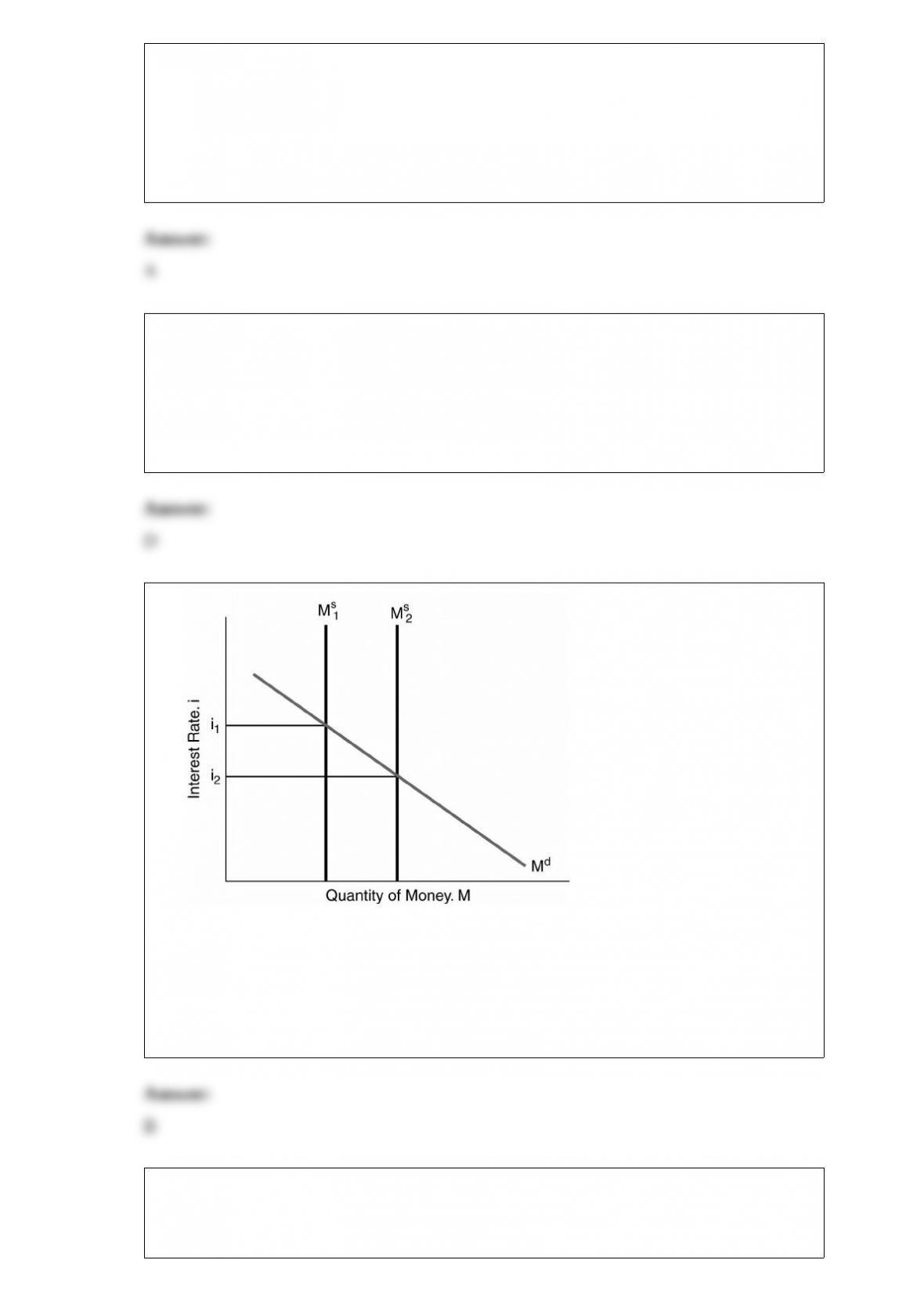
29)
Figure 4.3
In Figure 4.3, the decrease in the interest rate from i1 to i2 can be explained by
A) a decrease in money growth
B) an increase in money growth
C) a decline in the expected price level
D) only A and B of the above
30) Capital appreciation funds select stocks of ________ and tend to be ________ risky
than total return funds.
A) large, established companies that pay dividends regularly; more

B) large, established companies that pay dividends regularly; less
C) companies expected to grow rapidly; more
D) companies expected to grow rapidly; less
31) Fraudulent practices and other abuses of private pension funds led Congress to
enact the ________.
A) Federal Deposit Insurance Corporation Act
B) Employee Retirement Income Security Act
C) Federal Reserve Act
D) Social Security Act
32) The presence of ________ in financial markets leads to adverse selection and moral
hazard problems that interfere with the efficient functioning of financial markets.
A) noncollateralized risk
B) free-riding
C) asymmetric information
D) costly state verification