
The Nifty Fifty is considering opening a new store at a start-up cost of $720,000. The
initial investment will be depreciated straight-line to zero over the 15-year life of the
project. What is the average accounting rate of return?
A. 13.05 percent
B. 13.68 percent
C. 14.01 percent
D. 14.18 percent
E. 14.35 percent
Answer:
Trendsetters has a cost of equity of 18.1 percent. The market risk premium is 10.2
percent and the risk-free rate is 4.4 percent. The company is acquiring a competitor,
which will increase the company’s beta to 1.6. What effect, if any, will the acquisition
have on the firm’s cost of equity capital?
A. No effect
B. Decrease of 2.62 percent
C. Decrease of 0.84 percent
D. Increase of 2.62 percent
E. Increase of 4.13 percent

Answer:
Which one of the following would tend to create an unexpected increase in a firm’s
average collection period?
A. Increased credit sales
B. The implementation of a cash discount
C. Increased customer delinquencies
D. Increased dollar value per each sale
E. Increased collection efforts
Answer:
What is the primary purpose of a lockup agreement?
A. Ensures the lead underwriter maintains an economic interest in the IPO it is
managing

B. Ensures the issuer of new securities receives a minimally agreed upon amount from
the issue
C. Ensures no research reports are issued during the waiting period
D. Ensures company insiders maintain an economic interest in the issuer of an IPO for a
minimum period of time
E. Ensures an IPO is not underpriced by more than 5 percent
Answer:
Rockingham Motors issued a 20-year, 8 percent semiannual bond 3 years ago. The bond
currently sells for 98.6 percent of its face value. The company’s tax rate is 35 percent.
What is the aftertax cost of debt?
A. 2.72 percent
B. 5.43 percent
C. 5.69 percent
D. 5.72 percent
E. 5.99 percent
Answer:

Which one of the following is a special post office mailbox that is used to speed up the
collection of accounts receivable payments?
A. Separation box
B. Cash box
C. Concentration account
D. Lockbox
E. Float box
Answer:
Joseph Turner and Sons has 125,000 shares of stock outstanding. The firm has extra
cash so it announced this morning that it is willing to repurchase 25,000 of its shares.
What type of offer is the firm making?
A. Rights offer
B. Secondary issue
C. Targeted repurchase
D. Tender offer

E. Private issue
Answer:
Martha is investing $5 today at 6 percent interest so she can have $10 later. The $10 is
referred to as the:
A. true value.
B. future value.
C. present value.
D. discounted value.
Answer:
The Candy Cane Store has the following estimated sales.
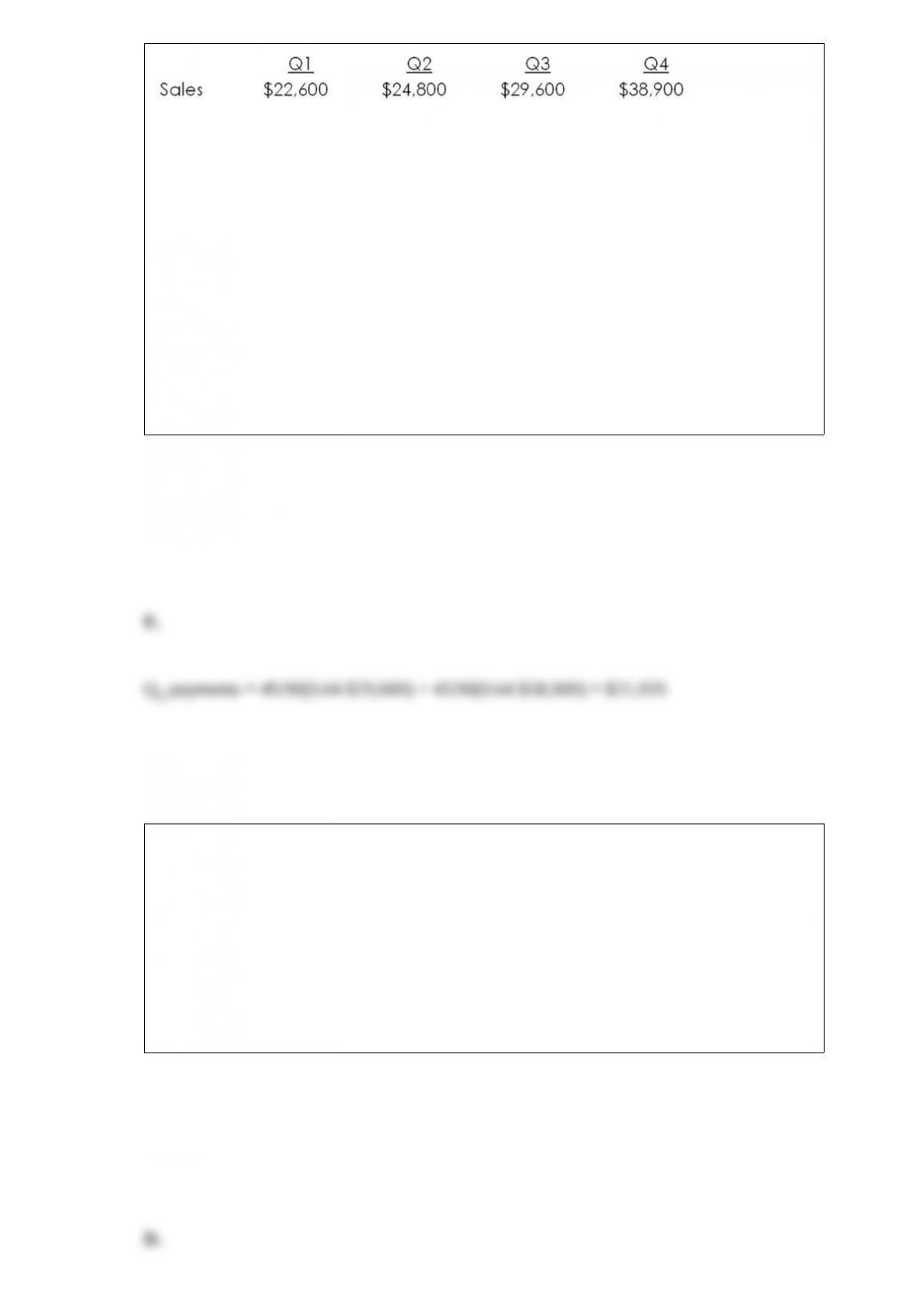
Purchases are equal to 64 percent of the following quarter’s sales. Assume each month
has 30 days, the accounts receivable period is 30 days and the accounts payable period
is 45 days. How much will the firm pay its suppliers in the third quarter?
A. $16,379
B. $16,811
C. $18,514
D. $20,947
E. $21,920
Answer:
A sole proprietorship:
A. provides limited liability for its owner.
B. involves significant legal costs during the formation process.
C. has an unlimited life.
D. has its profits taxed as personal income.
Answer:
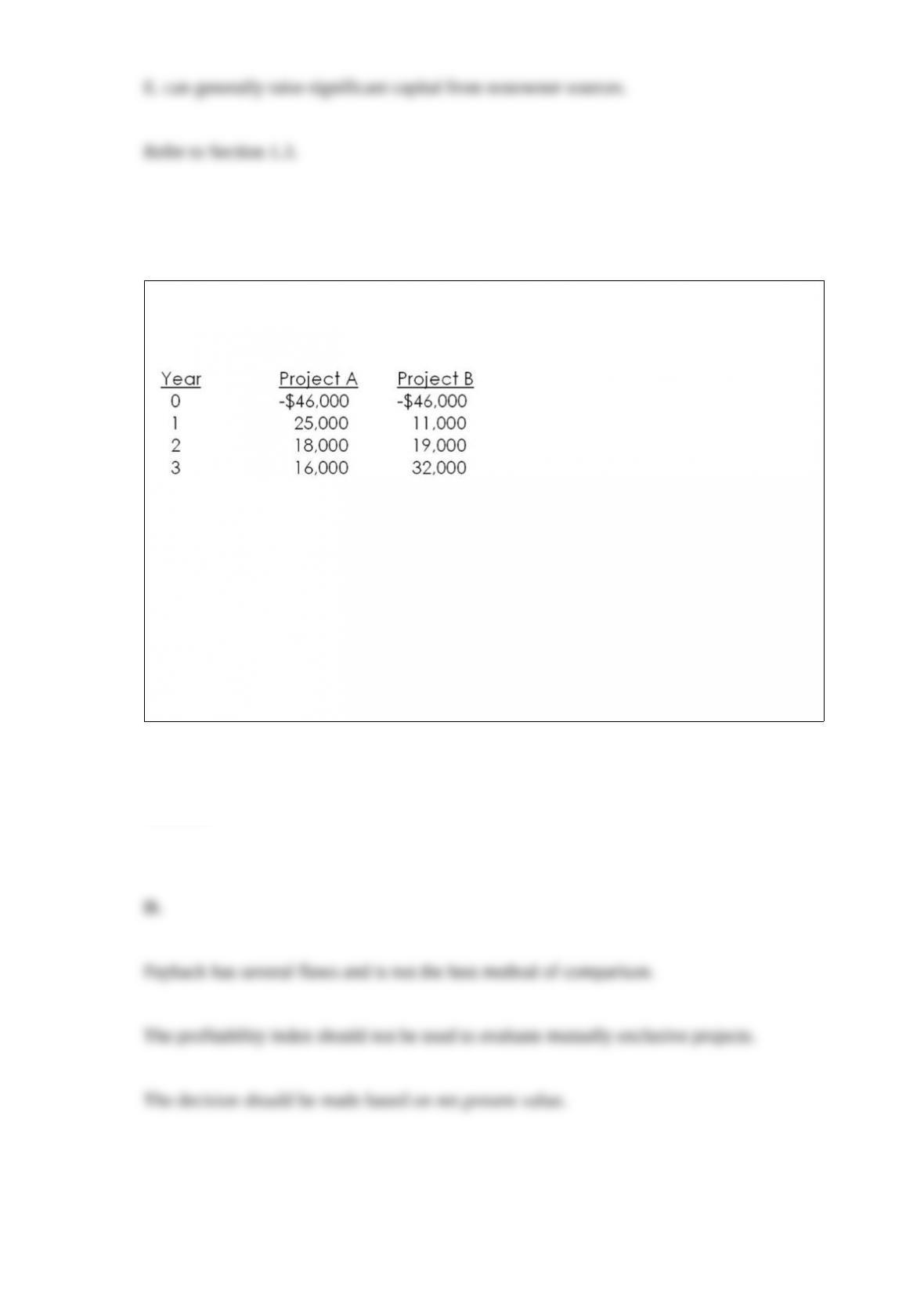
You are considering the following two mutually exclusive projects. The required return
on each project is 14 percent. Which project should you accept and what is the best
reason for that decision?
A. Project A, because it pays back faster
B. Project A, because it has the higher internal rate of return
C. Project B, because it has the higher internal rate of return
D. Project A, because it has the higher net present value
E. Project B, because it has the higher net present value
Answer:

Which one of the following best defines the term collection policy?
A. Process of determining which customers will be granted credit
B. Process of determining the probability that customers will not pay
C. Set of guidelines used by a firm to determine the cost of offering credit to its
customers
D. Daily process of handling cash inflows and outflows of cash
E. Set of procedures a firm follows in collecting accounts receivable
Answer:
Which one of the following is the computation of the risk premium for an individual
security? E(R) is the expected return on the security, Rf is the risk-free rate, β is the
security’s beta, and E(RM) is the expected rate of return on the market.
A. E(RM) – Rf
B. E(R) – E(RM)
C. E(R) – [E(RM) + Rf]
D. β[E(RM) – Rf]

E. β[E(R) – Rf]
Answer:
Jake owes $3,400 on his credit card. He is not charging any additional purchases
because he wants to get this debt paid in full. The card has an APR of 13.9 percent.
How much longer will it take him to pay off this balance if he makes monthly payments
of $50 rather than $60?
A. 28.24 months
B. 31.33 months
C. 36.74 months
D. 39.20 months
E. 41.79 months
Answer:

Julie is borrowing $12,800 to purchase a car. The loan terms are 36 months at 7.5
percent interest. How much interest will she pay on this loan if she pays the loan as
agreed? Round your answer to the nearest whole dollar.
A. $1,338
B. $1,414
C. $1,459
D. $1,506
E. $1,534
Answer:
Which one of the following is a direct bankruptcy cost?
A. Loss of customer goodwill resulting from a bankruptcy filing
B. Legal and accounting fees related to a bankruptcy proceeding
C. Management time spent on a bankruptcy proceeding
D. Any financial distress cost

E. Costs a firm spends trying to avoid bankruptcy
Answer:
The Insolvent Insurance Co. will pay you $2,500 a year for 10 years in exchange for
$30,000 today. What interest rate will you earn on this annuity?
A. -3.18 percent
B. 3.18 percent
C. 5.50 percent
D. 5.55 percent
E. 5.60 percent
Answer:
Your portfolio is 240 shares of Rising Sun Co. The stock currently sells for $62 a share.
The company has announced a dividend of $1.10 per share with an ex-dividend date of
May 6. Assume there are no taxes. What will your portfolio value be on May 7?
A. $14,616
B. $14,880
C. $15,026
D. $15,144
E. $15,210
Answer:
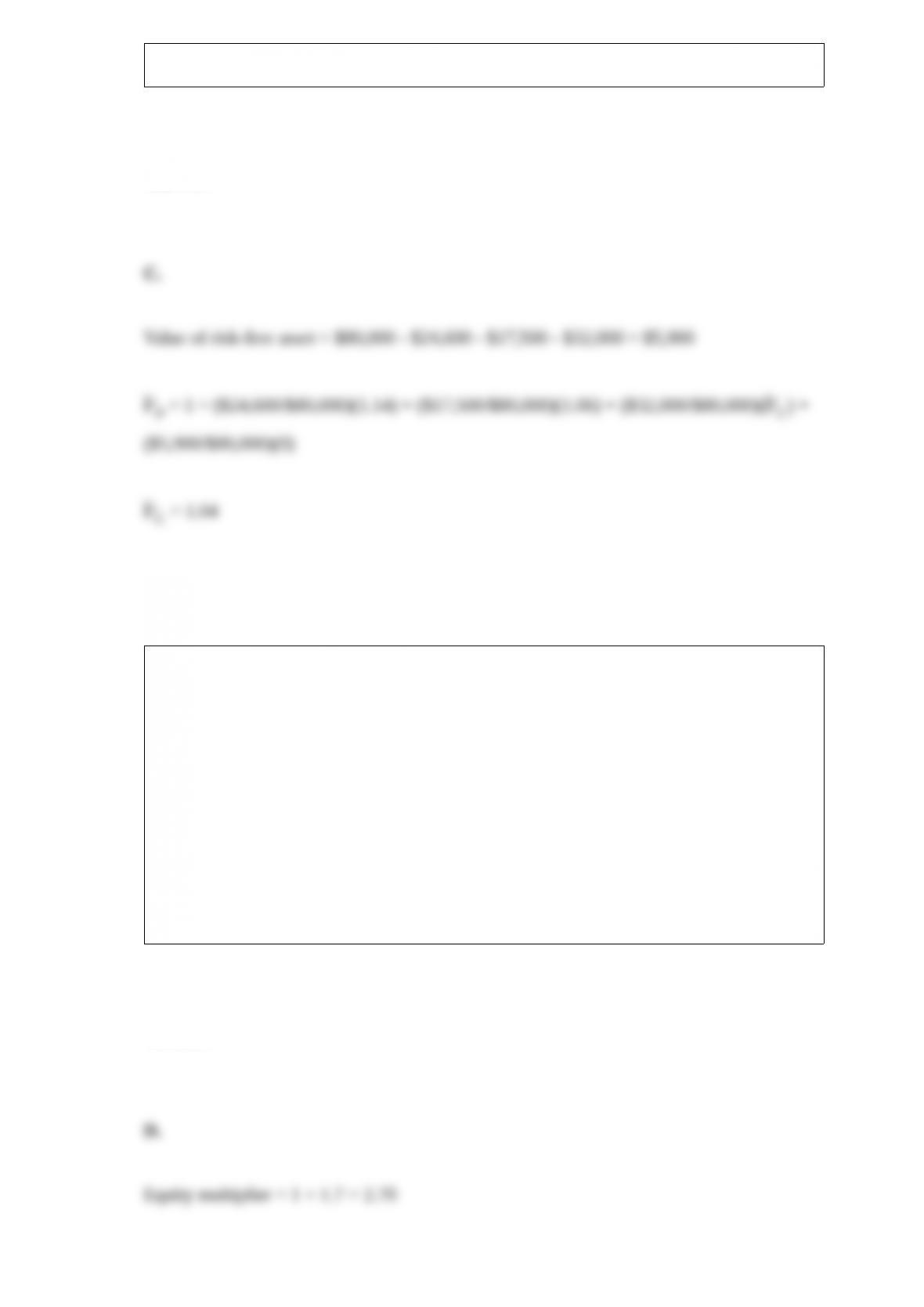
You currently own a portfolio valued at $80,000 that is equally as risky as the market.
Given the information below, what is the beta of Stock C?
A. 0.91
B. 0.95
C. 1.04
D. 1.13
E. 1.18
Answer:
Fresh Foods has sales of $213,600, total assets of $198,700, a debt-equity ratio of 1.7,
and a profit margin of 2.4 percent. What is the equity multiplier?
A. 0.70
B. 0.73
C. 1.93
D. 2.70
E. 2.84
Answer:
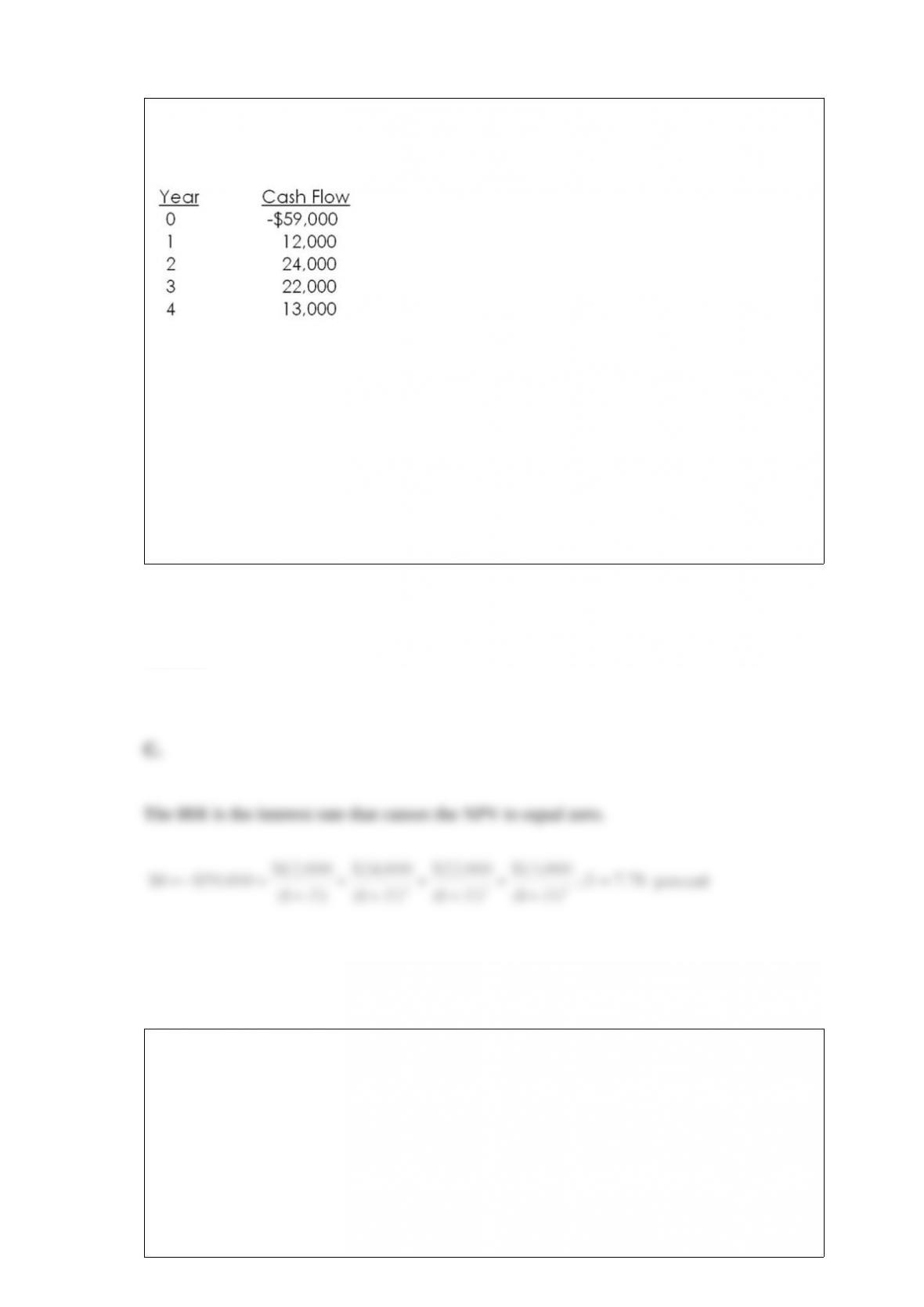
The Flour Baker is considering a project with the following cash flows. Should this
project be accepted based on its internal rate of return if the required return is 11
percent?
A. Yes, because the project’s rate of return is 7.78 percent
B. Yes, because the project’s rate of return is 9.36 percent
C. No, because the project’s rate of return is 7.78 percent
D. No, because the project’s rate of return is 9.36 percent
E. No, because the project’s rate of return is 13.08 percent
Answer:
When, if ever, will the geometric average return exceed the arithmetic average return
for a given set of returns?
A. When the set of returns includes only risk-free rates.
B. When the set of returns has a wide frequency distribution.
C. When the set of returns has a very narrow frequency distribution.

D. When all of the rates of return in the set of returns are equal to each other.
E. Never
Answer:
Tally Ho Inn has annual sales of $737,000. Earnings before interest and taxes is equal to
21 percent of sales. For the period, the firm paid $7,900 in interest. What is the profit
margin if the tax rate is 35 percent?
A. 12.46 percent
B. 12.95 percent
C. 13.33 percent
D. 15.29 percent
E. 16.11 percent
Answer:
Explain why the DuPont identity is so useful to a financial manager.
Answer:
Explain the difference between a sunk cost and an opportunity cost and give an example
of each.
Answer:
Explain the differences between a broker market and a dealer market.
Answer:
Since there are no perfect or ideal standard ratios for a firm, why is ratio analysis still
considered a valuable management tool?
Answer:
Todd wants to start his own business and is debating between organizing the business as
a sole proprietorship or a corporation. Explain the pros and cons of both forms of
business organization.
Answer:
Assume a firm follows a policy of using its weighted average cost of capital as the
required return for all of its proposed projects. Evaluate this policy. How will this policy
affect the overall risk level of the firm over time?
Answer:
There are regulations that prohibit “insider trading,” which is the use of nonpublic
information about a security to earn abnormal profits from trading that security. Which
form of market efficiency would make these laws unnecessary? Explain why.
Answer:
Explain what a mortgage-backed security (MBS) is and how it functions. Also, explain
why these securities were such a problem during 2008.
Answer: