1) decompose the return an american would have if he had bought a german stock at
100 per share and sold it one year later at 120. the spot exchange rate one year ago was
$1.50 = 1 and the spot rate prevailing at the end of the year was $1.55 = 1.
a.24% total return; 20% asset return; 4% attributable to exchange rate changes
b.20% total return; 16.77% asset return; 3.23% attributable to exchange rate changes
c.24% total return; 20% asset return; 3.33% attributable to exchange rate changes
d.none of the above
2) your firm is a swiss exporter of bicycles. you have sold an order to a french firm for
1,000,000 worth of bicycles. payment from the french firm (in euro) is due in 12
months. detail a strategy using futures contracts that will hedge your exchange rate risk.
have an estimate of how many contracts of what type and maturity.
a.go short 100 12-month euro futures contracts; and short 160 12-month sfr. futures
contracts
b.go long 100 12-month futures contracts; and long 160 12-month sfr. futures contracts
c.go long 100 12-month euro futures contracts; and short 160 12-month swiss franc
futures contracts
d.go short 100 12-month euro futures contracts; and long 160 12-month swiss franc
futures contracts
e.none of the above
3) when a swap bank serves as a dealer:
a.the swap bank stands willing to accept either side of a swap

b.the swap bank matches counterparties but does not assume any risk of the swap
c.the swap bank receives a commission for matching buyers and sellers
d.none of the above
4) the aud/$ spot exchange rate is aud1.60/$ and the sf/$ is sf1.25/$. the aud/sf cross
exchange rate is _____.
a.0.7813
b.2.0000
c.1.2800
d.0.3500
5) consider a plain vanilla interest rate swap. firm a can borrow at 8% fixed or can
borrow floating at libor. firm b is somewhat less creditworthy and can borrow at 10%
fixed or can borrow floating at libor + 1%. eun wants to borrow floating and resnick
prefers to borrow fixed. both corporations wish to borrow $10 million for 5 years.
which of the following swaps is mutually beneficial to each party and meets their
financing needs?
a.firm a borrows $10 million externally for 5 years at libor; agrees to swap libor to firm
b for 8 % fixed for 5 years on a notational principal of $5 million; b borrows $10
million externally at 10%
b.a borrows $10 million externally for 5 years at libor; agrees to pay 8% to b for libor
fixed for 5 years on a notational principal of $5 million; b borrows $10 million
externally at 10%
c.since the qsd = 0 there is no mutually beneficial swap
d.a borrows $10 million externally at 8% fixed for 5 years; agrees to swap libor to b for
8% fixed for 5 years on a notational principal of $5 million; b borrows $10 million
externally at libor + 1%
6) market microstructure refers to
a.the basic mechanics of how a marketplace operates
b.the basics of how to make small (micro-sized) currency trades
c.how macroeconomic variables such as gdp and inflation are determined

d.none of the above
7) in any given year, about what percent of new international bonds are likely to be
eurobonds rather than foreign bonds?
a.80%
b.45%
c.25%
d.15%
8) the statistical discrepancy in the balance-of-payments accounts
a.arise since recordings of payments and receipts are done at different times, in different
places, possibly using different methods
b.arise since some transactions (illegal transactions) occur “off the books”
c.represents omitted and misreported transactions
d.all of the above
9) mncs might have been lured to invest in china not only by lower labor and material
costs but also
a.by china’s lower labor and material costs
b.by the desire to preempt the entry of rivals into china’s potentially huge market
c.by the kung pao chicken
d.by the desire to see, if not buy, all the tea in china
10) for european options, what of the effect of an increase in st?
a.decrease the value of calls and puts ceteris paribus
b.increase the value of calls and puts ceteris paribus
c.decrease the value of calls, increase the value of puts ceteris paribus
d.increase the value of calls, decrease the value of puts ceteris paribus
11) with regard to fundamental forecasting versus technical forecasting of exchange
rates
a.the technicians tend to use “cause and effect” models
b.the fundamentalists tend to believe that “history will repeat itself” is the best model
c.both a and b
d.none of the above
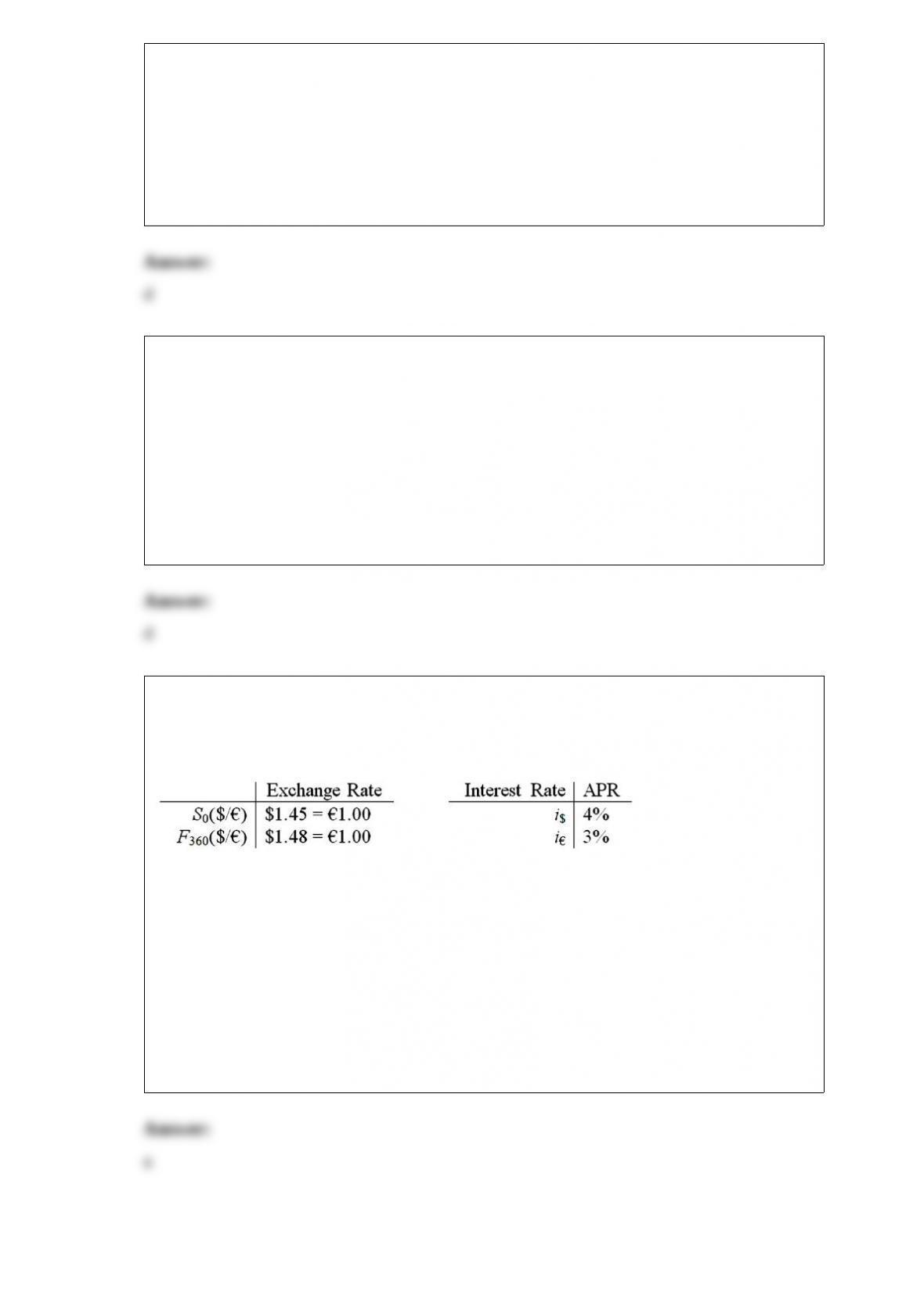
12) suppose you observe the following 1-year interest rates, spot exchange rates and
futures prices. futures contracts are available on 10,000. how much risk-free arbitrage
profit could you make on 1 contract at maturity from this mispricing?
a.$159.22
b.$153.10
c.$439.42
d.none of the above
the futures price of $1.48/ is above the irp futures price of $1.4641/, so we want to sell
(i.e. take a short position in 1 futures contract on 10,000, agreeing to sell 10,000 in 1
year for $14,800).

13) both subsidiary and affiliate banks
a.operate under the banking laws of the country in which they are incorporated
b.operate under the banking laws of the u.s
c.can underwrite securities, but not accept dollar-denominated deposits
d.both a and b
14) the united states withholds ___ of passive income from taxpayers that reside in
countries with which it does not have withholding tax treaties.
a.10%
b.20%
c.30%
d.40%
e.50%
15) in an interest-only currency swap
a.the counterparties must raise the actual notational principal in their home markets;
then exchange it for the foreign currency they desire. the must also hedge with forward
contracts on the currency
b.the counterparties periodically exchange the amortized portions of the notational
principals
c.both a and b

d.none of the above
16) in reference to capital requirements, value-at-risk analysis
a.refers to traditional bank loans and deposits
b.refers to a “risk-focused” approach to determining adequate bank capital
c.provides a level of confidence measure of the probability of the maximum loss that
can occur during a period of time
d.both b and c
17) according to the monetary/nonmonetary method, monetary balance sheet accounts
include
a.for example, cash, marketable securities, accounts receivable, notes payable, accounts
payable of a foreign subsidiary
b.for example stockholders’ equity and long term debt
c.for example inventory paid for in cash, but not working capital
d.cogs, sales, net income