
In recessions, the long-term expected real interest rate usually
a. rises.
b. declines.
c. stays unchanged.
d. rises early in the recession; declines later in the recession.
Answer:
Suppose a bank earned $173 million in interest on its assets of $2,153 million, it paid
out $81 million in interest on its liabilities (excluding capital) of $2,007 million, and it
paid its workers $71 million in total compensation. The bank’s return on equity is
approximately
a. 12 percent.
b. 14 percent.
c. 16 percent.
d. 18 percent.
Answer:
The average number of times a dollar of money is used for transactions over the course

of a year is referred to as the
a. money multiplier.
b. velocity of money.
c. money growth rate.
d. extent of exchange.
Answer:
Which of the following statements is true?
a. If a company retains profits instead of paying dividends, the price of their stock is
expected to rise.
b. Investors need not pay taxes on dividend earnings.
c. Dividend earnings are legally not allowed to be invested and can only be used for
consumption.
d. The annual dividend yield on a stock is always greater than the annual capital-gains
yield on the same stock.
Answer:
If your after-tax realized real interest rate was 1 percent over the past year and the

inflation rate was 3 percent, what was the nominal interest rate on your one-year bond if
your tax rate was 15 percent?
a. 4.45 percent
b. 4.7 percent
c. 5.0 percent
d. 5.25 percent
Answer:
Consider a fixed-payment security that pays $100 at the end of every year for three
years. If the annual rate of discount is 10 percent, the present value of the security is
a. $24.87.
b. $248.69.
c. $294.10.
d. $1,000.00.
Answer:
In the CAMELS rating system, which is used to assess the health of the banks, the letter
A stands for

a. accounting practices.
b. auditing procedures.
c. analysis of risk.
d. asset quality.
Answer:
Compiling information on basic economic variables such as the unemployment rate and
inflation rate is referred to as
among Fed members.
a. codehalo analytics
b. upanddown economics
c. realtime data mining
d. economic sequencing
Answer:
The amount of output that would be produced by an economy if resources were being
utilized at a high rate that is sustainable in the long run is referred to as the

a. potential output.
b. natural output.
c. Walrasian output.
d. partial-equilibrium output.
Answer:
Which of the following is true of real businesscycle models?
a. According to real business-cycle models the demand shocks are responsible for the
business cycles.
b. According to real business-cycle models government intervention is responsible for
business cycles.
c. According to real business-cycle models fluctuations in total factor productivity are
responsible for business cycles.
d. According to real businesscycle models erratic monetary policies are responsible for
business cycles.
Answer:
If a stock’s price is $20 at the beginning of a year and $17 at the end of the year, and it

pays a dividend of $2 during the year, then the stock’s current yield is_____ percent.
a. −15
b. −5
c. 5
d. 10
Answer:
The Herfindahl-Hirschman Index (HHI) is used to
a. calculate whether or not a bank has met its reserve requirements.
b. determine if a merger reduces competition in a banking market.
c. measure the capital adequacy of a bank.
d. find which bank has the lowest spread.
Answer:
In the two-period model, suppose a household’s income in the first period is $40,000,
income in the second period is $50,000, and the real interest rate is 25 percent. A
sudden shock leads to an increase in the household’s income in the first period to
$45,000 and a decrease in the household’s income in the second period to $43,750. The

household is_____ in the new situation.
a. better off
b. worse off
c. equally well off
d. possibly better off and possibly worse off
Answer:
The relationship between interest rates with differing times to maturity is known as
the_____ _____ of interest rates.
a. term structure
b. term curve
c. yield curve
d. yield structure
Answer:
Monetarists think that
a. money growth is closely related to inflation in the long run.

b. money demand is unstable in the long run.
c. the central should focus on short run economic fluctuations.
d. the central bank should rely on discretionary policy making.
Answer:
In economic expansions, the dollar usually
a. appreciates.
b. depreciates.
c. remains unaffected.
d. follows no consistent pattern.
Answer:
Phillips regularly invests in the securities of established companies. However, he does
not invest in new securities issued by companies. His transactions take place in
the______
a. closed market.
b. open market.

c. secondary market.
d. primary market.
Answer:
In the ATM model of the demand for cash
a. the amount that an individual withdraws is an exogenous variable while the
probability of theft or loss is an endogenous variable.
b. the amount that an individual withdraws is an endogenous variable while the
probability of theft or loss is an exogenous variable.
c. both the amount that an individual withdraws and the probability of loss and theft are
exogenous variables.
d. both the amount that an individual withdraws and the probability of loss and theft are
endogenous variables.
Answer:
In the aggregate demand-aggregate supply model, everything else remaining
unchanged, a decrease in labor force shifts the to the .
a. long-run aggregate supply; right

b. aggregate demand; right
c. short-run aggregate supply; left
d. aggregate demand; left
Answer:
Realized real interest rates in the United States were often negative in the early
a. 1960s.
b. 1970s.
c. 1980s.
d. 1990s.
Answer:
An index that measures the average stock prices of small firms in the United States is
the
a. Russell 2000 index.
b. NYSE index.
c. Dow Jones Industrial Average.

d. S&P
Answer:
Consider a coupon bond that pays $105 every year and repays its principal amount of
$1,500 at the end of 3 years. If the annual rate of discount is 7 percent, the present value
of the bond is approximately
a. $735.35.
b. $765.00.
c. $1,395.00.
d. $1,500.00.
Answer:
Which of the following is an investment spending?
a. Purchase of stocks
b. Purchase of bonds
c. Purchase of office building
d. Purchase of refrigerator by a household

Answer:
In the two-period model, a higher real interest rate
a. increases the present value of income.
b. causes the budget constraint to rotate in a counterclockwise direction.
c. makes households that had initially planned to save better off.
d. makes households that had initially planned to borrow better off.
Answer:
The equation that allows us to compare dollar amounts to be received at different dates
is the
a. present-value formula.
b. Taylor rule.
c. interest-rate parity equation.
d. Roy’s identity
Answer:

The liquidity-preference model of money is a
a. static general-equilibrium model.
b. dynamic general-equilibrium model.
c. static partial-equilibrium model.
d. dynamic partial-equilibrium model.
Answer:
If the interest accumulated on a principal amount of $5,000 at the end of a year is $400,
the annual rate of interest must be
a. 4%.
b. 6%.
c. 8%.
d. 20%.
Answer:

The average amount by which the returns on stocks exceeds the return on debt
securities is referred to as
a. beta coefficient.
b. gamma coefficient.
c. return spread.
d. equity premium.
Answer:
The reserve requirement is 0 percent on the first $8 million in transaction deposits, 3
percent on amounts between $8 million and $50 million, and 10 percent on amounts
above $50 million. A bank with transaction deposits totaling $7 million has required
reserves equal to
a. $0.00 million.
b. $0.21 million.
c. $0.70 million.
d. $1.17 million.
Answer:

Open-market operations are carried out between the Open Market Desk of the Fed and
a. foreign central banks.
b. the U.S. government.
c. citizens residing in the U.S.
d. primary government securities dealers.
Answer:
In the second half of the 1990s, the average annual real return to the stock market was
about each year.
a. 23 percent.
b. 10 percent.
c. 5 percent.
d. 2 percent.
Answer:
Which of the following statements is true?
a. The yield curve slopes downward when the term spread is positive.

b. Researchers suggest that the smaller the term spread, the higher the chance is of a
recession in the coming year.
c. The yield curve slopes upward when the term spread is negative
d. Researchers suggest that the larger the spread, the higher the chance is of a recession
in the coming year.
Answer:
If the stock market is efficient and investors are risk neutral, then
a. capital gains are always positive.
b. stock prices are predictable.
c. the CAPM model works perfectly.
d. stock prices follow a random walk.
Answer:
Assume that the nominal interest rate in an economy is 3 percent and the cost of going
to the ATM is $1.50. You spend $5 each day, and there is also a 12 percent probability
of having your cash lost or stolen.
a. What is your total cost of holding cash as a function of the number of days between
trips to the ATM?
b. How often will you go to the ATM to minimize your costs?
Answer:
Suppose the M1 multiplier is currently 23 and the M2 multiplier is currently 95. If
banks decide to increase the ratio of excess reserves they hold relative to the amount of
transaction accounts they hold, how will the multipliers for M1 and M2 be affected (in
qualitative, not quantitative, terms)?
Answer:
______ is said to occur when policymakers must increase inflation in response to an
increase in the expected inflation rate.
a. A liquidity trap

b. An expectations trap.
c. An adaptive expectations trap
d. An inflation trap
Answer:
In a market with six banks of equal size, two of the banks propose merging. Does the
merger violate the U.S.
Department of Justice’s guidelines?
Answer:
Answer the questions below.
a. Suppose the equation describing the Phillips curve in an economy is π = πe − 2(U −
UN).
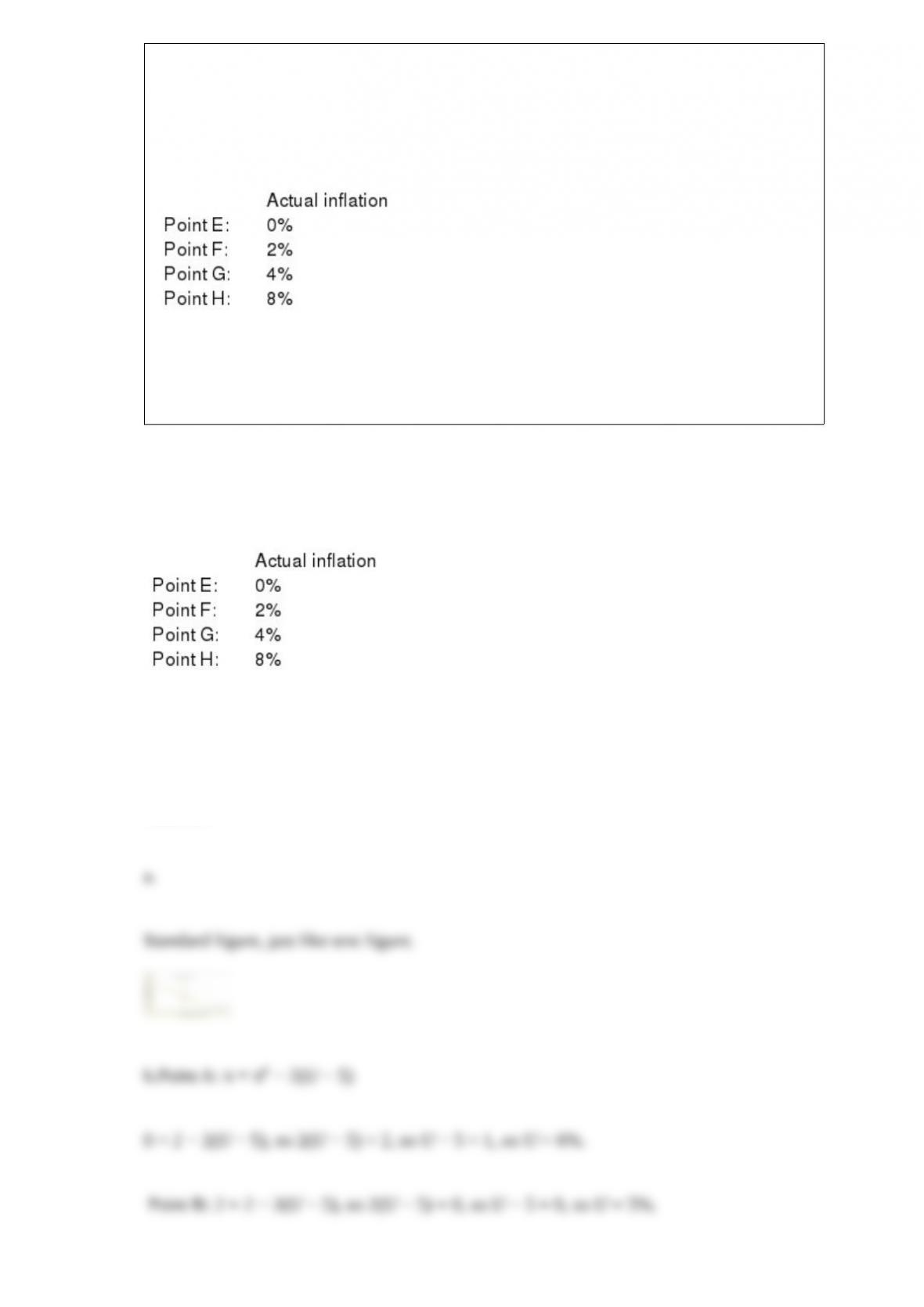
If the expected inflation rate is 2 percent and the natural rate of unemployment is
5%,draw a diagram showing the long-run Phillips curve and the current short-run
Phillips curve.
b.Calculate the unemployment rate corresponding to each of the following points.
c.
If the natural rate of unemployment were to fall to 4 percent, but the expected
inflation rate remained unchanged at 2 percent, what would be the unemployment rate
corresponding to each of the following points on the short-run Phillips curve?
Answer:
A correlation of_____ between output growth in two regions would mean that output
growth in both regions changed at exactly the same time and by the same proportionate
amount.
a. 0
b. less than 0
c. 1.0
d. 100
Answer:

Suppose you are an investor with a choice between three securities that are identical in
every way except in terms of their rates of return and risk.
Investment A: Total return = 10 percent with probability 50 percent
Total return = 20 percent with probability 50 percent
Investment B: Total return = 12 percent with probability 40 percent
Total return = 14 percent with probability 60 percent
Investment C: Total return = 10 percent with probability 60 percent
Total return = 30 percent with probability 40 percent
a. Which investment provides the highest expected return? Show your work by
calculating the expected return of all three investments.
b. Calculate the standard deviation of all three investments.
c. What type of investor might prefer investment A? Who might prefer investment B?
Answer:

Consider a one-year discount bond that pays $2,000 one year from now. If the annual
rate of discount is 3 percent, calculate the present value of the bond.
Answer:
If the expected inflation rate is 3 percent, the nominal interest rate is 5 percent, and the
actual inflation rate turns out to be 4 percent, then the realized real interest rate
is_____than the expected real interest rate and borrowers____relative to lenders.
a. less; gain
b. less; lose
c. greater; gain
d. greater; lose
Answer:

Assume that the price level in Japan is 120, the price level in the U.S. is 145, and the
price level in Mexico is
110. Also assume that the current nominal exchange rates are 115 yen per dollar and 4
pesos per dollar. Calculate the real exchange rates between each pair of countries.
Answer:
Describe the three major costs of unanticipated inflation and give an example of each.
Answer:

In general, periods in which the Taylor rule suggested tighter monetary policy than the
Fed actually put in place are periods of rising inflation. Periods in which the Taylor rule
suggested that monetary policy should be easier than the Fed actually put in place are
periods of declining inflation. Describe a recent exception to these results.
Answer:
If the federal funds rate equals the primary credit discount rate, the Fed is likely
to____securities in the open market, which will cause the federal funds rate to _____ .
a. buy; increase
b. buy; decrease
c. sell; decrease
d. sell; increase

Answer:
Suppose business firms collectively become pessimistic about prospects for future
profits because of continued worries about terrorism. Explain how this would affect
investment, aggregate demand, output, and the price level in the short run and the long
run.
Answer:
Donovan’s $200,000 CD matures. He deposits $20,000 into his checking account, buys
a CD for $80,000, and puts
$100,000 into his money-market mutual fund. How does this affect M1 and M2?
Answer:

A stock’s price is $20 at the beginning of a year. There is a 25 percent chance that the
price will be $17 at the end of the year, and a 75 percent chance that the price will be
$25 at the end of the year. The stock will pay a dividend of $3 during the year. The
expected return on the stock is percent.
a. 10
b. 20
c. 30
d. 40
Answer:
Consider the following four debt securities, which are identical in every characteristic
except as noted:
W: A corporate bond rated AAA X: A corporate bond rate BBB
Y: A corporate bond rated AAA with a shorter time to maturity than bonds W and X
Z: A corporate bond rated AAA with the same time to maturity as bond Y that trades in
a more liquid market than bonds W, X, or Y
List the bonds in the most likely order of the interest rates (yields to maturity) of the
bonds from highest to lowest. Explain your work.
Answer: