
1) near-cash assets in the form of short-term investments are often called
a.marketable securities
b.corporate bonds
c.treasury notes
d.treasury bonds
2) you are considering the purchase of a business that produces net cash flows of
$350,000 per year in perpetuity. in a perfectly competitive market, what should be the
asking price for the business if the firms cost of capital is 15%?
a.$350,000
b.$3,050,000
c.$2,333,333
d.none of the above
3) calculate the tax disadvantage to organizing a u.s. business today, after passage of the
jobs and growth tax reconciliation act of 2003, as a corporation versus a partnership,
given the following assumptions. all earnings will be paid out as dividends, and
operating income before taxes will be $1,500,000. the effective corporate tax rate is
35%, and the tax rate on corporate dividends is 15%. the average personal tax rate for
partners in the business is 35%.
a.$146,250
b.$152,250
c.$166,850
d.$170,375
4) managers of firms should only take actions that
a.increase the value of the firms future cash flows
b.they expect will increase the firms share price
c.have benefits which are at least as great as the cost of those actions

d.all of the above
5) before passage of the jobs and growth tax reconciliation act of 2003, some argued to
completely eliminate the tax rate on dividends. calculate the tax disadvantage to
organizing a u.s. business today if the jobs and growth tax reconciliation act of 2003
passed with this provision. consider the following firm: all earnings will be paid out as
dividends, and operating income before taxes will be $1,500,000. the effective
corporate tax rate is 35%, and the tax rate on corporate dividends is 0%. the average
personal tax rate for partners in the business is 35%. what is the tax disadvantage?
a.$0
b.$75,000
c.$100,000
d.$125,000
6) a merger in which the acquirer maintains the identity of the target as a separate
subsidiary or division.
a.subsidiary merger
b.statutory merger
c.subsidiary merger
d.reverse triangle merger
e.consolidation
7) narrbegin: far corporation
far corporation
far corporation is considering a new project to manufacture widgets. the cost of the
manufacturing equipment is $150,000. the cost of shipping and installation is an
additional $15,000. the asset will fall into the 3-year macrs class. the year 1-4 macrs
percentages are 33.33%, 44.45%, 14.81%, and 7.41%, respectively. sales are expected
to be $300,000 per year. cost of goods sold will be 80% of sales. the project will require
an increase in net working capital of $15,000. at the end of three years, far plans on
ending the project and selling the manufacturing equipment for $35,000. the marginal
tax rate is 40% and far corporations appropriate discount rate is 12%.
narrend
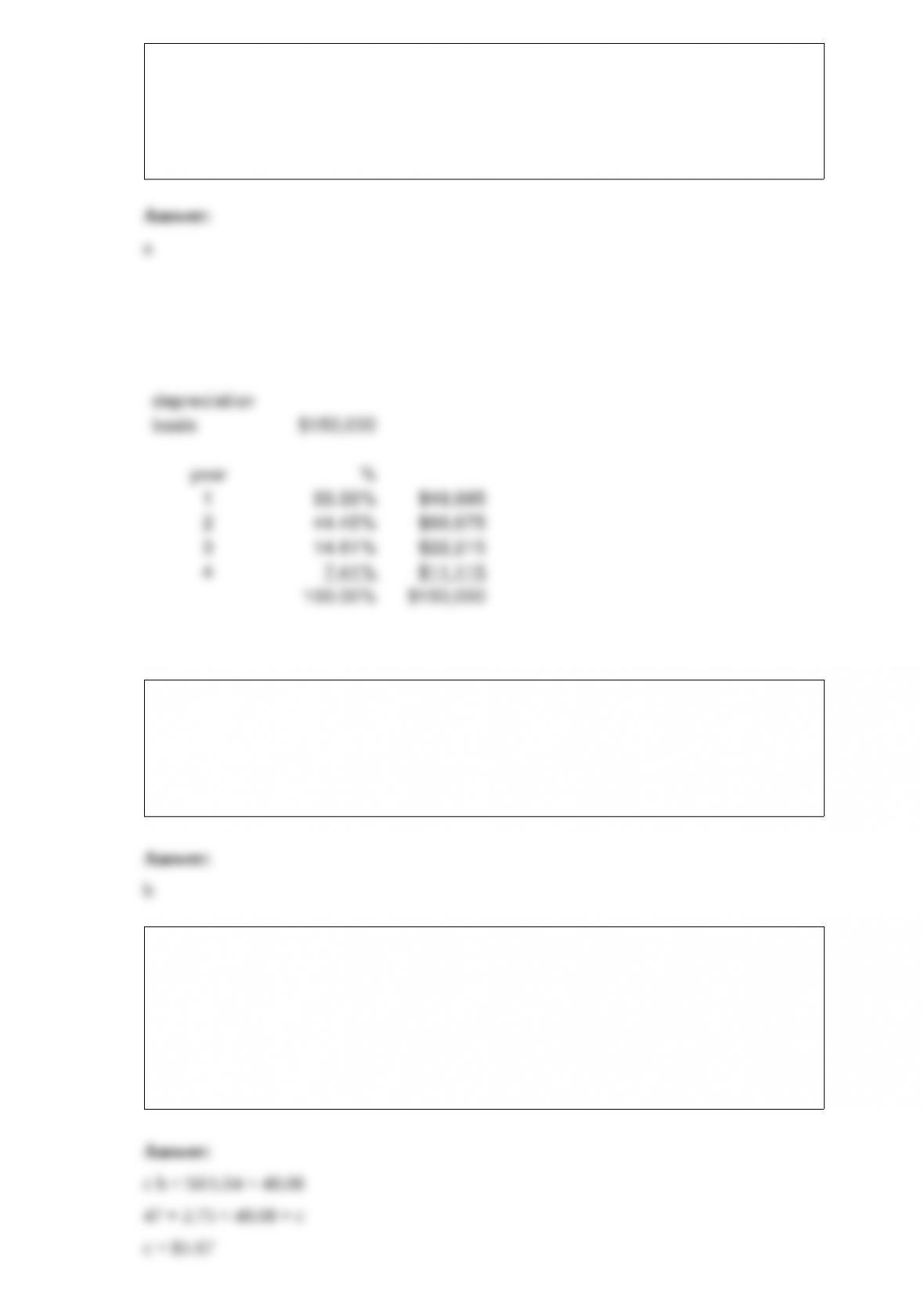
refer to far corporation. what is the depreciation expense in year 1?
a.$49,995
b.$22,215
c.$11,115
d.$66,675
8) bankruptcy filings before the bankruptcy act of 2005 took effect
a.did not change
b.increased
c.decreased
d.went to zero
9) a call option with a $50 strike price on bavarian sausage stock will expire in one
year. if you know that the risk free rate is 4%, that the stock currently sells at $47 and
the put on the same stock has a value of $2.75, what is the price of the call?
a.$2.75
b.$3.56
c.$1.67
d.$5.36

10) which of the following statements is true?
a.if compounding at a positive interest rate, the future value of an annuity due is always
less than the future value of an otherwise identical ordinary annuity
b.if compounding at a positive interest rate, the future value of an annuity due is always
greater than the future value of an otherwise identical ordinary annuity
c.if compounding at a positive interest rate, the future value of an ordinary annuity is
always greater than the future value of an otherwise identical annuity due
d.if compounding at an interest rate of 0%, the future value of an annuity due is always
greater than the future value of an otherwise identical ordinary annuity
e.none of the above
11) which of the following situations allow for a reorganization type bankruptcy filing?
a.a commercial bank that was caught in a cyclical downturn
b.a firm that sells high end pork bellies but finds little market for its product
c.an auto maker that became over-leveraged before an unexpected economic downturn
d.both a and c
12) when you retire you expect to live for another 30 years. during those 30 years you
want to be able to withdraw $4,000 at the beginning of every month for living expenses.
how much money do you have to have in your retirement account to make this happen.
assume that you can earn 8% on your investments.
a.$545,133.98
b.$1,440,000.00
c.$548,768.20
d.$673,625.34