
A firm initially finances its assets with specified proportions of debt and equity, and
then later issues additional debt, using the proceeds to pay a dividend to shareholders. If
the new debt has the same priority as the original debt, the value of the original debt
will probably fall, an effect called claim dilution. Which of the assumptions of an ideal
capital market is violated in this example?
a. Capital Markets are frictionless
b. Homogeneous expectations
c. Atomistic competition
d. The firm has a fixed investment program
e. Once chosen, the firm’s financing is fixed
Joe Ogden, the Chairman and CEO of Ogdenergy, Inc., a promising venture in the
natural gas industry, is negotiating with Summer Street Capital Partners, a Buffalo,
NY-based venture capital firm (VC), for funding of $15 mn., which will be used for
building PP&E. Summer Street is impressed with the venture, and is considering
providing the funding in exchange for equity shares. However, Summer Street is
concerned that if they demand an equity ownership percentage that is too high,
Ogdenergy’s entrepreneurs may be less inclined to work hard to ensure the venture’s
success. They determine that if they demand a 40% equity percentage, the firm will be
worth $44 mn., but if they demand a 60% ownership percentage, the firm’s value will
be only $26 mn. Which equity ownership percentage should Summer Street take? (i.e.,
which maximizes Summer Street’s NPV?)
a. Summer Street should take a 40% equity percentage.
b. Summer Street should take a 60% equity percentage.

The tradeoff in the traditional tradeoff theory of optimal capital structure is between:
a. agency costs of debt and information asymmetry costs of debt.
b. the tax benefit of debt and the expected costs of future financial distress.
c. the tax benefit of debt and agency costs of debt.
Leland and Pyle (1977) examine the effect of informational asymmetries on equilibrium
corporate valuation and financial structure. The authors develop a signaling model and
work through a specific example, focusing on optimal debt levels under conditions of
asymmetric information. In their signaling model, an entrepreneur seeks financing for a
project whose true value is known only to him. Clearly, direct transfer of information to
lenders is impossible. Information may, however, be transferred by a credible signal.
Here, the signal is:
a. the entrepreneur’s willingness to include debt in the firm’s capital structure.
b. the willingness of the entrepreneur to invest in his own project.
c. the entrepreneur’s ability to attract private equity capital.
d. the entrepreneur’s expressed willingness to remain as a manager of the firm.
In a multi-divisional firm, what are the two fundamental (and related) problems with
the internal capital allocation process?

a. centralized information and tax-avoidance
b. monitoring and signaling
c. decentralized information and incentive problems
d. signaling and tax-avoidance
In recent years, Sears, Roebuck & Co. has paid out only 32% of its earnings in
dividends. Retained earnings have been invested in expansion projects that have yielded
an average ROE of 20%. If Sears’ cost of equity capital is 16% and next year’s expected
dividend is $1 per share, compute the value of Sears’ shares using the constant dividend
growth model as interpreted through the sustainable growth model.
a. $5.01
b. $9.87
c. $20.47
d. $41.67
Admati and Pfleiderer (1994) argued that by having both inside and outside investors
contribute to a venture, ____________, and thus a rational continuation/termination

decision would be made at each stage of development.
a. both information asymmetry and principal-agent problems are resolved
b. taxes and risk are both minimized
c. the overinvestment and underinvestment problems are balanced out
d. perception biases cancel out
TRUE or FALSE. Agency costs of managerial discretion are one of the few costs that
are not exacerbated when a firm is under financial distress.
a. TRUE
b. FALSE
Scrutiny by the media and analysts has at least two important implications for a firm,
but does NOT include:
a. information they generate reduces information asymmetry.
b. their oversight of a firm’s management serves shareholders’ interest.
c. they accurately forecast the returns on individual firms based on private information
they generate.
The two most fundamental aspects of a corporation (as a form of business organization)
that lead to not only tremendous economies of scale and scope (as a positive) but also
are linked to the financing problems that we address in the course (as a negative) are:
a. the separation of ownership and control AND private ownership.
b. limited liability AND private ownership.
c. the separation of ownership and control AND limited liability.
d. private ownership AND leverage.
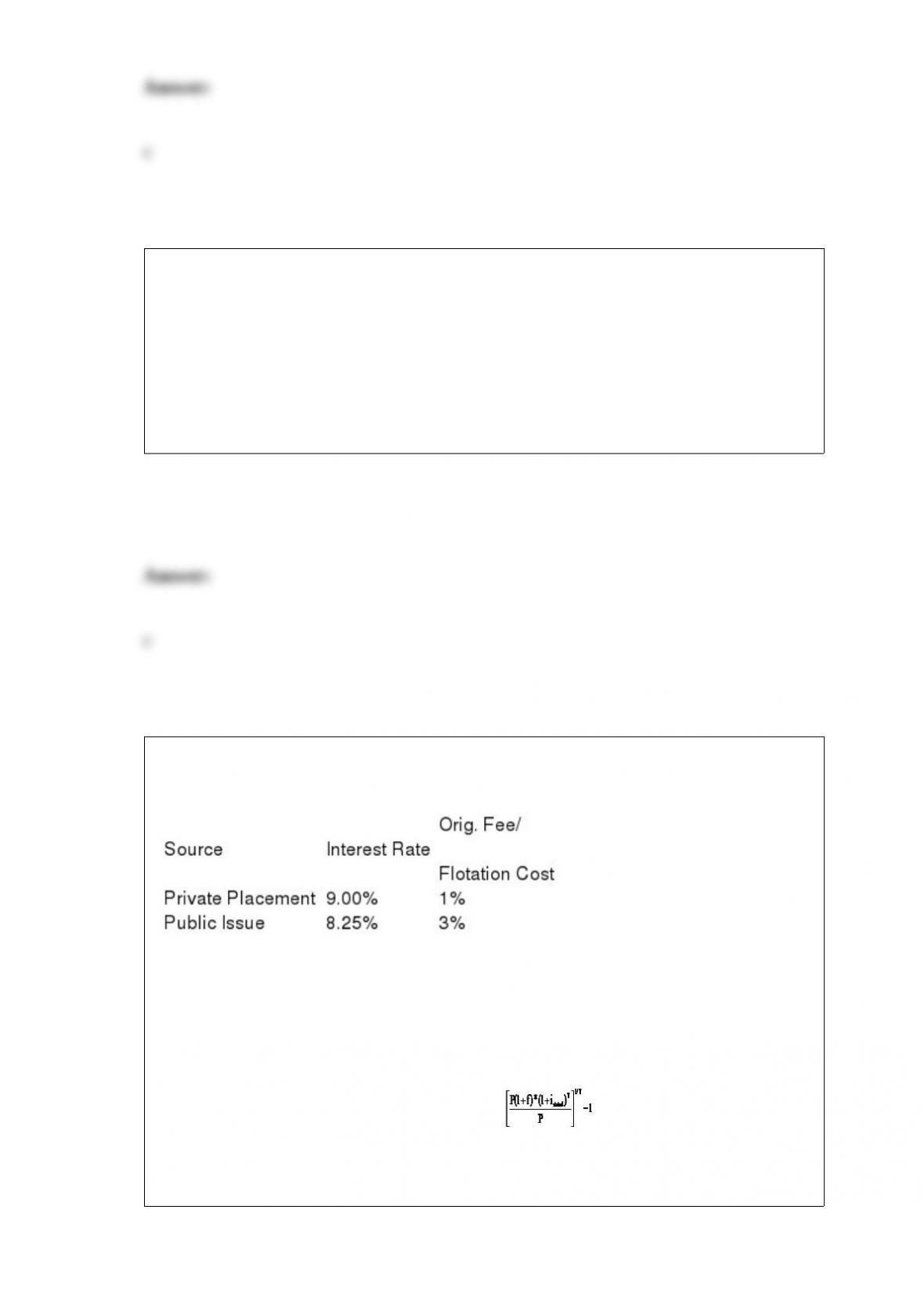
A firm wants to borrow $100 million for 5 years (pure discount, for simplicity). Which
of the following sources has the lower effective interest cost?
a. The private placement
b. The public issue
c. The costs are the same
FORMULA: Effective interest cost=ieffective = , where P is the amount of
loan proceeds that the firm needs, f is the loan origination fee or flotation cost as a
fraction of P, and istated is the stated interest cost.

In a takeover bid, target management may offer to repurchase the bidder’s shares at a
large premium if the bidder promises to cease and desist. The premium payoff is called
___(i)___, and the agreement to cease and desist is called a ___(ii)___.
The management of firm XYZ tends to pay out 35% of its earnings in dividends each
year, while the remainder is retained for capital investments that provide an expected
ROE of 18%. If the firm’s cost of equity capital is 13% and next year’s expected
dividend is Dt=$0.50 per share, compute the value of the firm’s shares using the
constant dividend growth model as interpreted through the sustainable growth model.
a. $7.46
b. $17.46
c. $27.46
d. $37.46
FORMULAS: g=bk; V=Dt/(r-g)

Which of the following is the least likely source of funding for a venture that is in the
seed stage of development?
a. angel financiers
b. bootstrapping
c. banks
In the text’s equity management model based on Myers (2000), a firm’s net cash flow is
allocated in three directions. Which of the following is NOT one of these directions?
a. acquisitions
b. dividends and share repurchases
c. reinvestment
d. management’s private benefits of control (i.e., perks)

For firm XYZ in the previous problem, suppose the firm’s business risk is defined in
terms of (ROA), and (ROA)=19%. Assuming that the debt is
default-free, compute (ROE).
FORMULA: (ROE)= (ROA)[TA/BEQ]
Regarding a firm’s overall organizational architecture, the direction of causality (i.e., in
terms of which components/elements drive other components/elements) generally runs:
a. business architecture→financial architecture.
b. financial architecture→business architecture.
c. economic architecture→financial architecture.
d. financial architecture→economic architecture.

A ________ occurs when a group of individuals uses cash to purchase the shares of a
firm and takes ownership and control of the firm.
a. buyout
b. acquisition
c. consolidation
d. merger
Firms that face a ________ tax rate structure have an incentive to hedge, because it can
reduce the firm’s expected tax liability.
a. flat
b. regressive (or concave)
c. decelerating
d. progressive (or convex)
Targeted stock, also known as tracking stock or letter stock, is a class of common stock
of a diversified company that is
a. linked to the performance of a particular business unit or division.
b. senior to other classes of the firm’s common stock.
c. convertible into the stock of an independenttarget company.

d. stock that tracks the performance of a stock index such as the S&P 500.
Lang, Ofek, and Stulz (1996) analyzed the relationship between leverage and growth
opportunities. They focus on the market’s assessment of the ability of the firm to
generate profitable growth. Their measure of profitable growth opportunities is Tobin’s
q ratio, the ratio of the market value of the firm’s equity to its book value. They
summarize their results as follows: “We show that there is a negative relation between
leverage and future growth. This negative relation between leverage and growth holds
for firms with (i) Tobin’s q ratio, but not for firms with (ii)__ Tobin’s q.
In a(n) __________, the parent of a multiple-subsidiary firm issues, via an IPO, equity
shares for a particular subsidiary, though the parent usually keeps majority ownership of
the shares, and thus control of the subsidiary.
a. asset sale
b. spin-off
c. equity carve-out
d. targeted stock issuance

Financial institutions (such as commercial banks and finance companies) play an
important role in mitigating information asymmetry problems in financial markets
because:
a. they require a potential borrower to disclose confidential information about their
project to the public before they are approved for a loan.
b. they regularly receive private information from the firm about the quality of the
firm’s projects, and yet will keep such information confidential.
c. they lend only to firms that do not suffer from information asymmetry problems.
Suppose the beta of the stock of Microsoft, Inc. is ßmsft=1.45. If rf=4% and rM=9%,
what is the equilibrium expected return on Microsoft stock, rmsft, according to the
CAPM? As an analyst of the firms in the high-technology industry, you expect
Microsoft to provide a return of 10% over the next year. Comparing your estimate with
equilibrium expected return on Microsoft that you just calculated, would you
recommend to your investors that they buy Microsoft stock?
a. Yes: Microsoft is underpriced
b. No: Microsoft is overpriced
FORMULA: rf+ ßi[rM-rf]

The following information on the stock of Avon, Inc. was obtained on Thurs., Nov. 11,
1999:
Stock price = VE= $28.50;
Latest annual dividends per share = Dt-1= $0.72
5-year average earnings growth rate = ghistorical= 4.31%
Suppose dividends per share for the next year are projected to be Dt= $0.75. If we also
assume that the market is pricing Avon stock to have an expected return of rE= 9%, is
the market pricing Avon stock to have ________ earnings growth rate, g, than/as it had
over the past 5 years?
a. a higher
b. a lower
c. the same
FORMULA: VE=Dt/(rE-g)=Dt-1(1+g)/(rE-g)
In a ______, a diversified firm is taken over and assets or divisions are sold, so that the
remaining firm is more focused and efficient.
a. spin-off
b. equity carve-out

c. bustup takeover
d. dispersal
In 1982, the SEC adopted Rule 415, also known as the _______ rule, which allows
qualifying firms to register a bond offering and then sell it either as a whole or
piecemeal at any time over several years.
a. delayed registration
b. deferred registration
c. shelf registration
d. piecemeal registration
Which category of liabilities & equities had the smallest proportion in every year from
1980- 2000?
a. current liabilities
b. debt
c. other non-current liabilities
d. common stock
e. preferred stock
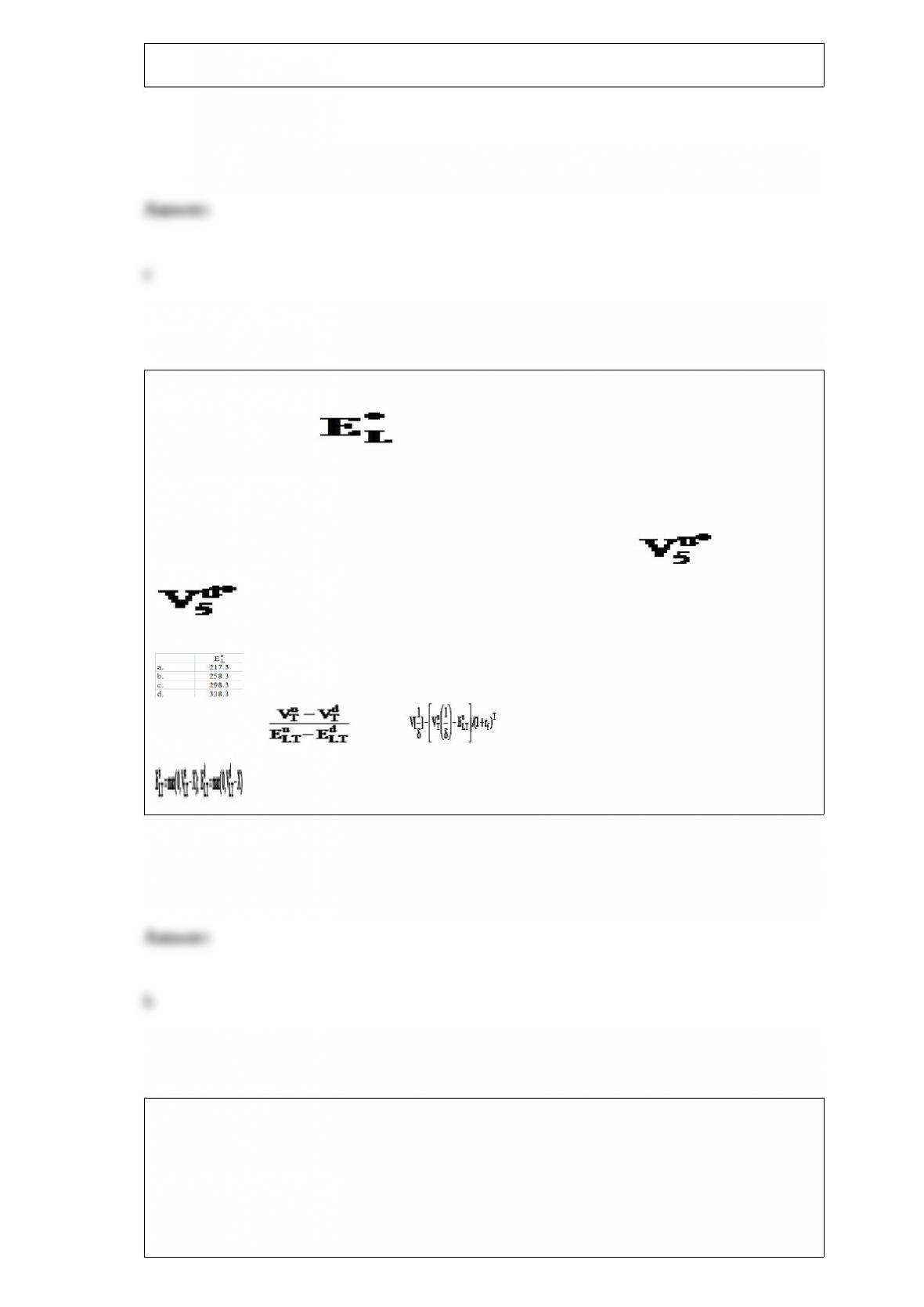
Continuing with the numbers from the previous question, compute new value of the
firm’s levered equity, , after the following actions by the firm’s management:
Management issues additional pure-discount debt which has a promised payment of
X”=621 at T=3 and has the same priority as the firm’s original debt. The firm receives
total proceeds of 500 for the new debt. Management uses the proceeds to double the
firm’s operations under identical conditions, such that V=1,000, =1,500, and
=666.67.
FORMULAS: ; EL = ;
Which of the following is NOT a stated reason why an internal capital market, managed
by a firm’s headquarters, may be superior to external financing?
a. External equity financing is problematic because of the information asymmetry
problem.

b. Even if internal and external providers of capital have the same ability to monitor,
internal providers will choose to monitor more intensely because they have residual
control over the assets, and therefore get more of the gains from monitoring.
c. If one unit performs poorly, its assets can be redeployed efficiently.
d. Management is generally better at managing internal (vs. external) equity.
Information asymmetry is chief among violations of which of the assumptions of an
ideal capital market?
a. Capital Markets are frictionless
b. Homogeneous expectations
c. Atomistic competition
d. The firm has a fixed investment program
e. Once chosen, the firm’s financing is fixed