1) The forward premium is the price specified in a call or put option.
2) Currency swaps, whereby two parties exchange currencies at a specified point in
time for a specified price, are often used by MNCs to hedge against interest rate risk.
3) The imperfect markets theory states that factors of production are somewhat
immobile, allowing firms to capitalize on a foreign country’s resources.
4) If managers of foreign subsidiaries make decisions that maximize the values of their
respective subsidiaries, they automatically maximize the value of the entire corporation.
5) Translation exposure results when an MNC translates each subsidiary’s financial data
to its home currency for consolidated financial statements.
6) One form of an exposure to political risk is terrorism.
7) If an MNC is extremely risk-averse, it may decide to hedge even though its hedging
analysis indicates that remaining unhedged will probably be less costly than hedging.
8) U.S.-based MNCs whose foreign subsidiary generates large earnings may be able to
offset exposure to exchange rate risk by issuing bonds denominated in the subsidiary’s
local currency.
9) The feasibility of a multinational project from the parent’s perspective is dependent
not on the subsidiary cash flows but on the cash flows that it ultimately receives.
10) If exchange rate movements are less volatile in the past than in the future, the
estimated maximum expected loss derived from the VAR method will be
underestimated.
11) According to the international Fisher effect:
a.exchange rates adjust to compensate for income differentials between countries
b.interest rates adjust to compensate for income differentials between countries
c.exchange rates adjust to compensate for interest rate differentials between countries
d.exchange rates adjust to compensate for risk differentials between countries
12) ____ involve(s) the collection of independent opinions on country risk without
group discussion by the assessors who provide these opinions.
a.The checklist approach
b.The Delphi technique
c.Quantitative analysis
d.Inspection visits
13) The capital asset pricing theory is based on the premise that:
a.only unsystematic variability in cash flows is relevant
b.only systematic variability in cash flows is relevant
c.both systematic and unsystematic variability in cash flows are relevant
d.neither systematic nor unsystematic variability in cash flows is relevant
14) Wisconsin Inc. conducts business in Zambia. Years ago, Wisconsin established a
subsidiary in Zambia that has consistently generated very large profits denominated in
Zambian kwacha. Wisconsin wishes to restructure its operations to reduce economic
exposure. Which of the following is not a feasible way of accomplishing this?
a.increase Zambian supply orders
b.increase Zambian sales
c.restructure debt to increase debt payments in Zambia
d.reduce Zambian sales
15) A(n) ____ letter of credit is not a trade-related letter of credit.
a.commercial
b.import/export
c.revocable
d.irrevocable
e.all of the above are trade-related letters of credit
16) Assume the U.S. has a balance of trade surplus with the country of Thor. When
individuals in Thor manufacture CDs and DVDs that look almost exactly like the
original product produced in the U.S. and other countries, they ____ the U.S. balance of
trade surplus with Thor. This activity is called ____.
a.reduce; flipping
b.reduce; pirating
c.increase; pirating
d.increase; flipping
17) Which one is not a disadvantage of a freely floating exchange rate system?
a.It can adversely affect a country that has high unemployment
b.It can adversely affect a country that has high inflation
c.The government may intervene to change the value of a given currency
d.The exchange rate risk is high and may be costly to manage
18) Currency options are commonly traded through the ____ system.
a.robot
b.Euro
c.GLOBEX
d.Scope
19) When using ____, funds are typically tied up for a significant period of time.
a.covered interest arbitrage
b.locational arbitrage
c.triangular arbitrage
d.B and C
20) Factors such as economic growth, inflation, and interest rates are an integral part of
____ forecasting.
a.technical
b.fundamental
c.market-based
d.none of the above
21) Assume the following information:
Quoted Bid PriceQuoted Ask Price
Value of an Australian dollar (A$) in $$0.67$0.69
Value of Mexican peso in $$.074$.077
Value of an Australian dollar in
Mexican pesos 8.2 8.5
Assume you have $100,000 to conduct triangular arbitrage. What will be your profit
from implementing this strategy?
a.$6,133
b.$2,368
c.$6,518
d.$13,711
22) Lampon Co. is a U.S. firm that has a subsidiary in Hong Kong that produces light
fixtures and sells them to Japan, denominated in Japanese yen. Its subsidiary pays all of
its expenses, including the cost of goods sold, in U.S. dollars. The Hong Kong dollar is
pegged to the U.S. dollar. If the Japanese yen appreciates against the U.S. dollar, the
Hong Kong subsidiary’s revenue will ____, and its expenses will ____.
a.increase; decrease
b.decrease; remain unchanged
c.decrease; increase
d.increase; remain unchanged
23) If the currency of a foreign currency-denominated bond ____, the funds needed to
make coupon payments will ____.
a.appreciates; increase
b.depreciates; decrease
c.appreciates; decrease
d.depreciates; increase
e.A and B
24) On January 1st, Madison Co. ordered raw material from Japan and agreed to pay
100 million yen for this order on April 1st. It negotiated a 3-month forward contract to
obtain 100 million Japanese yen on that date at $.009. On February 1st, the Japanese
firm informed Madison Co. that it won’t be able to fulfill that order. The Japanese yen
spot rate on February 1st is $.0087 and 2-month forward rate exhibits 3% discount. To
offset its existing contract Madison Co. will negotiate a forward contract to ____ for the
date of April 1st and the profit/loss generated from this transaction is a ____ U.S.
dollars.
a.sell yen; gain of $60,000
b.sell yen; loss of $60,000
c.buy yen; gain of $30,000
d.to buy yen; loss of $30,000

25) Recently, the U.S. experienced an annual balance of trade representing a ____.
a.large surplus (exceeding $100 billion)
b.small surplus
c.level of zero
d.deficit
26) The ____ is a self-sustaining federal agency responsible for insuring direct U.S.
investments in foreign countries against the risk of currency inconvertibility,
expropriation, and other political risks.
a.Export-Import Bank of the United States
b.Private Export Funding Corporation
c.Overseas Private Investment Corporation
d.none of the above
27) Which of the following is true?
a.Non-U.S. firms may desire to issue bonds in the U.S. due to less regulations in the
U.S
b.U.S. firms may desire to issue bonds in the U.S. due to less regulations in the U.S
c.U.S. firms may desire to issue bonds in the non-U.S. markets due to less regulations
in non-U.S. countries
d.A and B
28) Which of the following operations benefit(s) from depreciation of the firm’s local
currency?
a.borrowing in a foreign country and converting the funds to the local currency prior to
the depreciation
b.purchasing foreign supplies
c.investing in foreign bank accounts denominated in foreign currencies prior to
depreciation of the local currency
d.A and B
29) The ____ the correlation in project returns is over time, the ____ will be the project
portfolio risk as measured by the portfolio variance.
a.lower; lower
b.higher; lower
c.lower; higher
d.none of the above
30) Foghat Co. has 1,000,000 euros as receivables due in 30 days, and is certain that the
euro will depreciate substantially over time. Assuming that the firm is correct, the ideal
strategy is to:
a.sell euros forward
b.purchase euro currency put options
c.purchase euro currency call options
d.purchase euros forward
e.remain unhedged
31) A U.S. MNC has the equivalent of $1 million cash outflows in each of two highly
negatively correlated currencies. During ____ dollar cycles, cash outflows are ____.
a.weak; somewhat stable
b.weak; favorably affected
c.weak; adversely affected
d.none of the above
32) Which of the following is true?
a.Most forward contracts between firms and banks are for speculative purposes
b.Most future contracts represent a conservative approach by firms to hedge foreign
trade
c.The forward contracts offered by banks have maturities for only four possible dates in
the future
d.none of the above
33) Which of the following is probably not an example of the use of forward contracts
by an MNC?
a.Hedging pound payables by selling pounds forward
b.Hedging peso receivables by selling pesos forward
c.Hedging yen payables by purchasing yen forward
d.Hedging peso payables by purchasing pesos forward
e.All of the above are examples of using forward contracts
34) If an MNC has a net inflow in one currency and a net outflow of about the same
amount in another currency, then the MNCs’ transaction exposure is ____ if the two
currencies are ____ correlated.
a.high; positively
b.low; negatively
c.high; negatively
d.none of the above
35) If a country experiences high inflation relative to the U.S., its exports to the U.S.
should ____, its imports should ____, and there is ____ pressure on its currency’s
equilibrium value.
a.decrease; increase; upward
b.decrease; decrease; upward
c.increase; decrease; downward
d.decrease; increase; downward
e.increase; decrease; upward
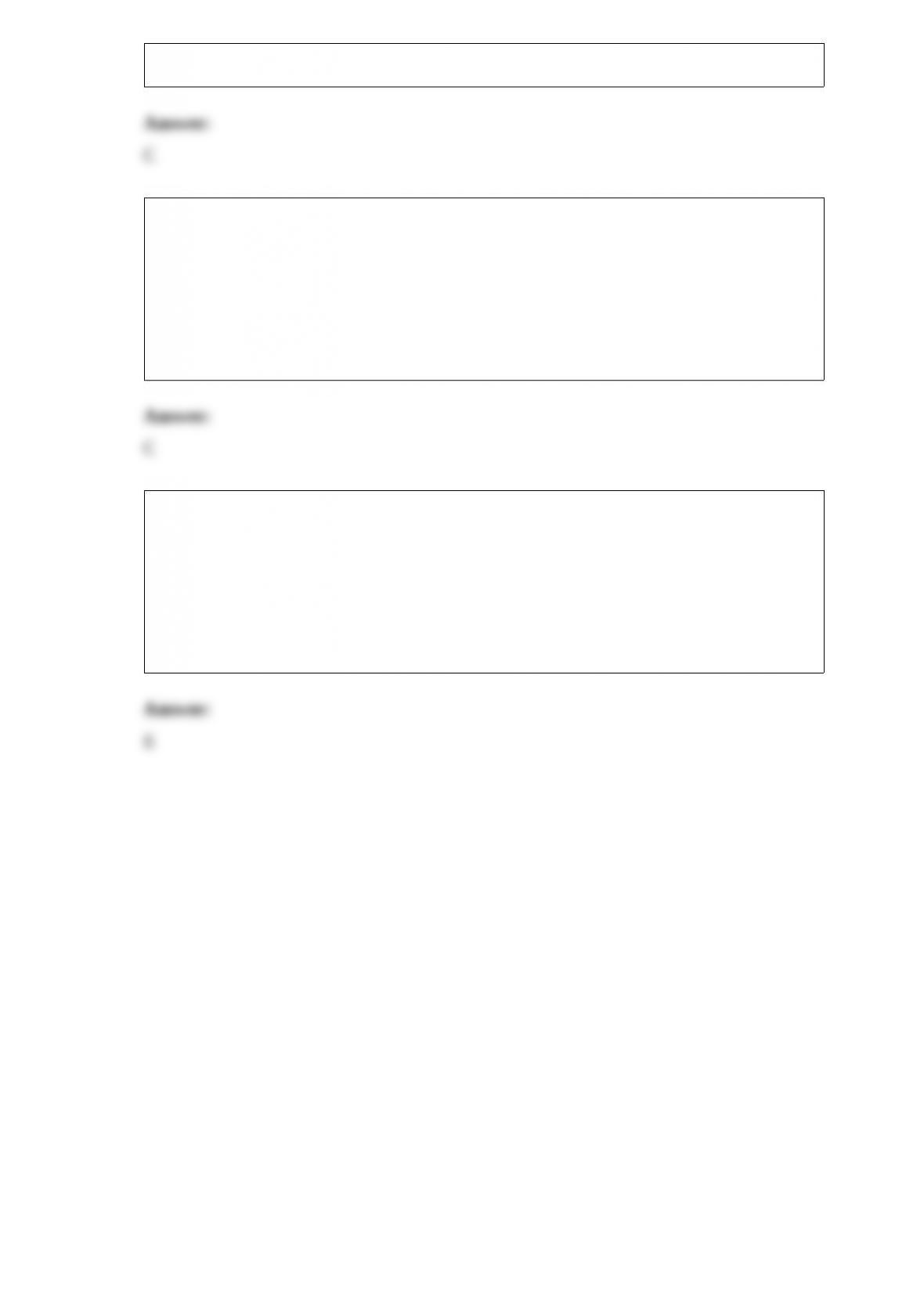
36) The following regression analysis was conducted for the inflation rate information
and exchange rate of the British pound:
Regression results indicate that a0 = 0 and a1 = 2. Therefore:
a.purchasing power parity holds
b.purchasing power parity overestimated the exchange rate change during the period
under examination
c.purchasing power parity underestimated the exchange rate change during the period
under examination
d.purchasing power parity will overestimate the exchange rate change of the British
pound in the future
37) When the dollar strengthens, the reported consolidated earnings of U.S.-based
MNCs are ____ affected by translation exposure. When the dollar weakens, the
reported consolidated earnings are ____ affected.
a.favorably; favorably affected but by a smaller degree
b.favorably; favorably affected by a higher degree
c.unfavorably; favorably affected
d.favorably; unfavorably affected
38) ____ is an input required for a multinational capital budgeting analysis, given that it
is conducted from the parent’s viewpoint.
a.Salvage value
b.Price per unit sold
c.Initial investment
d.Consumer demand
e.All of the above are inputs required for capital budgeting analysis