1) This is a principle of capital budgeting which states that the calculations of cash
flows should remain independent of financing.
A.generally accepted accounting principle
B.financing principle
C.separation principle
D.WACC principle
2) With regard to depreciation, the time value of money concept tells us that
A.delaying the depreciation expense is always better
B.taking the depreciation expense sooner is always better
C.delaying the depreciation expense is sometimes better
D.taking the depreciation expense sooner is sometimes better
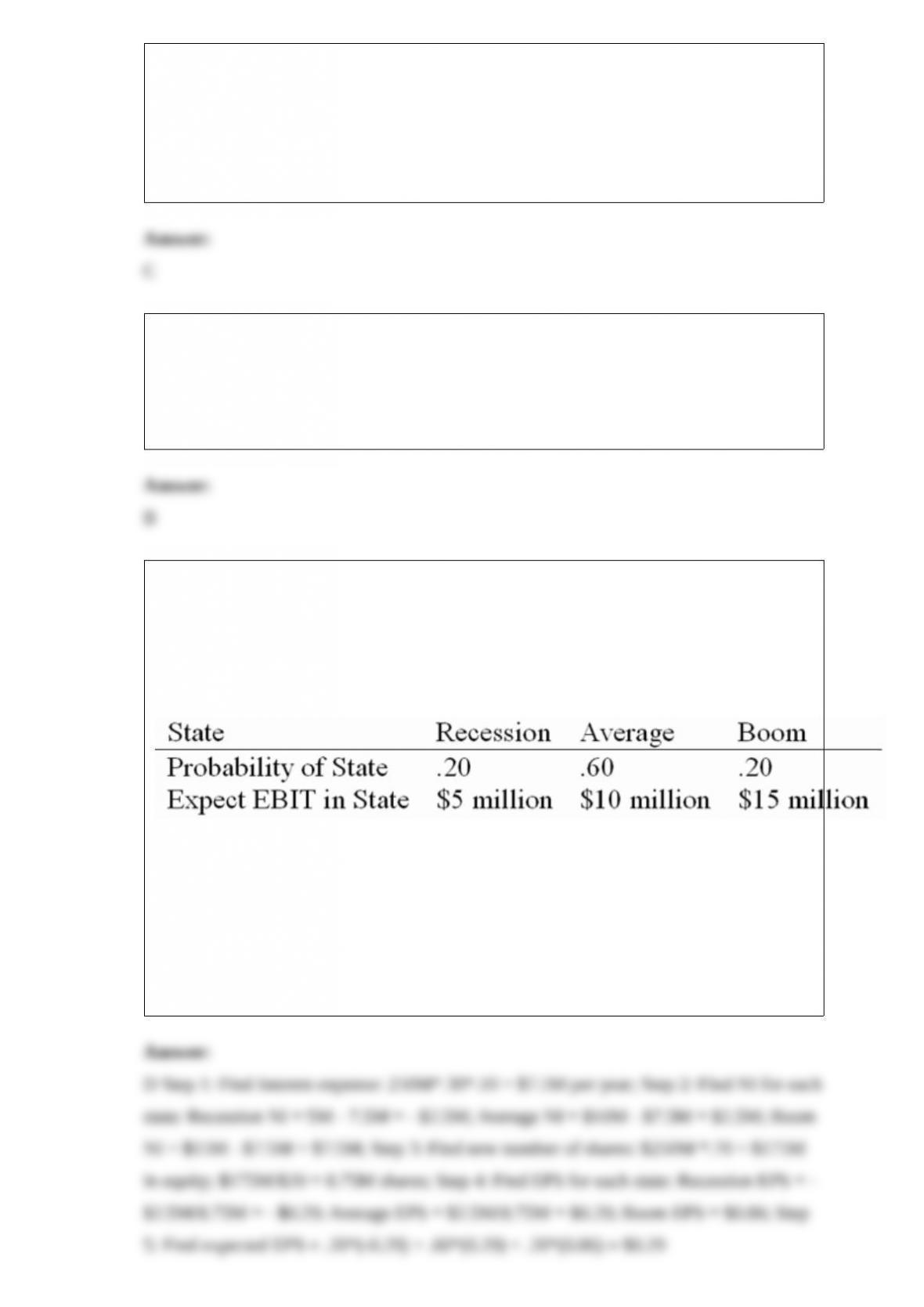
3) Daddi Mac, Inc., doesn’t face any taxes and has $250 million in assets, currently
financed entirely with equity. Equity is worth $20 per share, and book value of equity is
equal to market value of equity. Also, let’s assume that the firm’s expected values for
EBIT depend upon which state of the economy occurs this year, with the possible
values of EBIT and their associated probabilities as shown below:
The firm is considering switching to a 30 percent debt capital structure, and has
determined that they would have to pay a 10 percent yield on perpetual debt. What will
be the level of expected EPS if they switch to the proposed capital structure?
A.$0.33
B.$0.21
C.$0.37
D.$0.29
4) This is the interest rate that would exist on a default-free security if no inflation were
expected.
A.nominal interest rate
B.real interest rate
C.real risk free rate
D.market premium
5) This is one of the most extreme examples of firm re-leveraging which occurs when
someone uses a firm’s debt capacity to buy out the majority of the firm’s equity holders.
A.debt buyout
B.equity buyout
C.leveraged buyout
D.separation buyout
6) You are considering the purchase of one of two machines used in your manufacturing
plant. Machine A has a life of two years, costs $100 initially, and then $150 per year in
maintenance costs. Machine B costs $200 initially, has a life of three years, and requires
$120 in annual maintenance costs. Either machine must be replaced at the end of its life
with an equivalent machine. Which is the better machine for the firm? The discount rate
is 12% and the tax rate is zero.
A.Machine A
B.Machine B
C.Both Machines A and B
D.Neither Machine A nor B
7) With regard to money deposited in a bank, future values are:
A.smaller than present values
B.larger than present values
C.equal to future values
D.are completely independent of present values
8) Suppose that Freddy’s Fries has annual sales of $500,000, cost of goods sold of
$375,000, average inventories of $9,000, and average accounts receivable of $25,000.
Assuming that all of Freddy’s sales are on credit, what will be the firm’s operating
cycle?
A.27.01
B.18.25
C.8.76
D.9.49
9) The total risk of the S&P500 Index is equal to ____________________.
A.diversifiable risk
B.nondiversifiable risk
C.modern portfolio risk
D.efficient frontier risk
10) A furniture company is offering a choice of deals. You can receive $100 cash back
on the purchase, or a 2% APR, 2-year loan. The price of the dining room set is $3,750
and you could obtain a 2-year loan from your credit union at 6% APR. What is the cost
per month of each deal?
A.Cash back: $161.77 2% APR: $159.53
B.Cash back: $171.29 2% APR: $179.02
C.Cash back: $153.96 2% APR: $181.09
D.Cash back: $180.03 2% APR: $166.17
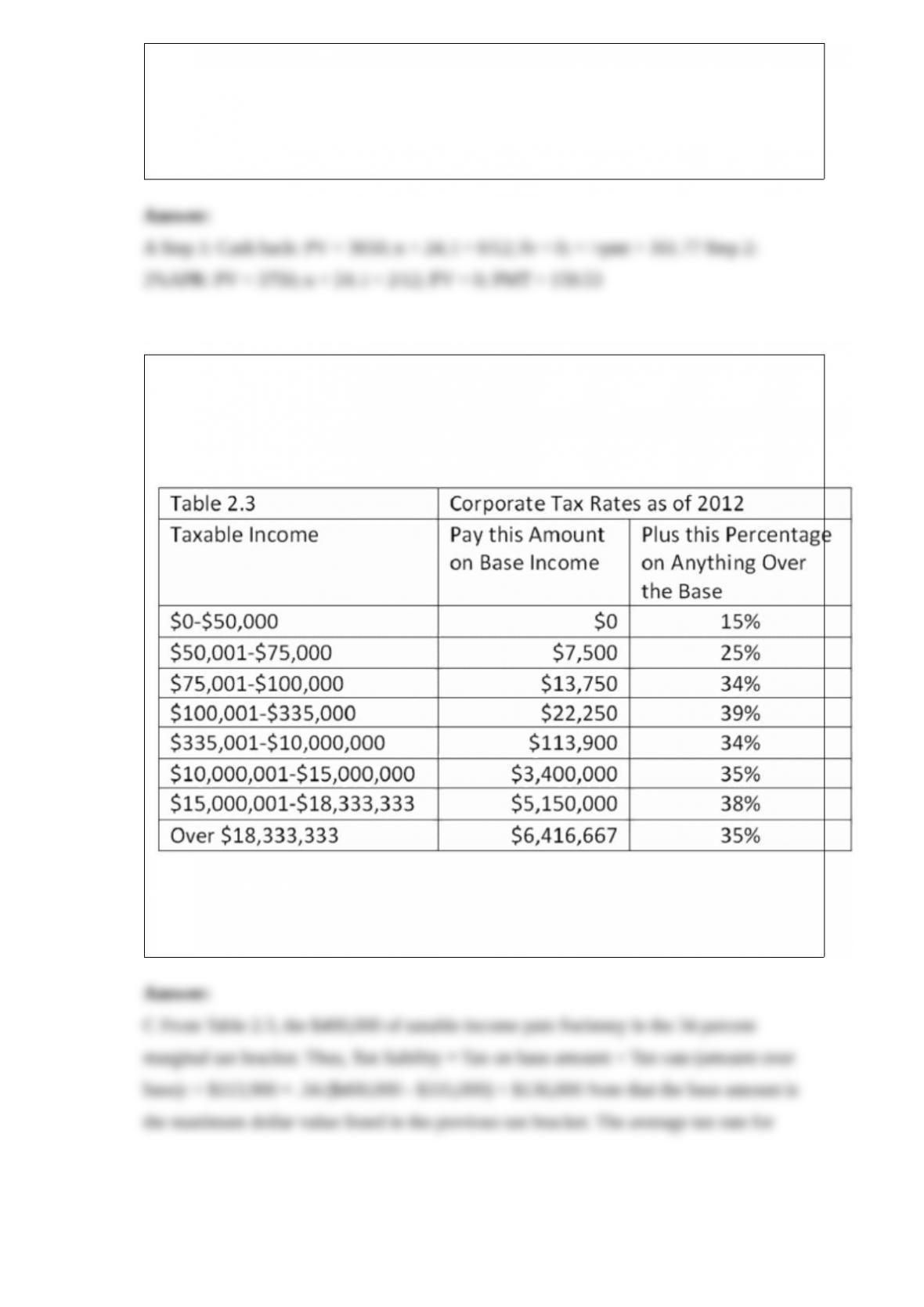
11) Corporate Taxes Swimmy, Inc. had $400,000 in 2010 taxable income. Using the tax
schedule from Table 2-3, what is the company’s 2010 income taxes, average tax rate,
and marginal tax rate, respectively?
A.$22,100, 5.53%, 34%
B.$113,900, 28.48%, 34%
C.$136,000, 34.00%, 34%
D.$136,000, 39.00%, 34%
12) Rank the following three stocks by their risk-return relationship, best to worst. Rail
Haul has an average return of 10 percent and standard deviation of 19 percent. The
average return and standard deviation of Idol Staff are 12 percent and 22 percent; and of
Poker-R-Us are 11 percent and 25 percent.
A.Idol Staff, Rail Haul, Poker-R-Us
B.Rail Haul, Idol Staff, Poker-R-Us
C.Idol Staff, Poker-R-Us, Rail Haul
D.Poker-R-Us, Rail Haul, Idol Staff
13) Suppose a firm has a dividend payout ratio of 65 percent and net income of $5
million. What would be the annual addition to retained earnings?
A.$3,250,000
B.$5,250,000
C.$1,750,000
D.$750,000
14) Which of the following statements is incorrect?
A.Stock dividends increase the number of shares and increase the total market value of
owner’s equity
B.Stock splits increase the number of shares but do not increase the total market value
of owner’s equity
C.In a stock dividend, the par value of the stock on the company’s books is not altered
D.In a stock split, the par value of the stock on the company’s books is altered

15) Effective Annual Rate A loan is offered with monthly payments and a 6.5 percent
APR. What’s the loan’s effective annual rate (EAR)?
A.5.69%
B.6.697%
C.7.28%
D.12.63%
16) Moving Cash Flows What is the value in year 7 of a $700 cash flow made in year 3
when the interest rates are 10 percent?
A.$478.11
B.$980.00
C.$1,024.87
D.$1,364.10
17) A company is considering two mutually exclusive projects, A and B. Project A
requires an initial investment of $200, followed by cash flows of $185, $40 and $15.
Project B requires an initial investment of $200, followed by cash flows of $0, $50 and
$230. What is the IRR of the project that is best for the company’s shareholders? The
firm’s cost of capital is 10%.
A.15.45%
B.15.12%
C.13.57%
D.12.71%
18) JAY Corp. is expected to pay a dividend of $5.00 per year indefinitely. If the
appropriate rate of return on this stock is 13 percent per year, and the stock consistently
goes ex-dividend 30 days before dividend payment date, what will be the expected
maximum price in light of the dividend payment logistics?
A.$3.16
B.$38.08
C.$38.46
D.$43.03
19) If bondholders of a firm in financial distress felt that they could recoup more of
their investment by renegotiating their claims with the firm and allowing it to continue
to operate, what type of bankruptcy would they probably push for?
A.Chapter 11
B.Chapter 13
C.Chapter 7
D.Chapter 9
20) This is a measure summarizing the overall past performance of an investment.
A.average return
B.dollar return
C.market return
D.percentage return
21) Wheels and More, Inc. normally pays an annual dividend. The last such dividend
paid was $3.00, all future dividends are expect to grow at a rate of 8 percent per year,
and the firm faces a require rate of return on equity of 12 percent. If the firm just
announced that the next dividend will be an extraordinary dividend of $7 per share that
is not expected to affect any other future dividends, what should the stock price be?
A.$78.76
B.$81.00
C.$82.00
D.$84.36

22) ABC Engineering just purchased a new machine. All of the following are examples
of incremental cash flows except _______________.
A.Freight charged to ship the machine
B.Developmental costs to determine which machine would best work with their unique
process
C.Increase in electric bill to run the machine
D.Reduction in maintenance expense associated with the new machine
23) These are sets of cash flows where all the initial cash flows are negative and all the
subsequent ones are either zero or positive.
A.expected cash flows
B.time line cash flows
C.non-normal cash flows
D.normal cash flows
24) A project’s IRR ____________________.
A.is the average rate of return necessary to pay back the project’s capital providers
B.will change with the cost of capital
C.is equal to the discounted cash flows divided by the number of cash flows if the cash
flows are a perpetuity
D.All of these answers are correct
25) From the perspective of control, the best form of business organization is the
__________.
A.Sole proprietorship
B.Corporation
C.Partnership
D.S Corporation

26) Interest rates A corporation’s 10-year bonds are currently yielding a return of 7.75
percent. The expected inflation premium is 3.0 percent annually and the real interest
rate is expected to be 3.00 percent annually over the next 10 years. The liquidity risk
premium on the corporation’s bonds is 0.50 percent. The maturity risk premium is 0.25
percent on 2-year securities and increases by 0.10 percent for each additional year to
maturity. What is the default risk premium on the corporation’s 10-year bonds?
A.0.18%
B.0.20%
C.0.22%
D.0.27%
27) Triangular Arbitrage Assume the U.S. dollar spot exchange rate with the Canadian
dollar is $1 = CA$1.125. The U.S. dollar and Swiss Franc exchange rate is $1 = 1.235.
If the cross rate between the franc and Canadian dollar is 1 franc = CA$0.9820, then
show that an arbitrage is possible. What positions should be taken to profit from the
mispricing?
A.Start with U.S. dollars, buy francs and convert them to Canadian dollars, then back to
U.S. dollars
B.Start with francs, buy U.S. dollars and convert them to Canadian dollars, then back to
francs
C.Start with Canadian dollars, buy francs and convert to U.S. dollars, then back to
Canadian dollars
D.Start with U.S. dollars, buy Canadian dollars and convert to francs, then back to U.S.
dollars
28) You are trying to pick the least-expensive car for your new delivery service. You
have two choices: the Scion xA, which will cost $13,000 to purchase and which will
have OCF of -$1,200 annually throughout the vehicle’s expected life of three years as a
delivery vehicle; and the Toyota Prius, which will cost $23,000 to purchase and which
will have OCF of -$550 annually throughout that vehicles expected five-year life. Both
cars will be worthless at the end of their life. If you intend to replace whichever type of
car you choose with the same thing when its life runs out, again and again out into the
foreseeable future, and if your business has a cost of capital of 12 percent, what is the
difference in the EAC of the two cars?
A.$317.88
B.$310.38
C.$413.25
D.$361.13
29) The research chemists at MegaClean created a new cleaner that keeps car and truck
tires shiny and clean for one year. They believe that this product will be highly
successful and will attract customers to purchase their existing line of household
cleaning products. This is an example of ___________.
A.Substitutionary effect
B.Complementary effect
C.Opportunity effect
D.Sunk cost