Your company issues $500,000 in bonds at a price of 98. The journal entry used to
record the issuance will include a debit to:
A) Cash for $490,000, a debit to Discount on Bonds Payable for $10,000, and a credit
to Bonds Payable for $500,000.
B) Cash for $490,000, a debit to Discount on Bonds Payable for $10,000, and a credit
to Bonds Payable for $500,000.
C) Bonds Payable for $500,000, a credit to Discount on Bonds Payable for $10,000,
and a credit to Cash for $490,000.
D) Bonds Payable for $490,000, a debit to Discount on Bonds Payable for $10,000, and
a credit to Cash for $500,000.
The total amount of interest that will be paid on a four-month, $6,500, 9% note payable
equals:
A) $585
B) $292
C) $146
D) $195
Which of the following is not a characteristic of tangible long-lived assets?
A) Productive
B) Used over one or more years
C) Not intended for resale
D) Amortized over their useful lives
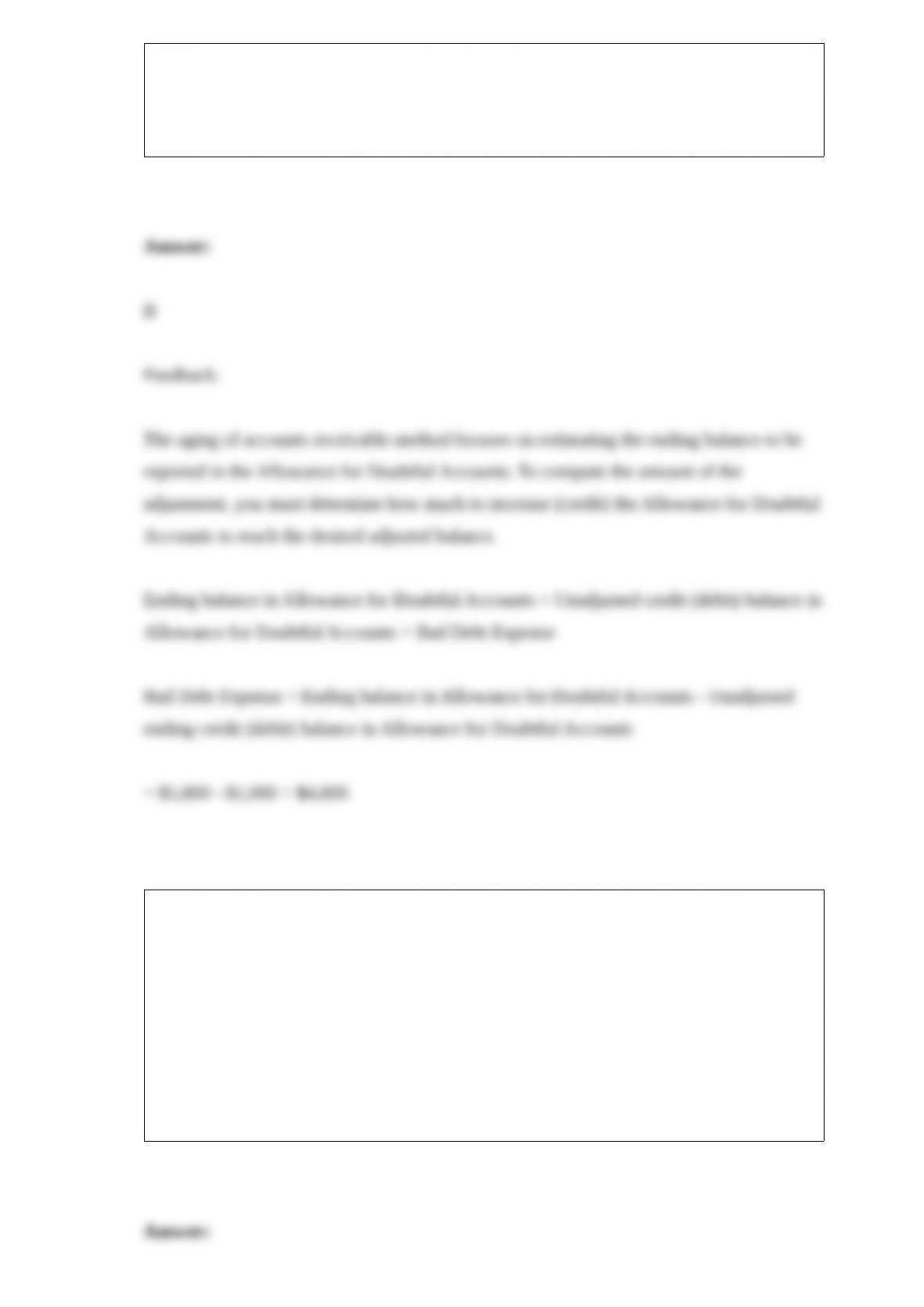
The unadjusted trial balance at the end of the year includes the following:
Both accounts have normal balances. The company uses the aging of accounts
receivable method. Its estimate of uncollectible receivables resulting from the aging
analysis equals $5,800. What is the amount of Bad Debt Expense to be recorded for the
year?
A) $5,800
B) $4,800
C) $6,800
D) $7,800
Use the information above to answer the following question. The company would
report net cash provided by (used in) financing activities of:
A) $(2,500).
B) $2,000.
C) $5,000.
D) $6,000.
A retail chain sells 100 designer sheet sets for $199.99 a set; the company purchased
these sheet sets at $69.95 per set. The company also sells 1,000 basic sheet sets for
$49.99 a set. The company purchased these sheet sets at $24.99 per set. Operating
expenses equal $10,000.
Required:
Part a. Calculate the gross profit percentages of each product (rounded to the nearest
whole number).
Part b. Calculate the total gross profit.
Part c. Calculate income before income tax expense
Axle Inc. updates its inventory perpetually. Its beginning inventory is $35,000, goods
purchased during the period cost $120,000, and the cost of goods sold for the period is
$140,000. What is the amount of the ending inventory?
A) $45,000
B) $20,000
C) $25,000
D) $15,000
The statement of cash flows cannot be used to determine:
A) changes in working capital.
B) expenditures on long-term assets.
C) profitability as measured by specific revenues and expenses.
D) reliance on external financing.
Choose the appropriate letter to match the term and the definition. There are more
definitions than terms.
Term
1) ____ Cost of Goods Sold Equation
2) ____ Goods Available for Sale
3) ____ Gross Profit (or Gross Margin)
4) ____ Gross Profit Percentage
5) ____ Multistep Income Statement
Definition
A. The sum of beginning inventory and purchases for the period.

B. Expresses the relationship between inventory on hand, purchased, and sold; shown
as either BI + P – EI = CGS or BI + P – CGS = EI.
C. The cost of inventory lost to theft, fraud, and error.
D. A reduction in the cost of inventory purchases associated with unsatisfactory goods.
E. A cash discount received for prompt payment of a purchase on account.
F. Refunds and price reductions given to customers after goods have been sold and
found unsatisfactory.
G. A sales price reduction given to customers for prompt payment of their account
balance.
H. Presents important subtotals, such as gross profit, to help distinguish core operating
results from other, less significant items that affect net income.
I. Net sales minus cost of goods sold. It is a subtotal, not an account.
J. A ratio indicating the percentage of profit earned on each dollar of sales, after
considering the cost of products sold.
A corporation declared a stock dividend on November 1 and issued 9,000 shares of
stock to its stockholders. Prior to the dividend, the balance in Retained Earnings was
$850,000, the number of shares of $5 par value stock issued and outstanding was
60,000, and the market value of the stock was $12. This stock dividend will cause total
stockholders’ equity to:
A) remain unchanged.
B) increase by $45,000.
C) decrease by $108,000.
D) decrease by $63,000.
On October 31, 2015, the bank statement shows that your company has $12,956.73 in
its checking account. You are aware of three outstanding checks for a total of $2,112.19.
During October, 2015, the bank rejected two deposited checks from customers totaling
$654.19 because of insufficient funds and charged you $12.00 in service fees. You had
not yet received notice about the bad checks, but you were aware of and have recorded
the $12.00 of service fees. Prior to adjustment on October 31, 2015, your Cash account
would have a balance of:
A) $14,402.73.
B) $15,711.11.
C) $11,498.73.
D) $10,202.35.
When the direct write-off method is used to account for uncollectible accounts, which
of the following accounts would not be used?
A) Bad Debt Expense
B) Accounts Receivable
C) Allowance for Doubtful Accounts
D) Notes Receivable
Lakeview Inc. uses the allowance method. During the year, Lakeview concludes that
specific customers will never pay their account balances, which total $6,844. The entry
to record the write-off of these accounts receivable would debit:
A) Accounts Receivable and credit Allowance for Doubtful Accounts for $6,844.
B) Accounts Receivable and credit Bad Debt Expense for $6,844.
C) Bad Debt Expense and credit Accounts Receivable for $6,844.
D) Allowance for Doubtful Accounts and credit Accounts Receivable for $6,844.
Dividends:
A) are an expense of doing business.
B) are not a legal obligation that a company must pay.
C) are reported only on the statement of retained earnings.
D) are reported on the balance sheet.