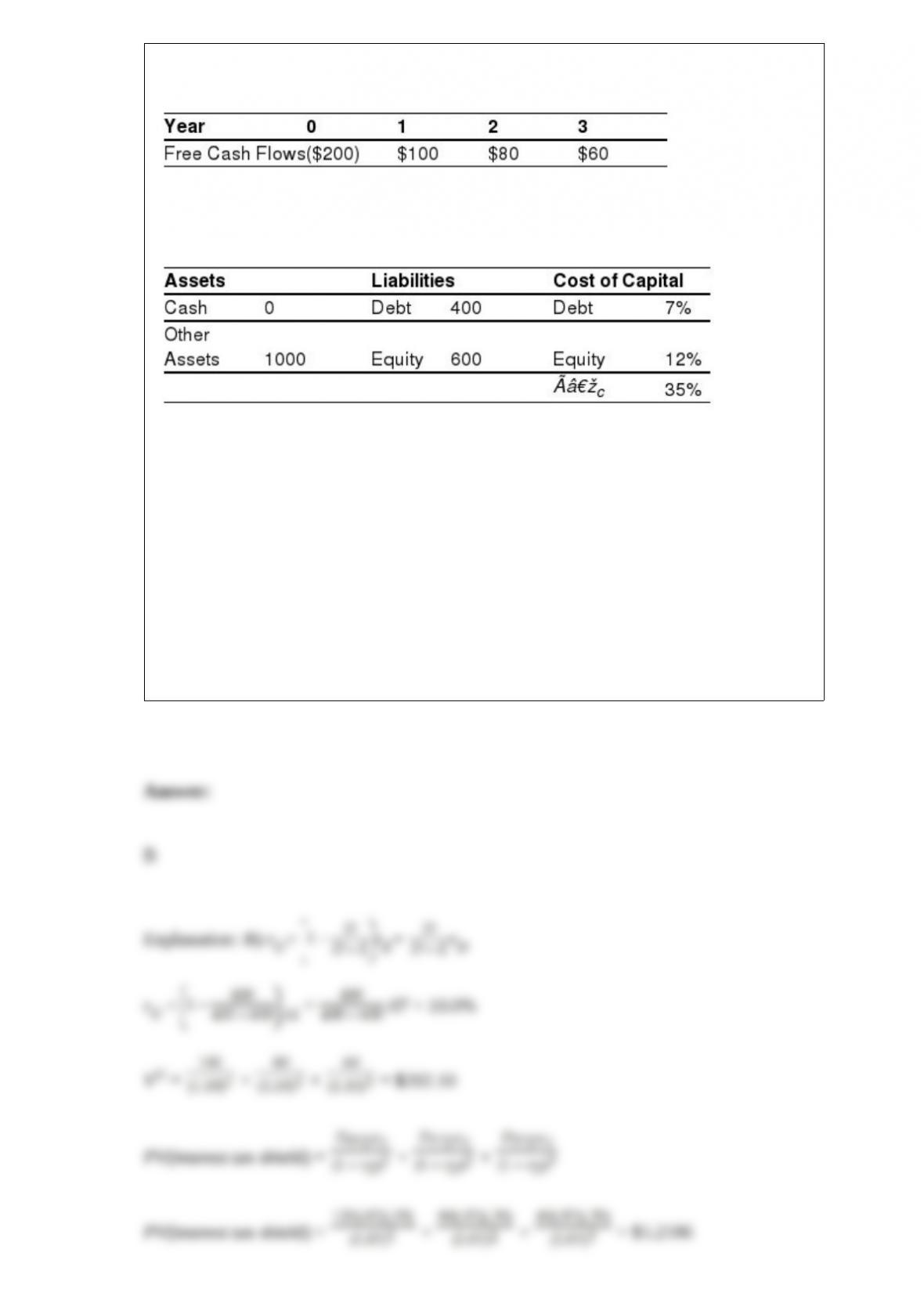
Aardvark Industries is considering a project that will generate the following free cash
flows:
You are also provided with the following market value balance sheet and information
regarding Aardvark’s cost of capital:
Suppose that to fund this new project, Aardvark borrows $120 with the principal to be
paid in three equal installments at the end each year. The levered value of Aardvark’s
new project is closest to:
A) $210.15
B) $207.35
C) $207.00
D) $210.50
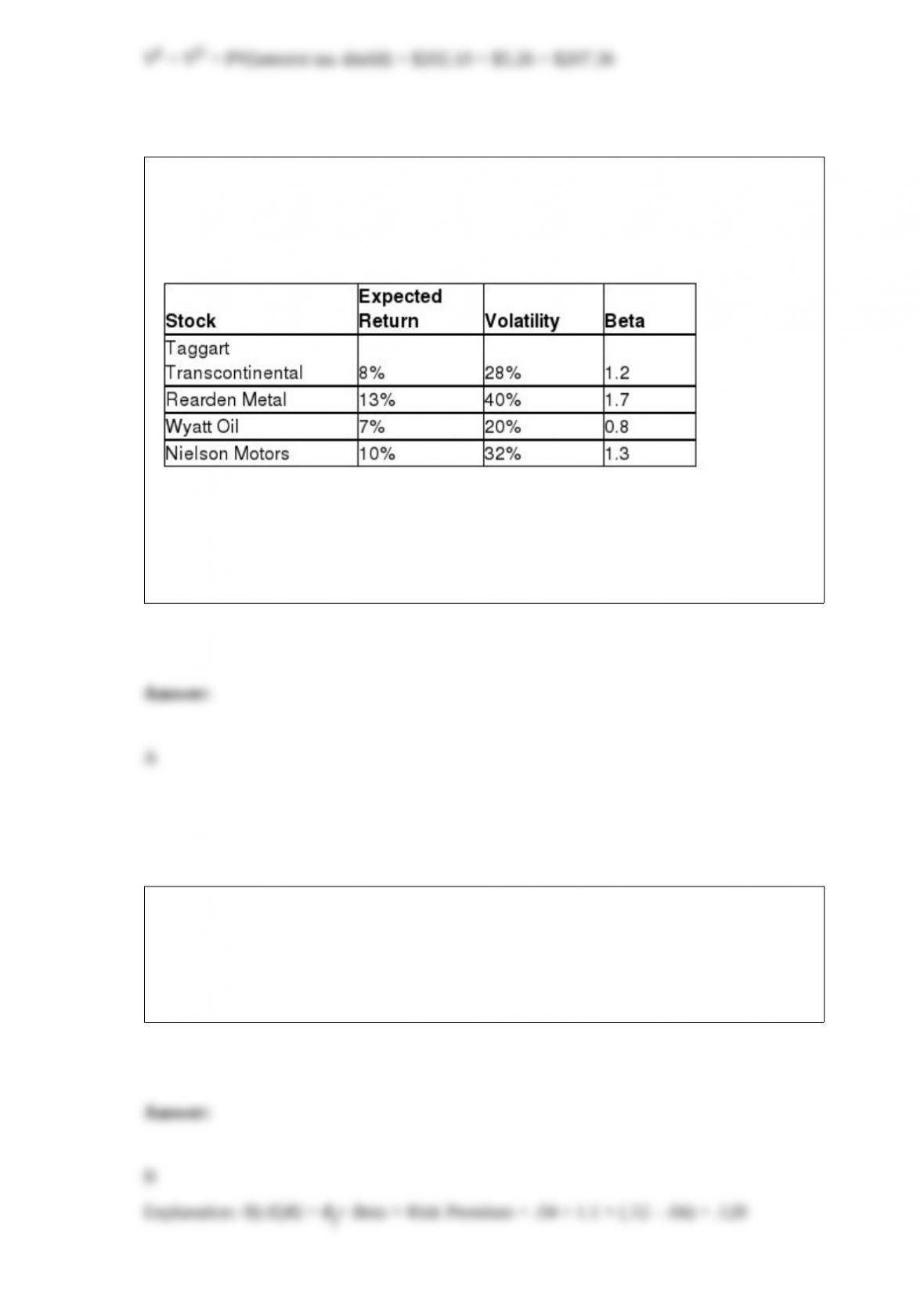
Assume that the CAPM is a good description of stock price returns. The market
expected return is 8% with 12% volatility and the risk-free rate is 3%. New news
arrives that does not change any of these numbers, but it does change the expected
returns of the following stocks:
A stock’s alpha is defined as the stock’s:
A) expected return minus its required return.
B) expected return minus its actual return.
C) nominal return minus its required return.
D) required return minus its actual return.
The cost of capital for a project with the same beta as Merck’s stock is closest to:
A) 11.2%
B) 12.8%
C) 12.4%
D) 11.6%

In an agency problem known as debt overhang, if the company has risky debt
outstanding, equity holders will choose to invest only if:
A) the NPV of the project exceeds a cutoff equal to the relative riskiness of the firm’s
debt times its debt-equity ratio.
B) the profitability index of the project exceeds a cutoff equal to the relative riskiness of
the firm’s debt times its debt-equity ratio.
C) the NPV of the project is negative.
D) the debt holders will lose all their money.
Which of the following formulas is INCORRECT?
A) Ï„*retain =
B) Pretain =
C) Pretain = Pcum ×
D) Pretain = Pcum × (1 – Ï„*retain)

Von Bora Corporation is expected pay a dividend of $1.40 per share at the end of this
year and a $1.50 per share at the end of the second year. You expect Von Bora’s stock
price to be $25.00 at the end of two years. Von Bora’s equity cost of capital is 10%.
Suppose you plan on purchasing Von Bora stock in one year, right after the $1.40
dividend is paid. You then plan on selling your stock at the end of year two, right after
the $1.50 dividend is paid. The dividend yield that you will receive on your investment
is closest to:
A) 5.75%
B) 6.50%
C) 6.25%
D) 4.00%
Which of the following is consistent with the CAPM and efficient capital markets?
A) A security with a beta of 1 has a return last year of 8% when the market has a return
of 12%.
B) Small stocks with a beta of 1.5 tend to have higher returns on average than large
stocks with a beta of 1.5.
C) A security with only diversifiable risk has an expected return that exceeds the
risk-free interest rate.
D) A security with only systematic risk has an expected return that exceeds the risk-free
interest rate.
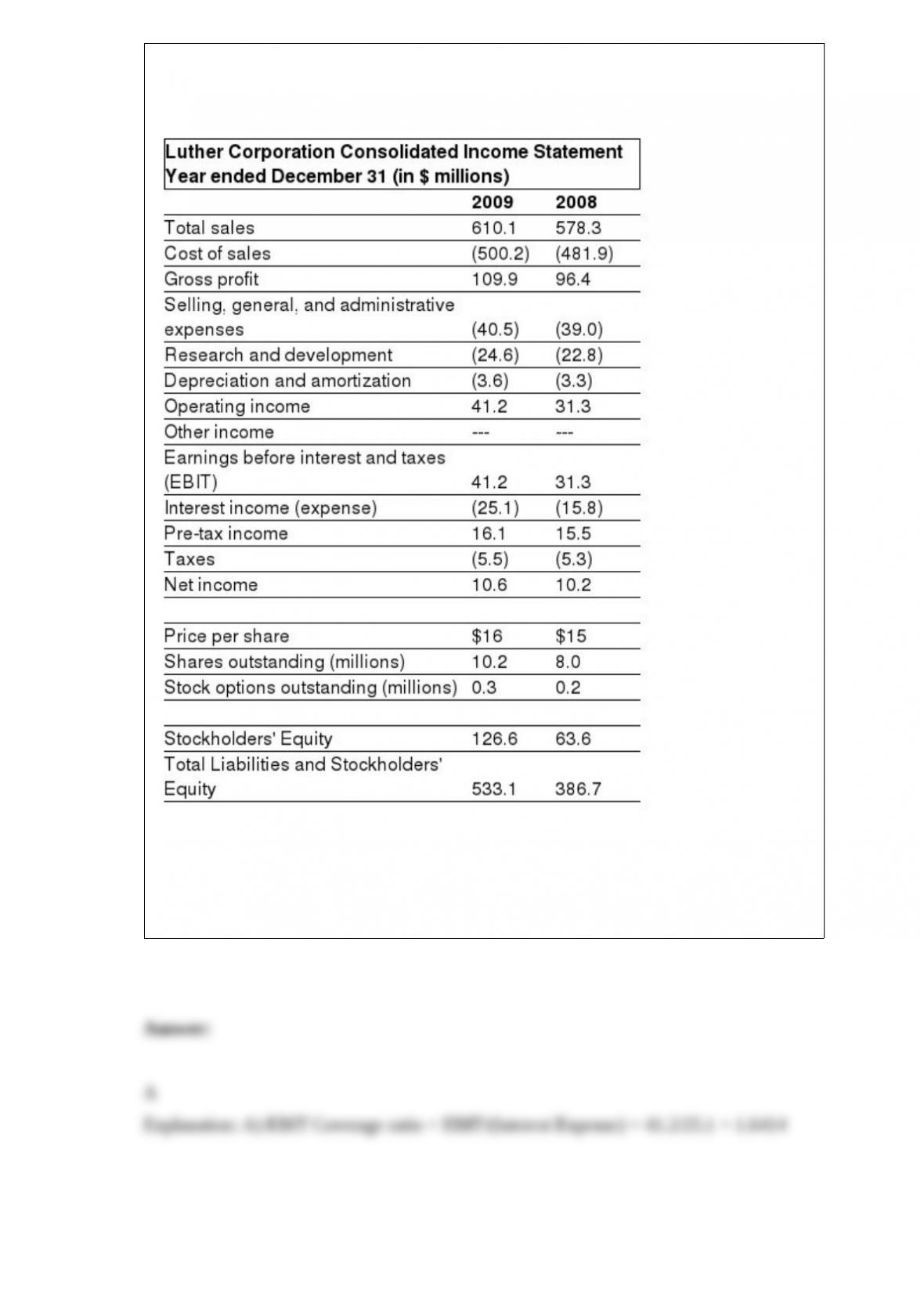
Luther’s EBIT coverage ratio for the year ending December 31, 2008 is closest to:
A) 1.64
B) 1.78
C) 1.98
D) 2.19

An exception to the key difference between sovereign default and corporate bonds is:
A) member states of the U.S.
B) member states of the EMU.
C) member states of the African Union.
D) member states of the NAFTA.
Which of the following statements is FALSE?
A) The expected return of a portfolio is equal to the weighted average expected return,
but the volatility of a portfolio is less than the weighted average volatility.
B) Each security contributes to the volatility of the portfolio according to its volatility,
scaled by its covariance with the portfolio, which adjusts for the fraction of the total
risk that is common to the portfolio.
C) Nearly half of the volatility of individual stocks can be eliminated in a large
portfolio as a result of diversification.
D) The overall variability of the portfolio depends on the total co-movement of the
stocks within it.
Consider a portfolio that consists of an equal investment in 20 firms. For each of these
firms, there is a 70% probability that the firms will have a 16% return and a 30% that
they will have a – 8% return. Each of these firms’ returns is independent of all others.
The standard deviation of this portfolio is closest to:
A) 2.5%
B) 4.2%
C) 8.8%
D) 11.0%

Consider the following regression model:
Rs– rf= as+ (RF1– rf) + (RF2– rf) + e
The term is a(n):
A) measure of the expected percent change in the excess return of a security for a 1%
change in the excess return of the second factor portfolio.
B) error term that has an expectation of zero and is uncorrelated with either factor.
C) constant term.
D) measure of the expected percent change in the excess return of a security for a 1%
change in the excess return of the first factor portfolio.
Assume that you are 30 years old today, and that you are planning on retirement at age
65. Your current salary is $45,000 and you expect your salary to increase at a rate of 5%
per year as long as you work. To save for your retirement, you plan on making annual
contributions to a retirement account. Your first contribution will be made on your 31st
birthday and will be 8% of this year’s salary. Likewise, you expect to deposit 8% of
your salary each year until you reach age 65. Assume that the rate of interest is 7%.
The present value (at age 30) of your retirement savings is closest to:
A) $87,000
B) $108,000
C) $46,600
D) $75,230

Assume that the Wilshire 5000 currently has a dividend yield of 2% and that on
average, the dividends of Wilshire 5000 firms have increased by about 7% per year. If
the risk-free interest rate is 4%, then your estimate for the future market risk premium
is:
A) 4%
B) 7%
C) 8%
D) 5%
Omicron Technologies has $50 million in excess cash and no debt. The firm expects to
generate additional free cash flows of $40 million per year in subsequent years and will
pay out these future free cash flows as regular dividends. omicrons unlevered cost of
capital is 10% and there are 10 million shares outstanding. Omicron’s board is meeting
to decide whether to pay out its $50 million in excess cash as a special dividend or to
use it to repurchase shares of the firm’s stock.
Including its cash, Omicron’s total market value is closest to:

A) $500 million
B) $900 million
C) $400 million
D) $450 million
Luther is a successful logistical services firm that currently has $5 billion in cash.
Luther has decided to use this cash to repurchase shares from its investors, and has
already announced the stock repurchase plan. Currently Luther is an all equity firm with
1.25 billion shares outstanding. Luther’s shares are currently trading at $20 per share.
Assume that in addition to 1.25 billion common shares outstanding, Luther has stock
options given to employees valued at $2 billion. After the repurchase how many shares
will Luther have outstanding?
A) 1.0 billion
B) 1.2 billion
C) 0.75 billion
D) 1.1 billion

Which of the following statements regarding growing annuities is FALSE?
A) A growing annuity is a stream of N growing cash flows, paid at regular intervals.
B) We assume that g < r when using the growing annuity formula.
C) PV of a growing annuity = C ×
D) A growing annuity is like a growing perpetuity that never comes to an end.
Consider two firms, With and Without, that have identical assets that generate identical
cash flows. Without is an all-equity firm, with 1 million shares outstanding that trade
for a price of $24 per share. With has 2 million shares outstanding and $12 million
dollars in debt at an interest rate of 5%.
Assume that MM’s perfect capital markets conditions are met and that you can borrow
and lend at the same 5% rate as with. You have $5000 of your own money to invest and
you plan on buying Without stock. Using homemade leverage you borrow enough in
your margin account so that the payoff of your margined purchase of Without stock will
be the same as a $5000 investment in with stock. The number of shares of Without
stock you purchased is closest to:
A) 425
B) 1650
C) 2000
D) 825

Which of the following formulas regarding NPV is INCORRECT?
A) NPV + PV(benefits) = PV(Cost)
B) NPV + PV(costs) = PV(benefits)
C) NPV = PV(All project cash flows)
D) All of the above
Monsters Incorporated (MI) in ready to launch a new product. Depending upon the
success of this product, MI will have a value of either $100 million, $150 million, or
$191 million, with each outcome being equally likely. The cash flows are unrelated to
the state of the economy (i.e. risk from the project is diversifiable) so that the project
has a beta of 0 and a cost of capital equal to the risk-free rate, which is currently 5%.
Assume that the capital markets are perfect.
Assume that in the event of default, 20% of the value of MI’s assets will be lost in
bankruptcy costs and suppose that MI has zero-coupon debt with a $140 million face
value due next year. Calculate the value of levered equity, the value of debt, and the
total value of MI with leverage.

You are presently invested in the Luther Fund, a broad based mutual fund that invest in
stocks and other securities. The Luther Fund has an expected return of 14% and a
volatility of 20%. Risk-free Treasury bills are currently offering returns of 4%. You are
considering adding a precious metals fund to your current portfolio. The metals fund
has an expected return of 10%, a volatility of 30%, and a correlation of -.20 with the
Luther Fund.
Will adding the precious metals fund improve your portfolio?
Luther Corporation
Consolidated Balance Sheet
December 31, 2009 and 2008 (in $ millions)
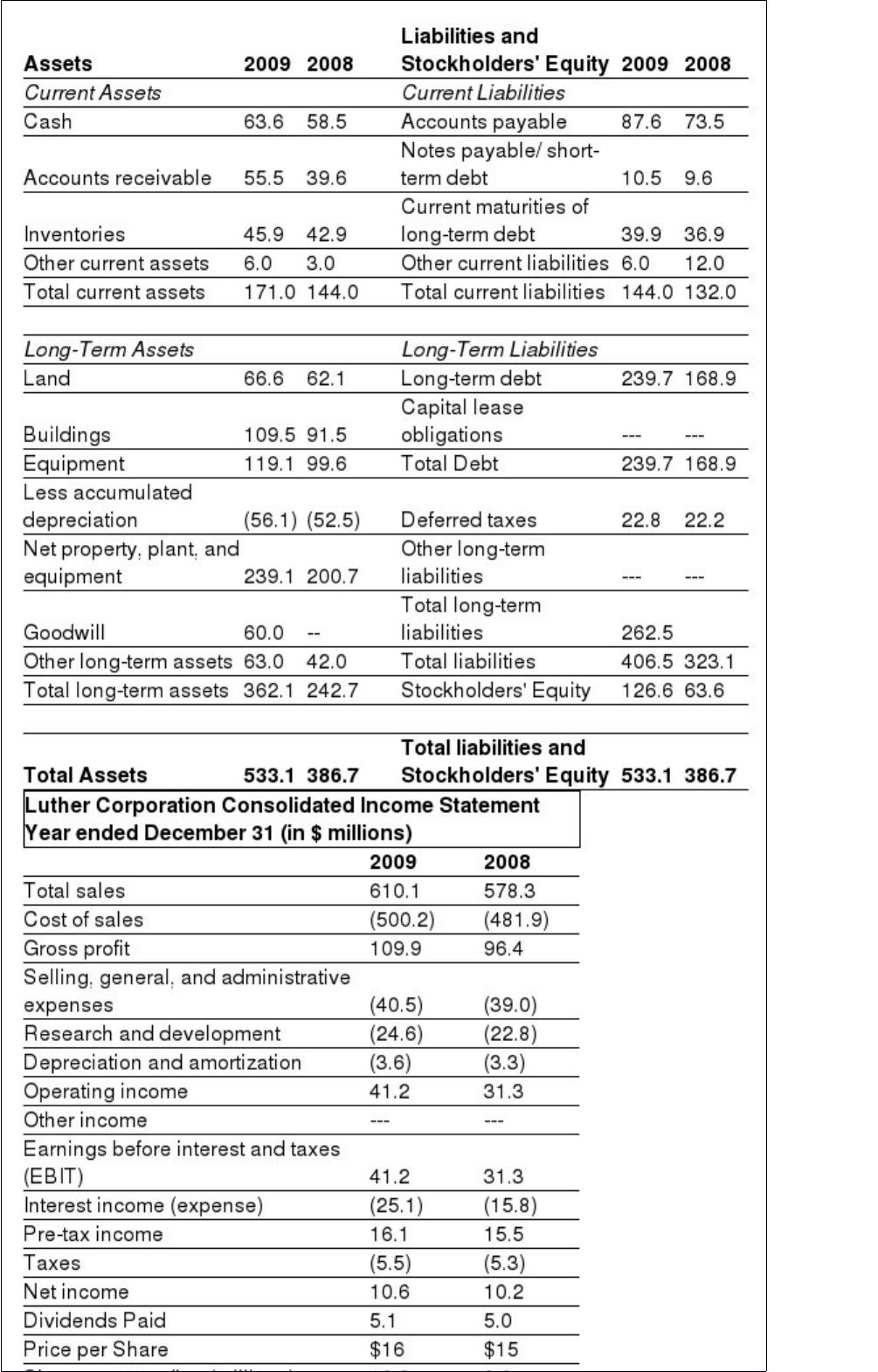
For the year ending December 31, 2009 Luther’s cash flow from operating activities is:
Explain the difference between a sub-chapter “S” corporation and a sub-chapter “C”
corporation.
Epiphany Industries is considering a new capital budgeting project that will last for
three years. Epiphany plans on using a cost of capital of 12% to evaluate this project.
Based on extensive research, it has prepared the following incremental cash flow
projects:
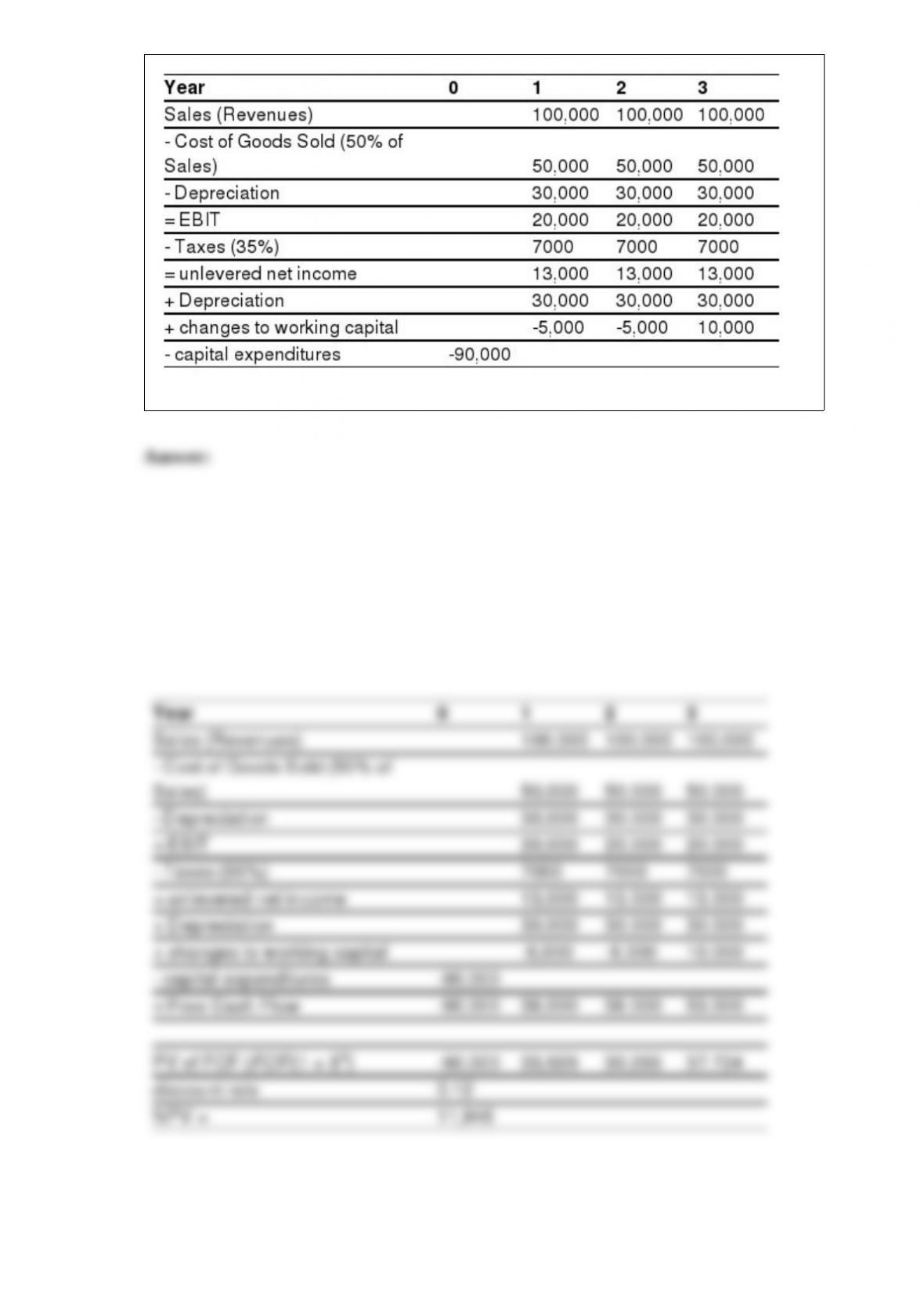
What is the NPV of the Epiphany’s project?
What are the four financial statements that all public companies must produce?
Assume that Rose Corporation’s (RC) EBIT is not expected to grow in the future and
that all earnings are paid out as dividends. RC is currently an all equity firm. It expects
to generate earnings before interest and taxes (EBIT) of $6 million over the next year.
Currently RC has 5 million shares outstanding and its stock is trading for a price of
$12.00 per share. RC is considering borrowing $12 million at a rate of 6% and using the
proceeds to repurchase shares at the current price of $12.00.
Show mathematically that the stock price of RC won’t change following the debt
issuance and share repurchase.
A company that manufactures copper piping is offering to trade you 5,925 tons of
low-grade copper ore for 4,000 tons of high-grade copper ore. Assuming you currently
have 4,000 tons of high-grade ore, what are the total benefits and added benefits of
taking the trade?
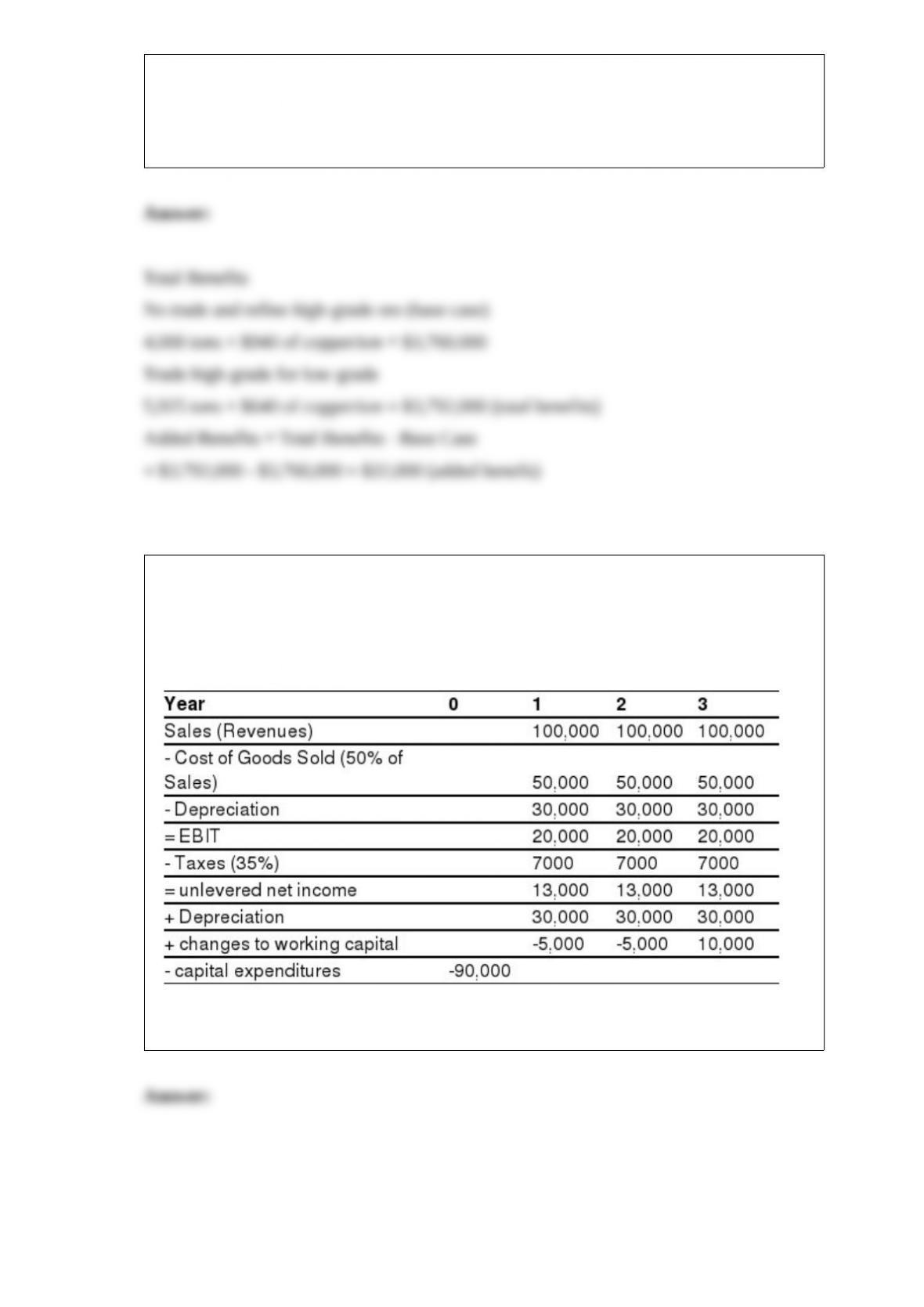
Epiphany Industries is considering a new capital budgeting project that will last for
three years. Epiphany plans on using a cost of capital of 12% to evaluate this project.
Based on extensive research, it has prepared the following incremental cash flow
projects:
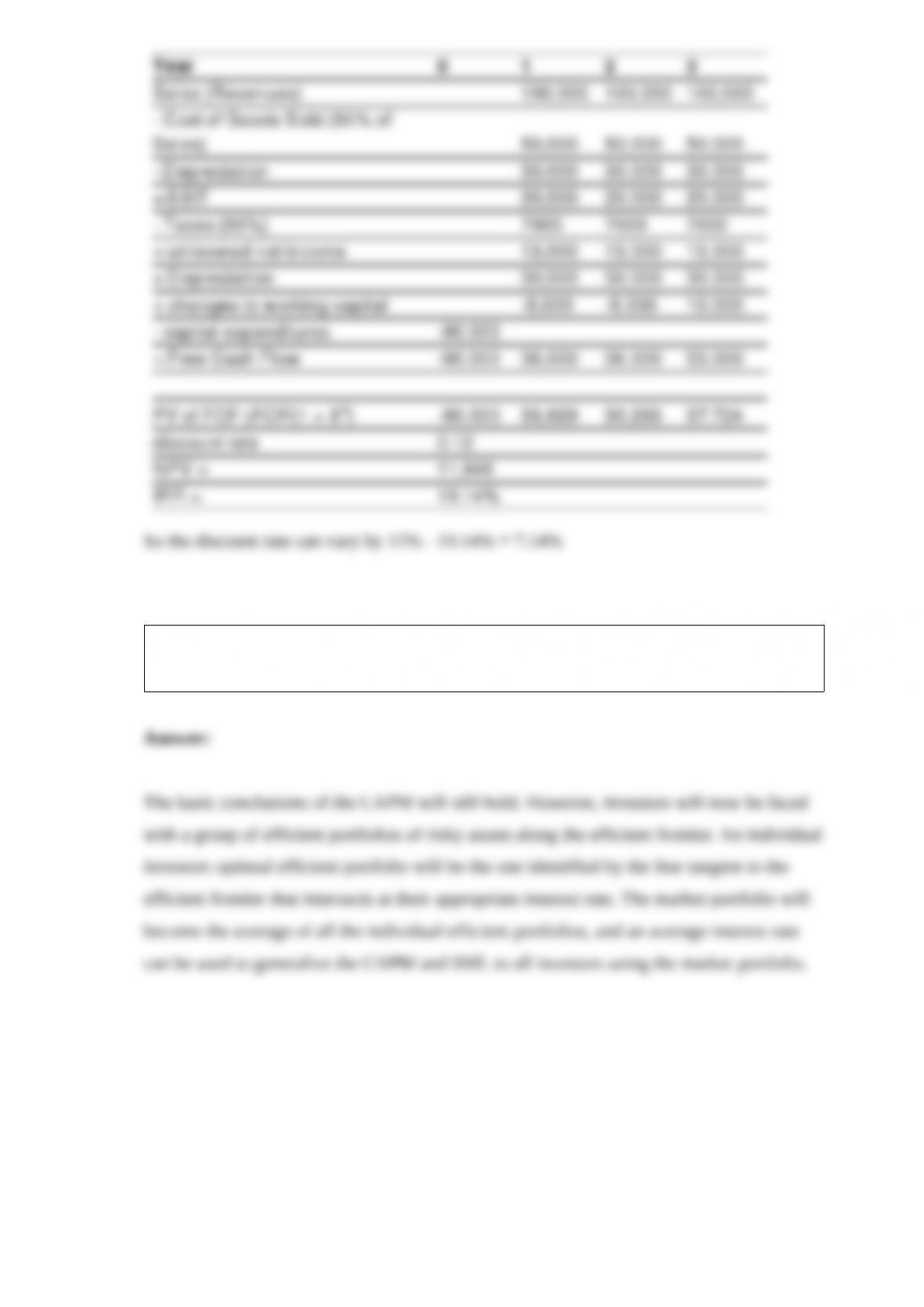
Epiphany would like to know how sensitive the project’s NPV is to changes in the
discount rate. How much can the discount rate vary before the NPV reaches zero?
Explain how having different interest rates for borrowing and lending affects the CAPM
and the SML.