
Suppose that Merck (MRK) stock is trading for $36.70 per share with 2.11 billion
shares outstanding while Boeing (BA) has 697.5 million shares outstanding and a
market capitalization of $38.223 billion. Assume that you hold the market portfolio.
Merck’s market capitalization is closest to:
A) $38.2 billion
B) $77.4 billion
C) $89.4 billion
D) $115.6 billion
Which of the following statements is FALSE?
A) We can use scenario analysis to evaluate alternative pricing strategies for our
project.
B) Scenario analysis considers the effect on NPV of changing multiple project
parameters.
C) The difference between the IRR of a project and the cost of capital tells you how
much error in the cost of capital it would take to change the investment decision.
D) Scenario analysis breaks the NPV calculation into its component assumptions and
show how the NPV varies as each one of the underlying assumptions change.
Consider the following two projects:

The payback period for project Alpha is closest to:
A) 3.2 years
B) 2.9 years
C) 3.1 years
D) 2.6 years
An exchange traded fund (ETF) is a security that represents a portfolio of individual
stocks. Consider an ETF for which each share represents a portfolio of two shares of
Apple Inc. (APPL), one share of Google (GOOG), and ten shares of Microsoft (MSFT).
Suppose the current stock prices of each individual stock are as shown below:
The price per share of this ETF in a normal market is closest to:
A) $800
B) $1,001
C) $1,067
D) $1,267

JRN Enterprises just announced that it plans to cut its dividend from $2.50 to $1.50 per
share and use the extra funds to expand its operations. Prior to this announcement,
JRN’s dividends were expected to grow at 4% per year and JRN’s stock was trading at
$25.00 per share. With the new expansion, JRN’s dividends are expected to grow at 8%
per year indefinitely. Assuming that JRN’s risk is unchanged by the expansion, the value
of a share of JRN after the announcement is closest to:
A) $25.00
B) $15.00
C) $31.25
D) $27.50
Which of the following statements is FALSE?
A) Debt holders are not foolish’”they recognize that when the firm defaults, they will
not be able to get the full value of the assets. As a result, they will pay less for the debt
initially.
B) The costs of financial distress represent an important departure from Modigliani and
Miller’s assumption of perfect capital markets.
C) Levered firms risk incurring financial distress costs that reduce the cash flows
available to investors.
D) When securities are fairly priced, the original shareholders of a firm pay the future

value of the costs associated with bankruptcy and financial distress.
Which of the following industries likely to have the highest costs of financial distress?
A) Grocery store
B) Semiconductors
C) Real estate
D) Utilities
Consider a project with free cash flows in one year of $90,000 in a weak economy or
$117,000 in a strong economy, with each outcome being equally likely. The initial
investment required for the project is $80,000, and the project’s cost of capital is 15%.
The risk-free interest rate is 5%.
Suppose that to raise the funds for the initial investment, the project is sold to investors
as an all-equity firm. The equity holders will receive the cash flows of the project in one
year. The market value of the unlevered equity for this project is closest to:
A) $94,100
B) $90,000
C) $86,250
D) $98,600
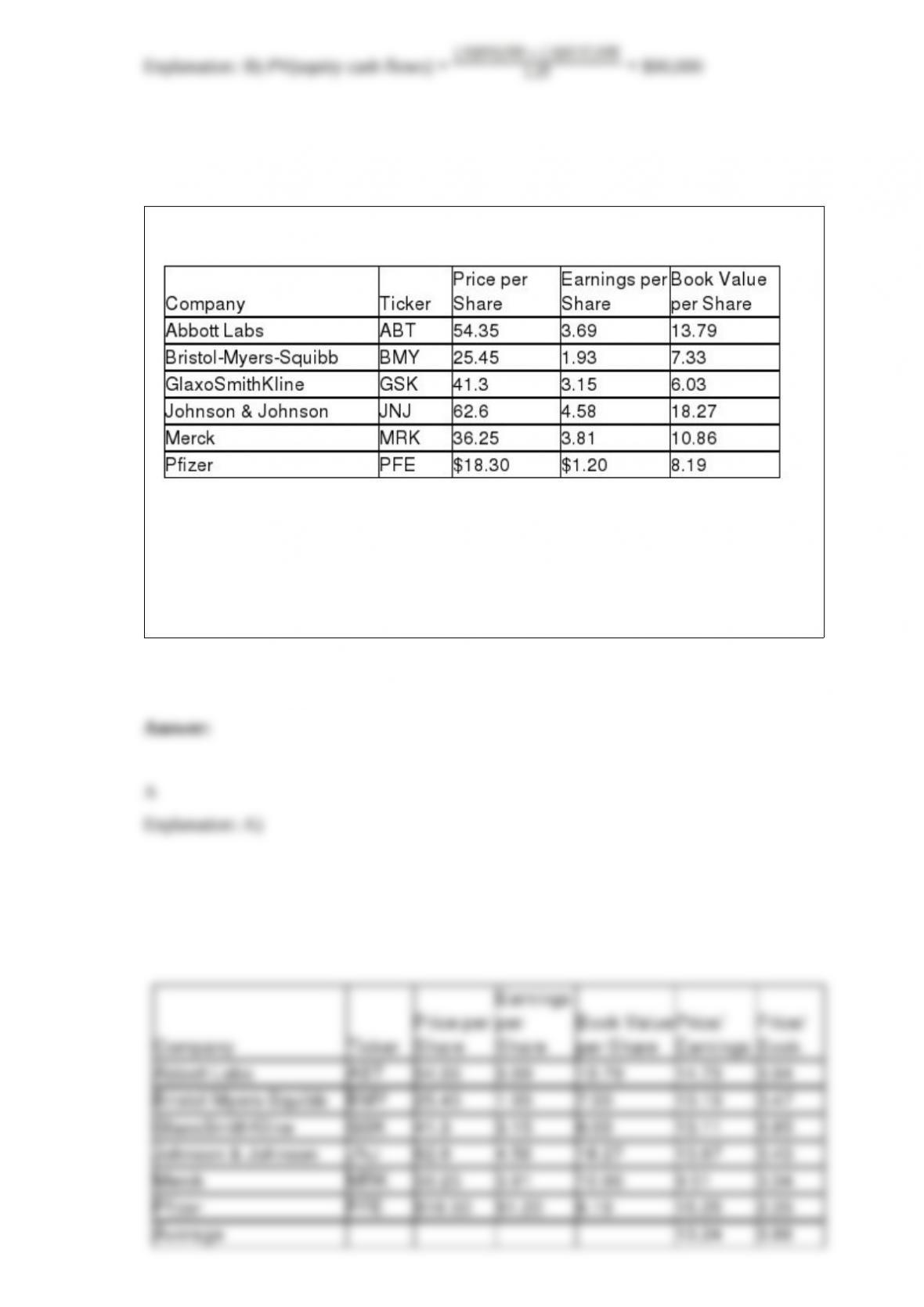
Assuming that Novartis AG (NVS) has an EPS of $3.35, based upon the average
price-to-book ratio for its competitors, Novartis’ stock price is closest to:
A) $13.00
B) $22.95
C) $39.70
D) $44.35

Which of the following statements is FALSE?
A) Project externalities are direct effects of the project that may increase of decrease the
profits of other business activities of the firm.
B) Incremental earnings are the amount by which the firm’s earnings are expected to
change as a result of the investment decision.
C) The average selling price of a product and its cost of production will generally
change over time.
D) Any money that has already been spent is a sunk cost and therefore irrelevant in the
capital budgeting process.
Which of the following statements is FALSE?
A) Portfolios with high market capitalizations must have positive alphas if the market
portfolio is not efficient.
B) The book-to-market is the observation that firms with high book-to-market ratios
have positive alphas.
C) If the market portfolio is not efficient, then a portfolio of high book-to-market stocks
will likely have positive alphas.
D) Portfolios with low book-to-market ratios must have zero alphas if the market
portfolio is efficient.

Which of the following statements is FALSE?
A) The direct costs of bankruptcy are likely to be higher for firms with more
complicated business operations and for firms with larger numbers of creditors, because
it may be more difficult to reach agreement among many creditors regarding the final
disposition of the firm’s assets.
B) In a prepackaged bankruptcy (or “prepack”) a firm will first develop a reorganization
plan with the agreement of its main creditors, and then file Chapter 7 to implement the
plan and pressure any creditors who attempt to hold out for better terms.
C) A study of Chapter 7 liquidations of small businesses found that the average direct
costs of bankruptcy were 12% of the value of the firm’s assets.
D) Studies typically report that the average direct costs of bankruptcy are
approximately 3% to 4% of the pre-bankruptcy market value of total assets.
In a corporation, the ultimate decisions regarding business matters are made by:
A) the Board of Directors.
B) debt holders.
C) shareholders.
D) investors.
Monsters Incorporated (MI) in ready to launch a new product. Depending upon the
success of this product, MI will have a value of either $100 million, $150 million, or
$191 million, with each outcome being equally likely. The cash flows are unrelated to
the state of the economy (i.e. risk from the project is diversifiable) so that the project
has a beta of 0 and a cost of capital equal to the risk-free rate, which is currently 5%.
Assume that the capital markets are perfect.
Assume that in the event of default, 20% of the value of MI’s assets will be lost in
bankruptcy costs and suppose that MI has zero-coupon debt with a $125 million face
value due next year. The yield to maturity of MI’s debt is closest to:
A) 13.75%
B) 5.00%
C) 19.25%
D) 12.50%
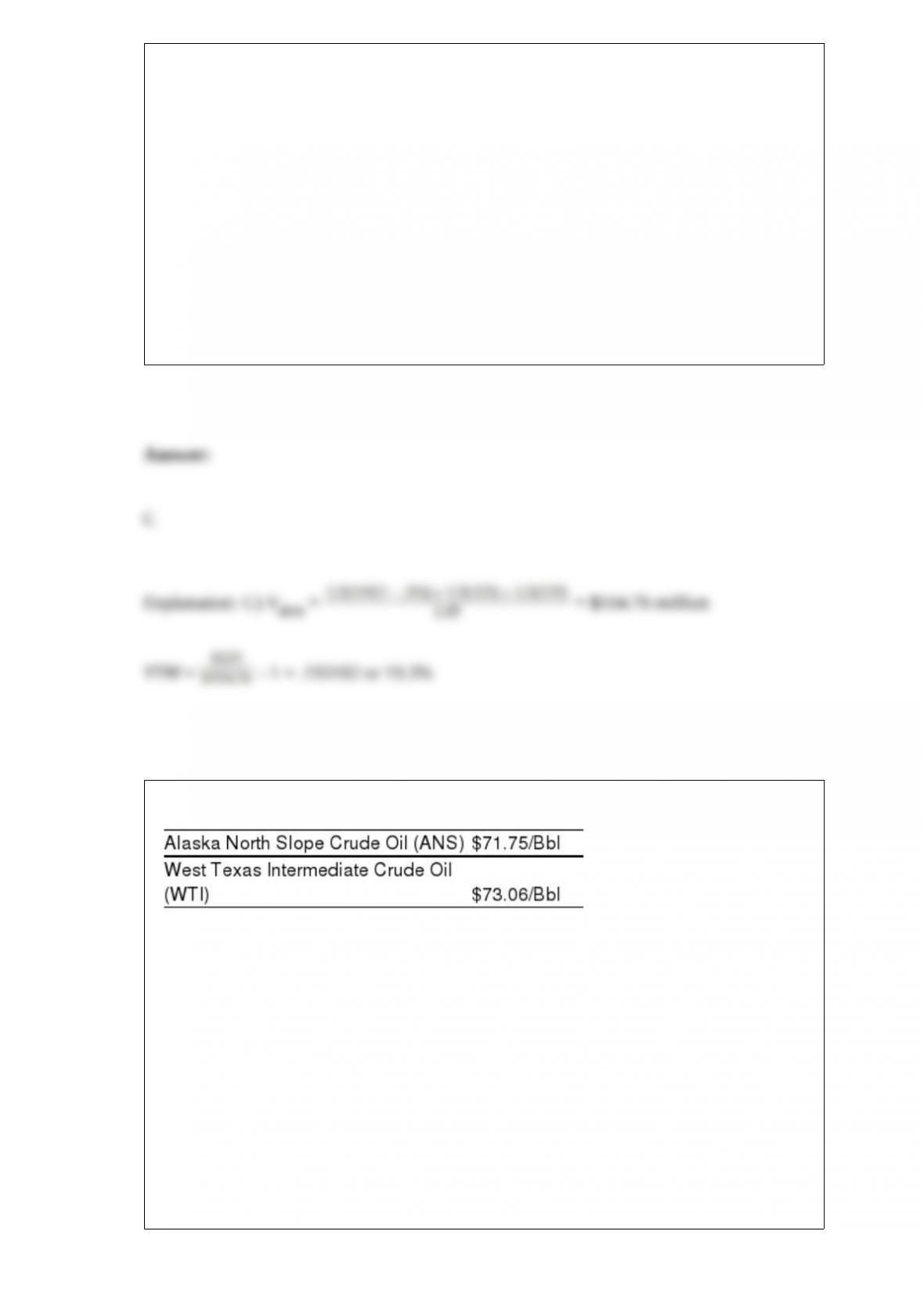
As an oil refiner, you are able to produce $76 worth of unleaded gasoline from one
barrel of Alaska North Slope (ANS) crude oil. Because of its lower sulfur content, you
can produce $77 worth of unleaded gasoline from one barrel of West Texas
Intermediate (WTI) crude.
Another oil refiner is offering to trade you 10,150 Bbls of Alaska North Slope (ANS)
crude oil for 10,000 Bbls of West Texas Intermediate (WTI) crude oil. Assuming you
currently have 10,000 Bbls of WTI crude, the added benefit (cost) to you if you were to
sell the 10,000 Bbls of WTI crude and use the proceeds to purchase and refine ANS
crude is closest to:
A) ($1,400)
B) $1,400
C) ($3,908)
D) $3,908

Money that has been or will be paid regardless of the decision whether or not to
proceed with the project is:
A) cannibalization.
B) considered as part of the initial investment in the project.
C) an opportunity cost.
D) a sunk cost.
Suppose that you have received two job offers. Rearden Metal offers you a contract for
$75,000 per year for the next two years while Wyatt Oil offers you a contract for
$90,000 per year for the next two years. Both jobs are equivalent. Suppose that Rearden
Metal’s contract is certain, but Wyatt Oil has a 60% chance of going bankrupt at the end
of the year. In the event that Wyatt Oil files for bankruptcy, it will cancel your contract
and pay you the lowest amount possible for you to not quit. If you do quit, you expect

you could find an new job paying $75,000 per year, but you would be unemployed for
four months while searching for this new job.Assuming your cost of capital is 6
percent, the present value of your expected wage if you accept Rearden Metal’s offer is
closest to:
A) $133,000
B) $138,000
C) $140,000
D) $144,000
Investors that suffer from a familiarity bias:
A) prefer not to invest in companies they are familiar with.
B) favor investments in companies they are familiar with.
C) invest in the same stocks that their friends or family recommend.
D) tend to overestimate the precision of their knowledge.
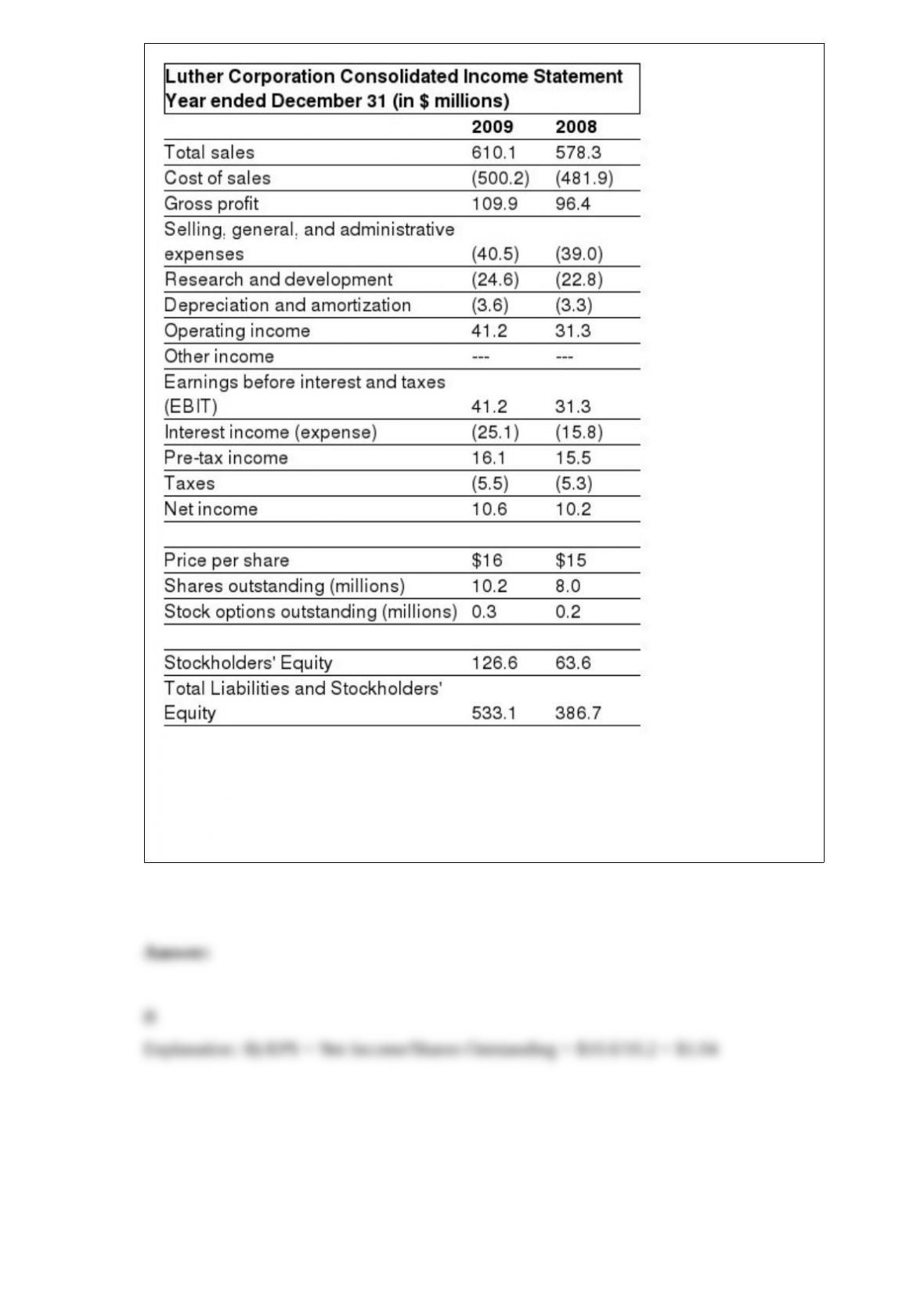
For the year ending December 31, 2009 Luther’s earnings per share are closest to:
A) $0.96
B) $1.04
C) $1.28
D) $1.33