
1) A firm has net income of $114,000, a return on assets of 12.6 percent, and a
debt-equity ratio of 0.60 . What is the return on equity?
A.17.11 percent
B.18.98 percent
C.20.16 percent
D.22.20 percent
E.24.60 percent
2) An auction market:
A.is an electronic means of exchanging securities
B.has a physical trading floor
C.handles primary market transactions exclusively
D.is also referred to as an OTC market
E.is dealer based
3) Harter’s Meats has an average collection period of 36 days and factors all of its
receivables immediately at a 1.2 percent discount. Assume all accounts are collected in
full. What is the firm’s effective cost of borrowing?
A.12.88 percent
B.12.94 percent
C.12.97 percent
D.13.02 percent
E.13.07 percent
4) Which one of the following best describes the primary intent of the Sarbanes-Oxley
Act of 2002?
A.Increase the costs of going public
B.Increase protection against corporate fraud
C.Limit secondary issues of corporate securities
D.Decrease the number of publicly traded firms
E.Increase the number of firms that “go dark”

5) Which one of the following terms applies to a junk bond that was originally issued
with a bond rating of AA?
A.Debenture
B.Covenant
C.Fallen angel
D.Sinking
E.Triple B
6) The 8 percent, $1,000 face value bonds of Sweet Sue Foods are currently selling at
$1,057. These bonds have 16 years left until maturity. What is the current yield?
A.7.38 percent
B.7.57 percent
C.8.00 percent
D.8.23 percent
E.8.28 percent
7) Dividends are which one of the following?
A.Payable at the discretion of a firm’s president
B.Treated as a tax-deductible expense to the paying firm
C.Paid out of aftertax profits
D.Paid to holders of record as of the declaration date
E.Only partially taxable to high-income individual shareholders
8) Innovative Technologies has 50,000 shares of stock outstanding at a market price of
$8 a share. Which one of the following stock splits should the firm declare if it wants to
increase the stock price to exactly $20 a share? Ignore any taxes or market
imperfections.
A.5-for-2 stock split

B.3-for-1 stock split
C.1-for-3-reverse stock split
D.2-for-5 reverse stock split
E.3-for-10 reverse stock split
9) What percentage of capital gains are excluded from taxation for corporate
shareholders?
A.0 percent
B.10 percent
C.25 percent
D.70 percent
E.75 percent
10) Which one of the following is the most apt to have the largest risk premium in the
future based on the historical record for 1926-2011?
A.U.S. Treasury bills
B.Large-company stocks
C.Long-term government debt
D.Small-company stocks
E.Long-term corporate debt
11) Which one of the following is the best example of a raw material?
A.Set of tires for an automaker
B.Partially assembled airplane
C.Cabinets ready to be shipped
D.Can of paint waiting to be sold
E.Cell phone waiting to be encased

12) Which one of the following cannot be computed?
A.Future value of an ordinary annuity
B.Future value of a perpetuity
C.Present value of a perpetuity
D.Present value of an annuity due
E.Present value of an ordinary annuity
13) The matching principle states that:
A.costs should be recorded on the income statement whenever those costs can be
reliably determined
B.costs should be recorded when paid
C.the costs of producing an item should be recorded when the sale of that item is
recorded as revenue
D.sales should be recorded when the payment for that sale is received
E.sales should be recorded when the earnings process is virtually completed and the
value of the sale can be determined
14) The Paint Ball Range, Inc. paid $30,500 in dividends and $7,600 in interest over the
past year. Sales totaled $211,800 with costs of $167,900. The depreciation expense was
$16,500. The applicable tax rate is 34 percent. What is the amount of the operating cash
flow?
A.$14,232
B.$15,306
C.$28,222
D.$37,168
E.$40,568
15) Which one of the following is an example of long-run exposure to exchange rate
risk? Ignore all fees and transaction costs.
A.A U.S. firm owns land in Mexico valued at three million pesos. That value has
remained constant in Mexican pesos for the past year. However, the firm’s financial
statement reflects a 3 percent decrease in the value of that land for last year

B.A U.S. firm sells $250,000 worth of goods to Peru. However, when the payment for
those goods arrives and the U.S. firm exchanges the foreign currency, it receives only
$248,700
C.A U.S. firm purchases $120,000 worth of goods from Canada. However, by the time
the goods arrive and the invoice is payable, the cost of those goods has increased to
$120,400
D.A few years ago, a U.S. firm built a factory in Asia to take advantage of the lower
labor costs. Today, the Asian labor costs have increased such that the Asian factory no
longer provides a cost advantage over a U.S. factory
E.A U.S. traveler withdrew an extra $2,000 in cash from her savings account to take
with her as emergency funds when she traveled to Mexico. Before leaving on her trip,
she exchanged this money into Mexican pesos. She never used any of this money
during her vacation, so exchanged all of it back into U.S. dollars on her return and
received $1,960
16) Which of the following are factors that help explain why the percentage of U.S.
industrial firms paying dividends has increased since the early 2000s?
I. Decrease in the number of non-dividend-paying firms
II. Maturing of young, successful firms
III. Signaling of a firm’s financial health
IV. May 2003 tax act
A.I and III only
B.II and IV only
C.I, II, and III only
D.II, III, and IV only
E.I, II, III, and IV
17) The value of a bond is dependent on the:
A.coupon rate and the current yield
B.coupon rate and the yield to maturity
C.current yield and the yield to maturity
D.coupon rate but neither the current yield nor the yield to maturity
E.yield to maturity but neither the current yield nor the coupon rate

18) Your German friend has decided to come and visit you in the U.S. You estimate the
cost of her trip at $2,600. What is the cost to her in euros if the U.S. dollar equivalent of
the euro is 1.3266?
A.1,566.67
B.1,959.90
C.1,908.50
D.2,716.34
E.3,449.16
19) You just returned from a trip to Venezuela and have 1,650 bolivaresfuertes in your
pocket. How many dollars will you receive when you exchange this money if the U.S.
dollar equivalent of the bolivaresfuertes is 0.465701?
A.$629.08
B.$768.41
C.$811.40
D.$2,897.18
E.$3,543.05
20) When, if ever, will the geometric average return exceed the arithmetic average
return for a given set of returns?
A.When the set of returns includes only risk-free rates
B.When the set of returns has a wide frequency distribution
C.When the set of returns has a very narrow frequency distribution
D.When all of the rates of return in the set of returns are equal to each other
E.Never
21) An asset used in a three-year project falls in the five-year MACRS class for tax
purposes. The asset has an acquisition cost of $5.4 million and will be sold for $1.2
million at the end of the project. If the tax rate is 35 percent, what is the aftertax salvage
value of the asset?
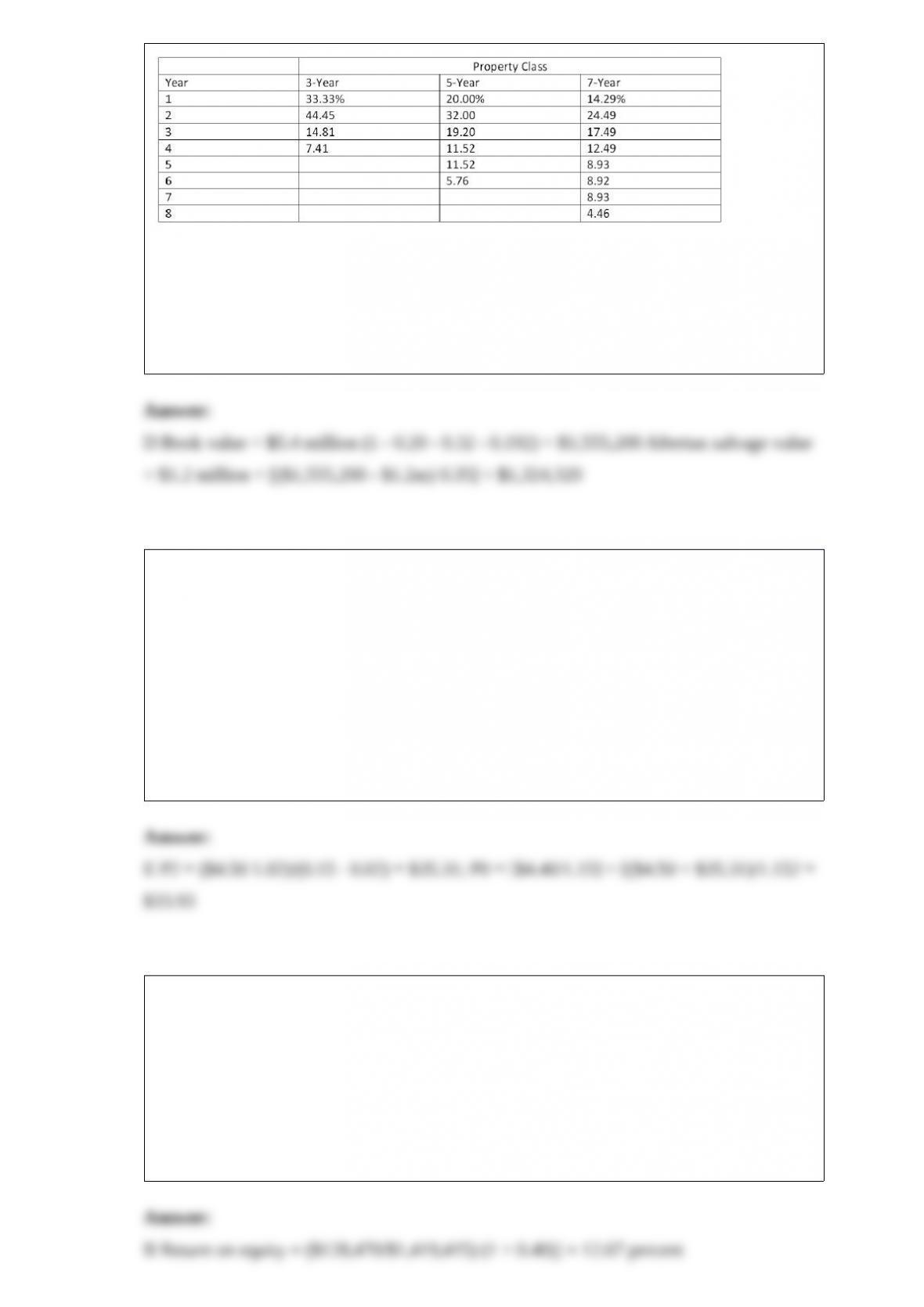
Table 9.7 Modified ACRS depreciation allowances
A.$1,075,680
B.$780,000
C.$904,320
D.$1,324,320
E.$1,187,560
22) The Three Amigos Restaurant just paid an annual dividend of $4.20 per share and is
expected to pay annual dividends of $4.40 and $4.50 per share the next two years,
respectively. After that, the firm expects to maintain a constant dividend growth rate of
2 percent per year. What is the value of this stock today if the required return is 15
percent?
A.$27.64
B.$29.61
C.$30.66
D.$33.05
E.$33.93
23) Mercier United has net income of $128,470. There are currently 32.67 days’ sales in
receivables. Total assets are $1,419,415, total receivables are $122,306, and the
debt-equity ratio is 0.40 . What is the return on equity?
A.11.42 percent
B.12.67 percent
C.13.09 percent
D.13.48 percent
E.15.03 percent
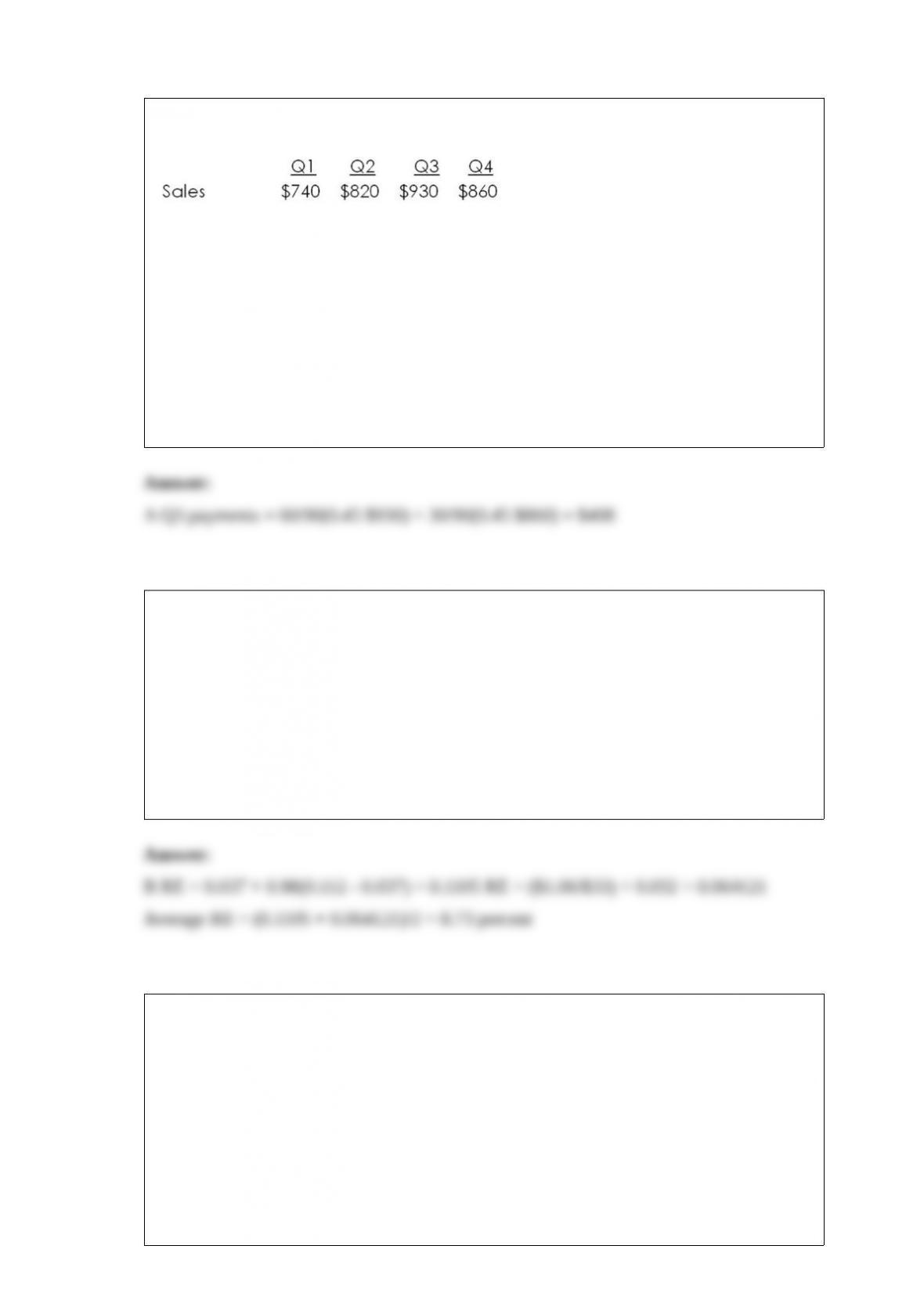
24) Pannick Motors has projected the following sales for the coming year.
Sales in the year following this one are projected to be 12 percent greater in each
quarter. Assume the company places orders during each quarter equal to 45 percent of
projected sales for the next quarter. How much will the firm pay its suppliers in quarter
3 if the firm has a 60-day payables period?
A.$408
B.$427
C.$463
D.$489
E.$511
25) The Cracker Barrel has a beta of 0.98, a dividend growth rate of 3.2 percent, a stock
price of $33 a share, and an expected annual dividend of $1.06 per share next year. The
market rate of return is 11.2 percent and the risk-free rate is 3.7 percent. What is the
firm’s cost of equity?
A.7.74 percent
B.8.73 percent
C.9.30 percent
D.9.72 percent
E.17.46 percent
26) Which of the following are advantages of the corporate form of organization?
I. Ability to raise large sums of equity capital
II. Ease of ownership transfer
III. Profits taxed at the corporate level
IV. Limited liability for all owners
A.I and II only
B.III and IV only
C.II, III, and IV only
D.I, II, and IV only
E.I, II, III, and IV
27) John’s has common stock outstanding at a price of $27 a share. The total market
value of the equity is $435,000. How many shares of stock will be outstanding if the
firm does a 2-for-5 reverse stock split?
A.40,278 shares
B.36,000 shares
C.6,444 shares
D.7,500 shares
E.16,500 shares
28) What are the differences between a regular cash dividend, a liquidating dividend, a
special dividend, and an extra cash dividend?
29) Explain how the forward exchange market can help reduce short-run exposure to
exchange rate risk.
30) List the various determinants of bond yields and indicate the type of situation that
would cause each determinant to increase the yield on a bond.
31) Assume a fellow student made these statements during a class discussion:
“Bankruptcy costs affect a firm only if the firm files a bankruptcy petition with the
court. Therefore, the static theory of capital structure only applies to bankrupt firms.”
Write a response to your fellow student that either supports or contradicts that student’s
statements.
32) Identify some of the specific costs firms incur if their current asset levels are either
too high or too low.
33) What are some of the key factors an individual should consider before selecting a
first-stage venture capitalist?
34) You want to have $2.5 million saved on the day you retire. Explain how you can
minimize the amount of cash you must invest in order to achieve this goal.
35) Explain what capital structure management is and give three examples of capital
structure decisions.