
With no policy, each firm emits 120 tons of carbon. As H reduces its emissions from
120 to 0, its marginal abatement cost (MAC) rises from $0 to $480; as L reduces its
emissions from 120 to 0, its MAC rises from $0 to $120. The MD of a ton of carbon is
$96. The tax per ton is T.
Refer to Figure 2.2. Suppose instead of a tax the government sells 120 permits. If the
price were $48, L would demand ___ and H would demand ___.
A. 24; 96
B. 48; 108
C. 72; 96
D. 72; 108
Answer:
If there were no government, the free market would
A. enrich workers.
B. enrich capitalists.
C. prosper.
D. fail.
Answer:
A gasoline tax can be justified by
A. pollution and road maintenance costs.
B. pollution costs only.
C. road maintenance costs only.
D. neither pollution nor road maintenance costs.
Answer:
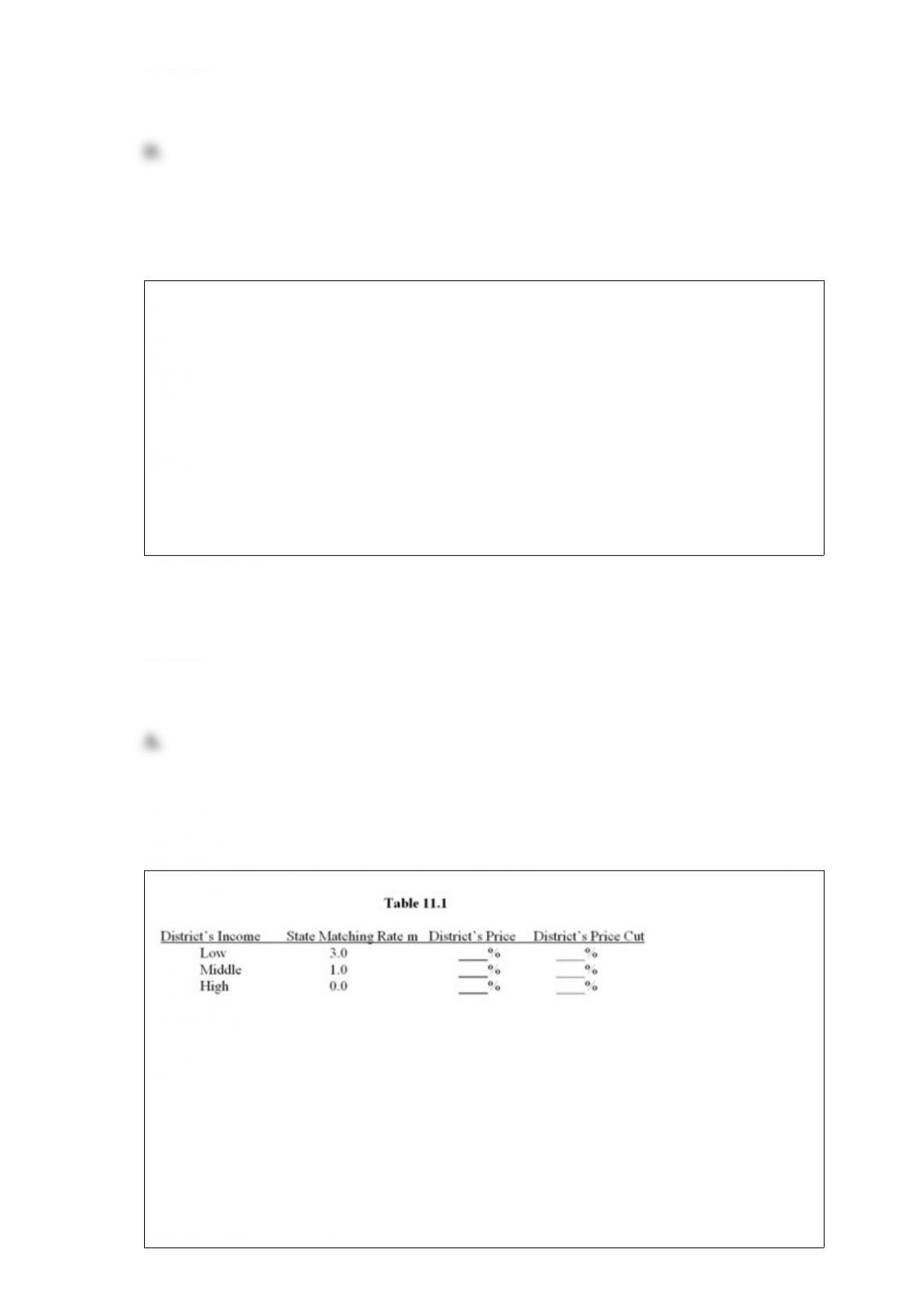
Refer to Table 11.1. The district’s price for the middle-income district is ___.
A. 75%
B. 50%
C. 33%

D. 25%
Answer:
For the top 5% of households, which is much more than 5%?
A. Their share of the nation’s pre-tax income and their share of federal tax
B. Their share of the nation’s pre-tax income but not their share of federal tax
C. Their share of federal tax but not their share of the nation’s pre-tax income
D. Neither their share of the nation’s pre-tax income nor their share of federal tax
Answer:
The chapter describes a plan in which high school juniors would be mailed a ____ that
shows the grant they will receive according to their family’s ____.
A. booklet; adjusted gross income
B. postcard; adjusted gross income

C. booklet; wealth
D. postcard; wealth
Answer:
U.S. taxes are ___ of GDP while OECD taxes are ___ of GDP.
A. 40%; 30%
B. 40%; 50%
C. 30%; 40%
D. 30%; 50%
Answer:
The consumption tax rate is set so that it raises the same total revenue from the two
persons as the 15% income tax ($30,000).

Refer to Table 9.1. A comparison of the bottom and top blocks shows that a switch to a
consumption tax _____ total saving due to the ____.
A. decreases; horizontal redistribution effect and the incentive effect
B. increases; incentive effect only
C. increases; horizontal redistribution effect only
D. increases; horizontal redistribution effect and the incentive effect
Answer:
Under a variable voucher plan, a private school system would have ____.
A. selective admissions
B. no tuition

C. very high tuition
D. very low tuition
Answer:
If labor supply is steeper than demand, a payroll tax on employers is born mostly by
___.
A. employers
B. workers
C. consumers
D. stockholders
Answer:
Health taxes (on alcohol or tobacco) can be justified by
A. an externality argument and an internality argument.
B. an externality argument only.

C. an internality argument only.
D. neither an externality argument nor an internality argument.
Answer:
A household’s comprehensive income equals its consumption plus its ___.
A. wealth
B. increase in wealth (its saving)
C. wages
D. wages, interest, dividends, and capital gains
Answer:
In 2007, U.S. Treasury debt held by the public was _____.
A. $1 trillion
B. $5 trillion

C. $9 trillion
D. $13 trillion
Answer:
Federal tax revenue as a percent of GDP is ___ forty years ago.
A. much higher than
B. about the same as
C. much lower than
D. nothing compared to
Answer:
If Congress replaced the charitable deduction with a charitable credit, then the tax
saving for H (in a 35% tax bracket) and L (in a 10% tax bracket), who each gave $1,000
to charity, would
A. depend on their tax brackets.

B. be the same.
C. be different.
D. depend on what Congress decided to make their credit rates.
Answer:
If a firm can build for $100,000 in year 0 without borrowing, and profit would be
$110,000 in year 1, it should do it
A. regardless of the interest rate.
B. if and only if the interest rate is less than 11%.
C. if and only if the interest rate is less than 10%.
D. if and only if the interest rate is less than 9%.
Answer:
The EITC is a _____.

A. welfare program
B. work bonus
C. nonrefundable tax credit
D. refundable tax deduction
Answer:
If the tax on a good doubles, T doubles, ΔQ ____, and the efficiency loss _____.
A. stays constant; doubles
B. stays constant; quadruples
C. doubles; doubles
D. doubles; quadruples
Answer:
If permits are sold,

A. emissions are certain but cost is uncertain.
B. cost is certain but emissions are uncertain.
C. emissions and cost are certain.
D. emissions and cost are uncertain.
Answer:
For each $1 a local government spends on activity X, the state government will give it
$2 to spend on X. This is an example of ____.
A. a conditional block grant
B. an unconditional block grant
C. an open-ended categorical matching grant
D. a closed-ended categorical matching grant
Answer:
Banks are generally more reluctant to lend to college students than to home buyers
because of _____.

A. a bias against higher education
B. a bias against college-age individuals
C. the equilateral problem
D. the collateral problem
Answer:
The ___ tax raises about 45% of federal revenue.
Answer:
If the government ___ is $100 billion at the beginning of this year, and this year the
government ___ is $50 billion, then at the beginning of next year the government ___ is
$___ billion.
Answer:
Two possible problems with having local governments compete are tax _____ and tax
_____.
Answer:
Suppose country H proposes a treaty where each government H and L would agree to
levy a tax of $96 on its own polluters. If country L is unaffected by global warming, L
should still agree to levy this tax on its own polluters if H pays L at least $______.
Why?
Answer:
The Welfare Reform Act of 1996 moved welfare in a _____ direction and changed the
program’s name to ____.
Answer:

It is best for a firm to reduce an emission when MAC is less than (MD, Tax).
Answer:
Imposing a progressive consumption tax on the affluent would be less harmful to ___
than raising the income tax on the affluent.
Answer:
Refer to Figure 3.1. The socially optimal wall thickness is feet.
Answer:

The optimal quality of a public school occurs where _____ in a standard public good
diagram.
Answer: