
1) Which of the following outcomes is (are) sometimes associated with participative
budgeting?
A.Employees make little effort to achieve budgetary goals
B.Budget preparation time can be somewhat lengthy
C.The problem of budget padding may arise
D.Financial modeling becomes much more difficult to undertake
E.Budget preparation time can be somewhat lengthy and the problem of budget padding
may arise
2) Which of the following statements about similarities between process costing and
job-order costing are true?
I. Both systems assign production costs to units of output.
II. Both systems require extensive knowledge of financial accounting.
III. The flow of costs through the manufacturing accounts is essentially the same.
A.I only
B.I and III
C.II and III
D.III only
E.I, II, and III
3) Nelson Company owes money to Nash Company for the purchase of equipment.
Nash Company has given Nelson the following payment options:
I. Immediate payment in full of $38,000.
II. Annual payments of $15,000 made at the end of each of the next three years.
III. A single payment of $48,000 made at the end of three years.
Assume that both Nelson and Nash use a 10% interest rate compounded annually. What
option would Nash prefer, and what is the present value of that option?
A.Option I, $34,542
B.Option I, $38,000
C.Option II, $37,305
D.Option III, $34,164
E.Option III, $36,048
4) A favorable labor efficiency variance is created when:
A.actual labor hours worked exceed standard hours allowed
B.actual hours worked are less than standard hours allowed
C.actual wages paid are less than amounts that should have been paid
D.actual units produced exceed budgeted production levels
E.actual units produced exceed standard hours allowed
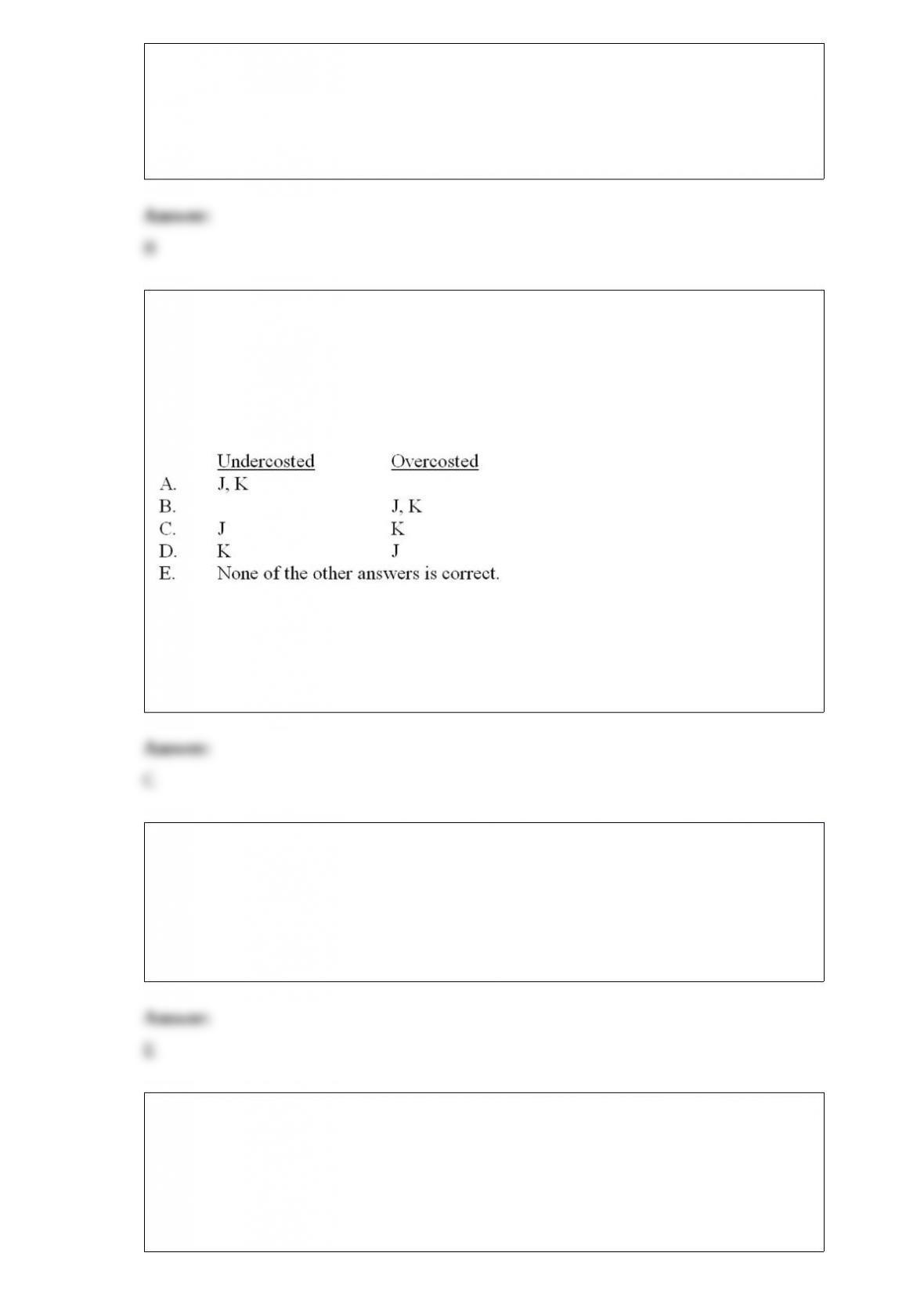
5) Koski manufactures products J and K, applying overhead on the basis of labor hours.
J, a low-volume product, requires a variety of complex manufacturing procedures. K,
on the other hand, is both a high-volume product and relatively simplistic in nature.
What would an activity-based costing system likely disclose about products J and K as
a result of Koski’s current accounting procedures?
A.Choice A
B.Choice B
C.Choice C
D.Choice D
E.Choice E
6) A company’s cash flows for income taxes are normally affected by:
A.revenues
B.operating expenses
C.gains on the sale of assets
D.losses on the sale of assets
E.All of the other answers are correct
7) Baxter Company, which pays a 10% commission to its salespeople, reported sales
revenues of $210,000 for the period just ended. If fixed and variable sales expenses
totaled $56,000, what would these expenses total at sales of $168,000?
A.$16,800
B.$35,000
C.$44,800
D.$51,800
E.None of the other answers are correct
8) Which of the following techniques is not used to analyze cost behavior?
A.Least-squares regression
B.High-low method
C.Visual-fit method
D.Linear programming
E.Multiple regression
9) Which of the following bodies oversees audits and auditors, and sanctions firms and
individuals for violations of laws and regulations?
A.American Institute of Certified Public Accountants (
B.American Accounting Association (AAA)
C.Public Company Accounting Oversight Board (PCAOB)
D.Financial Accounting Standards Board (FASB)
E.Accounting Principles Board (APB)
10) Soloman Corporation recently purchased 25,000 gallons of direct material at $5.60
per gallon. Usage by the end of the period amounted to 23,000 gallons. If the standard
cost is $6.00 per gallon and the company believes in computing variances at the earliest
point possible, the direct-material price variance would be calculated as:
A.$800F
B.$9,200F
C.$9,200U
D.$10,000F
E.$10,000U
11) Buckman Corporation, which began operations on January 1 of the current year,
reported the following information:
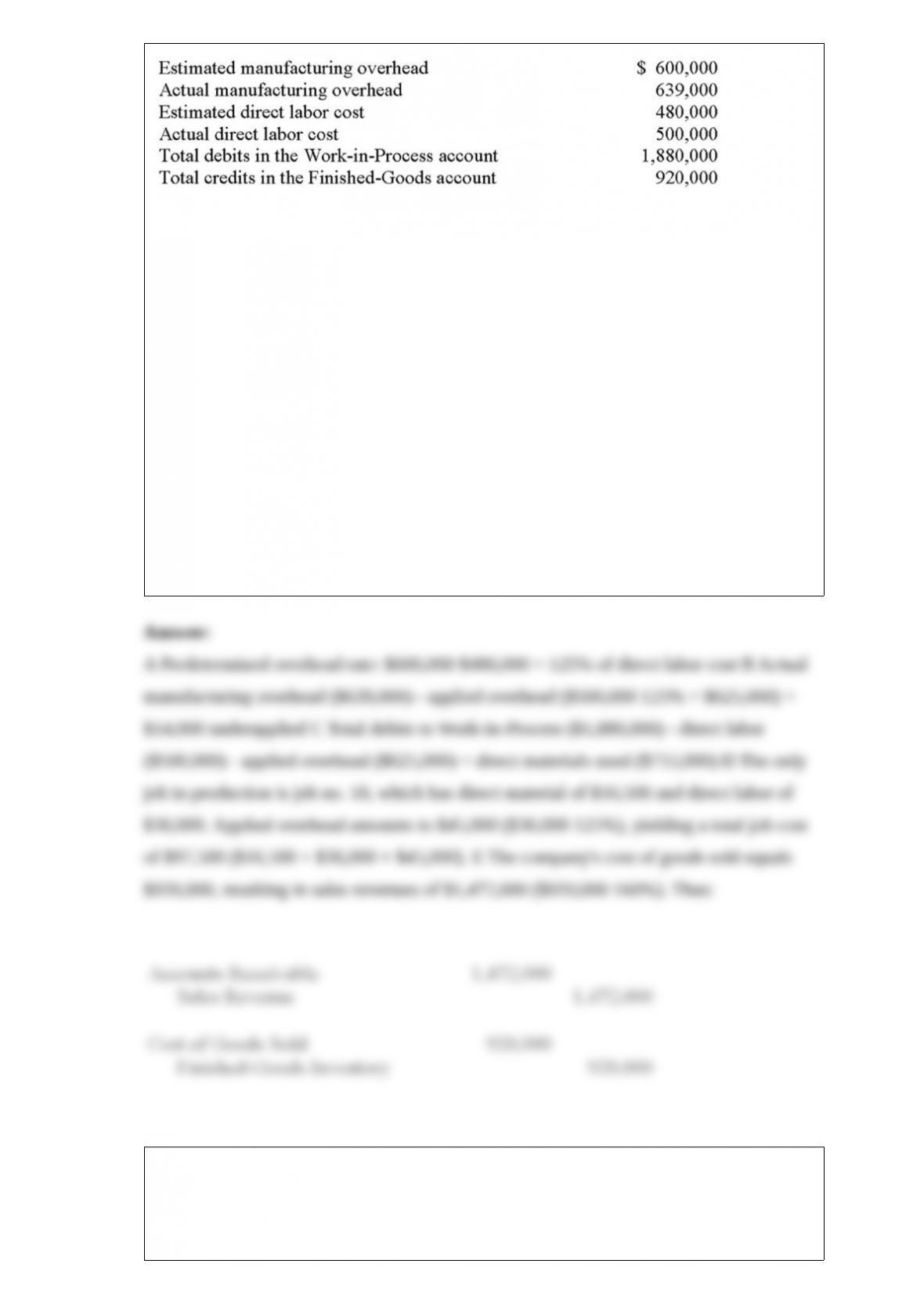
Buckman uses a normal cost system and applies manufacturing overhead to jobs on the
basis of direct labor cost. A 60% markup is added to the cost of completed production
when finished goods are sold. On December 31, job no. 18 was the only job that
remained in production. That job had direct-material and direct-labor charges of
$16,500 and $36,000, respectively.
Required:
A. Determine the company’s predetermined overhead rate.
B. Determine the amount of under- or overapplied overhead. Be sure to label your
answer.
C. Compute the amount of direct materials used in production.
D. Calculate the balance the company would report as ending work-in-process
inventory.
E. Prepare the journal entry (ies) needed to record Buckman’s sales, which are all made
on account.
12) The final step in recognizing the completion of production requires a company to:
A.debit Finished-Goods Inventory and credit Work-in-Process Inventory
B.debit Work-in-Process Inventory and credit Finished-Goods Inventory
C.add direct labor to Work-in-Process Inventory
D.add direct materials, direct labor, and manufacturing overhead to Work-in-Process
Inventory
E.add direct materials to Finished-Goods Inventory
13) BFF Corporation uses an imputed interest rate of 13% in the calculation of residual
income. Division X, which is part of BFF, had invested capital of $1,200,000 and an
ROI of 16%. On the basis of this information, X’s residual income was:
A.$24,960
B.$36,000
C.$156,000
D.$192,000
E.None of the other answers are correct
14) Wellcom Corporation has the following sales mix for its three products: A, 20%; B,
35%; and C, 45%. Fixed costs total $400,000 and the weighted-average contribution
margin is $100. How many units of product A must be sold to break-even?
A.800
B.4,000
C.20,000
D.None of the other answers is correct
E.Cannot be determined based on the information presented
15) All of the following are inventoried under absorption costing except:
A.direct labor
B.raw materials used in production
C.utilities cost consumed in manufacturing
D.sales commissions
E.machine lubricant used in production
16) At the Nassau Advertising Agency, partner and staff compensation cost is a key
driver of agency overhead. In light of this fact, which of the following is the correct
expression to determine the amount of overhead applied to a particular client job?
A.(Budgeted overhead budgeted compensation) budgeted compensation cost on the job
B.(Budgeted overhead budgeted compensation) actual compensation cost on the job
C.(Budgeted compensation budgeted overhead) budgeted compensation cost on the job
D.(Budgeted compensation budgeted overhead) actual compensation cost on the job
E.None of these, because service providers do not apply overhead to jobs
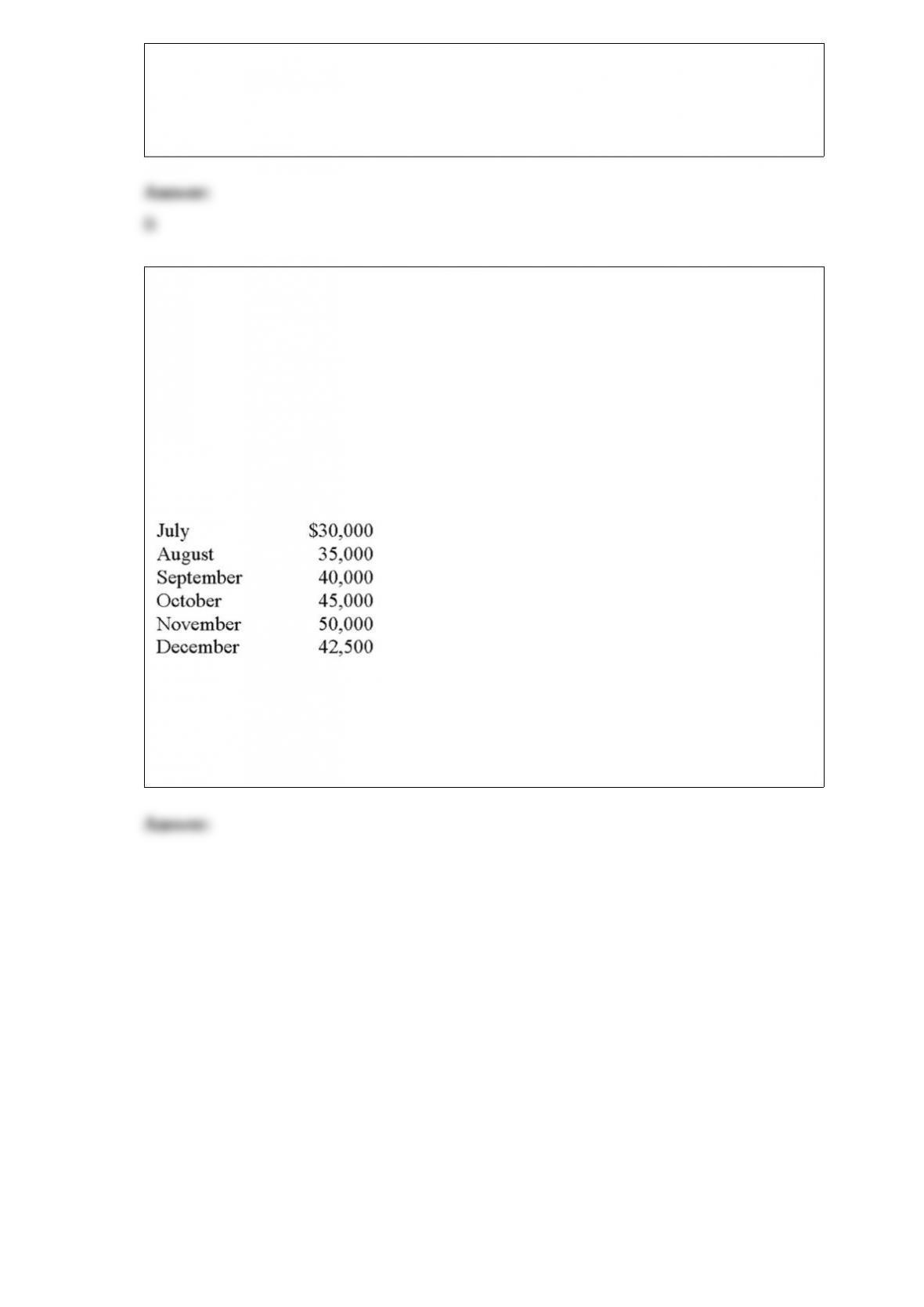
17) Tiara Company has the following historical collection pattern for its credit sales:
70% collected in month of sale
15% collected in the first month after sale
10% collected in the second month after sale
4% collected in the third month after sale
1% uncollectible
Budgeted credit sales for the last six months of the year follow.
Required:
A. Calculate the estimated total cash collections during October.
B. Calculate the estimated total cash collections during the year’s fourth quarter.
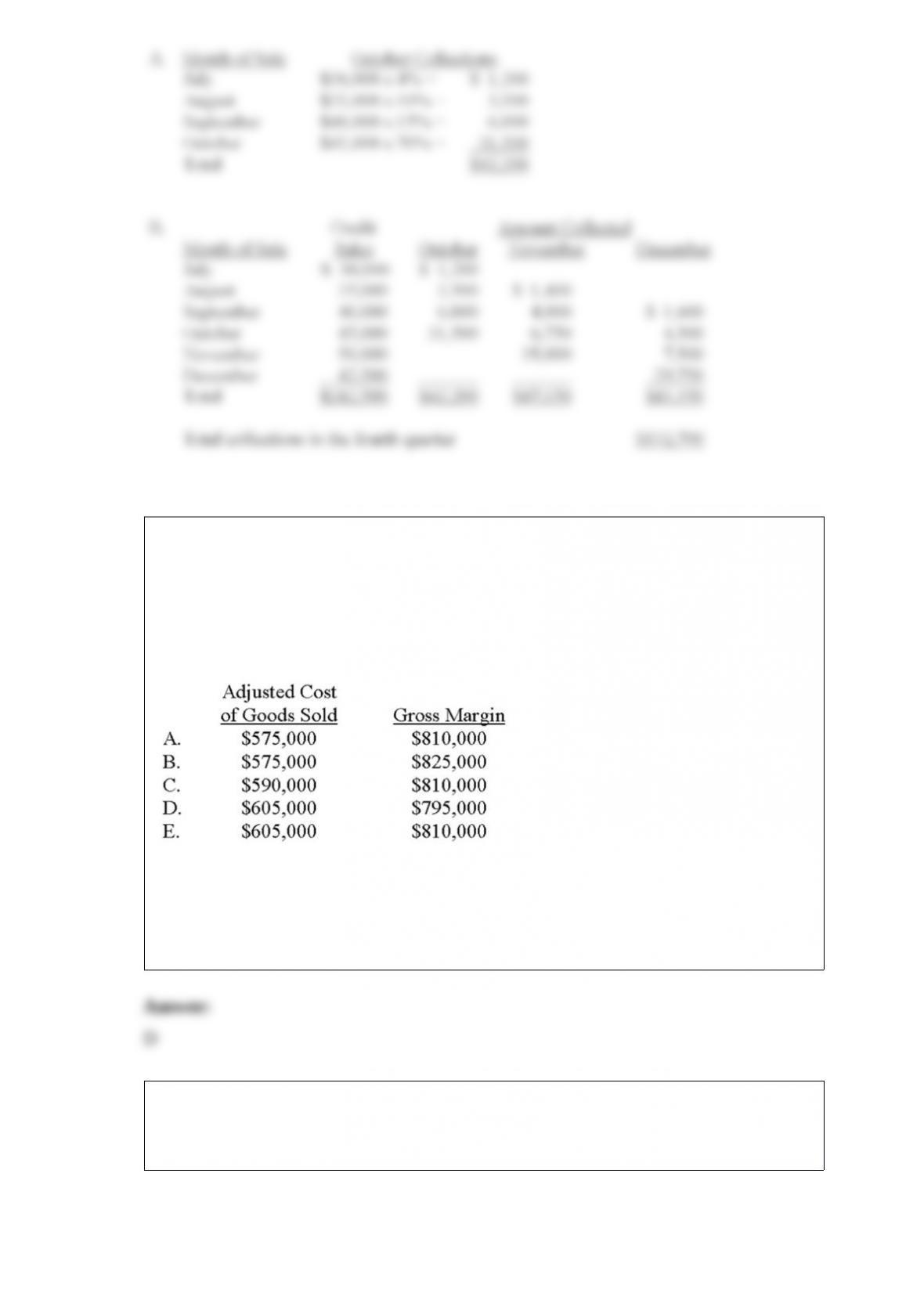
18) Fletcher, Inc. disposes of under- or overapplied overhead at year-end as an
adjustment to cost of goods sold. Prior to disposal, the firm reported cost of goods sold
of $590,000 in a year when manufacturing overhead was underapplied by $15,000. If
sales revenue totaled $1,400,000, determine (1) Fletcher’s adjusted cost of goods sold
and (2) gross margin.
A.Choice A
B.Choice B
C.Choice C
D.Choice D
E.Choice E
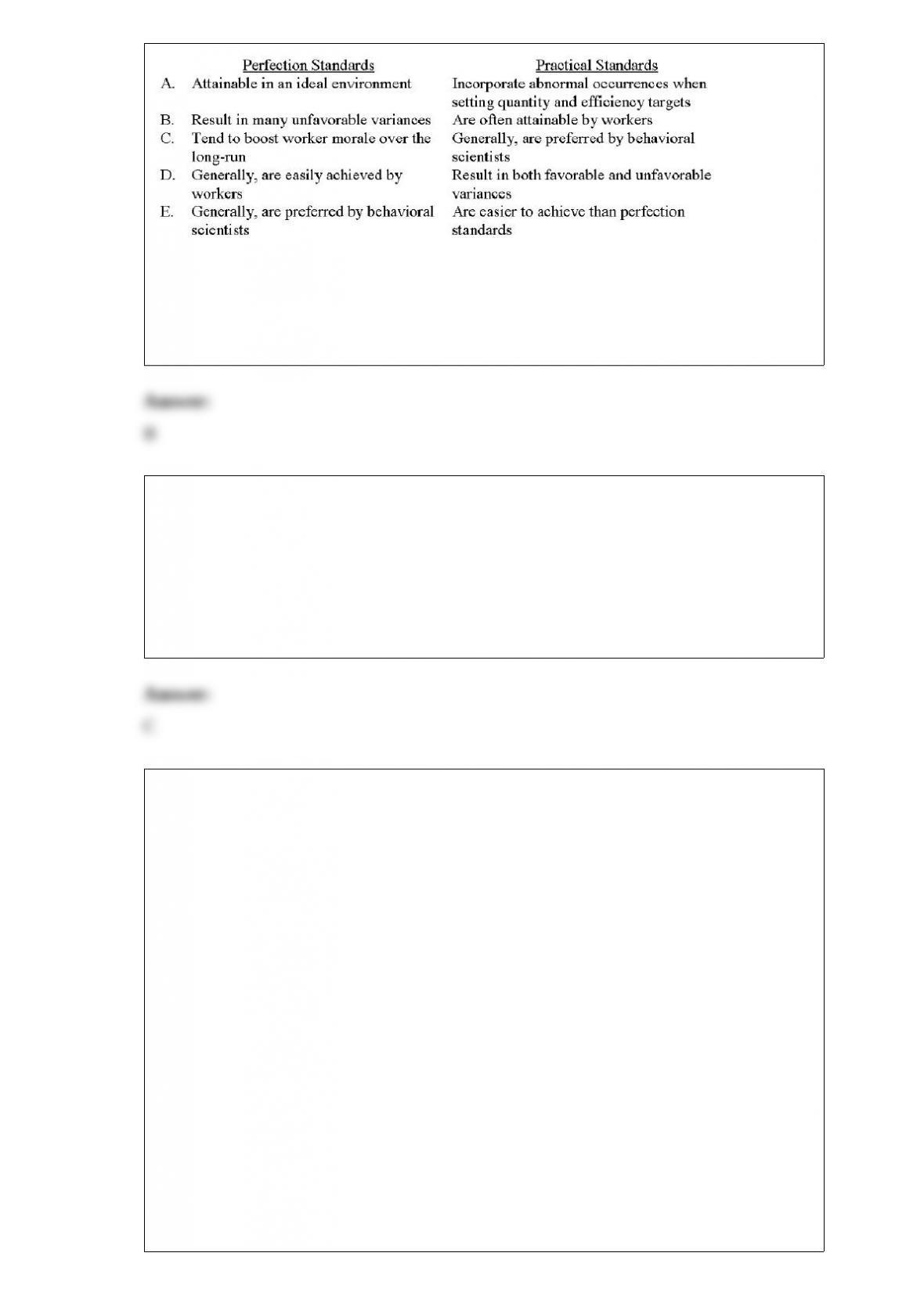
19) Which of the following choices correctly notes a characteristic associated with
perfection standards and one associated with practical standards?
A.Choice A
B.Choice B
C.Choice C
D.Choice D
E.Choice E
20) Which of the following formulas can often reconcile the difference between
absorption- and variable-costing income?
A.Change in inventory units predetermined variable-overhead rate per unit
B.Change in inventory units predetermined variable-overhead rate per unit
C.Change in inventory units predetermined fixed-overhead rate per unit
D.Change in inventory units predetermined fixed-overhead rate per unit
E.(Absorption-costing income – variable-costing income) fixed-overhead rate per unit
21) Levitt Corporation, which uses an operation-costing system, has three processing
departments. All units pass through Department no. 1; upon completion, 70% of the
goods are sent to Department no. 2 and 30% are sent to Department no. 3. Additional
data follow.
Forty thousand units were manufactured during the year.
Conversion cost in each department was: No. 1, $380,000; no. 2, $196,000; and no. 3,
$150,000.
Batch no. 67, which consisted of 500 units, was sent to Department no. 3 for its
additional processing. Direct materials of $23,500 and $11,900 were introduced to this
batch in Department nos. 1 and 3, respectively.
Levitt assigns conversion cost to goods manufactured on the basis of units produced.
Required:
A. Determine the conversion cost per unit in Department no. 1, Department no. 2, and
Department no. 3 .
B. Compute the total cost of batch no. 67 .
C. Operation costing is sometimes referred to as a hybrid costing system. Briefly
explain.
22) Which of the following equations is used to calculate cost of goods sold during the
period?
A.Beginning finished goods + cost of goods manufactured + ending finished goods
B.Beginning finished goods – ending finished goods
C.Beginning finished goods + cost of goods manufactured
D.Beginning finished goods + cost of goods manufactured – ending finished goods
E.Beginning finished goods + ending finished goods – cost of goods manufactured
23) Which of the following statements about similarities between process costing and
job-order costing are true?
I. Both systems assign production costs to units of output.
II. Both systems require extensive knowledge of financial accounting.
III. The flow of costs through the manufacturing accounts is essentially the same.
A.I only
B.I and III
C.II and III
D.III only
E.I, II, and III
24) A favorable labor rate variance is created when:
A.actual labor hours worked exceed standard hours allowed
B.actual hours worked are less than standard hours allowed
C.actual wages paid are less than amounts that should have been paid for the number of
hours worked
D.actual units produced exceed budgeted production levels
E.actual units produced exceed standard hours allowed
25) Chino began business at the start of the current year. The company planned to
produce 25,000 units, and actual production conformed to expectations. Sales totaled
22,000 units at $30 each. Costs incurred were:
If there were no variances, the company’s absorption-costing income would be:
A.$190,000
B.$202,000
C.$208,000
D.$220,000
E.None of the other answers are correct
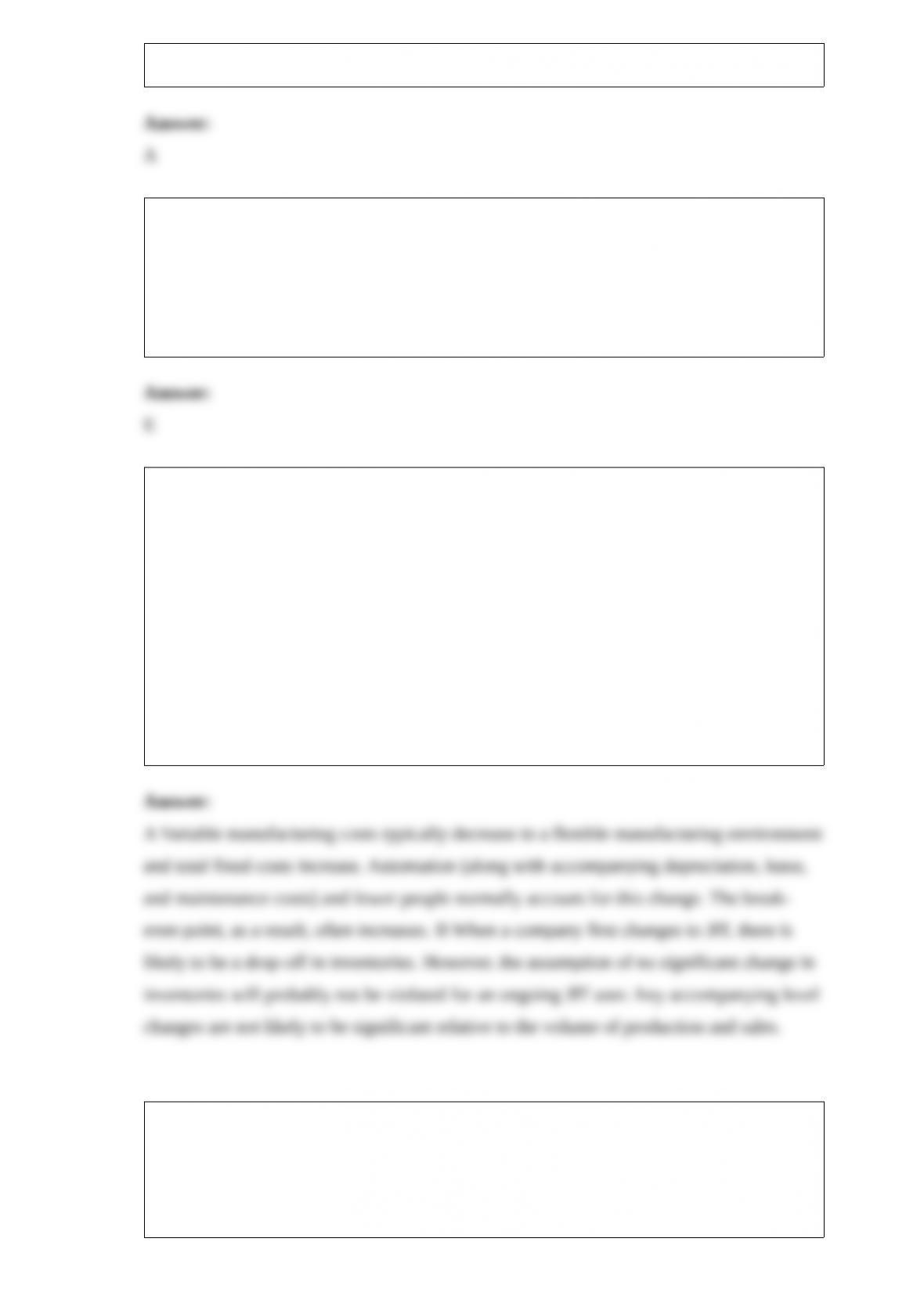
26)
Refer to the figure above. Line A is the:
A.total revenue line
B.fixed cost line
C.variable cost line
D.total cost line
E.profit line
27) Which of the following perspectives is normally absent in a balanced scorecard?
A.Financial
B.Customer
C.Internal operations
D.Learning and innovation/growth
E.None of these
28) Many firms are moving toward flexible manufacturing systems and adopting the
just-in-time (JIT) philosophy.
Required:
A. How is cost behavior altered in the typical flexible manufacturing environment as
compared to a traditional manufacturing system? What is the impact on the break-even
point? Explain.
B. One of the assumptions underlying cost-volume profit analysis is that sales volume
and production volume are equal. Stated another way, inventories are assumed to
remain constant. Is this assumption likely to be violated under an ongoing JIT
philosophy? Explain.
29) The time value of money and present value are important business concepts.
Required:
Differentiate between the concepts discounting and compounding.
30) Templeton Industries currently assigns overhead to products by using a
predetermined rate based on direct labor hours. The company is considering the
adoption of an activity-based costing (ABC) system, and management desires a brief
overview of this system before it makes a final decision.
Compare ABC with the company’s current system, focusing on the number of cost
pools and cost drivers, costing accuracy, and cost distortion.
31) Chen Enterprises purchased 67,000 pounds (cost = $616,400) of direct material to
be used in the manufacture of the company’s only product. According the production
specifications, each completed unit requires four pounds of direct material at a standard
cost of $9 per pound. Direct materials consumed by the end of the period totaled 65,500
pounds in the manufacture of 16,050 finished units.
An examination of Chen’s payroll records revealed that the company worked 42,000
labor hours (cost = $621,600) during the period, and specifications called for each
completed unit requiring 2.6 hours of labor at a standard cost of $15 per hour.
Assume that the company computes variances at the earliest point in time.
Required:
Calculate the direct-material price and quantity variances, and the direct-labor rate and
efficiency variances. Indicate whether each variance is favorable or unfavorable.
32) A production manager was recently given a performance report that showed a
sizable unfavorable variable-overhead efficiency variance. The manager was puzzled as
to how the department could be inefficient in the use/incurrence of this cost.
Required:
Briefly explain the nature of this variance to the manager. Does the variance really have
much to do with variable overhead efficiencies or inefficiencies? Discuss.
33) Cheney Corporation produces goods in the United States, to be sold by a separate
division located in Italy. More specifically, the Italian division imports units of product
X34 from the U.S. and sells them for $950 each. (Imports of similar goods sell for
$850.) The Italian division is subject to a 40% tax rate whereas the U.S. tax rate is only
30%. The manufacturing cost of product X34 in the United States is $720. Furthermore,
there is a 10% import duty computed on the transfer price that will be paid by the
Italian division and is deductible when computing Italian income.
Tax laws of the two countries allow transfer prices to be set at U.S. manufacturing cost
or the selling prices of comparable imports in Italy.
Required:
Analyze the profitability of the U.S. division, the Italian division, and Cheney as a
whole to determine if the overall corporation would be better off if transfers took place
at (1) U.S. manufacturing cost or (2) the selling price of comparable imports.
34) Santorini Corporation has experienced a number of out-of-stock situations with
respect to its finished-goods inventories. Inventory at the end of May, for example, was
only 50 unitsan all-time low.
Management desires to implement a policy whereby finished-goods inventory is 70% of
the following month’s sales. Budgeted sales for June, July, and August are expected to
be 5,000 units, 5,600 units, and 5,500 units, respectively.
Required:
Determine the number of units that Santorini must produce in June and July.
35) Terry Pineno, new-accounts manager at East Bank of Clarion, has been asked to
project how many new accounts she will open during 20×2 . The local economy has
been growing, and the bank has experienced a 10% increase in the number of new
accounts over each of the past five years. In 20×1, the bank had 10,000 accounts.
Pineno is paid a salary, plus a bonus of $20 for every new account above the budgeted
amount. Thus, if the annual budget calls for 1,000 new accounts, and 1,080 new
accounts are obtained, her bonus will be $1,600 (80 $20).
Pineno believes that the local economy will continue to grow at the same rate in 20×2
as it has in recent years. She decided to submit a projection of 700 new accounts for
20×2 .
Required:
Your consulting firm has been hired by the bank president to make recommendations
for improving the bank’s operation. Write a memorandum to the president defining and
explaining the negative consequences of budgetary slack. Also discuss the bank’s bonus
system for the new-accounts manager and how the bonus program tends to encourage
budgetary slack.