Granger Corp. stock currently sells for $48.29 per share. The market requires a 13
percent return on the firm’s stock. If the company maintains a constant 5.5 percent
growth rate in dividends, what was the most recent annual dividend per share paid on
the stock?
A. $3.43
B. $3.57
C. $3.90
D. $4.15
E. $4.36
Answer:
The market value of a firm’s fixed assets:
A. must exceed the book value of those assets.
B. is more predictable than the book value of those assets.
C. in addition to the firm’s net working capital reflects the true value of a firm.
D. is decreased annually by the depreciation expense.
Answer:
Which one of the following best describes the primary intent of the Sarbanes-Oxley Act
of 2002?
A. Increase the costs of going public
B. Increase protection against corporate fraud
C. Limit secondary issues of corporate securities
D. Decrease the number of publicly traded firms
E. Increase the number of firms that “go dark”
Answer:
Which one of the following statements is correct concerning a firm’s fixed assets?
A. The market value is the expected selling price in today’s economy.
B. The market value is affected by the accounting method selected.
C. The market value is equal to the initial cost minus the depreciation to date.
D. The book value is equal to the market value minus the accumulated depreciation.
E. The book value is the greater of the initial cost or the current market value.
Answer:
Ready To Go is an all-equity firm specializing in hot ready-to-eat meals. Management
has estimated the firm’s earnings before interest and taxes will be $175,000 annually
forever. The present cost of equity is 15.1 percent. Currently, the firm has no debt but is
considering borrowing $750,000 at 9 percent interest. The tax rate is 34 percent. What
is the value of the unlevered firm?
A. $623,017
B. $646,511
C. $704,141
D. $764,901
E. $855,200
Answer:
What is the principal amount of a bond that is repaid at the end of the loan term called?
A. Coupon
B. Market price
C. Accrued price
D. Dirty price
E. Face value
Answer:
The Monster Truck operates several specialty vehicles that provide hot food and
beverages for firms that have workers employed in outlying regions. The company has
annual sales of $350,500. Cost of goods sold average 48 percent of sales and the profit
margin is 5.2 percent. The average accounts receivable balance is $44,700. On average,
how long does it take The Hot Truck to collect payment for its services?
A. 7.84 days
B. 24.17 days
C. 46.55 days
D. 48.33 days
E. 51.90 days
Answer:
Assume the SEC approved the registration statement for a new securities issue this
morning. Which one of the following statements must be true about this issue?
A. The red herrings can now be distributed as the distribution was awaiting the SEC
approval.
B. The waiting period started when the approval was received this morning.
C. The SEC believes the issue will be a profitable investment for all purchases made at
the offer price.
D. The issuer is following all the required rules and regulations in regard to this issue.
E. The final prospectuses were all delivered or the SEC would not have approved the
issue.
Answer:
Percentage returns:
I. are easy to understand.
II. relay information about a security more easily than dollar returns do.
III. are not affected by the amount of the investment.
IV. can be easily separated into dividend yield and capital gain yield.
A. II and III only
B. I and III only
C. I, II, and III only
D. I, II, and IV only
E. I, II, III, and IV

Answer:
Sue needs to invest $3,626 today in order for her savings account to be worth $5,000
six years from now. Which one of the following terms refers to the $3,626?
A. Present value
B. Compound value
C. Future value
D. Complex value
E. Factor value
Answer:
Which one of the following statements related to a cash budget is correct?
A. Capital expenditures are treated as a cash inflow on a cash budget.
B. The cumulative surplus is computed prior to adjusting for the minimum cash
balance.
C. A positive net cash inflow for a period indicates the cash disbursements exceed the
cash collections for the period.
D. Financially healthy firms can have a negative quarterly net cash inflow.
E. Firms generally set the minimum cash balance at zero for planning purposes.
Answer:
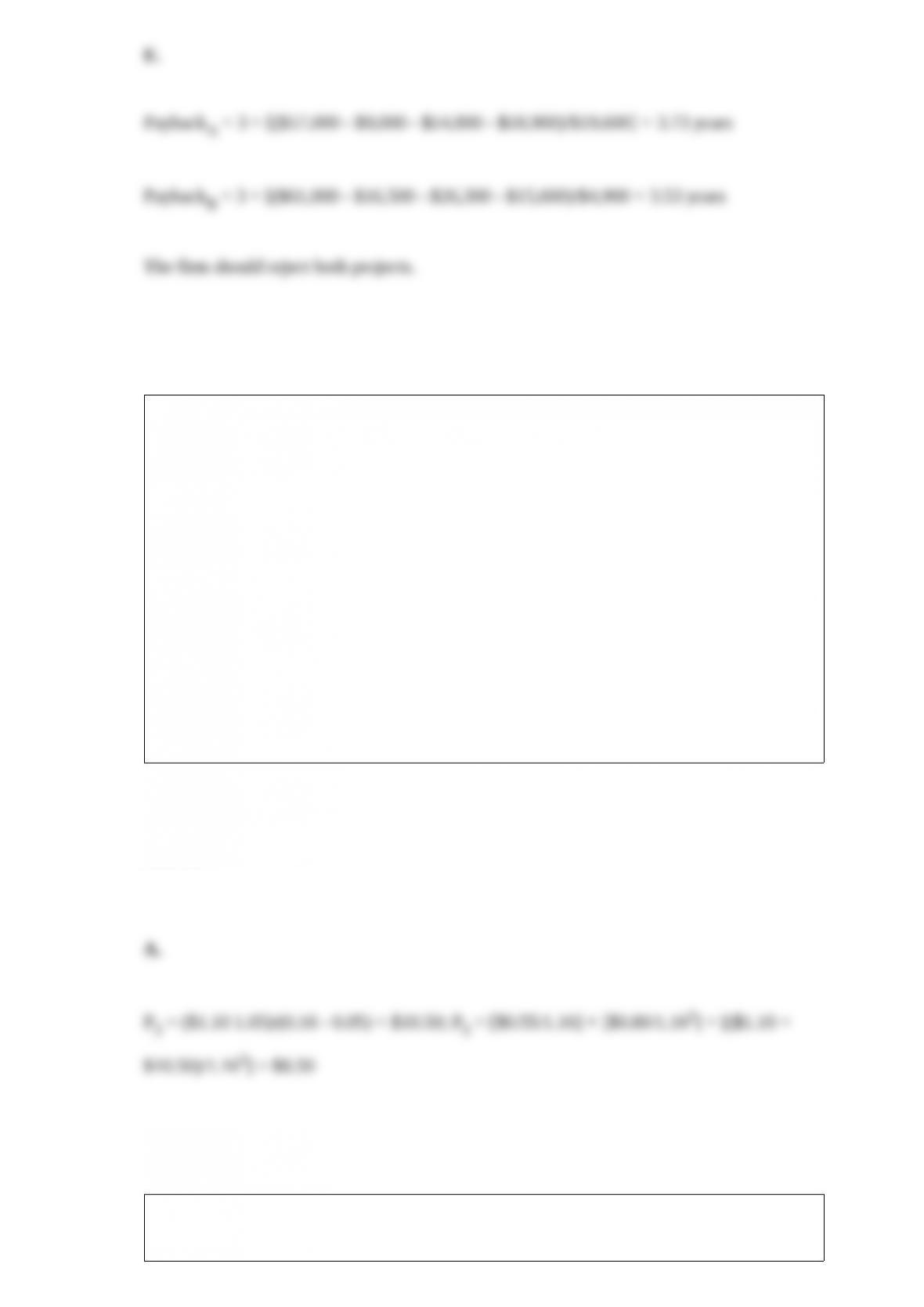
Baker’s Supply imposes a payback cutoff of 3.5 years for its international investment
projects. If the company has the following two projects available, should it accept either
of them?
A. Accept both Projects A and B
B. Accept Project A but not Project B
C. Accept Project B but not Project A
D. Both Project A and B are acceptable but you can select only one project
E. Reject both Projects A and B
Answer:
New Gadgets is growing at a very fast pace. As a result, the company expects to pay
annual dividends of $0.55, 0.80, and $1.10 per share over the next three years,
respectively. After that, the dividend is projected to increase by 5 percent annually. The
last annual dividend the firm paid was $0.40 a share. What is the current value of this
stock if the required return is 16 percent?
A. $8.50
B. $9.67
C. $10.46
D. $12.23
E. $12.49
Answer:
Which one of the following conditions exists at the point where a firm maximizes its
value?

A. The tax benefit from an additional dollar of debt is zero.
B. Financial distress costs are equal to zero.
C. The debt-equity ratio is 1.0.
D. WACC is minimized.
E. The cost of equity is minimized.
Answer:
An increase in which one of the following will increase operating cash flow for a
profitable, tax-paying firm?
A. Fixed expenses
B. Interest paid
C. Net capital spending
D. Inventory
E. Depreciation
Answer:
Which one of the following statements is correct?
A. Exchange rates are adjusted each morning and held constant until the next morning.
B. The four most common currencies traded in the foreign exchange market are the
U.S. dollar, franc, euro, and peso.
C. All countries of South America uses the peso as their currency.
D. New Zealand uses the same currency as Australia and that is the A$.
E. The foreign exchange market is the largest financial market in the world.
Answer: