1) suppose that the one-year u.s. interest rate is 8% and the equivalent one-year india
interest rate is 12%. according to covered interest parity, there is:
a.forward discount on dollar
b.forward premium on dollar
c.forward premium for indian rupee
d.forward flat on dollar
2) assume that the 6-month ius = 10% and the 6-month iswiss = 20%, and the spot rate
is $1.20 per swiss franc. using the approximate covered interest rate parity condition,
the 6-month forward rate ($/swiss franc) is:
a.1.08
b.1.14
c.1.26
d.1.32
3) if a currency has appreciated ________ the price differential between two countries
as implied by ppp, then a currency is ________.
a.the same as, undervalued
b.the same as, overvalued
c.more than, overvalued
d.less than, overvalued
4) perfect capital mobility between countries implies that:
a.the covered interest parity holds
b.the interest rate on domestic bonds equals to the interest rate on similar foreign bond
plus the forward premium on foreign exchange
c.the actual portfolio composition adjusts instantaneously to desired portfolio
composition
d.all of the above are correct
5) which of the following features describe the forward market for foreign exchange?
i.tailored size contracts
ii.small amount contracts
iii.tailored maturities
iv.large amount contracts
a.ii only
b.iv only
c.i, ii, and iii
d.i, iii, and iv
6) which of the following reasons explain why interest rate parity may not hold
perfectly?
i.banking practices
ii.government controls
iii.business loan risk
iv.varying expectations
a.i only
b.ii only
c.ii and iv
d.i, iii, and iv
7) refer to table 6-1. on may 5, 2012, the 1-year forward yen was selling at a:
a.3.56% premium per annum against the dollar
b.3.69% premium per annum against the dollar
c.3.56% discount per annum against the dollar
d.3.69% discount per annum against the dollar
8) which of the following is not one of the three equilibrium conditions in an is-lm-bp
model?
a.goods market equilibrium
b.balance of payments equilibrium
c.currency equilibrium
d.money market equilibrium
9) when an investor prefers a portfolio that is diverse, has a smaller return than an
alternative, and has a much smaller variance then the investor must be:
a.risk seeking
b.risk loving
c.risk neutral
d.risk averse
10) for u.s. bank to set up an international banking facility (ibf), the bank must:
a.construct a separate branch for all ibf activity
b.keep a separate record of any loans or deposits done by the ibf
c.obtain annual permission from the federal deposit insurance corporation for all ibf
activity
d.set up a bank in an offshore banking center
11) in foreign exchange trading, arbitrage has ______ risk and speculation has
________ risk.
a.zero; zero
b.positive; positive
c.zero; positive
d.positive; zero
12) the fixed rate of currencies that will be delivered at an agreed upon future date is
called the:
a.swap price
b.future rate
c.forward rate
d.strike price
13) let ft be the forward rate, st be the spot exchange rate, and set+1 be the expected
future spot rate. which of the following expressions represents the risk premium?
a.
b.
c.
d.
14) special drawing rights are issued by
a.the international monetary fund
b.the united nations
c.the world bank
d.the central banks of england, japan, and the united states
15) consider two securities known as security a and b. if returns on security a decrease
10% while returns on security b increase 10%, then the correlation coefficient is:
a.positive
b.negative
c.zero
d.impossible to determine
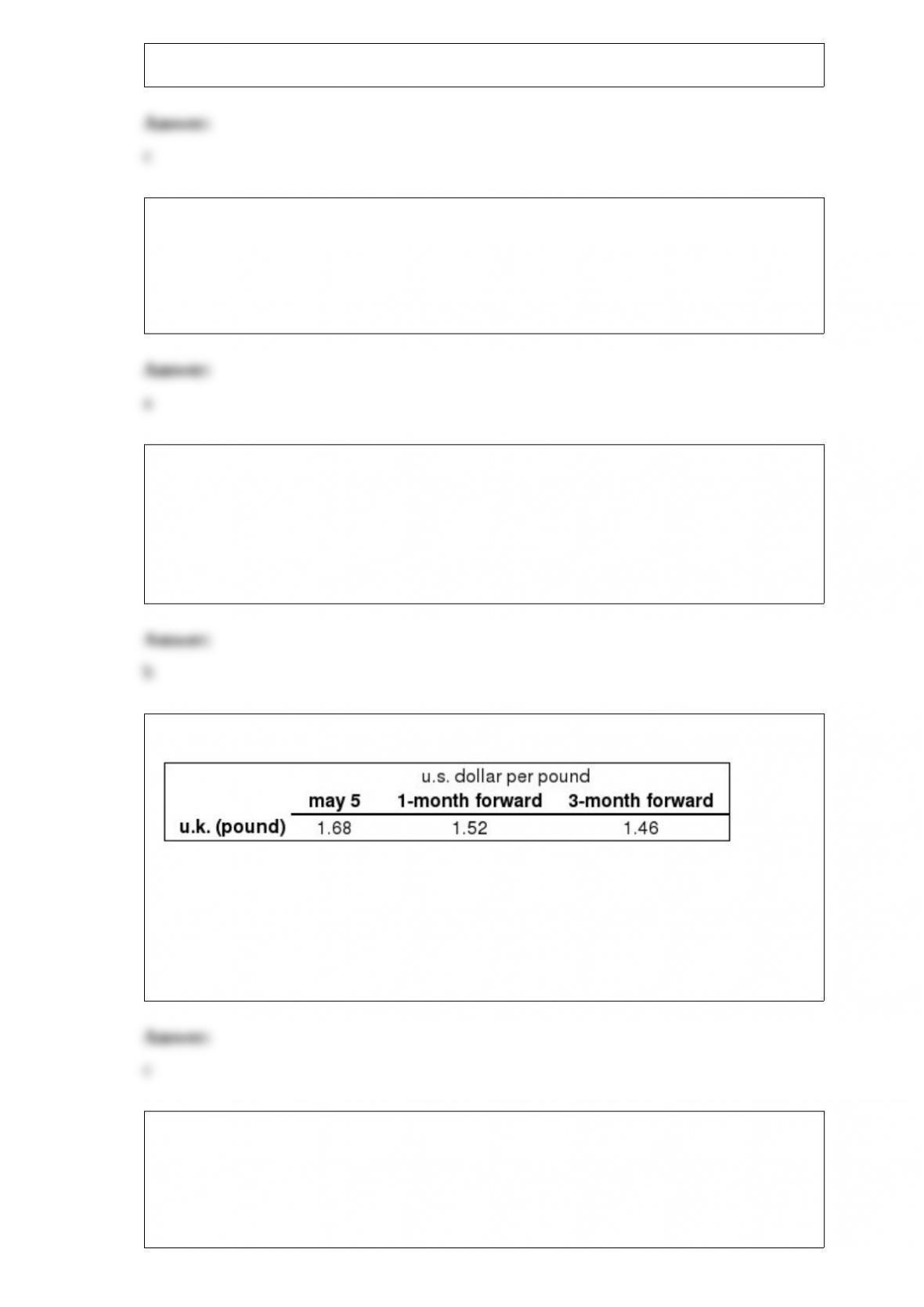
16) table 6-2: spot and forward exchange rates on may 5, 2012
refer to table 6-2. comparing the yens forward rates against the yens spot rate, over the
period of a forward contract, we would expect the yens spot rate to:
a.remain constant against the dollar
b.appreciate against the dollar
c.depreciate against the dollar
d.depreciate against the dollar in the first 30 days and then appreciate afterward
17) an unsterilized intervention in which a central bank sells domestic currency to buy
foreign assets will lead to:
a.an increase in foreign reserves
b.a decrease in domestic money supply
c.an appreciation of domestic currency

d.all of the above are correct
18) country risk analysis is used to:
a.establish negotiations with the imf
b.set borrowing conditions with the domestic banks
c.assess the risk of international deals
d.forecast currency exchange conditions in the future