Baxter & Baxter has total assets of $710,000. There are 45,000 shares of stock
outstanding with a market value of $28 a share. The firm has a profit margin of 7.1
percent and a total asset turnover of 1.29. What is the price-earnings ratio?
A. 16.38
B. 17.99
C. 19.38
D. 20.12
E. 22.41
Answer:
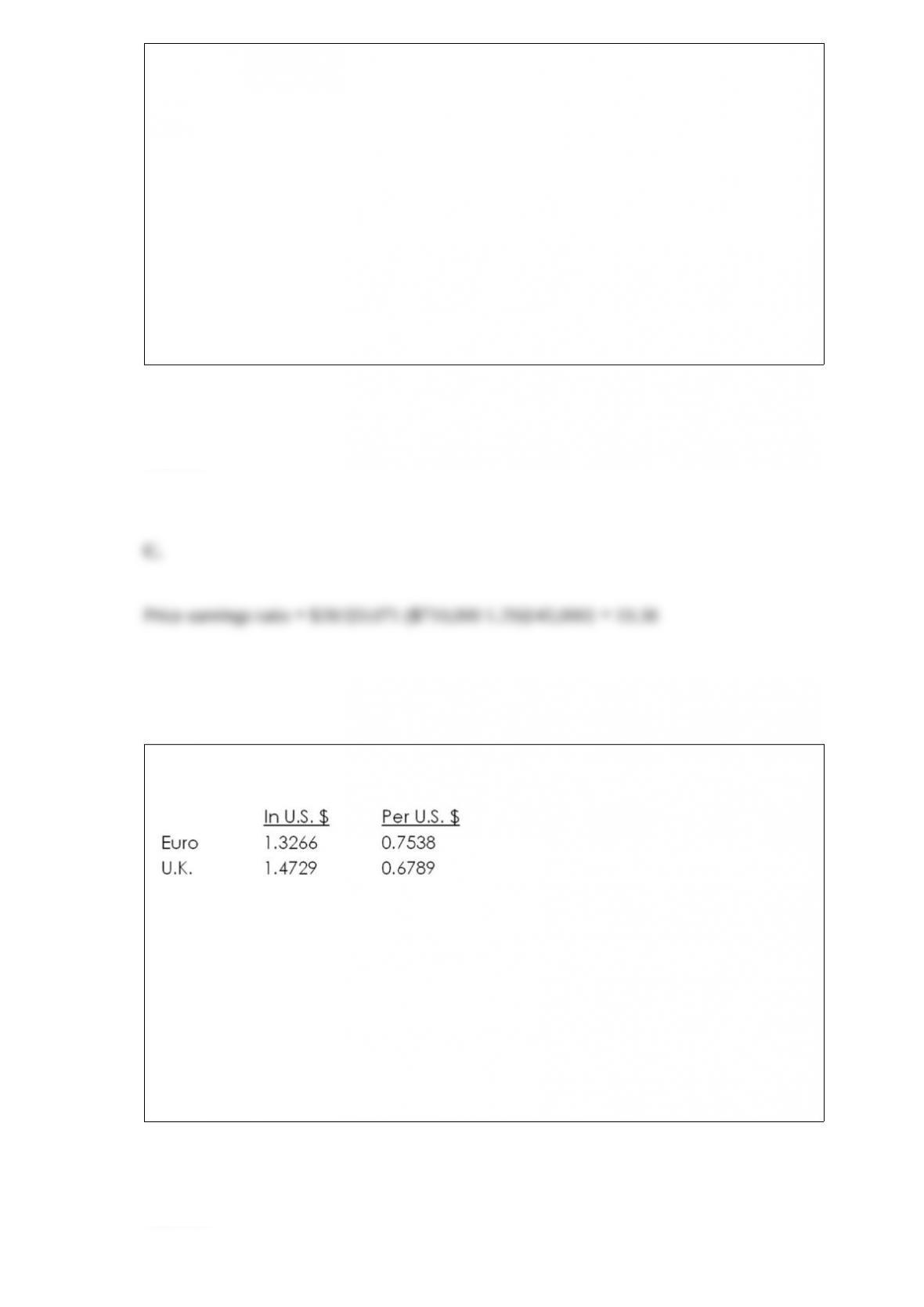
Given the following exchange rates, what is the cross-rate for euros in terms of British
pounds?
A. €1.1066 = 1
B. €1.1079 = 1
C. €1.1092 = 1
D. €1.1103 = 1
E. €1.1116 = 1
Answer:

Valentino’s maintains a constant debt-equity ratio of 0.45. The firm had net income of
$11,800 for the year and paid $6,500 in dividends. The firm has total assets of $92,000.
What is the sustainable growth rate?
A. 7.38 percent
B. 8.27 percent
C. 9.11 percent
D. 9.62 percent
E. 10.38 percent
Answer:
Mary has just been asked to analyze an investment to determine if it is acceptable.
Unfortunately, she is not being given sufficient time to analyze the project using various
methods. She must select one method of analysis and provide an answer based solely on
that method. Which method do you suggest she use in this situation?
A. Internal rate of return
B. Payback

C. Average accounting rate of return
D. Net present value
E. Profitability index
Answer:
Which two of the following tend to limit the amount of dividends that can be paid by a
leveraged corporation?
I. Current tax laws
II. Corporate tax exclusion
III. Bond indenture covenant
IV. State laws pertaining to retained earnings
A. I and II only
B. I and III only
C. II and III only
D. II and IV only
E. III and IV only
Answer:

A firm grants credit with terms of 2/5, net 20. The firm’s customers have ___ days to
pay in order to receive a _____ percent discount.
A. 2; 5
B. 5; 2
C. 15; 2
D. 20; 2
E. 30; 5
Answer:
Lee pays 1 percent per month interest on his credit card account. When his monthly rate
is multiplied by 12, the resulting answer is referred to as the:
A. annual percentage rate.
B. compounded rate.
C. effective annual rate.
D. perpetual rate.
Answer:

The Rainbow Company has total sales of $713,200 and a profit margin of 8.5 percent.
Currently, the firm has 12,500 shares outstanding. What are the earnings per share?
A. $2.98
B. $3.31
C. $3.56
D. $4.58
E. $4.85
Answer:
Which of the following are determinants of a firm’s sustainable rate of growth?
I. Amount of sales generated from each dollar invested in assets
II. Amount of debt per dollar of equity
III. Amount of current assets per dollar of current liabilities

IV. Percentage of net income distributed as dividends
A. I and III only
B. II and IV only
C. I, II, and IV only
D. II, III, and IV only
E. I, II, III, and IV
Answer:
Which one of the following analytical methods is based on net income?
A. Profitability index
B. Internal rate of return
C. Average accounting return
D. Modified internal rate of return
E. Payback
Answer:

Bob’s is a retail chain of specialty hardware stores. The firm has 21,000 shares of stock
outstanding that are currently valued at $68 a share and provide a 13.2 percent rate of
return. The firm also has 500 bonds outstanding that have a face value of $1,000, a
market price of $1,068, and a 7 percent coupon. These bonds mature in 6 years and pay
interest semiannually. The tax rate is 35 percent. The firm is considering expanding by
building a new superstore. The superstore will require an initial investment of $12.3
million and is expected to produce cash inflows of $1.1 million annually over its
10-year life. The risks associated with the superstore are comparable to the risks of the
firm’s current operations. The initial investment will be depreciated on a straight line
basis over the life of the project. At the end of the 10 years, the firm expects to sell the
superstore for $6.7 million. Should the firm accept or reject the superstore project and
why?
A. Accept; the project’s NPV is $1.27 million.
B. Accept; the NPV is $4.89 million.
C. Reject; the NPV is $1.06 million.
D. Reject; the NPV -$3.27 million.
E. Reject; the NPV is -$5.71 million.
Answer:

One year ago, you purchased 500 shares of stock for $12 a share. The stock pays $0.22
a share in dividends each year. Today, you sold your shares for $28.30 a share. What is
your total dollar return on this investment?
A. $6,222
B. $7,432
C. $8,150
D. $7,775
E. $8,260
Answer:
A firm has an equity multiplier of 1.5. This means that the firm has a:
A. debt-equity ratio of 0.67.
B. debt-equity ratio of 0.33.
C. total debt ratio of 0.50.

D. total debt ratio of 0.67.
E. total debt ratio of 0.33.
Answer:
Windsor stock has produced returns of 22.6 percent, 18.7 percent, 11.3 percent, -19.8
percent, and 2.4 percent over the past five years, respectively. What is the variance of
these returns?
A. 0.028453
B. 0.031947
C. 0.035682
D. 0.039515
E. 0.040016
Answer:

Sensitivity analysis:
A. looks at the most reasonably optimistic and pessimistic results for a project.
B. helps identify the variable within a project that presents the greatest forecasting risk.
C. is used for projects that cannot be analyzed by scenario analysis because the cash
flows are unconventional.
D. is generally conducted prior to scenario analysis just to determine if the range of
potential outcomes is acceptable.
Answer:
Stock in ABC Enterprises has a beta of 1.06. The market risk premium is 6.8 percent,
and T-bills are currently yielding 3.2 percent. ABC’s most recent dividend was $1.56
per share, and dividends are expected to grow at a 4 percent annual rate indefinitely. If
the stock sells for $43 a share, what is your best estimate of ABC’s cost of equity?
A. 7.78 percent
B. 8.82 percent
C. 9.09 percent
D. 9.41 percent
E. 9.69 percent

Answer:
A project has expected cash inflows, starting with year 1, of $2,200, $2,900, $3,500,
and finally in year 4, $4,000. The profitability index is 1.14 and the discount rate is 12
percent. What is the initial cost of the project?
A. $7,899.16
B. $8,098.24
C. $8,166.19
D. $9,211.06
E. $9,250.00
Answer:
Which one of the following transactions occurred in the primary market?

A. Maria gave 100 shares of Alto stock to her best friend.
B. Gene purchased 300 shares of Alto stock from Ted.
C. South Wind Products sold 1,000 shares of newly issued stock to Mike.
D. Terry sold 3,000 shares of Uno stock to his brother.
E. The president of Trecco, Inc. sold 500 shares of Trecco stock to his son.
Answer:
A firm has two open positions on its board of directors. How many shares do you need
to own to guarantee your own election to the board if the firm has 12,500 shares of
stock outstanding and uses cumulative voting? Each share is granted one vote.
A. 3,334 shares
B. 4,168 shares
C. 5,251 shares
D. 5,501 shares
E. 6,251 shares
Answer:

Jefferson International is trying to choose between the following two mutually
exclusive design projects:
The required return is 12 percent. If the company applies the profitability index (PI)
decision rule, which project should the firm accept? If the company applies the NPV
decision rule, which project should it take? Given your first two answers, which project
should the firm actually accept?
A. Project A; Project B; Project A
B. Project A; Project B; Project B
C. Project B; Project A; Project A
D. Project B; Project A; Project B
E. Project B; Project B, Project B
Answer:

The Sarbanes-Oxley Act in 2002 was prompted by which one of the following from the
1990s?
A. Increased stock market volatility
B. Corporate accounting and financial fraud
C. Increased executive compensation
D. Increased foreign investment in U.S. stock markets
E. Increased use of tax loopholes
Answer: