
1) Securitization made it harder for banks to lend money because they could not pass
the risk on to other investors.
2) Mortgage-backed securities are securities that represent claims on the cash flows
generated by a pool of mortgages.
3) Returns from internationally diversified portfolios tend to be superior to those
yielded by purely domestic ones.
4) Upward-sloping yield curves result from higher future inflation expectations, lender
preferences for shorter maturity loans, and greater supply of short-term as opposed to
long-term loans relative to their respective demand.
5) Under the floating inventory lien, the borrower is free to sell the merchandise and is
expected to remit the amount lent against each item, along with accrued interest, to the
lender immediately after the sale. The lender then releases the lien on the appropriate
item.
6) Leasing is considered a source of financing provided by the lessee to the lessor.
7) A portfolio combining two assets whose returns are less than perfectly positive
correlated can increase total risk to a level above that of either of the components.

8) Two assets whose returns move in the opposite directions and have a correlation
coefficient of -1 ar either risk-free assets or low-risk assets.
9) Even though a business firm can be viewed as a portfolio of assets, firms are not
rewarded for selecting a diversified portfolio of assets because investors can more
efficiently diversify the risk on their own.
10) The over-the-counter (OTC) market is a market for trading smaller and unlisted
securities.
11) The contribution margin is defined as the percent of each sales dollar that remains
after satisfying fixed operating costs.
12) A portfolio of two negatively correlated assets has less risk than either of the
individual assets.
13) To carry out systematic retirement of bonds, a corporation makes semiannual or
annual payments that are used to retire bonds by purchasing them in the marketplace.
14) In general, an international bond is one that is initially sold in the country of the
borrower and, then, often distributed in home country.
15) Longer the maturity of a Treasury security, the smaller the interest rate risk.
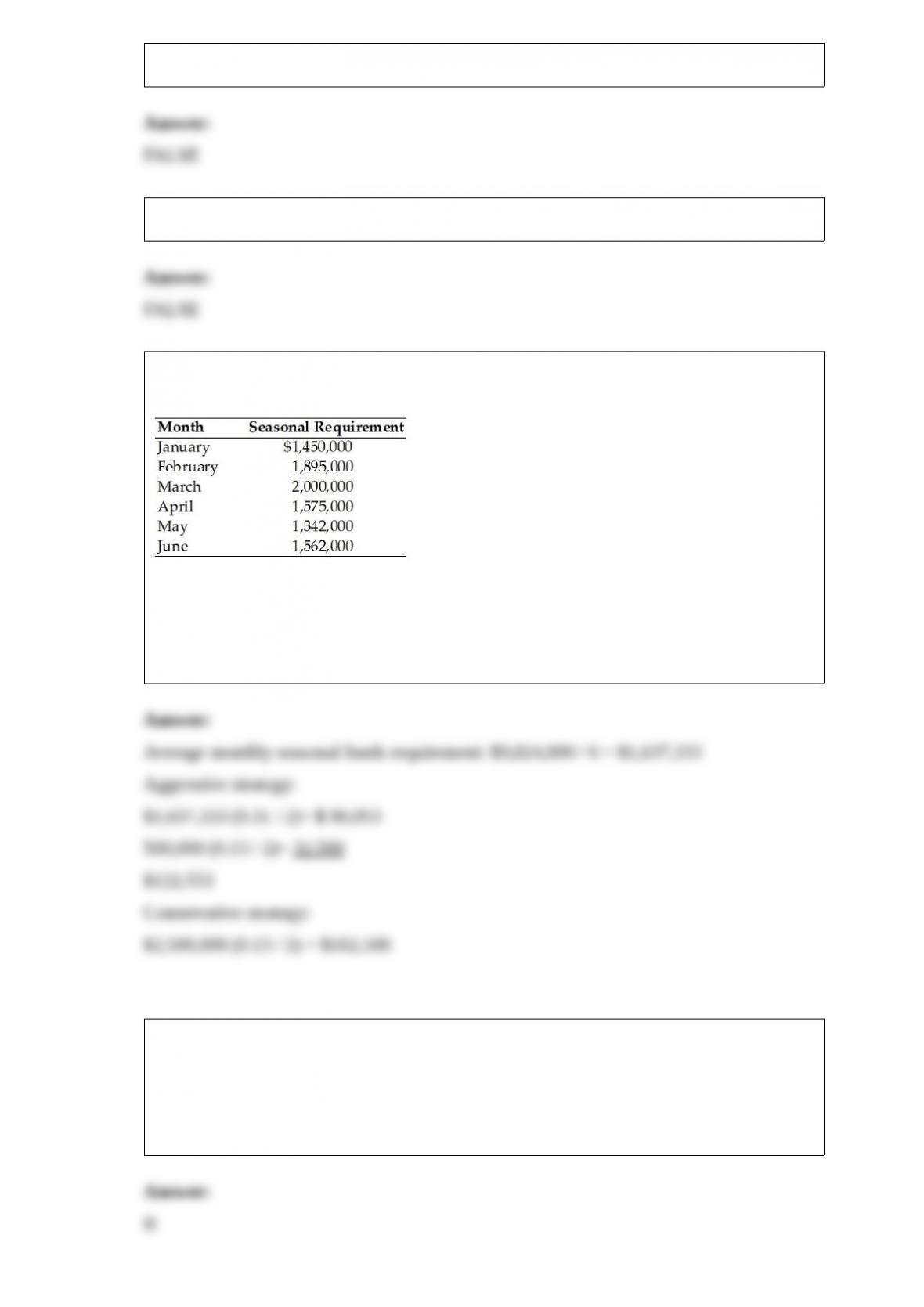
16) Studio San, a dealer in contemporary art, has forecasted its seasonal financing needs
for the next six months as follows:
(a)The firm projects that short-term funds will cost 11 percent and long-term funds will
cost 13 percent annually.
(b)The firm’s permanent funds requirement is $500,000.
Calculate financing costs for the first six months using the aggressive and conservative
strategies.
17) Most money market transactions are made in ________.
A) common stock
B) marketable securities
C) commodities market
D) preferred stock

18) A firm has fixed operating costs of $25,000, a per unit sales price of $5, and a
variable cost per unit of $3. What is its operating breakeven point if it targets net
operating income of $10,000?
A) 12,500 units
B) 15,000 units
C) 17,500 units
D) 25,000 units
19) Strikes, lawsuits, regulatory actions, or the loss of a key account are all examples of
________.
A) diversifiable risk
B) market risk
C) economic risk
D) systematic risk
20) What is the expected return for Asset X if it has a beta of 1.5, the expected market
return is 15 percent, and the expected risk-free rate is 5 percent?
A) 5.0%
B) 7.5%
C) 15.0%
D) 20.0%
21) Government is typically a ________.
A) net provider of funds because it borrows more than it saves
B) net demander of funds because it borrows more than it saves
C) net provider of funds because it can print money at will
D) net demander of funds because it saves more than it borrows
22) Which of the following is true of inventory level?
A) A purchasing manager would purchase higher inventories when prices are low and
lower inventories when prices are high irrespective of inventory requirement
B) A marketing manager would like to have smaller inventories of finished products to
ensure production of goods as per customer specification
C) A financial manager would keep inventory levels low to ensure that the firm’s money
is not unwisely invested in excess resources
D) A manufacturing manager would keep raw materials inventories low to ensure use of
latest materials in production process
23) Operating and financial constraints placed on a corporation by loan provision are
________.
A) agency costs to lenders
B) agency costs to a firm
C) necessary to regulate ownership of a firm
D) necessary to control the risk of a firm
24) Tangshan China’s stock is currently selling for $160.00 per share and the firm’s
dividends are expected to grow at 5 percent indefinitely. In addition, Tangshan China’s
most recent dividend was $5.50. The expected risk free rate of return is 3 percent, the
expected market return is 8 percent, and Tangshan has a beta of 1.20.
(a)What is the expected return based on the dividend valuation model?
(b)What is the required return based on the CAPM?
(c)Would Tangshan China be a good investment at this time? Explain
25) The 2002 law that established the Public Company Accounting Oversight Board
(PCAOB) was called ________.
A) the McCain-Feingold Act
B) the Harkins-Oxley Act
C) the Sarbanes-Harkins Act
D) the Sarbanes-Oxley Act
26) Profit maximization as a goal is ideal because it directly considers ________.
A) risk and book value of assets
B) timing and cash flow
C) timing and risk
D) EPS and stock price
27) A firm purchased raw materials on account and paid for them within 30 days. The
raw materials were used in manufacturing a finished good sold on account 100 days
after the raw materials were purchased. The customer paid for the finished good 60
days later. The firm’s cash conversion cycle is ________ days.
A) 10
B) 70
C) 130
D) 190
28) ________ leverage is concerned with the relationship between sales revenues and
earnings before interest and taxes.
A) Investing
B) Operating
C) Variable
D) Total
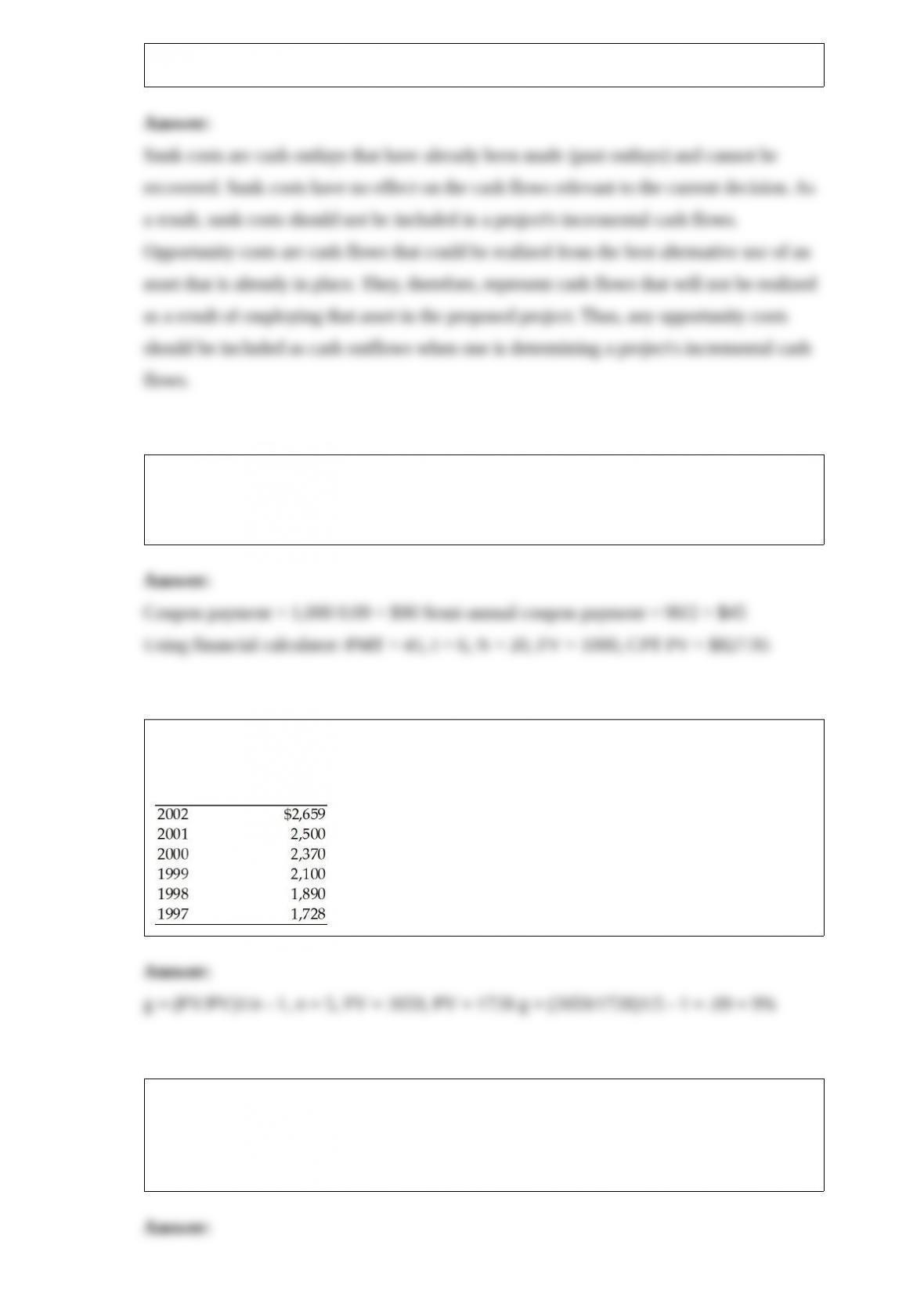
29) Table 8.3
Consider the following two securities X and Y.
Using the data from Table 8.3, what is the systematic risk for a portfolio with two-thirds
of the funds invested in X and one-third invested in Y?
A) 0.88
B) 1.17
C) 1.33
D) 1.67

30) ________ costs are a function of time, not sales, and are typically contractual.
A) Fixed
B) Semi-variable
C) Variable
D) Operating
31) The Sarbanes-Oxley Act of 2002 resulted in ________.
A) tightened audit regulations and controls
B) toughened penalties against overcompensated executives
C) lenient penalties against executives who commit corporate fraud
D) delayed disclosure of stock sales by corporate executives
32) According to the residual theory of dividends, if a firm’s equity need is less than the
amount of retained earnings, the firm would ________.
A) borrow to pay the cash dividend
B) declare a dividend equal to the remaining balance
C) pay no cash dividends
D) pay dividends higher than the remaining balance to gain credibility
33) In 2003-2004, the United States signed a regional trade pact with the Dominican
Republic, Costa Rica, El Salvador, Guatemala, Honduras, and Nicaragua called the
Central American Free Trade Agreement or CAFTA.
34) Janice borrows $25,000 from the bank at 15 percent to be repaid in 10 equal annual
installments. Calculate the end-of-year payment.
35) Please explain the difference between a sunk cost and an opportunity cost and give
an example of each type of cost.
36) Yantai Food, Inc. has issued a bond with par value of $1,000, a coupon rate of 9
percent that is paid semi-annually, and that matures in 10 years. What is the value of the
bond if the required rate of return is 12 percent?
37) The following table presents the Sally’s Silly Service Company’s net earnings for
the past six years. Compute the growth rate in the company’s earnings.
38) Assume you have a choice between two deposit accounts. Account X has an annual
percentage rate of 12.25 percent but with interest compounded monthly. Account Y has
an annual percentage rate of 12.20 percent with interest compounded continuously.
Which account provides the highest effective annual return?
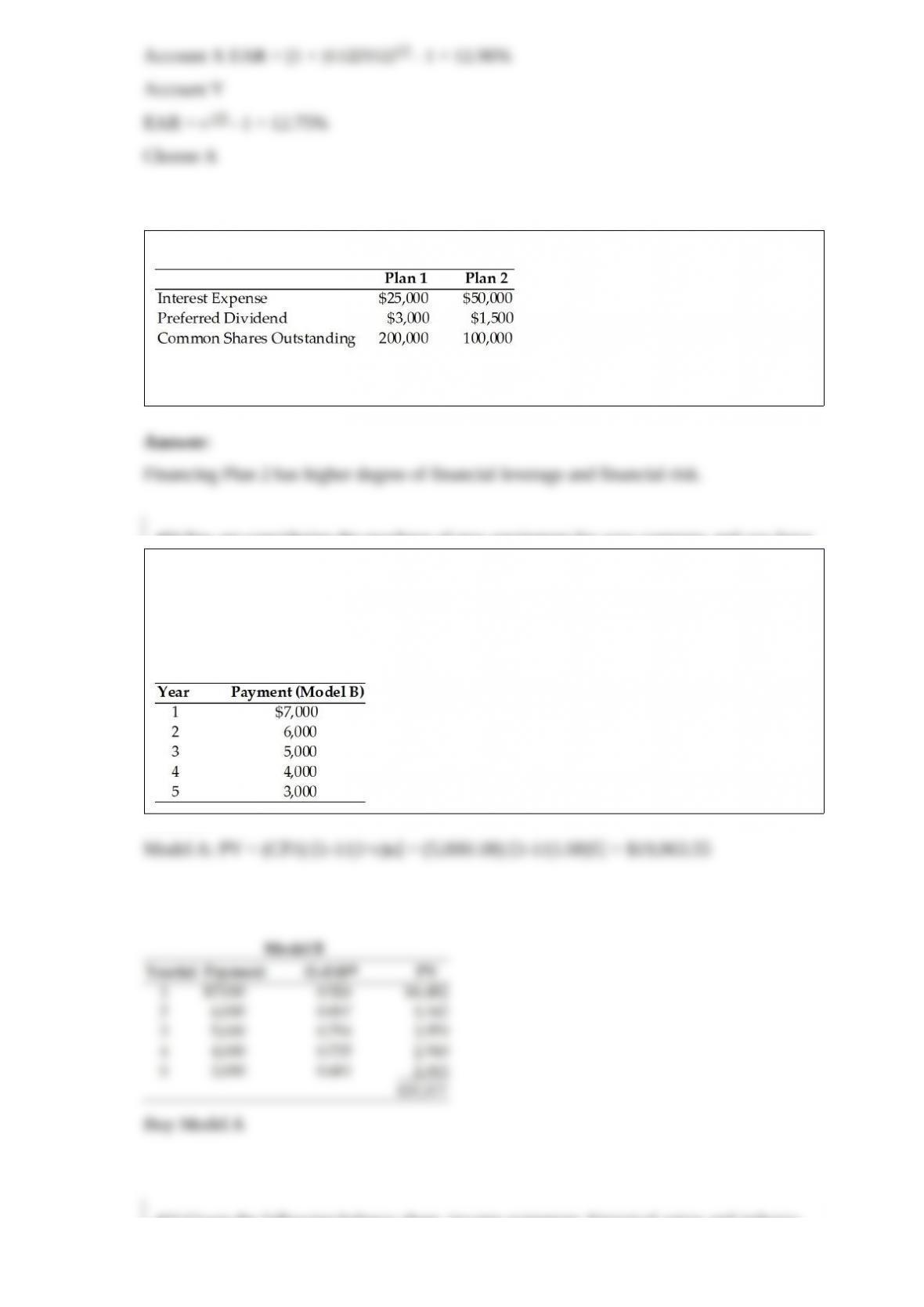
39) Table 13.1
Which plan has a higher degree of financial leverage and financial risk? (See Table
13.1)
40) You are considering the purchase of new equipment for your company and you have
narrowed down the possibilities to two models which perform equally well. However,
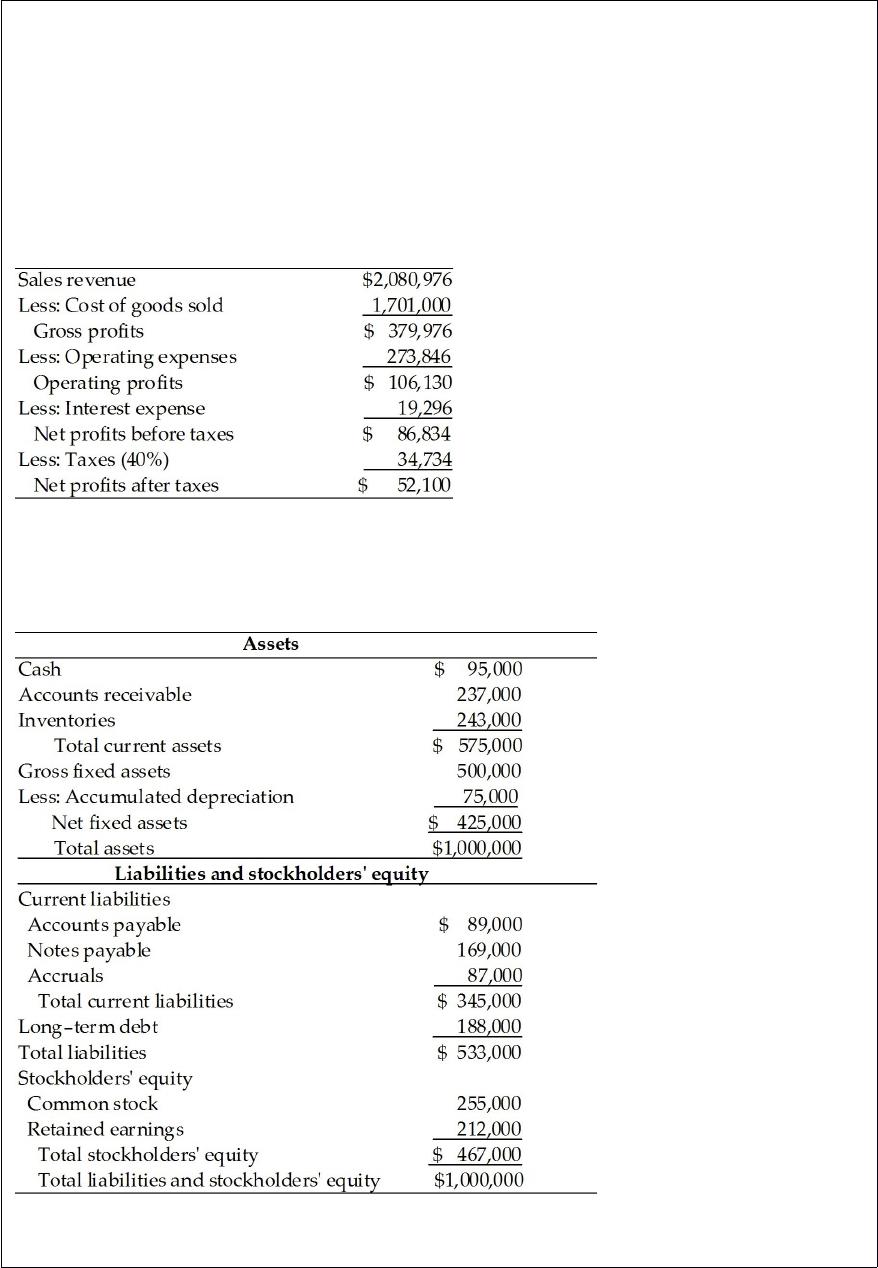
the method of paying for the two models is different. Model A requires $5,000 per year
payment for the next five years. Model B requires the following payment schedule.
Which model should you buy if your opportunity cost is 8 percent?
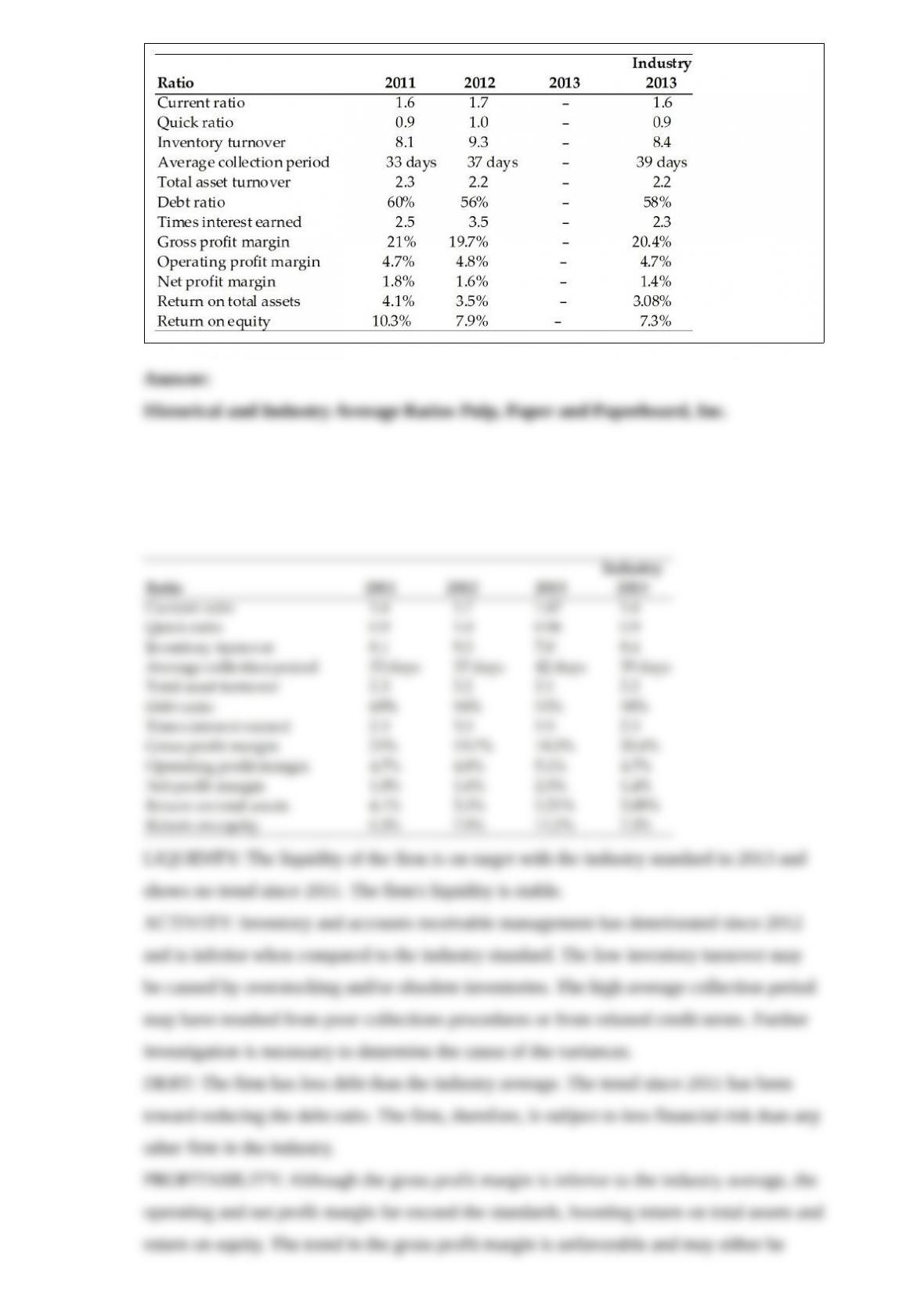
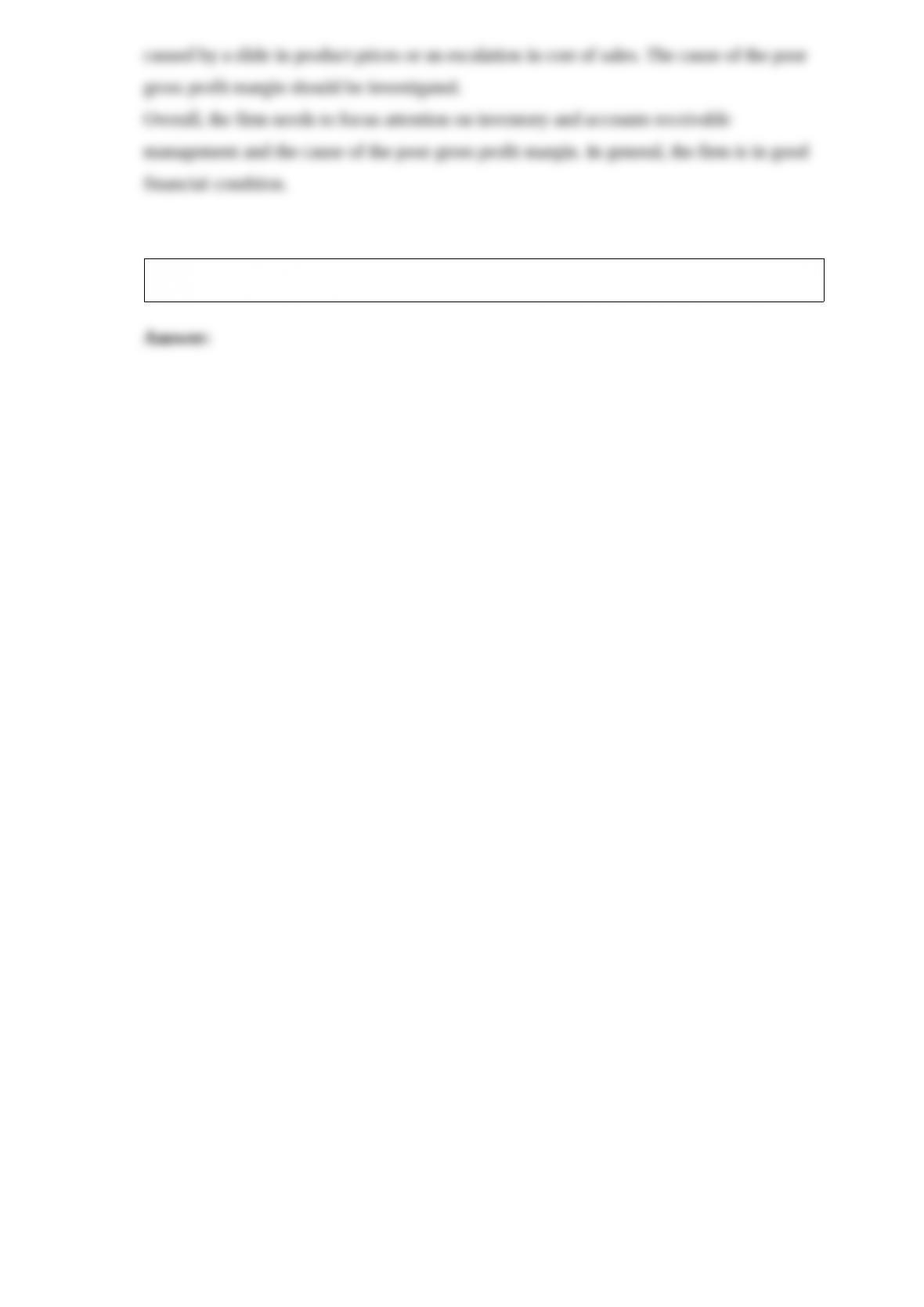
41) Given the following balance sheet, income statement, historical ratios and industry
averages, calculate the Pulp, Paper, and Paperboard, Inc. financial ratios for the most
recent year. Analyze its overall financial situation for the most recent year. Analyze its
overall financial situation from both a cross-sectional and time-series viewpoint. Break
your analysis into an evaluation of the firm’s liquidity, activity, debt, and profitability.
Income Statement
Pulp, Paper, and Paperboard, Inc.
For the Year Ended December 31, 2013
Balance Sheet
Pulp, Paper, and Paperboard, Inc.
December 31, 2013
Historical and Industry Average Ratios
Pulp, Paper and Paperboard, Inc.
42)