1) you have $16,000 to invest in a mutual fund with a nav = $45. you choose a fund
with a 4% front load, a 1% management fee, and a 0.25% 12b-1 fee. assume that the
management and 12b-1 fees are charged on year-end assets. the gross annual return on
the fund’s shares was 9%. what was your net annual rate of return to the nearest basis
point?
a.3.33%
b.7.64%
c.6.25%
d.4.52%
e.4.64%
2) in the area of bank supervision, which of the following are functions of the federal
reserve banks?
i. examinations of state member banks
ii. approval of member bank and bank holding company acquisitions
iii. deposit insurance
a.i only
b.i and ii only
c.ii and iii only
d.i and iii only
e.i, ii, and iii
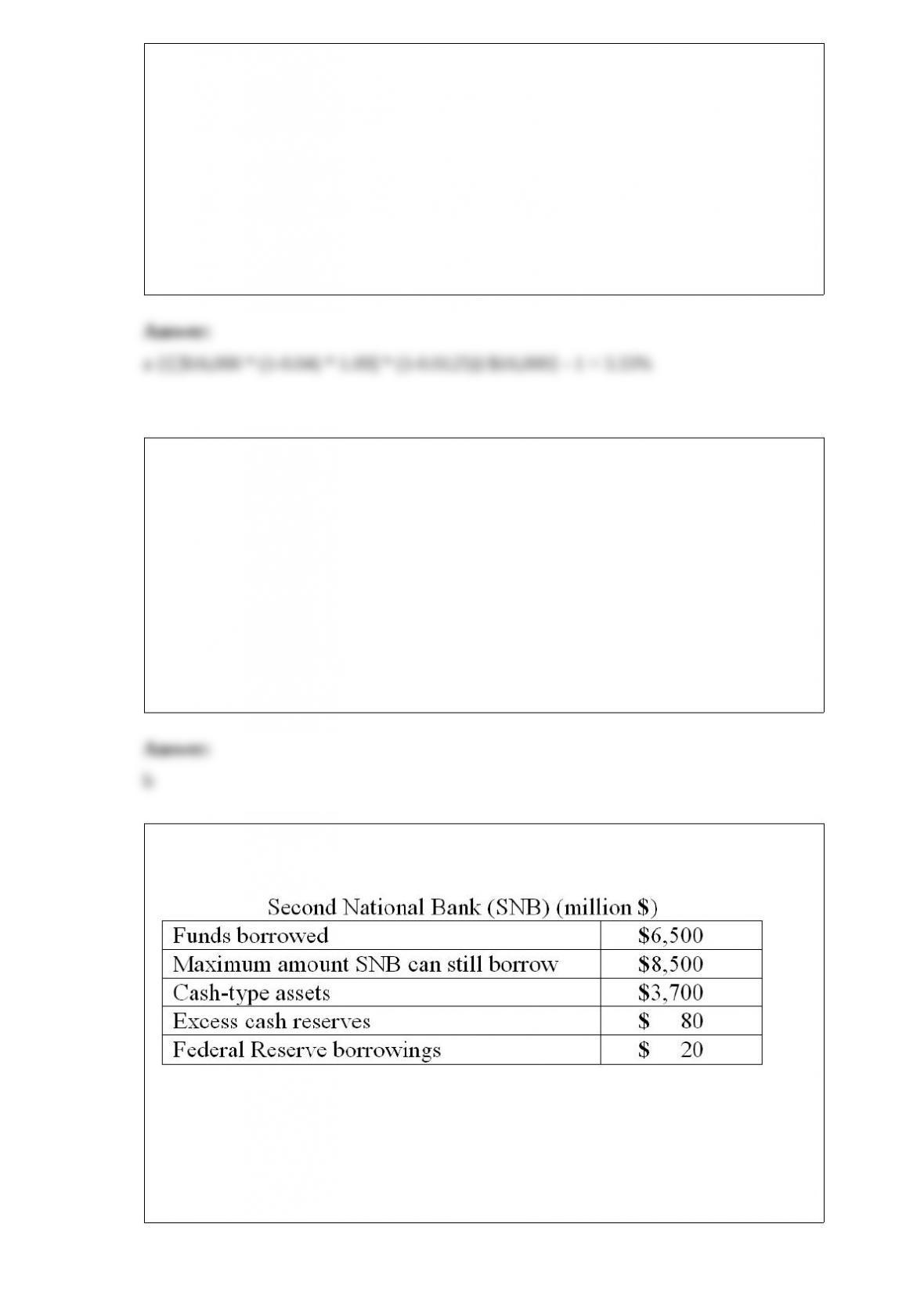
3) figure 21-2
what is second national bank’s total net liquidity?
a.$6,520
b.$13,500
c.$14,200
d.$12,280
e.$5,760

4) a(n) ___________ plan does not require the employer to guarantee retirement
benefits nor to maintain a minimum level of pension reserves.
a.defined benefit
b.insured pension
c.corporate pension
d.uninsured pension
e.defined contribution
5) an unregistered issue sold to a few large institutional buyers is an example of a
a.best efforts offering
b.fully underwritten public offering
c.shelf offering
d.private placement
e.sec rule 415 offering
6) a six-year maturity bond has a five-year duration. over the next year maturity will
decline by 1 year and duration will decline by
a.less than one year
b.more than one year
c.1 year
d.n years
e.n/(n-1) years
7) a bond that pays interest semiannually has a 6% promised yield and a price of $1045.
annual interest rates are now projected to increase 50 basis points. the bond’s duration is
5 years. what is the predicted new bond price after the interest rate change? (watch your
rounding.)
a.$1020.35

b.$1069.65
c.$1070.36
d.$1019.64
e.none of the above
8) a finance company that makes loans to high risk customers is called a
a.subprime lender
b.commercial bank
c.factor
d.warehouse lender
e.credit lender
9) a bank has a negative duration gap. which one of the following statements is most
correct?
a.if all interest rates are projected to increase, to limit a net value decline, before rates
rise the bank should increase the amount of short-term loans on the balance sheet
b.if all interest rates are projected to increase, to limit a net value decline, before rates
rise the bank should increase the amount of short-term bonds issued by the bank
c.if all interest rates are projected to decrease, to limit a net value decline, before rates
fall the bank should increase the amount of long-term loans on the balance sheet
d.if all interest rates are projected to decrease, to limit a net value decline, before rates
fall the bank should increase the amount of long-term bonds issued by the bank
10) loan sales are likely to continue because
i. they can increase near term reported earnings.
ii. they reduce the amount of capital required.
iii. more corporate borrowers have access to the commercial paper market.
a.i and ii only
b.ii and iii only
c.i and iii only
d.ii only
e.i, ii, and iii

11) a bank with short-term floating-rate assets funded by long-term fixed-rate liabilities
could hedge this risk by
i. buying a t-bond futures contract.
ii. buying options on a t-bond futures contract.
iii. entering into a swap agreement to pay a fixed rate and receive a variable rate.
iv. entering into a swap agreement to pay a variable rate and receive a fixed rate.
a.i and iii only
b.i, ii, and iv only
c.ii and iv only
d.iii only
e.iv only
12) a thrift purchases a 1-year interest rate floor with a floor rate of 4.23% from a large
bank. the option has a notional principle of $1 million and costs $2,000. if in one year,
interest rates are 3%, the thrift’s net profit, ignoring commissions and taxes was _____
and if in one year, interest rates were 2%, the thrift’s net profit was _____.
a.$0; $7,500
b.$8,800; -$2,000
c.$8,800; $0
d.$29,500; -$2,000
e.$29,500; $0
13) which of the following would increase the value of a bank charter?
i. tightening restrictions on new charters
ii. broadening the activities banks can engage in
iii. increasing reserve requirements
iv. doubling capital adequacy requirements
a.i and ii only
b.ii only
c.iii and iv only
d.i and iv only
e.ii and iii only

14) would you expect the demand curve for businesses to be steeper than the demand
curve for funds by the federal government? explain.