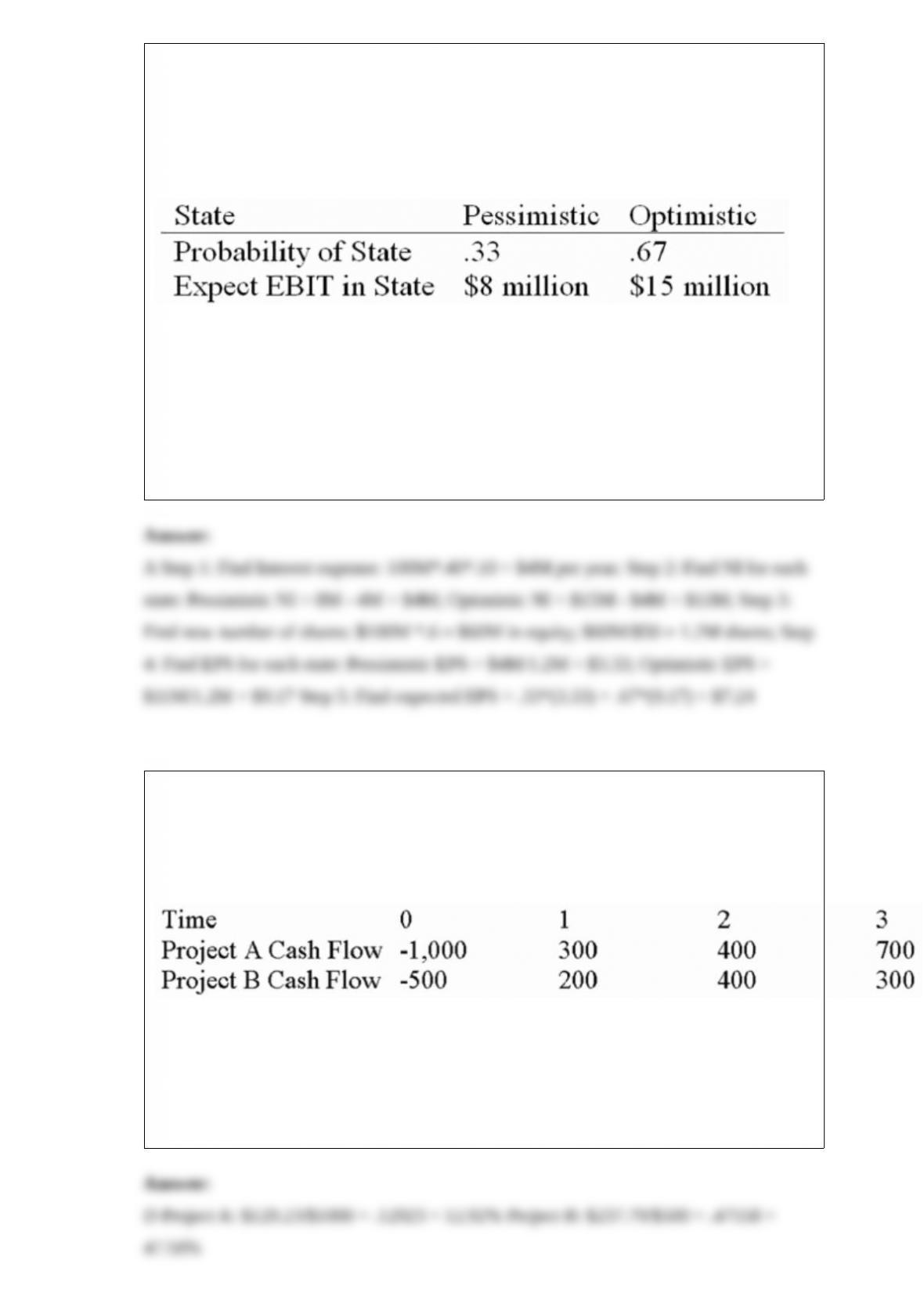
1) HiLo, Inc., doesn’t face any taxes and has $100 million in assets, currently financed
entirely with equity. Equity is worth $50 per share, and book value of equity is equal to
market value of equity. Also, let’s assume that the firm’s expected values for EBIT
depend upon which state of the economy occurs this year, with the possible values of
EBIT and their associated probabilities as shown below:
The firm is considering switching to a 40 percent debt capital structure, and has
determined that they would have to pay a 10 percent yield on perpetual debt. What will
be the level of expected EPS if they switch to the proposed capital structure?
A.$7.24
B.$6.94
C.$5.59
D.$5.67
2) Suppose your firm is considering two mutually exclusive, required projects with the
cash flows shown below. The required rate of return on projects of both of their risk
class is 10 percent, and the maximum allowable payback and discounted payback
statistic for the projects are 2.5 and 3.5 years, respectively.
Use the PI decision rule to evaluate these projects; which one(s) should be accepted or
rejected?
A.accept both A and B
B.accept neither A nor B
C.accept A, reject B
D.reject A, accept B

3) Risk Premiums You own $14,000 of Diner’s Corp stock that has a beta of 2.1. You
also own $14,000 of Comm Corp (beta = 1.3) and $12,000 of Airlines Corp (beta =
0.6). Assume that the market return will be 15 percent and the risk-free rate is 6.5
percent. What is the total risk premium of the portfolio?
A.11.645%
B.20.55%
C.23.905%
D.38.00%
4) Given these two exchange rates, $1 = 1.32 Australian dollars and $1 = £0.56,
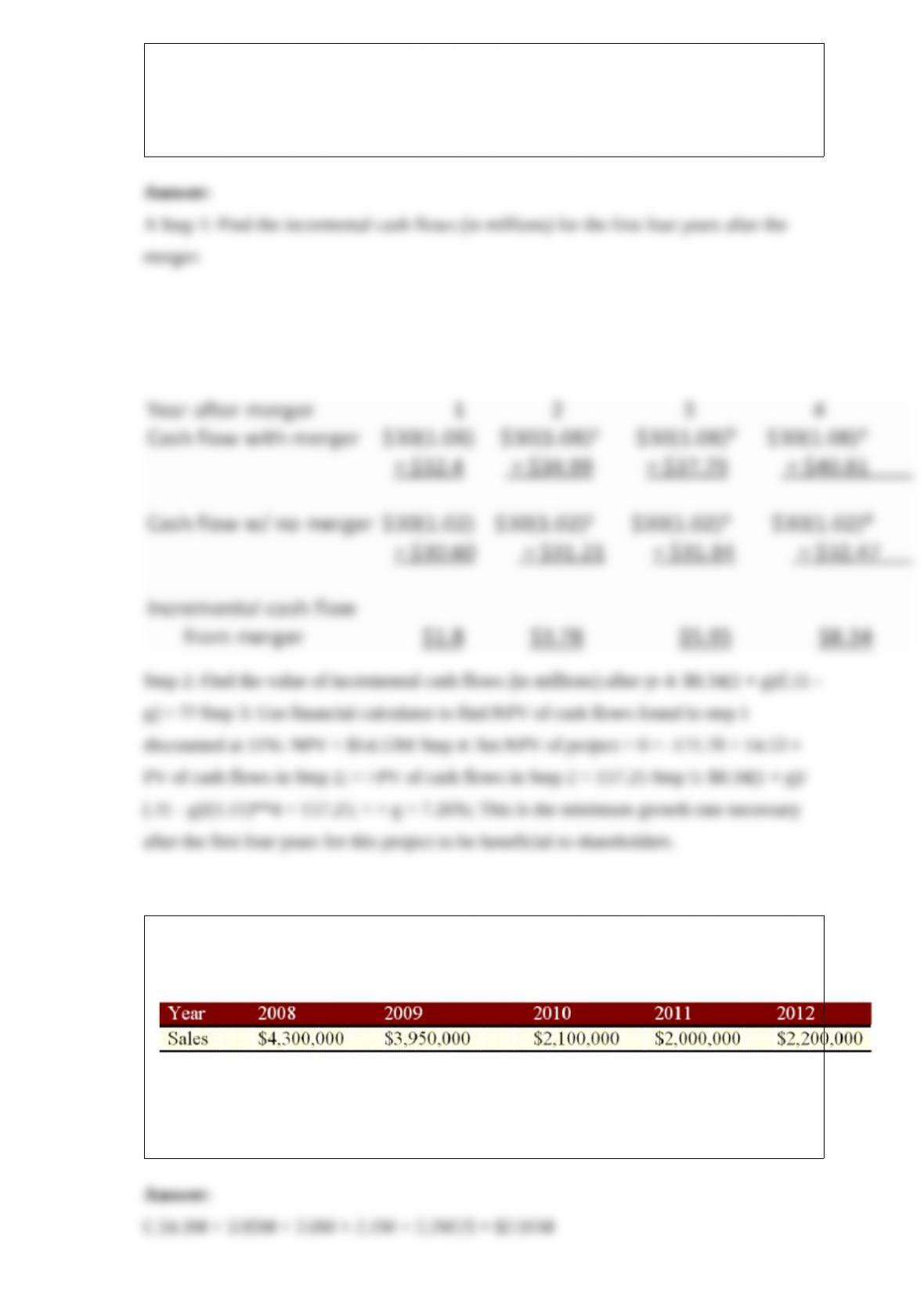
compute the cross-rate between the Australian dollar and the pound. State this exchange
rate in Australian dollars and in pounds.
A.A$2.49
B.A$2.36
C.A$2.91
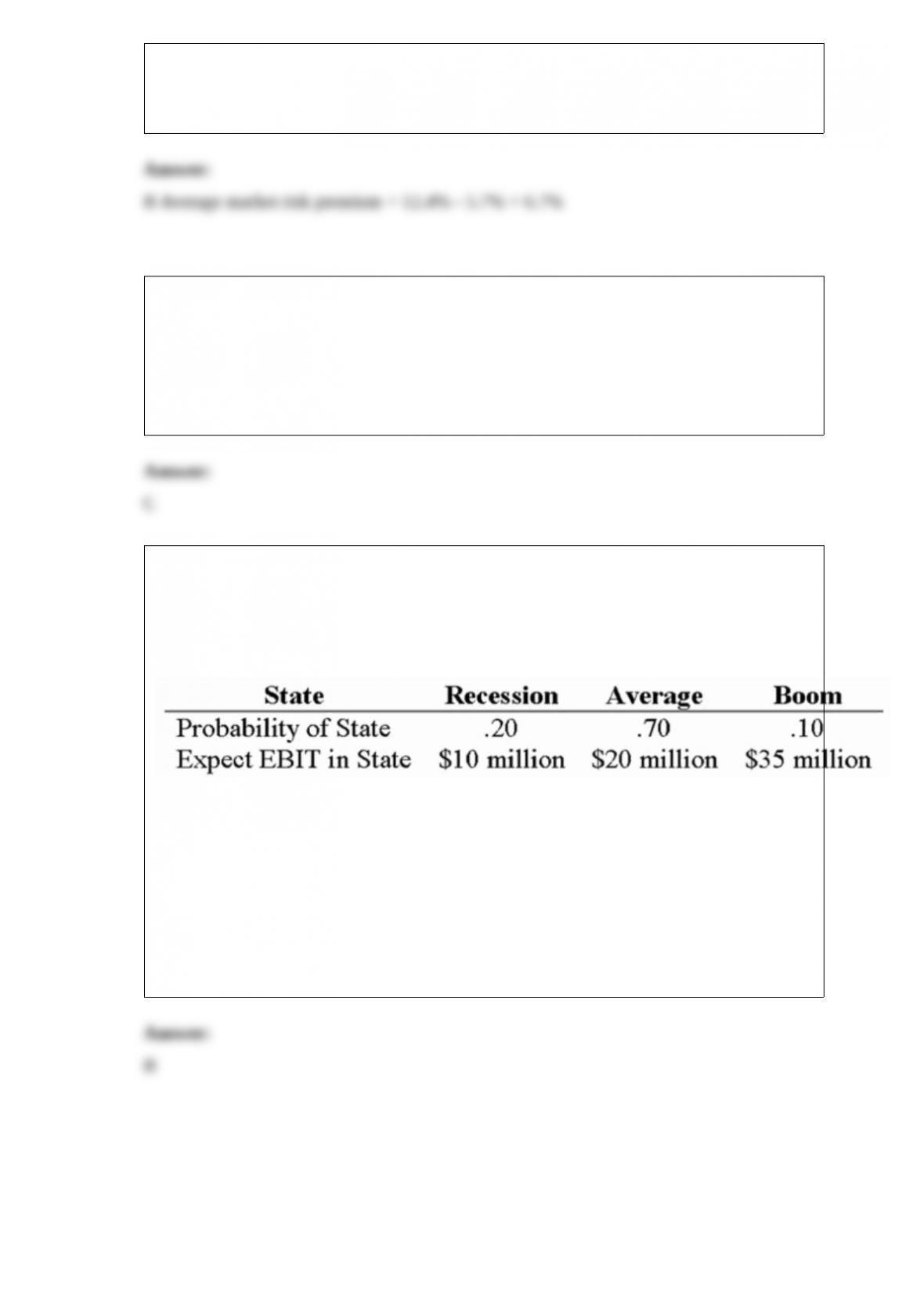
D.A$2.17
5) Solving for Time How long will it take $3,000 to reach $5,000 when it grows at 7
percent per year?
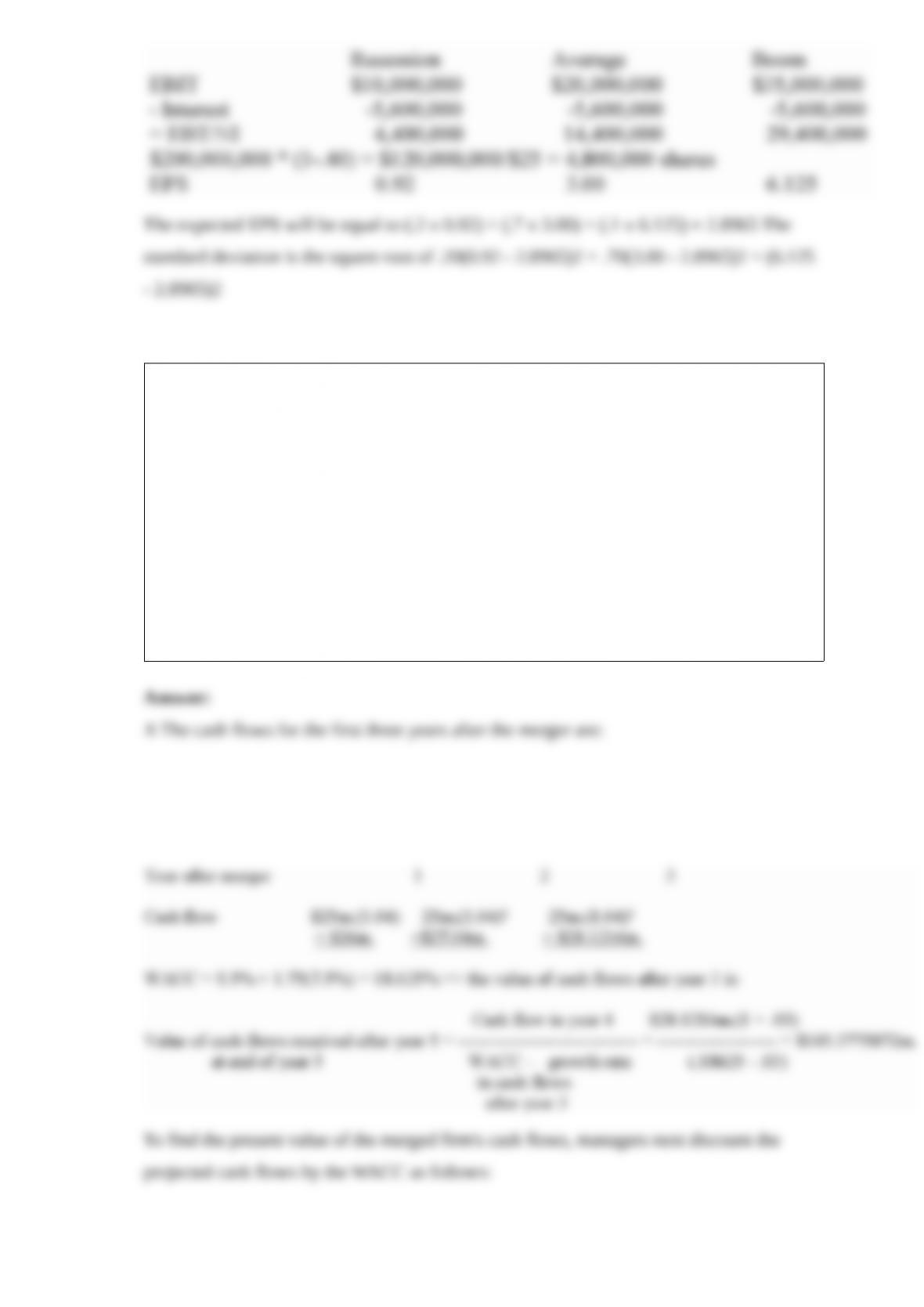
A.7.00 years
B.7.55 years
C.9.52 years
D.10.29 years
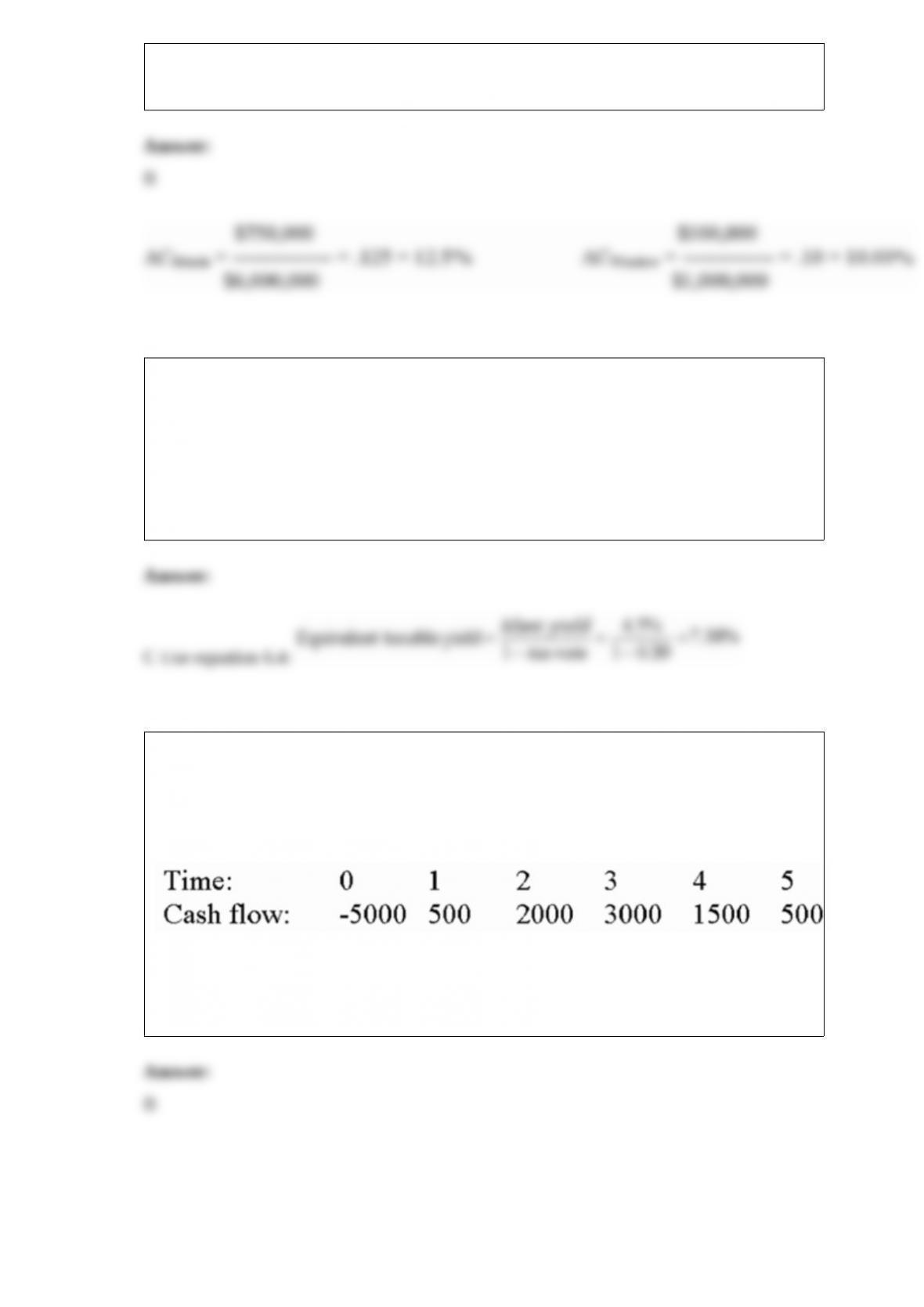
6) Suppose your firm is considering investing in a project with the cash flows shown
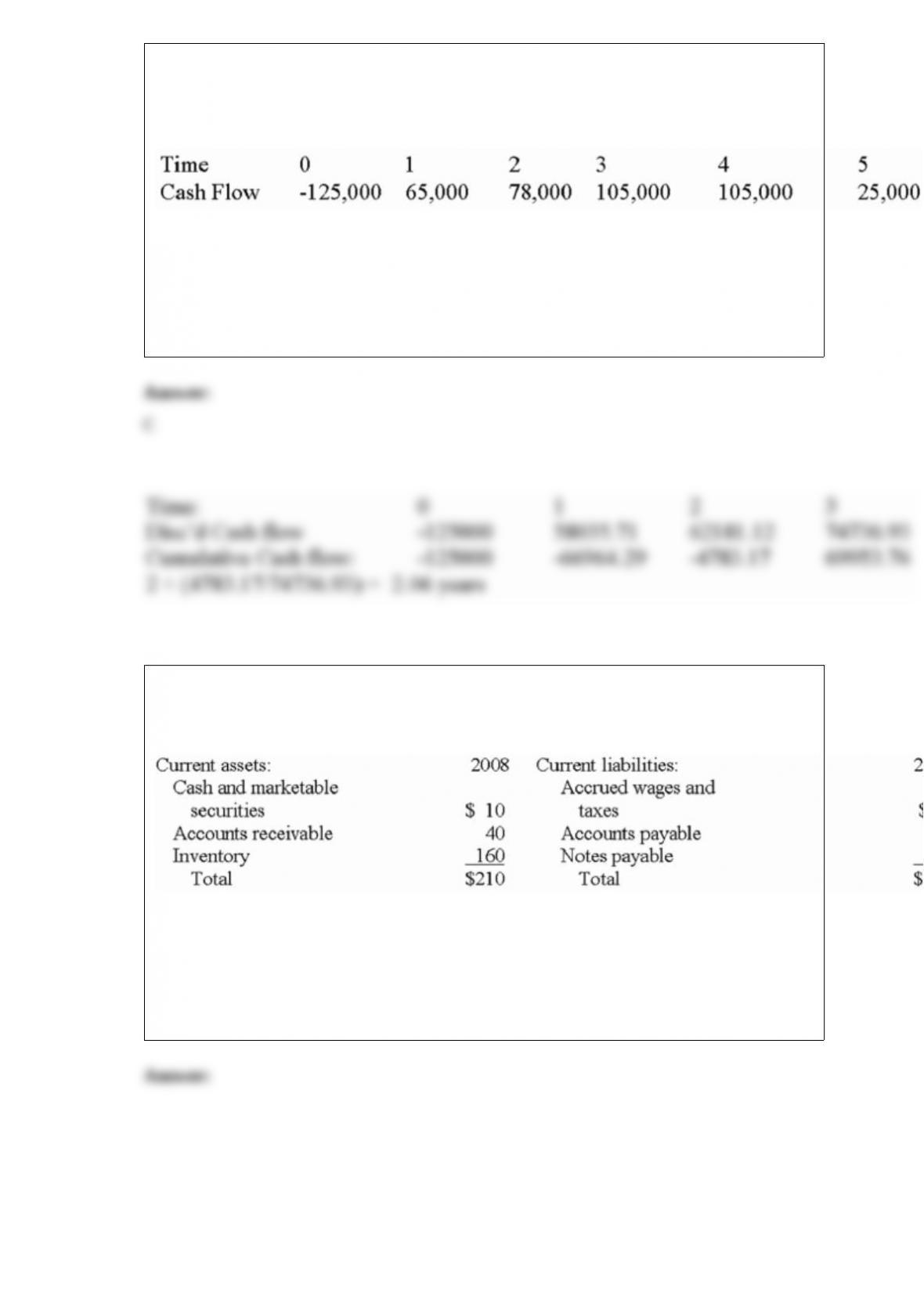
below, that the required rate of return on projects of this risk class is 12 percent, and
that the maximum allowable payback and discounted payback statistic for the project
are 2 and 2.5 years, respectively.
Use the discounted payback decision rule to evaluate this project; should it be accepted
or rejected?
A.1.77 years, reject
B.1.94 years, accept
C.2.06 years, accept
D.3.00 years, reject
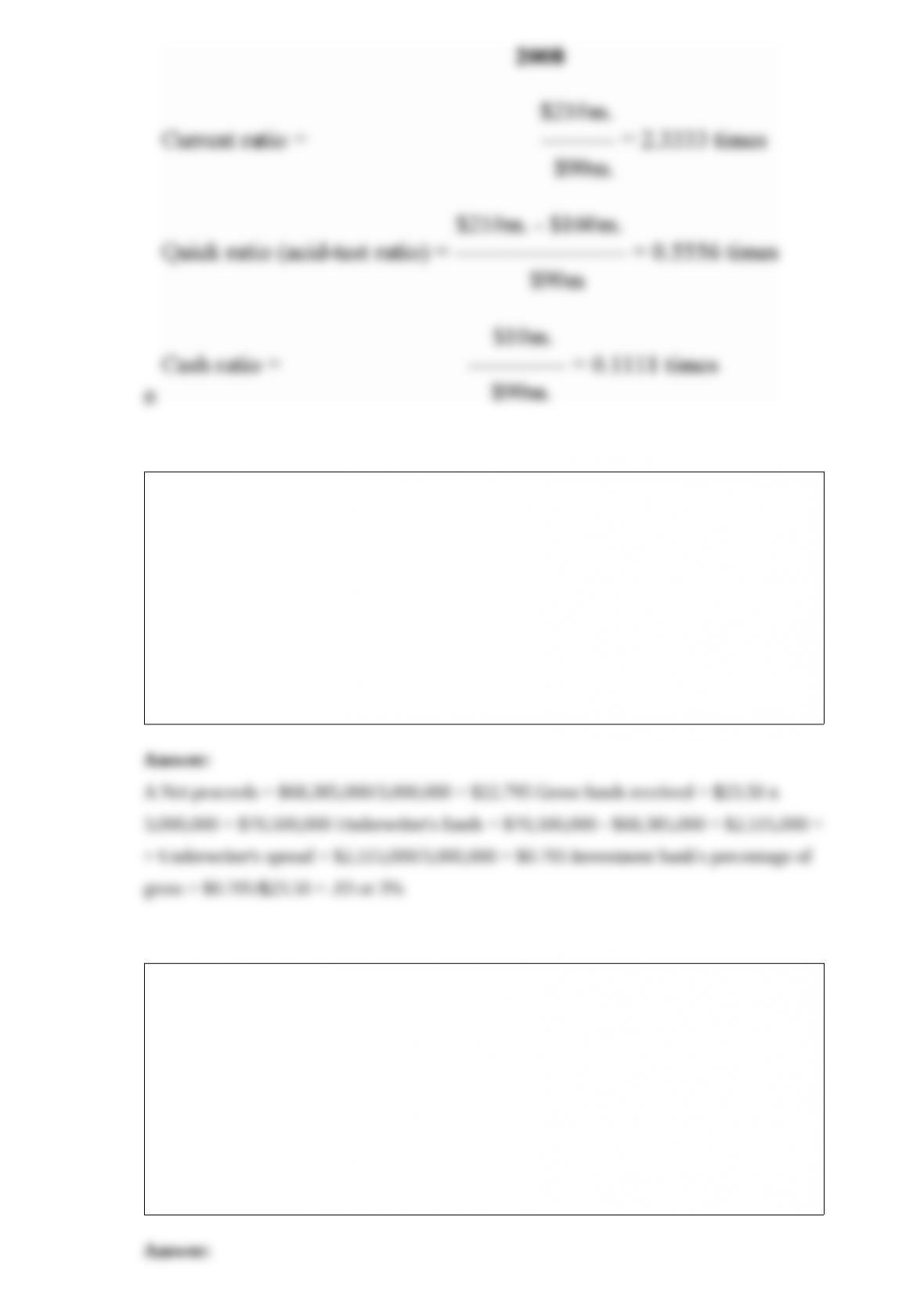
7) Liquidity Ratios The top part of Mars, Inc.’s 2008 balance sheet is listed below (in
millions of dollars).
What are Mars, Inc.’s Current ratio, Quick ratio, and Cash ratio for 2008?
A.0.1111, 0.5556, 0.2
B.2.3333, 0.5556, 0.1111
C.4.2, 1.0, 0.2
D.10.5, 6.0, 1.0
8) Calculating Costs of Issuing Stock Saddles and Bridles, Inc., with the help of its
investment bank recently issued 3 million shares of new stock. The offer price on the
stock was $23.50 per share and Saddles received a total of $68.385 million from the
stock offering. Calculate the net proceeds and the underwriter’s spread charged by the
underwriter to Saddles. What percentage of the gross proceeds is the investment bank
charging Saddles for underwriting the stock issue?
A.3%
B.6%
C.9%
D.97%
9) Calculating Costs of Issuing Stock WuShock, Inc., needs to raise $500 million to
finance its plan for nationwide expansion. In discussions with its investment bank,
WuShock learns that the bankers recommend an offer price (or gross price) of $50 per
share and they will charge an underwriter’s spread of $2.00 per share. Calculate the net
proceeds to WuShock from the sale of stock. How many shares of stock will WuShock
need to sell in order to receive the $500 million they need?
A.10,000,000
B.10,416,667
C.250,000,000
D.500,000,000
10) All of the following capital budgeting tools are suitable for firms facing time
constraints except ______.
A.NPV
B.Payback
C.Discounted payback
D.All of these answers are suitable for firms facing time constraints
11) GEN has 10 million shares outstanding and a stock price of $89.25. What is GEN’s
market capitalization?
A.$89,250,000,000
B.$89,250,000
C.$892,500,000
D.$892,500
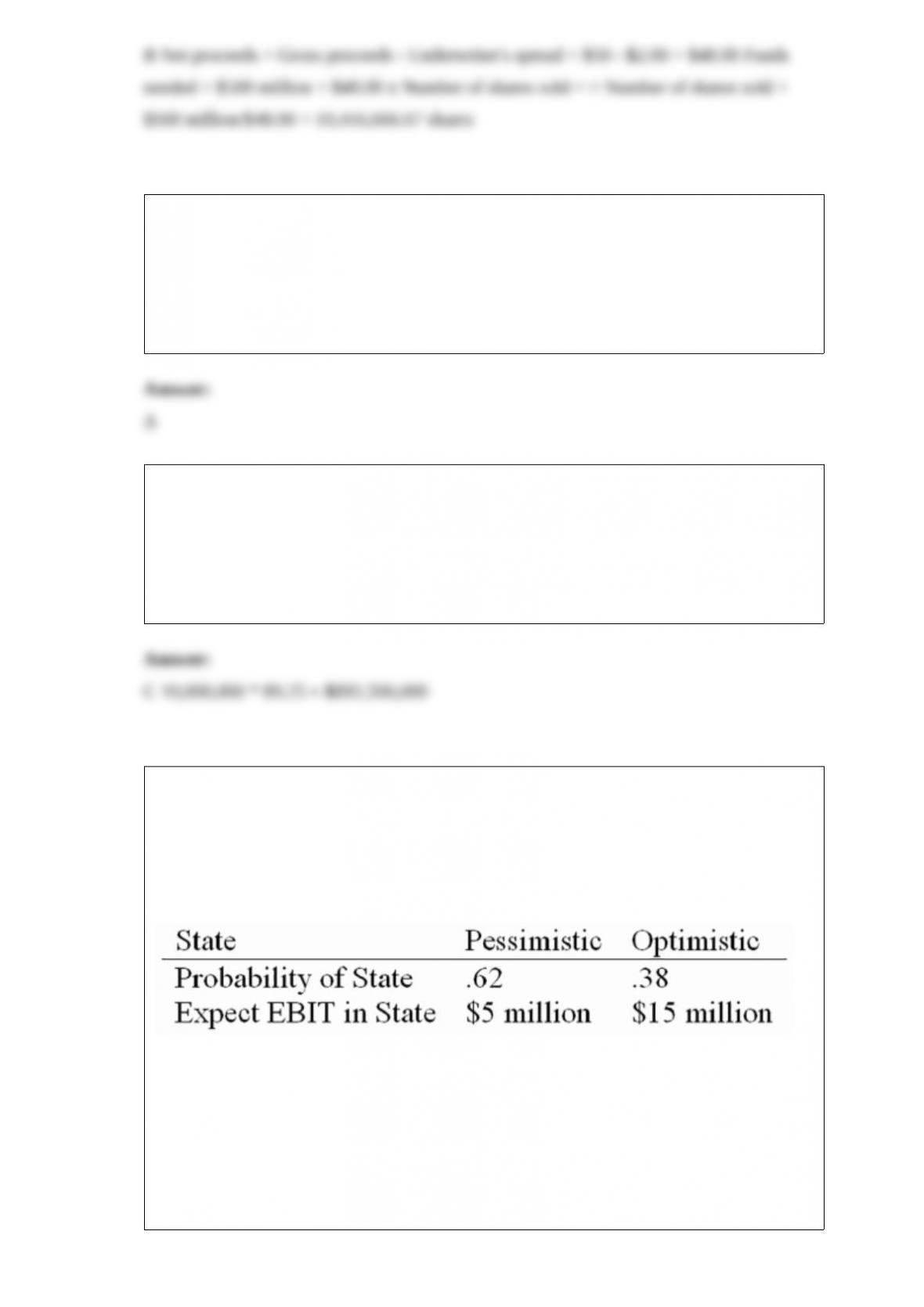
12) HiLo, Inc., doesn’t face any taxes and has $100 million in assets, currently financed
entirely with equity. Equity is worth $50 per share, and book value of equity is equal to
market value of equity. Also, let’s assume that the firm’s expected values for EBIT
depend upon which state of the economy occurs this year, with the possible values of
EBIT and their associated probabilities as shown below:
The firm is considering switching to a 40 percent debt capital structure, and has
determined that they would have to pay a 10 percent yield on perpetual debt. What will
be the level of expected EPS if they switch to the proposed capital structure?
A.$3.19
B.$4.00
C.$4.72
D.$5.97

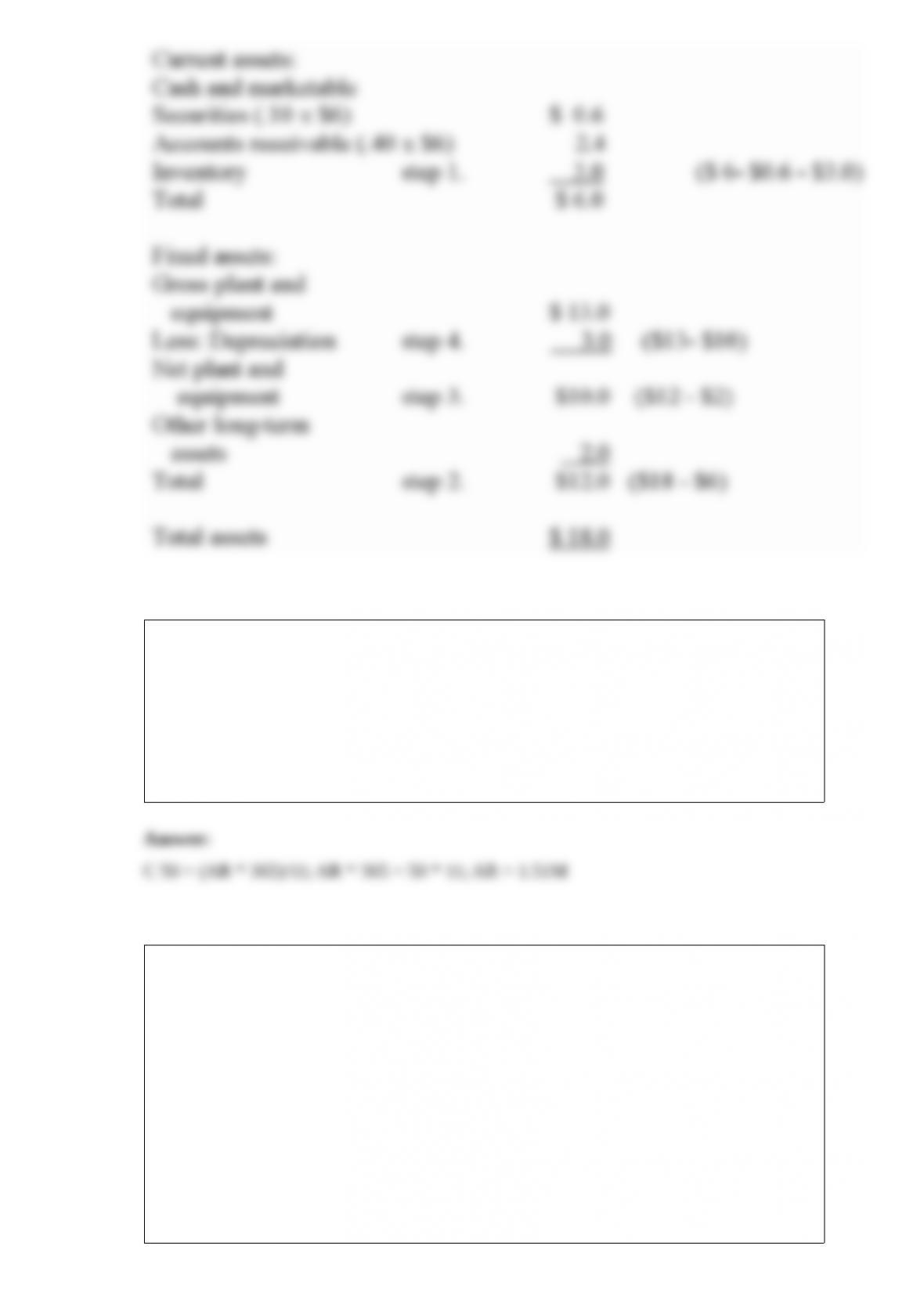
13) Balance Sheet School Books, Inc. has total assets of $18 million of which $6
million are current assets. Cash makes up 10 percent of the current assets and accounts
receivable makes up another 40 percent of current assets. School Books’ gross plant and
equipment has an original cost of $13 million and other long-term assets have a cost
value of $2 million. Using this information, what are the balance of inventory and the
balance of depreciation on School Books’ balance sheet?
A.$3 million, $2 million
B.$3 million, $3 million
C.$2.4 million, $2 million
D.$2.4 million, $3 million
14) A firm ended the year with an average collection period of 50 days. The firm’s
credit sales were $11 million. What is the firm’s year-end balance in accounts
receivable?
A.$1.27 million
B.$0.85 million
C.$1.51 million
D.$2.05 million
15) You are evaluating a project for The Tiff-any golf club, guaranteed to correct that
nasty slice. You estimate the sales price of The Tiff-any to be $375 per unit and sales
volume to be 1000 units in year 1; 1400 units in year 2; and 1325 units in year 3 . The
project has a three-year life. Variable costs amount to $225 per unit and fixed costs are
$100,000 per year. The project requires an initial investment of $165,000 in assets
which will be depreciated straight-line to zero over the three-year project life. The
actual market value of these assets at the end of year 3 is expected to be $35,000. NWC
requirements at the beginning of each year will be approximately 10 percent of the
projected sales during the coming year. The tax rate is 34 percent and the required
return on the project is 10 percent. What change in NWC occurs at the end of year 1?
A.$25,000
B.$15,000

C.$10,000
D.$17,500
16) Kelly Girl’s Golf Games, Inc., with the help of its investment bank recently issued
1.5 million shares of new stock. The offer price on the stock was $36.25 per share and
Kelly Girl’s received a total of $50,000,000 through this stock offering. Calculate the
net proceeds and the underwriter’s spread on the stock offering. What percentage of the
gross price is the investment bank charging Kelly Girl’s for underwriting the stock
issue?
A.7.39%
B.7.64%
C.7.12%
D.8.05%
17) Say that you purchase a house for $150,000 by getting a mortgage for $135,000 and
paying a $15,000 down payment. Assume you get a 15-year mortgage with a 6%
interest rate. If the house appreciates at a 2% rate per year, what will be the value of the
house in 7 years? How much of this value is equity?
A.$172,302.85; $65,101.91
B.$172,302.85; $85615.01
C.$185,612.09; $79,662.83
D.$185,612.09; $81,038.72
18) KJ Enterprises estimates that it takes, on average, 3 days for their customers’
payments to reach them, 1 day for the payments to be processed and deposited by their
bookkeeping department, and 2 more days for the checks to clear once they’re
deposited. What is their collection float?
A.1 days
B.2 days
C.3 days
D.6 days
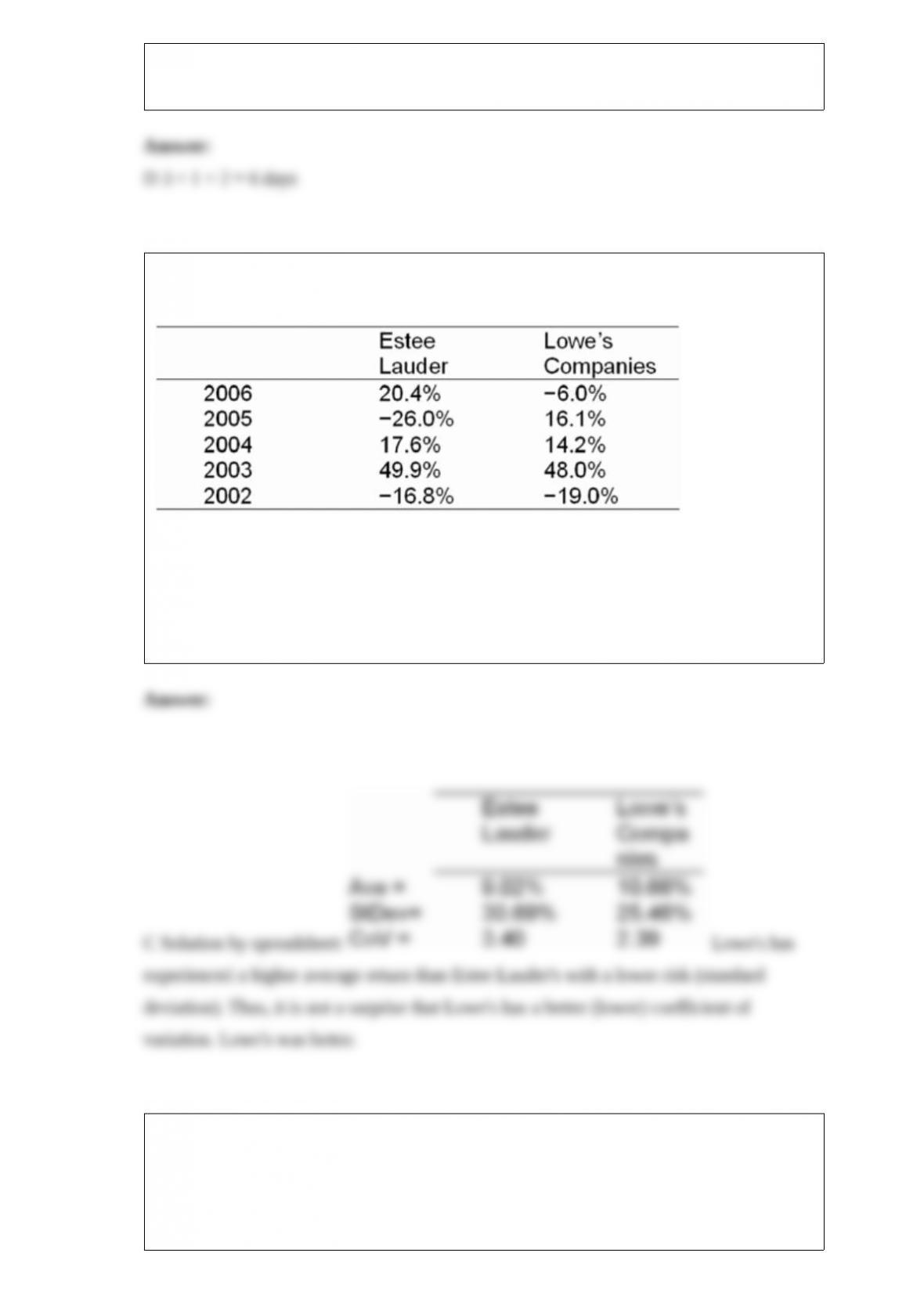
19) Consider the following annual returns of Estee Lauder and Lowe’s Companies:
Compute each stock’s average return, standard deviation, and coefficient of variation.
A.Estee Lauder: 9.02%; 17.99%; 2.00 Lowe’s Companies: 10.66%; 18.99%; 1.78
B.Estee Lauder: 9.02%; 30.69%; 3.4 Lowe’s Companies: 10.66%; 18.99%; 1.78
C.Estee Lauder: 9.02%; 30.69%; 3.4 Lowe’s Companies: 10.66%; 25.46%; 2.39
D.Estee Lauder: 10.7%; 17.79%; 1.66 Lowe’s Companies: 12.64%; 18.99%; 1.50
20) Which of the following is a concern regarding beta?
A.Using different market proxies will result in different estimates of beta
B.A company can alter its risk level which may make the beta estimate obsolete
C.Research indicates that a company’s beta does not appear to predict its future return
very well

D.All of these statements are valid concerns regarding beta
21) Calculation of Bankruptcy Probability Suppose a linear probability model you have
developed finds there are two factors influencing the past bankruptcy behavior of firms:
the debt ratio and the profit margin. Based on past bankruptcy experience, the linear
probability model is estimated as:
PDi = .15 (debt ratio) + .05 (profit margin)
A firm you are thinking of lending to has a debt ratio of 50 percent and a profit margin
of 8 percent. Calculate the firm’s expected probability of default, or bankruptcy.
A.7.90%
B.11.6%
C.30.00%
D.7.80%
22) Your company is considering a new project that will require $100,000 of new
equipment at the start of the project. The equipment will have a depreciable life of 10
years and will be depreciated to a book value of $25,000 using straight-line
depreciation. The cost of capital is 11%, and the firm’s tax rate is 34%. Estimate the
present value of the tax benefits from depreciation.
A.$13,607.52
B.$14,841.29
C.$15,017.54
D.$16,997.13
23) Calculation of Average Costs with Economies of Scope Blinds N Such is
considering a merger with Window Supply Stores. Blinds’ total operating costs of
producing services are $750,000 for sales volume of $6 million. Window’s total
operating costs of producing services are $100,000 for a sales volume (JP) of $1
million. Calculate the average cost of production for the Blinds and Window firms,
respectively.
A.10%, 12.5%
B.12.5%, 10%
C.75%, 1.67%
D.13.93%, 13.93%
24) Taxable Equivalent Yield What’s the taxable equivalent yield on a municipal bond
with a yield to maturity of 4.5 percent for an investor in the 39 percent marginal tax
bracket?
A.1.76%
B.4.50%
C.7.38%
D.11.54%
25) Compute the Discounted Payback statistic for Project Y and recommend whether
the firm should accept or reject the project with the cash flows shown below if the
appropriate cost of capital is 12 percent and the maximum allowable discounted
payback is 3 years.
A.3.45 years, reject
B.3.86 years, reject
C.3.45 years, accept
D.3.86 years, accept
26) Which of the following is an incorrect priority of claims in the event of liquidation?
(Note: The first item would be paid first.)
A.Secured creditors, Wages due employees, Unsecured creditor claims, Common
shareholders
B.Secured creditors, Unsecured creditor claims, Preferred shareholders, Common
shareholders
C.Secured creditors, Administration expenses, Common shareholders, Preferred
shareholders
D.Secured creditors, Wages due employees, Taxes due federal government, Preferred
shareholders
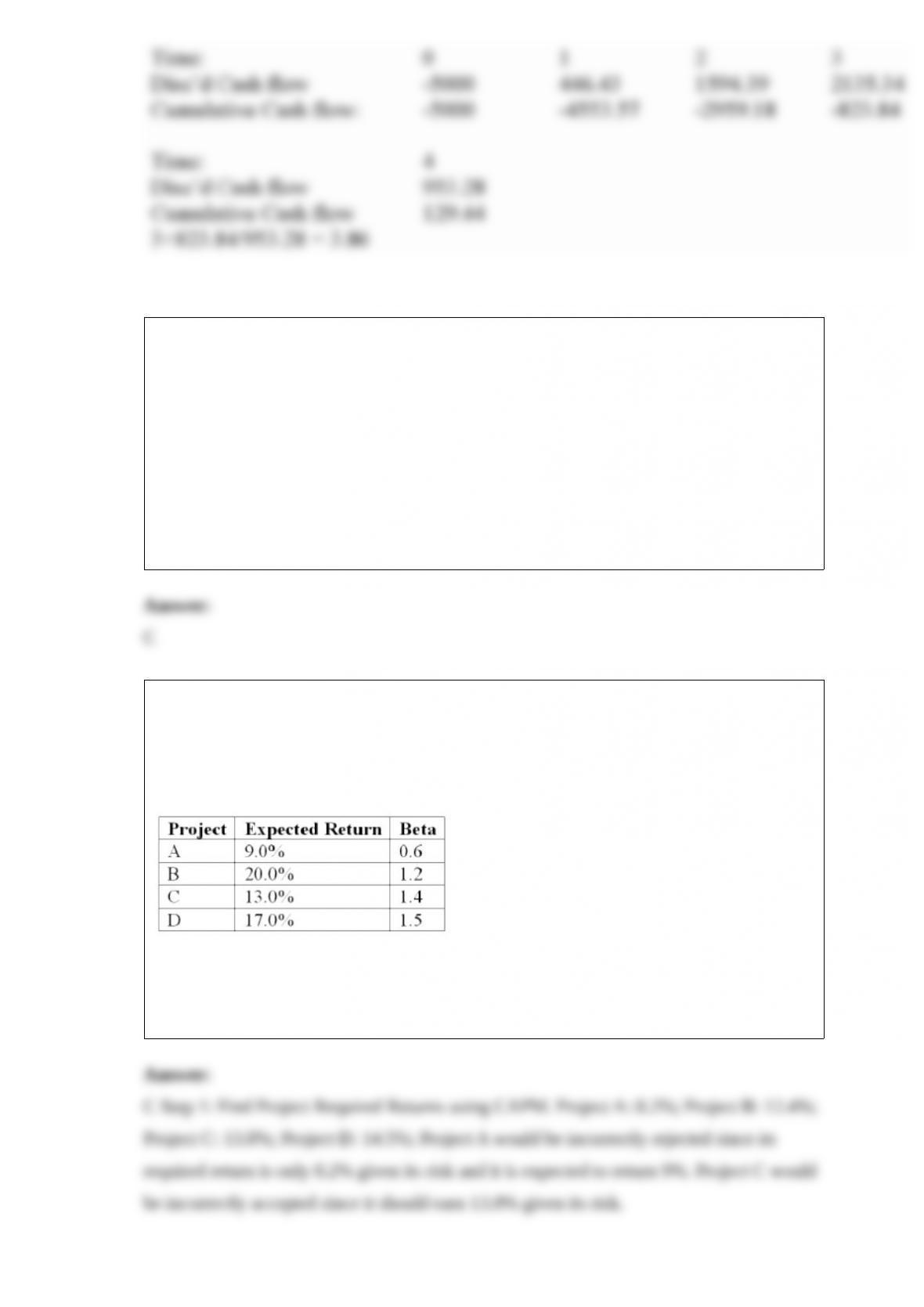
27) An all-equity firm is considering the projects shown below. The T-bill rate is 4%
and the market risk premium is 7%. If the firm uses its current WACC of 12% to
evaluate these projects, which project(s), if any, will be incorrectly accepted or
rejected?
A.Project A would be incorrectly rejected
B.Both Projects A and C would be incorrectly rejected
C.Project A will be incorrectly rejected and Project B would be incorrectly accepted
D.None of the projects will be incorrectly accepted or rejected

28) Required Return If the risk-free rate is 8 percent and the market risk premium is 2
percent, what is the required return for the market?
A.2%
B.6%
C.8%
D.10%
29) Solving for Rates What annual rate of return is earned on a $900 investment when it
grows to $2,500 in fifteen years?
A.1.78%
B.2.78%
C.6.58%
D.7.05%
30) What is the value in year 3 of a $10,000 cash flow made in year 20 if interest rates
are 5%?
A.$4,362.97
B.$4,491.27
C.$5,374.11
D.$5,572.19
31) The managers of State Bank have been approached by City Bank about a possible
merger. State Bank is asking a price of $171.78 million to be purchased by City Bank.
City Bank currently has total cash flows of $30 million that are growing at 2 percent
annually. Managers of State Bank estimate that because of synergies the merged firm’s
cash flows will increase by an additional 6 percent for the first four years following the
merger. After the first four years, managers of State Bank have estimated that
incremental cash flows will grow at a rate of 3 percent. The WACC for the merged
firms is 11 percent. Managers of City Bank agree that cash flows should grow at an
additional 6 percent for the first four years, but are unsure of the long-term growth rate
in incremental cash flows estimated by City Bank. Calculate the minimum growth rate
needed after the first four years such that City Bank would see this merger as a positive
NPV project.
A.7.26%
B.7.73%
C.8.01%
D.8.29%
32) Suppose a firm has had the historical sales figures shown below. What would be the
forecast for next year’s sales using the average approach?
A.$2,730,000
B.$2,810,000
C.$2,910,000
D.$2,990,000

33) A local furniture store is advertising a deal in which you buy a $3,500 living room
set with 3 years before you need to make payments (no interest is incurred). How much
would you have to deposit each month in a savings account earning 3.5% APR,
compounded monthly, to be able to pay the $3,500 bill in three years?
A.$92.35
B.$108.13
C.$112.86
D.$121.97
34) A 7.5% coupon bond with 9 years left to maturity is priced to offer a 10.4% yield to
maturity. You believe that in one year, the yield to maturity will be 8%. What is the
change in price the bond will experience in dollars? (Assume interest payments are
semiannual and par value is $1,000.)
A.$97.75
B.$101.50
C.$129.25
D.$137.75
35) Which of the following statements is correct?
A.Most often, corporate bonds are offered publicly through investment banking firms as
underwriters which use a best effort underwriting
B.In a competitive sale, the bond-issuing firm invites bids from a number of
institutional buyers such as mutual funds and pension funds
C.In a negotiated sale, a consortium of investment banks obtain the right to originate,
underwrite and distribute the new bonds though a Dutch auction process
D.None of these statements are correct
36) Risk Premium The annual return on the S&P 500 Index was 12.4 percent. The
annual T-bill yield during the same period was 5.7 percent. What was the market risk
premium during that year?
A.5.7%
B.6.7%
C.12.4%
D.18.1%
37) This is the assumption that decisions about which projects to fund are separate from
the decisions about how to fund them.
A.break-even principle
B.capital structure principle
C.separation principle
D.long position principle
38) Your company doesn’t face any taxes and has $200 million in assets, currently
financed entirely with equity. Equity is worth $25 per share, and book value of equity is
equal to market value of equity. Also, let’s assume that the firm’s expected values for
EBIT depend upon which state of the economy occurs this year, with the possible
values of EBIT and their associated probabilities as shown below:
The firm is considering switching to a 40-percent debt capital structure, and has
determined that they would have to pay a 7 percent yield on perpetual debt in either
event. What will be the standard deviation in EPS if they switch to the proposed capital
structure?
A.1.05
B.1.56
C.2.67
D.7.15
39) Valuation of a Merger You own stock in Carpet City, Inc., which has just made a bid
of $165 million to purchase Tile Corporation. The two firms currently have cumulative
total cash flows of $25 million which are growing at 2 percent annually. Managers
estimate that because of synergies the merged firm’s cash flows will increase by an
additional 4 percent for the first three years following the merger. After the first three
years cash flows will grow at a rate of 3 percent. The merged firms are expected to have
a beta = 1.75, the risk-free rate is 5.5 percent, and the market risk premium is currently
7.5 percent. Calculate the NPV of the merger. Will you vote in favor of the merger?
A.yes, the NPV is $0
B.yes, the NPV is £ $0
C.no, the NPV is $0
D.no, the NPV is £ $0
40) Compare and contrast the IRR and the MIRR statistic.
41) The constant growth model requires what information for computing shareholders’
required return?
42) How does a competitive sale of securities differ from a negotiated sale?
43) What information is included in the registration statement filed with the SEC for
getting shares of stock to the investing public?
44) Why does the optimal capital structure shift from “debt doesn’t matter” to “the more
debt, the better” when we add corporate taxation to our assumptions?
45) What are the costs and benefits of holding liquid securities on a firm’s balance
sheet?
46) Suppose your firm has decided to use a divisional WACC approach to analyze
projects. The firm currently has 4 divisions, A through D, with average betas for each
division of 0.5, 1.2, 1.5 and 1.8, respectively. If all current and future projects will be
financed with half debt and half equity, and if the current cost of equity (based on an
average firm beta of 1.0 and a current risk-free rate of 5 percent, market premium of 10
percent) is 15 percent and the after-tax yield on the company’s bonds is 7 percent, what
will the WACCs be for each division?

47) Describe “The More Debt, The Better” statement with regard to the optimal capital
structure.