1) Since corporations have specialized needs, they usually prefer futures contracts to
forward contracts for hedging purposes.
a. True
b. False
2) Assume a two-country world: Country A and Country B. Which of the following is
correct about purchasing power parity (PPP) as related to these two countries?
a. If Country A’s inflation rate exceeds Country B’s inflation rate, Country A’s currency
will weaken
b. If Country A’s interest rate exceeds Country B’s inflation rate, Country A’s currency
will weaken
c. If Country A’s interest rate exceeds Country B’s inflation rate, Country A’s currency
will strengthen
d. If Country B’s inflation rate exceeds Country A’s inflation rate, Country A’s currency
will weaken
3) Movements of foreign currencies tend to be more volatile for shorter time horizons.
a. True
b. False
4) If a currency call option is in the money, then the present exchange rate exceeds the
strike price.
a. True
b. False
5) Which of the following is not a possible bid/ask quotation for the Barbados dollar?
a. $.50/$.51
b. $.49/$.50
c. $.52/$.51
d. $.51/$.52

e. All of the above are possible bid/ask quotations.
6) A weakening of the U.S. dollar with respect to the British pound would likely reduce
U.S. exports to the U.K. and increase U.S. imports from the U.K.
a. True
b. False
7) Kalons, Inc. is a U.S.-based MNC that frequently imports raw materials from
Canada. Kalons is typically invoiced for these goods in Canadian dollars and is
concerned that the Canadian dollar will appreciate in the near future. Which of the
following is not an appropriate hedging technique under these circumstances?
a. purchase Canadian dollars forward
b. purchase Canadian dollar futures contracts
c. purchase Canadian dollar put options
d. purchase Canadian dollar call options
8) MNCs may be able to lock in a lower cost from financing in a low interest rate
foreign currency if they:
a. have future cash inflows in that foreign currency
b. have future cash outflows in that foreign currency
c. have offsetting future cash inflows and outflows in that foreign currency
d. have no other cash flows in that foreign currency
9) Given a home country and a foreign country, purchasing power parity (PPP) suggests
that:
a. a home currency will depreciate if the current home inflation rate exceeds the current
foreign interest rate
b. a home currency will appreciate if the current home interest rate exceeds the current
foreign interest rate
c. a home currency will appreciate if the current home inflation rate exceeds the current
foreign inflation rate
d. a home currency will depreciate if the current home inflation rate exceeds the current
foreign inflation rate
10) The management of economic exposure is normally focused completely on
transactions that will occur in the next three months.
a. True
b. False
11) Which of the following forecasting techniques would best represent the use of
today’s forward exchange rate to forecast the future exchange rate?
a. fundamental forecasting
b. market-based forecasting
c. technical forecasting
d. mixed forecasting
12) If interest rates on the euro are consistently below U.S. interest rates, then for the
international Fisher effect (IFE) to hold:
a. the value of the euro would often appreciate against the dollar
b. the value of the euro would often depreciate against the dollar
c. the value of the euro would remain constant most of the time
d. the value of the euro would appreciate in some periods and depreciate in other
periods, but on average have a zero rate of appreciation
13) Currency call options allow the purchaser to lock in the price paid for a currency.
Therefore, they are often used by MNCs to hedge foreign currency payables.
a. True
b. False
14) ____ are commonly used to hedge interest rate risk.
a. Currency swaps
b. Parallel loans
c. Interest rate swaps

d. Forward contracts
e. None of the above
15) Most MNCs obtain equity funding:
a. in foreign countries
b. in their home country
c. through global offerings
d. through private placements
16) Forecasting a currency’s future value is difficult, because it is difficult to identify
how the factors affecting the currency value will change, and how they will interact to
impact the currency’s value.
a. True
b. False
17) According to the text:
a. banks in the U.S. are prohibited from facilitating cash transfers for MNCs
b. banks in most non-U.S. countries are more advanced than the U.S. in facilitating cash
transfers for MNCs
c. an MNC with subsidiaries in several different countries has no problems in
coordinating its cash transfers since a uniform global banking system exists
d. none of the above
18) A macroeconomic perspective focuses on the financial management decisions that
affect the value of MNC.
a. True
b. False
19) Sensitivity analysis allows for all of the following except:
a. accountability for uncertainty
b. focus on a single point estimate of future exchange rates
c. development of a range of possible future values
d. consideration of alternative scenarios
20) Even if translation exposure does not affect cash flows, it is a concern of many
MNCs.
a. True
b. False
21) The lower bound of a put option premium is the greater of zero and the difference
between the exercise price and the spot rate; the upper bound of a currency put option is
the exercise price.
a. True
b. False
22) Global regulations require that shareholders in all countries have the same rights
wherever there are stock markets.
a. True
b. False
23) A firm considers an exporting project and will invoice the exports in dollars. The
expected cash flows in dollars would be more difficult if the currency of the foreign
country is ____.
a. fixed
b. volatile
c. stable
d. none of the above, as the firm is not exposed
24) Countries with a ____ rate of inflation tend to have a ____ interest rate.
a. high; low
b. low; high
c. high; high
d. A and B are correct
25) A put option on British pounds has a strike (exercise) price of $1.48. The present
exchange rate is $1.55. This put option can be referred to as:
a. in the money
b. out of the money
c. at the money
d. at a discount
26) The Central American Trade Agreement (CAFTA) is intended to raise tariffs and
regulations between the U.S., the Dominican Republic, and Central American countries.
a. True
b. False
27) Which of the following is not true regarding the Bretton Woods Agreement?
a. It called for fixed exchange rates between currencies
b. Governments intervened to prevent exchange rates from moving more than 1 percent
above or below their initially established levels
c. The agreement lasted from 1944 until 1971
d. Each country used gold to back its currency
e. All of the above are true regarding the Bretton Woods Agreement
28) Exhibit 20-3
Cameron Corporation would like to simultaneously borrow Japanese yen () and
Sudanese dinar (SDD) for a six-month period. Cameron would like to determine the
expected financing rate and the variance of a portfolio consisting of 30% yen and 70%
dinar. Cameron has gathered the following information:
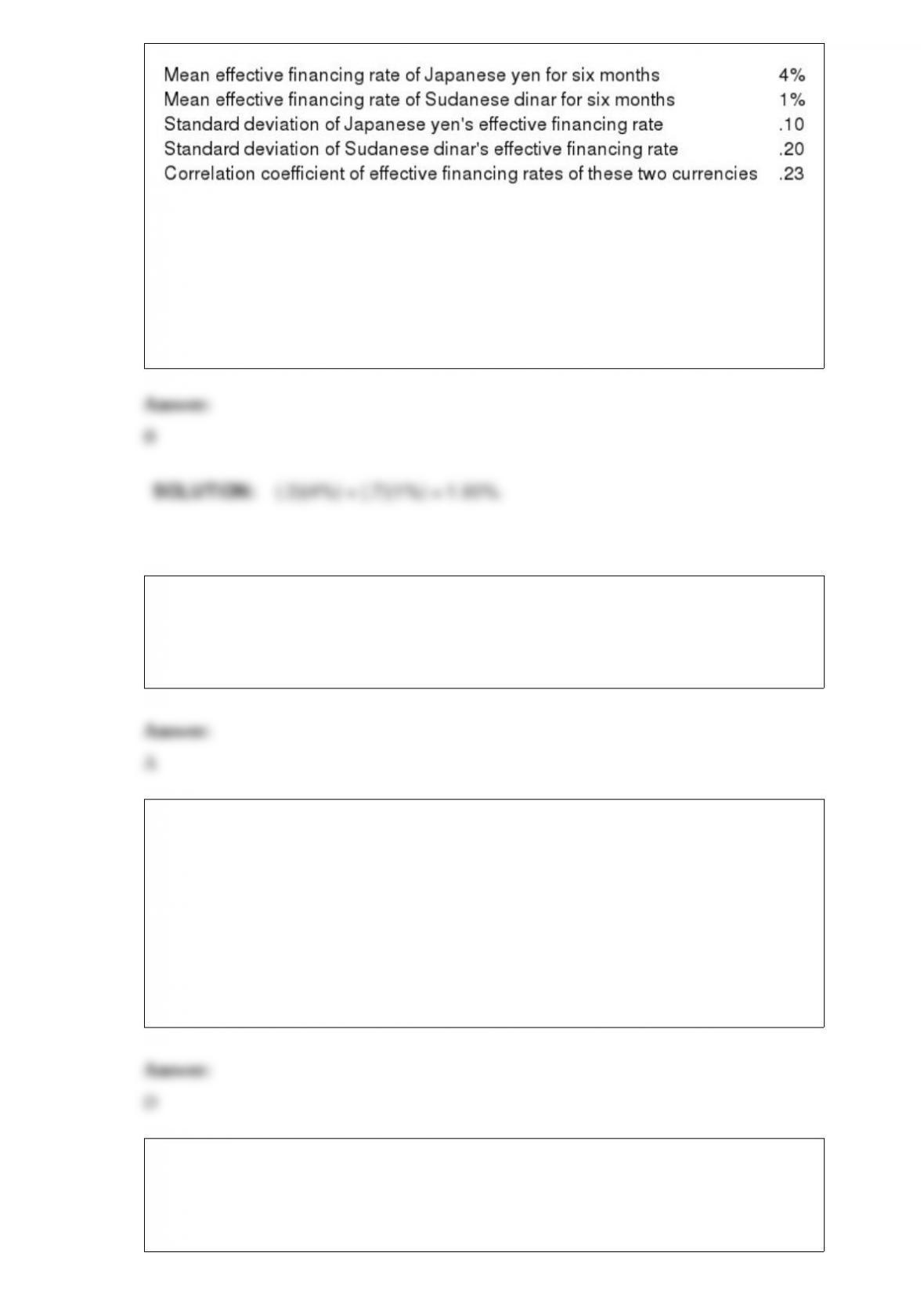
Refer to Exhibit 20-3. What is the expected financing rate of the portfolio contemplated
by Cameron Corporation?
a. 3.10%
b. 1.90%
c. 17.00%
d. 13.00%
e. none of the above
29) Currency devaluations have the potential to reduce unemployment, while currency
revaluations have the potential to reduce inflation.
a. True
b. False
30) A U.S. firm is bidding for a project needed by the Swiss government. The firm will
not know if the bid is accepted until three months from now. The firm will need Swiss
francs to cover expenses but will be paid by the Swiss government in dollars if it is
hired for the project. The firm can best insulate itself against exchange rate exposure
by:
a. selling futures in francs
b. buying futures in francs
c. buying franc put options
d. buying franc call options
31) Because creditors may prefer that firms maintain low exposure to exchange rate
risk, exchange rate movements may cause earnings to be more volatile, and because
investors may prefer corporations to perform hedging for them, exchange rate risk is
probably relevant.
a. True
b. False
32) The ____ hedge is not a technique to eliminate transaction exposure discussed in
your text.
a. index
b. futures
c. forward
d. money market
e. currency option
33) According to ____, the effective yield earned by U.S. investors will be the same as
the effective yield earned by non-U.S. investors in any given period.
a. interest rate parity (IRP)
b. the international Fisher effect (IFE)
c. purchasing power parity (PPP)
d. none of the above
34) Which of the following is not true regarding host government attitudes towards
direct foreign investment (DFI)?
a. Host governments may offer incentives to MNCs in the form of subsidies in certain
circumstances
b. Host governments generally perceive DFI as a remedy to eliminate a country’s
political problems
c. The ability of a host government to attract DFI is dependent on the country’s markets
and resources
d. Some types of DFI will be more attractive to some governments than to others
e. All of the above are true
35) The euro is the currency:
a. adopted in all western European countries as of 1999
b. adopted in all eastern European countries as of 1999
c. adopted in all European countries as of 1999

d. none of the above