
For the post-World War II period,
(a) increases in short-term interest rates tend to continue for many periods.
(b) increases in short-term interest rates tend to be quickly followed by decreases.
(c) short-term interest rates have typically been greater than long-term interest rates.
(d) short-term interest rates have fallen persistently from the very high levels that
prevailed at the end of World War II.
Answer:
Regulation Q
(a) prohibited interstate banking.
(b) placed ceilings on allowable interest rates on time and savings deposits.
(c) required all banks to hold reserves against demand deposits.
(d) broadened the basis on which the Fed could make discount loans.
Answer:
One value to investors of holding stock or bonds is that
(a) they are exempt from both state and federal taxes.

(b) they are very low risk investments.
(c) they are more liquid than the physical assets of the companies issuing them.
(d) they are exempt from state taxes, although they are not exempt from federal taxes.
Answer:
Which of the following is a correct reason why a decrease in the money supply will
tend to cause stock prices to fall?
(a) A decrease in the money supply will cause interest rates to rise, thereby shifting
funds from financial to real investments.
(b) A decrease in the money supply will cause interest rates to fall, thereby shifting
funds from financial to real investments.
(c) A decrease in the money supply will result in higher corporate profits in real terms.
(d) A decrease in the money supply will cause interest rates to rise, thereby making
bonds more attractive investments than stocks.
Answer:
During the financial panic of the early 1930s
(a) the public converted large amounts of currency to bank deposits.

(b) the spread between interest rates on safe and risky securities widened sharply.
(c) spending by large firms declined relative to spending by households and small firms.
(d) banks shifted large amounts of funds from government securities to loans.
Answer:
If the nominal interest rate on saving is 12% and the expected inflation rate is 6%, what
is the percentage reduction in real interest income resulting from a tax of 25%?
(a) 25%
(b) 50%
(c) 60%
(d) 100%
Answer:
The first crucial test for the Fed as a lender of last resort occurred
(a) as Southern banks left the system during the Civil War.
(b) as the federal government needed to raise large amounts of money during World
War I.

(c) during the S&L crisis of the 1980s.
(d) following the stock market crash of October 1929.
Answer:
Necessity assets are assets
(a) used by savers to conduct regular transactions.
(b) with wealth elasticities of greater than 1.
(c) held by savers for investment.
(d) not subject to federal income tax.
Answer:
New Keynesian and new classical economists agree that
(a) policymakers cannot permanently maintain the unemployment rate below the
natural rate.
(b) production beyond the full-employment level of output is impossible, even in the
short run.
(c) in the long run the inflation rate must be zero.

(d) the LRAS curve slopes up.
Answer:
As wealth increases in the economy, we would expect to observe
(a) bond prices and interest rates both rise.
(b) bond prices and interest rates both fall.
(c) bond prices rise and interest rates fall.
(d) bond prices fall and interest rates rise.
Answer:
Which of the following statements concerning stabilization policy is correct?
(a) Increasing government spending during an economic boom would be an example of
a stabilization policy.
(b) Increasing taxes during a recession would be an example of a stabilization policy.
(c) New Keynesian economists are skeptical of the value of stabilization policies.
(d) Increasing the money supply during a recession is an example of a stabilization
policy.

Answer:
Economists define risk as
(a) the difference between the interest rate borrowers pay and the interest rate lenders
receive.
(b) the degree of uncertainty of an asset’s return.
(c) the ease with which an asset can be exchanged for other assets or for goods and
services.
(d) the difference between the return on common stock and the return on corporate
bonds.
Answer:
As wealth increases in the economy, savers are willing
(a) to hold more cash relative to their holdings of bonds.
(b) to buy fewer bonds at any given price.
(c) to buy more bonds at any given price.
(d) to lend less at any given interest rate.

Answer:
Deliberate actions by a central bank to influence the exchange rate are known as
(a) current account actions.
(b) foreign-exchange market interventions.
(c) dollar-value operations.
(d) foreign-commerce maneuvers.
Answer:
A U.S. subsidiary of a foreign bank
(a) is subject to domestic bank regulation.
(b) may not make loans within the United States.
(c) may not accept deposits from U.S. residents.
(d) is not subject to the same branching restrictions as U.S. banks.
Answer:
Suppose that the number of buyers and sellers of municipal bonds decreases
substantially. The result should be a (an)
(a) increase in the prices of municipal bonds.
(b) decrease in the prices of municipal bonds.
(c) increase in U.S. Treasury bond yields.
(d) decrease in the tax rate on municipal bond yields.
Answer:
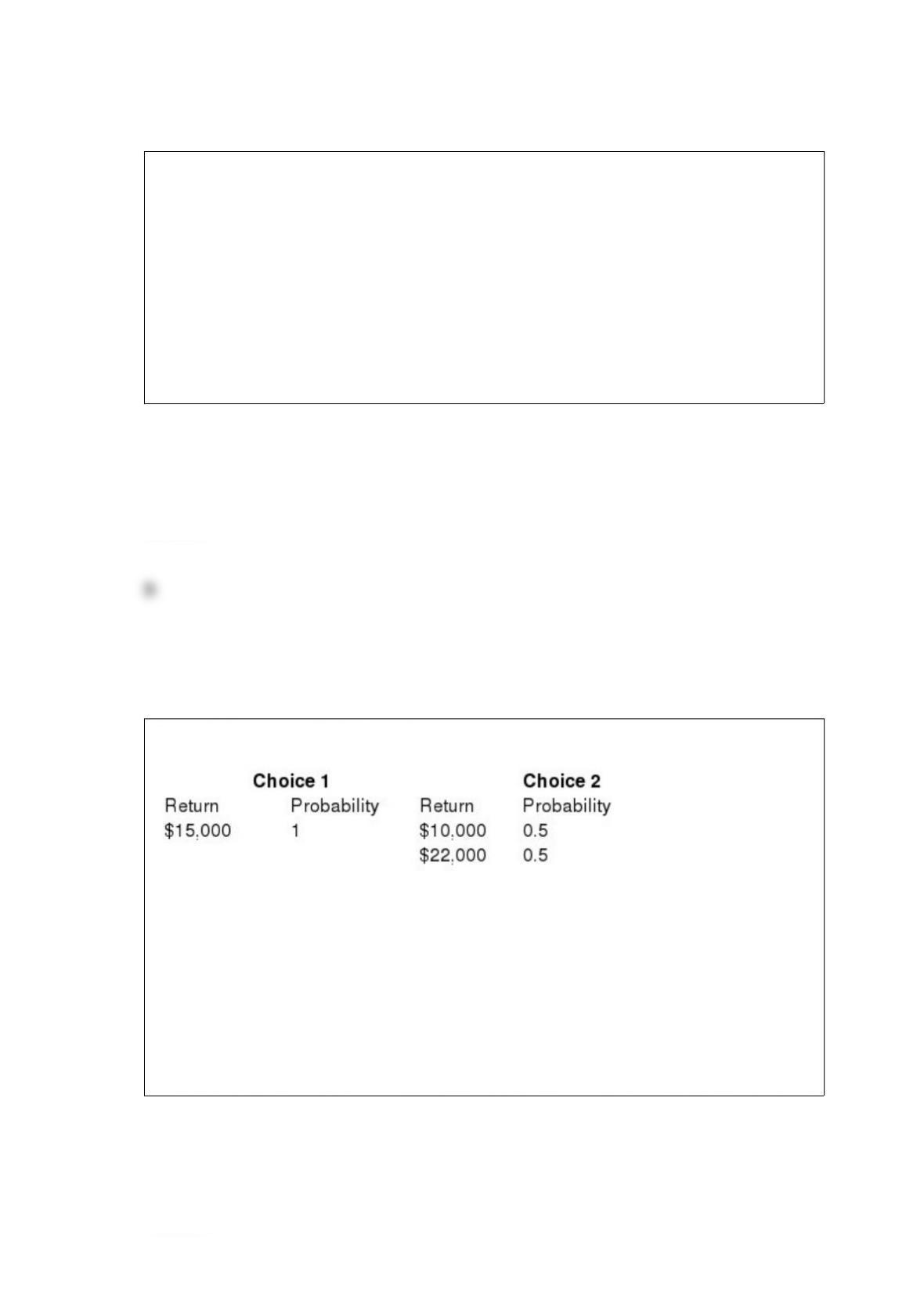
A risk-neutral saver will
(a) prefer Choice 1 to Choice 2.
(b) prefer Choice 2 to Choice 1.
(c) be indifferent between Choice 1 and Choice 2.
(d) Not enough information has been provided to be certain of the saver’s decision.
Answer:

If government purchases decrease, the IS curve will
(a) shift to the left and intersect the FE line at a higher real interest rate.
(b) shift to the right and intersect the FE line at a lower real interest rate.
(c) shift to the left and intersect the FE line at a lower real interest rate.
(d) shift to the right and intersect the FE line at a higher real interest rate.
Answer:
From 1970 through 1997, the domestic government sector was
(a) a net borrower.
(b) a net lender.
(c) neither a borrower nor a lender.
(d) a major factor in keeping real interest rates low.
Answer:

According to new Keynesian economists, sustained expected increases in the nominal
money supply will lead to
(a) increases in output in the short run and sustained increases in prices in the long run.
(b) sustained increases in prices, with no short-run increases in output.
(c) short-run increases in prices and output, with a stable price level and no increases in
output in the long run.
(d) sustained increases in both prices and output in the long run.
Answer:
A bubble occurs when
(a) the price of a stock is above its fundamental value.
(b) inside information is used to make profits from trading a company’s stock.
(c) a company reports profits that are significantly above or below the expectations of
financial analysts.
(d) the futures price is greater than the price of the underlying asset.
Answer:
A decline in market interest rates

(a) reduces the value of future interest payments.
(b) reduces the value of future principal payments.
(c) increases the prices of bonds.
(d) increases the prices only of newly issued bonds.
Answer:
Why do individuals hold money when it does not provide the services that, say, a house
does?
(a) Money is the most liquid asset.
(b) Money is the only form in which wealth may be held.
(c) Money increases in value faster than other assets.
(d) Money is useful in avoiding taxes on certain transactions.
Answer:
A general equilibrium is an outcome in which
(a) all the markets in the economy are in equilibrium at the same time.

(b) exports and imports are both zero.
(c) the inflation rate is zero.
(d) no further economic growth is possible.
Answer:
A rule specifying a constant rate of growth of M1 during the early 1980s
(a) was adopted in the United States, but not in Japan.
(b) would have resulted in greater inflation than actually occurred.
(c) would have resulted in a more contractionary policy than the one the Fed actually
pursued.
(d) was dropped following an acceleration in the inflation rate.
Answer:
The FOMC states its overall objectives for interest rates in
(a) the Governors’ Order.
(b) the General Directive.
(c) the Federal Reserve Bulletin.

(d) the Chairman’s Order.
Answer:
Which of the following statements is NOT true of credit cards?
(a) The rate of return to banks from credit card lending is lower than for other bank
assets.
(b) Credit cards represent a preauthorized line of credit to borrowers.
(c) The first credit cards to be widely accepted were nonbank travel and entertainment
cards.
(d) If bank cardholders don’t pay the balance in full every month, they pay a finance
charge on the unpaid balance.
Answer:
The primary reason the Fed makes discount loans to banks is to
(a) carry out monetary policy.
(b) help increase bank profitability.
(c) earn interest.

(d) help banks overcome short-term liquidity problems.
Answer:
Information on financial assets is communicated
(a) only to borrowers.
(b) only to savers.
(c) only to the appropriate agency of the federal government.
(d) both to borrowers and savers.
Answer:
FOMC directives to the account manager
(a) are usually very detailed, leaving him little room for discretion.
(b) are issued very infrequently, leaving the account manager effectively in charge of
monetary policy for months at a time.
(c) are usually vaguely worded.
(d) are usually concerned with technical matters and have little to do with monetary
policy.
Answer: