Sarah Palin reportedly was paid a $11 million advance to write her book Going Rogue.
The book took one year to write. In the time she spent writing, Palin could have been
paid to give speeches and appear on TV news as a political commentator. Given her
popularity, assume that she could have earned $8 million over the year (paid at the end
of the year) she spent writing the book. Assume that she was unable to fulfill her media
commitments of appearing on TV news as a political commentator or give
speeches.while she was writing the book.
Assuming that Palin’s cost of capital is 10%, then the NPV of her book deal is closest
to:
A) $2.00 million
B) $2.20 million
C) $3.00 million
D) $3.75 million
Assume that Rose Corporation’s (RC) EBIT is not expected to grow in the future and
that all earnings are paid out as dividends. RC is currently an all equity firm. It expects
to generate earnings before interest and taxes (EBIT) of $6 million over the next year.
Currently RC has 5 million shares outstanding and its stock is trading for a price of
$12.00 per share. RC is considering borrowing $12 million at a rate of 6% and using the
proceeds to repurchase shares at the current price of $12.00.
Following the borrowing of $12 and subsequent share repurchase, the value of a share
for RC is closest to:
A) $14.00
B) $13.20
C) $12.00
D) $10.80
Monsters Incorporated (MI) in ready to launch a new product. Depending upon the
success of this product, MI will have a value of either $100 million, $150 million, or
$191 million, with each outcome being equally likely. The cash flows are unrelated to
the state of the economy (i.e. risk from the project is diversifiable) so that the project
has a beta of 0 and a cost of capital equal to the risk-free rate, which is currently 5%.
Assume that the capital markets are perfect.
Suppose that MI has zero-coupon debt with a $125 million face value due next year.
The initial value of MI’s equity is closest to:
A) $30 million
B) $15 million
C) $29 million
D) $24 million
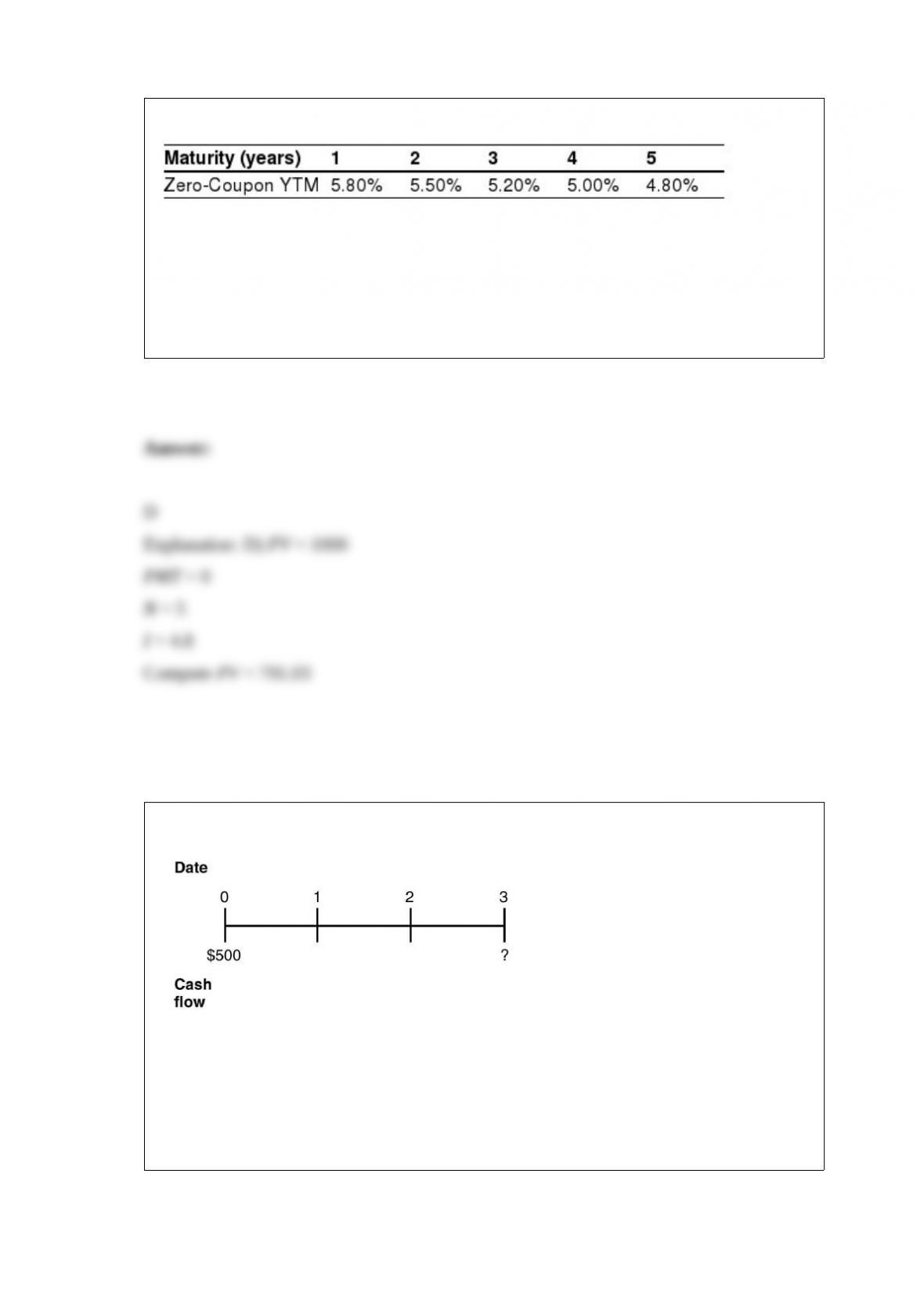
Consider the following zero-coupon yields on default free securities:
The price of a five-year, zero-coupon, default-free security with a face value of $1000 is
closest to:
A) $754
B) $772
C) $776
D) $791
Consider the following timeline:
If the current market rate of interest is 10%, then the future value of this timeline is
closest to:
A) $666
B) $500
C) $605
D) $650
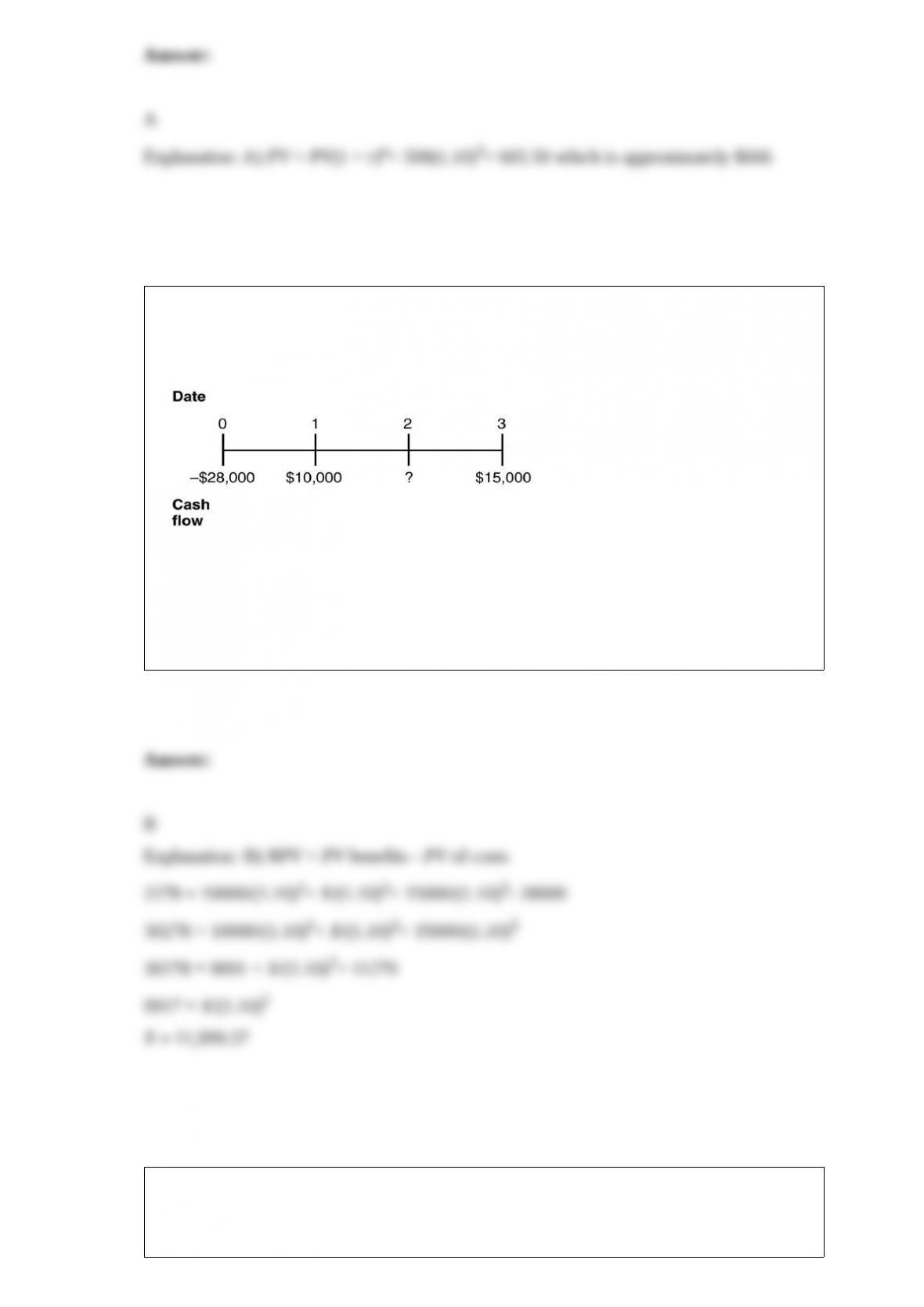
You are offered an investment opportunity that costs you $28,000, has an NPV of
$2278, lasts for three years, has interest rate of 10%, and produces the following cash
flows:
The missing cash flow from year 2 is closest to:
A) $12,500
B) $12,000
C) $13,000
D) $10,000
Monsters Incorporated (MI) in ready to launch a new product. Depending upon the
success of this product, MI will have a value of either $100 million, $150 million, or
$191 million, with each outcome being equally likely. The cash flows are unrelated to
the state of the economy (i.e. risk from the project is diversifiable) so that the project
has a beta of 0 and a cost of capital equal to the risk-free rate, which is currently 5%.
Assume that the capital markets are perfect.
Assume that in the event of default, 20% of the value of MI’s assets will be lost in
bankruptcy costs. Suppose that at the start of the year, MI has no debt outstanding, but
has 5.6 million shares of stock outstanding. If MI issues debt of $125 million due next
year and uses the proceeds to repurchase shares, the share price following the
announcement of the repurchase will be closest to:
A) $23.90
B) $23.75
C) $25.00
D) $5.15
Consider a bond that pays $1000 in one year. Suppose that the market interest rate for
savings is 8%, but the interest rate for borrowing is 10%. The price range that this bond
must trade in a normal market if no arbitrage opportunities exist is closest to:
A) $909 to $917
B) $909 to $926
C) $917 to $926
D) $909 to $1000
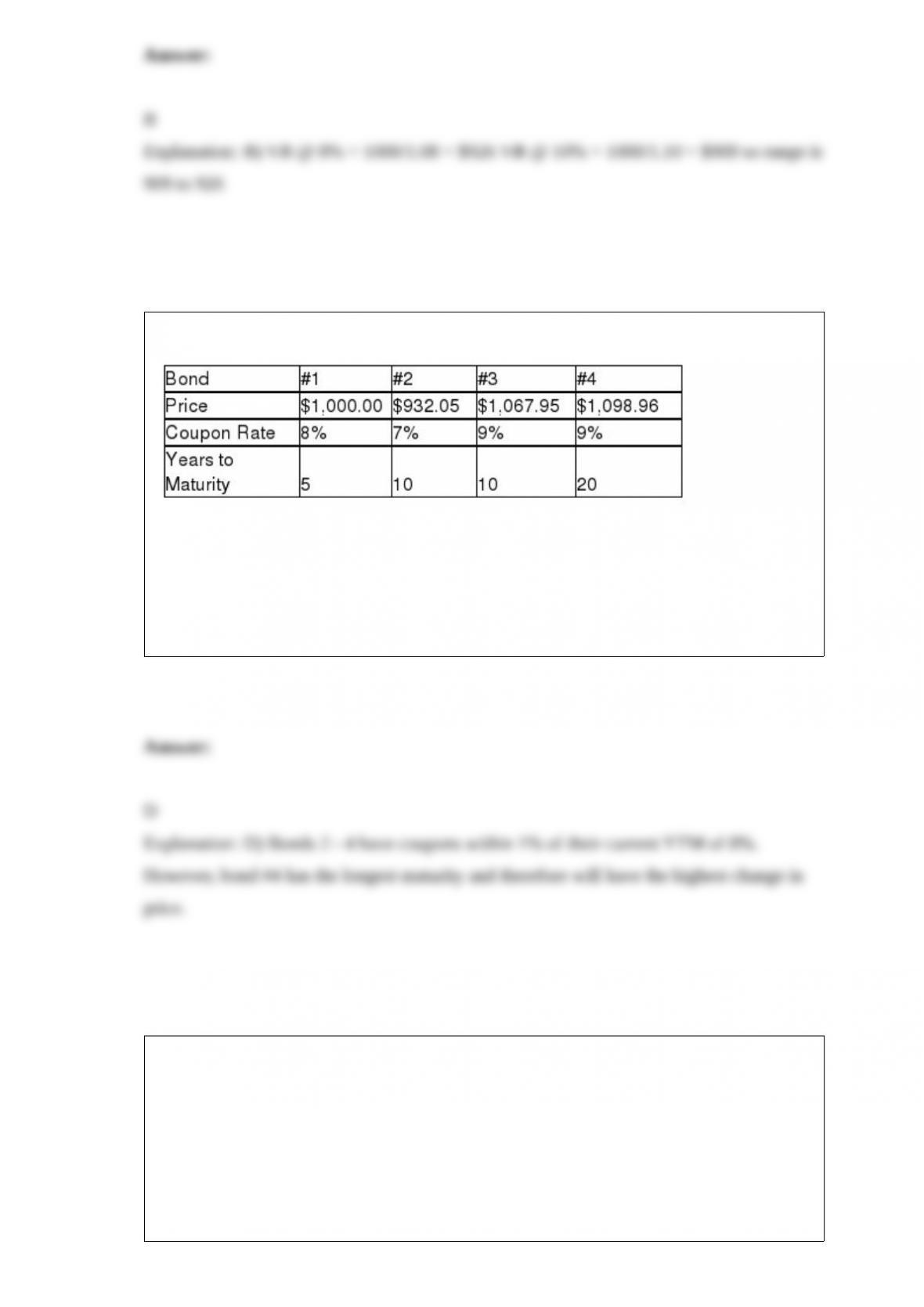
Consider the following four corporate bonds that have semiannual compounding:
If the YTM of these bonds increased to 9%, which bond’s price would be most sensitive
to this change in YTM?
A) #1
B) #2
C) #3
D) #4
Food For Less (FFL), a grocery store, is considering offering one hour photo
developing in their store. The firm expects that sales from the new one hour machine
will be $150,000 per year. FFL currently offers overnight film processing with annual
sales of $100,000. While many of the one hour photo sales will be to new customers,
FFL estimates that 60% of their current overnight photo customers will switch and use
the one hour service.
The level of incremental sales associated with introducing the new one hour photo
service is closest to:
A) $90,000
B) $150,000
C) $60,000
D) $120,000