
Liquidity risk for an FI includes the possibility of an unexpected inflow of funds.
Answer:
During the financial crisis of 2008, there were large deposit inflows to the banking
system.
Answer:
The buyer of a loan participation benefits because the only risk exposure is to the
borrower.
Answer:
FDICIA required that banks and thrifts adopt the same capital requirements.

Answer:
For a given change in interest rates, fixed-rate liabilities with longer-term maturities
will have smaller changes in price than liabilities with shorter maturities.
Answer:
The Pension Benefit Guaranty Corporation (PBGC) insures pension benefits against the
under-funding of pension plans by corporations.
Answer:
Under Basel III, banks must hold a total capital to credit risk-adjusted assets equal to 8
percent to be adequately capitalized.
Answer:

One method of reducing the risk of a liquidity crisis for an FI to efficiently manage
liquid asset positions.
Answer:
Usury ceilings place caps on interest rates that FIs can charge on certain types of loans
and are established by federal regulatory authorities.
Answer:
The risk-based capital ratio fails to take into account the effects of diversification in the
credit portfolio.
Answer:

All credit unions are nationally chartered and regulated by the National Credit Union
Administration.
Answer:
Hedging the FI’s interest rate risk by buying a put option on a bond is an attractive
alternative to a manager.
Answer:
Banks increasingly have been susceptible to nonbank competition on both sides of the
balance sheet.
Answer:

The commercial paper market is an example of nonbank competition on the asset side
of the balance sheet that has become increasingly intense for banks.
Answer:
If a household invests in corporate securities and does not supervise how the funds are
invested or used by the corporation, the risk of not earning the desired return or not
having the funds returned increase.
Answer:
Decimalization involves making quotes in the equities markets in units of 1 cent ($0.01)
rather than in units of one-eights of a dollar ($0.125).
Answer:

In general, the interest rate spread (spread effect) between rate sensitive assets and rate
sensitive liabilities is positively related to the change in net interest income.
Answer:
Small banks make proportionately larger amounts of real estate loans than large banks.
Answer:
In the repricing gap model, assets or liabilities are rate sensitive within a given time
period if the dollar values of each are subject to receiving a different interest rate should
market rates change.
Answer:
In recent years, the proportion of savings and demand deposits have decreased and the
proportion of pension funds have increased in the financial assets held by U.S.

households.
Answer:
Market risk is present whenever an FI takes an open position and prices change in a
direction opposite to that expected.
Answer:
Credit derivatives allow FIs to reduce credit risks without removing loan assets from
their balance sheet.
Answer:
Buying a cap is like buying insurance against a decrease in interest rates.

Answer:
Investing in appropriate technology allows an FI to access lower-cost funding markets.
Answer:
The more costly it is to supervise the use of funds by a borrower, the less likely a saver
will encounter agency costs.
Answer:
The book value of bank equity is the present value of assets minus the present value of
liabilities.
Answer:

Finance companies generally charge lower interest rates on consumer loans than do
depository institutions.
Answer:
Because retail CDs have fixed maturities, FI managers always should have perfect
information regarding the scheduling of interest and principal payments.
Answer:
In the statistical modeling of the country risk analysis, the investment ratio is
considered to have a negative impact on the probability of rescheduling because the
larger expenditures on investment infrastructure leaves less funds for debt payment.
Answer:

Regulator forbearance is a policy of allowing economically insolvent FIs to continue in
operation.
Answer:
Which of the following observations concerning payday lenders is NOT TRUE?A.
They provide short-term cash advances.
B. Their advances are due when borrowers receive their next paycheck.
C. The industry originated from check cashing outlets.
D. The payday loan industry is regulated at the state level.
E. The demand for short-term loans has decreased considerably.
Answer:
The economic insolvency of many thrift institutions during the 1980s was due, at least
in part, to unexpected increases in interest rates.

Answer:
If the average maturity of assets is 4 years and the average maturity of liabilities is 4
years, then the FI has no interest rate risk exposure.
Answer:
The DEAR of a portfolio of assets is simply the weighted average of each individual
assets’ DEAR.
Answer:
In the life insurance model, morbidity risk differs from mortality risk by the
circumstances surrounding the actual death event.
Answer:

The determination of risk-adjusted on-balance-sheet assets under Basel III requires the
segregation of assets into nine categories of credit risk exposure.
Answer:
The discount effect and the prepayment effect are negatively correlated in their impact
on the value of a principal-only (PO) mortgage-backed strip security.
Answer:
A bank with a negative repricing (or funding) gap faces reinvestment risk.
Answer:

Surrender value is the amount of cash a life insurance policy holder can receive by
turning in the policy before it expires or matures.
Answer:
A U.S. bank agrees to a swap of making fixed-rate interest payments of $12 million to a
UK bank in exchange for floating-rate payments of LIBOR + 4 percent in British
pounds for a notional amount of £100 million. The current exchange rate is $1.50/£.
The interest payments will be exchanged at the end of the year at the prevailing rates.
At the end of the year, LIBOR is 4 percent and the exchange rate is $1.50/£. What is the
net payment paid or received in dollars by the U.S. bank? A. The U.S. bank paid $12
million and received $8 million for a net payment of $4 million.
B. The U.S. bank paid $12 million and received $10 million for a net payment of $2
million.
C. The U.S. bank paid $12 million and received $12 million for a net receipt of $0
million.
D. The U.S. bank paid $12 million and received $14 million for a net receipt of $2
million.
E. The U.S. bank paid $12 million and received $16 million for a net receipt of $4
million.
Answer:

What is the duration of this Treasury note? A. 1.500 years.
B. 1.371 years.
C. 1.443 years.
D. 2.882 years.
E. 1.234 years.
Answer:
A bank has assets of $500,000,000 and equity of $40,000,000. The assets have an
average duration of 5.5 years, and the liabilities have an average duration of 2.5 years.
An 8-year fixed-rate T-bond with the same coupon as the fixed-rate on the swap has a
duration of 6 years, and the duration of a floating-rate bond that reprices annually is one
year. The bank wishes to hedge its balance sheet with swap contracts that have notional
contracts of $100,000. What is the optimal number of swap contracts into which the
bank should enter? A. 2,500 contracts.
B. 2,760 contracts.
C. 13,800 contracts.

D. 3,200 contracts.
E. None of the above.
Answer:
Credit spread call options are useful becauseA. its value increases as the risk premium
on a specified benchmark bond of the borrower increases above some exercise spread.
B. an increase in the value of the call option will tend to offset the decreasing value of
an FI’s loan and net worth as the credit quality of the borrower decreases.
C. they will always cause a loss at least equal to the required premium on the option.
D. All of the above.
E. Answers A and B only.
Answer:

Banks and other FIs sell loans because of all of the following EXCEPT A. loan
diversification benefits.
B. reduction in reserve requirements.
C. lowering of capital costs.
D. reduction of liquid assets of the institution.
E. increase in fee income through brokerage functions.
Answer:
What is the bank’s leverage adjusted duration gap? A. 6.73 years
B. 0.29 years
C. 6.44 years
D. 6.51 years
E. 0 years.
Answer:

Use the following two choices to identify whether each intermediary or entity is a net
buyer or net seller of credit derivative securities.
a. Net buyer (typically)
b. Net seller (typically)
Corporations
Answer:
Given the expected one-year rates in one year, what are the possible bond prices in one
year? A. $85.22 and $86.25.

B. $85.73 and $86.69.
C. $85.22 and $86.69.
D. $85.73 and $86.25.
E. $83.35 and $84.65.
Answer:
This risk of default is associated with general economy-wide or macro conditions
affecting all borrowers. A. Systematic credit risk.
B. Firm-specific credit risk.
C. Refinancing risk.
D. Liquidity risk.
E. Sovereign risk.
Answer:

Which of the following was not an operating characteristic of foreign banks operating
in the U.S. prior to the International Banking Act of 1978? A. They had no access to
the Federal Reserve’s discount window.
B. They were not subject to the Federal Reserve’s audits and exams.
C. They had special rates on FDIC deposit insurance.
D. They could not use the Fedwire or the fed funds market.
E. They were not subject to the Glass-Steagall Act.
Answer:
As interest rates increase, the buyer of a bond put option stands to A. make limited
gains.
B. incur limited losses.
C. incur unlimited losses.
D. lose the entire premium amount.
E. Answers A and D only.
Answer:

Another method that may be employed by banks to lower required reserves is to A.
transfer deposits to another domestic bank on Friday and transfer them back on the
following Monday.
B. sweep demand deposits into higher interest-bearing accounts on Friday with a return
sweep the following Monday.
C. rely more heavily on zero explicit interest-rate deposits.
D. delay posting deposits made on Friday until the following Monday.
E. do nothing, because reserve requirements cannot be avoided.
Answer:
Choose among the following major banking laws.
A. The McFadden Act of 1927
B. The Glass-Steagall Act of 1933
C. The Depository Institutions Deregulation and Monetary Control Act (DIDMCA) of
1980
D. The Garn-St Germain Depository Institutions Act of 1982
E. The Competitive Equality in Banking Act of 1987
F. The Financial Institutions Reform, Recovery, and Enforcement Act of 1989

G. The Federal Deposit Insurance Corporation Improvement Act (FDICIA) of 1991
H. The Riegle-Neal Interstate Banking and Branching Efficiency Act of 1994
I. Financial Services Modernization Act of 1999
This legislation separated commercial and investment banking.
Answer:
The federal safety net to minimize bank failures includes all of the following EXCEPT
A. deposit insurance.
B. reserve requirements.
C. contagious runs.
D. minimum capital requirements.
E. the discount window of the Federal Reserve Bank.
Answer:
Policies established by The International Swaps and Derivatives Association (ISDA)
forbid swap contracts to be made between parties of different credit standing.

Answer:
Overseas bank is pooling 50 similar and fully amortized mortgages into a pass-through
security. The face value of each mortgage is $100,000 paying 180 monthly interest and
principal payments at a fixed rate of 9 percent per annum.
For the first monthly payment, what are the interest and principal portions of the
payment? A. $37,500 principal and $13,213 principal.
B. $37,500 interest and $13,213 principal.
C. $37,500 principal and $7,809 interest.
D. $37,500 interest and $7,809 principal.
E. $37,500 interest and $17,756 principal.
Answer:
A reason for the use of market risk management (MRM) for the purpose of identifying
potential misallocations of resources caused by prudential regulation is which of the
following? A. Regulation.
B. Resource allocation.

C. Management information.
D. Setting limits.
E. Performance evaluation.
Answer:
The contagion effect A. stems from the positive correlation in FI returns.
B. results when interest rate risk increases credit risk and liquidity risk exposures.
C. occurs when liquidity risk problems at bad banks damages well-run banks.
D. occurs when a computer virus infects the computerized electronics payments
systems Fedwire and CHIPS.
E. is completely eliminated by government provided deposit insurance against bank
runs.
Answer:
Holding corporate bonds with fixed interest rates involves A. default risk only.
B. interest rate risk only.
C. liquidity risk and interest rate risk only.
D. default risk and interest rate risk.
E. default and liquidity risk only.
Answer:
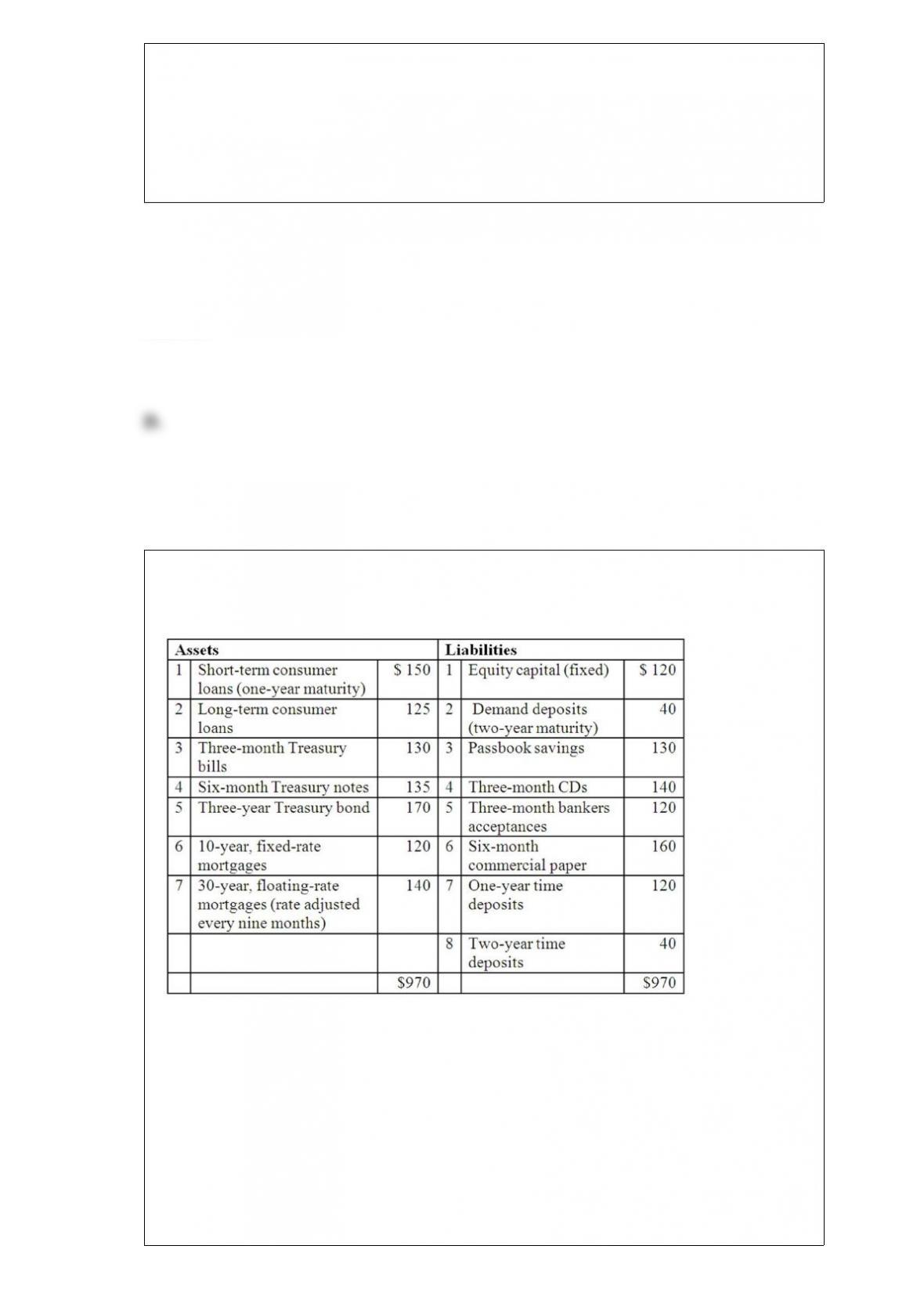
The balance sheet of XYZ Bank appears below. All figures in millions of US Dollars.
Suppose that
interest rates rise by 2 percent on both RSAs and RSLs. The expected annual change in
net interest income of the bank isA. -$300,000.
B. $500,000.
C. -$2,800,000.
D. -$3,000,000.
E. $300,000.

Answer:
Use the duration model to approximate the change in the market value (per $100 face
value) of two-year loans if interest rates increase by 100 basis points. A. -$1.756
B. -$1.775
C. +$98.24
D. -$1.000
E. +$1.924
Answer:

Which of the following is not included in the Common Equity Tier I capital under Basel
III? A. Retained earnings.
B. Par value of common shares issued by the bank.
C. Par value of noncumulative perpetual preferred stock.
D. Paid-in excess (surplus) of common stock.
E. Common shares issued by consolidated subsidiaries of the bank.
Answer:
Which of the following is NOT a reason for a FI to sell loans with recourse? A. To
reduce capital requirements.
B. To avoid credit risk exposure.
C. To control interest rate risk exposure.
D. To avoid regulatory scrutiny.
E. To make it possible to lend large amounts to an individual borrower.

Answer:
If in one year there is no change to either interest rates or exchange rates, what is the
end-of-year profit or loss for the bank? (Hint: Annual interest is paid on both the
Canadian bonds and the CD on the date of liquidation in exactly one year.) A. Profit of
US $20,000.
B. Loss of C $224,000.
C. Profit of US $50,000.
D. Profit of C $63,700.
E. Profit of US $313,000.
Answer:

Identify the correct observation. A. Most loan sales are completed in less than 30 days.
B. Up to 50 percent of loan sales eventually fail to be completed at all.
C. There is no incentive to renege on a loan sales contract.
D. The tendency to renege on a loan sales contract decrease as market prices move
away from those originally agreed.
E. Contractual problems, trading frictions, and costs rarely affect loan sales.
Answer:
What is the market share of Bank 3? A. 12.5 percent.
B. 37.5 percent.
C. 25.0 percent.
D. 62.5 percent.
E. 50.0 percent.
Answer:

Which of the following arises in policies in which the insured event occurs during a
coverage period but a claim is not filed or reported until many years later? A. Short-tail
losses.
B. Adverse selection.
C. Moral hazard.
D. Long-tail losses.
E. Social inflation.
Answer:
An agreement between a buyer and a seller at time 0 to exchange a pre-specified asset
for cash at a specified later date is the characteristic of a A. spot contract.
B. forward contract.
C. futures contract.
D. put options contract.
E. call options contract.
Answer:

Which of the following identifies the primary function of the Office of the Comptroller
of the Currency? A. Manage the deposit insurance fund and carry out bank
examinations.
B. Regulate and examine bank holding companies as well as individual commercial
banks.
C. Charter national banks and approve their merger activity.
D. Determine permissible activities for state chartered banks.
E. Stand as the “lender of last resort” for troubled banks.
Answer:
Hadbucks National Bank current balance sheet appears below. All assets and liabilities
are currently priced at par and pay interest annually.
What is the
weighted average maturity of liabilities? A. 5.50 years.
B. 6.40 years.
C. 1.44 years.
D. 1.30 years.

E. 1.10 years.
Answer:
In the derivatives markets, the instrument with the longest potential maturity is A.
options.
B. futures.
C. forwards.
D. swaps.
E. currencies.
Answer:

If Bank 1 is acquired by Bank 2, what is the impact on the market’s HHI? A. An
increase in the HHI of 1600.
B. An increase in the HHI of 625.
C. An increase in the HHI of 1563.
D. A decrease in the HHI of 222.
E. A decrease in the HHI of 360.
Answer:
“Matching the book” or trying to match the maturities of assets and liabilities is
intended to protect the FI from A. liquidity risk.
B. interest rate risk.
C. credit risk.
D. foreign exchange risk.
E. off-balance-sheet risk.

Answer:
An agreement between a buyer and a seller at time 0 where the seller of an asset agrees
to deliver an asset immediately and the buyer agrees to pay for the asset immediately is
the characteristic of a A. spot contract.
B. forward contract.
C. futures contract.
D. put options contract.
E. call options contract.
Answer:
Choose among the following major banking laws.
A. The McFadden Act of 1927
B. The Glass-Steagall Act of 1933
C. The Depository Institutions Deregulation and Monetary Control Act (DIDMCA) of
1980
D. The Garn-St Germain Depository Institutions Act of 1982
E. The Competitive Equality in Banking Act of 1987

F. The Financial Institutions Reform, Recovery, and Enforcement Act of 1989
G. The Federal Deposit Insurance Corporation Improvement Act (FDICIA) of 1991
H. The Riegle-Neal Interstate Banking and Branching Efficiency Act of 1994
I. Financial Services Modernization Act of 1999
This legislation limited thrift investments in non-residential real estate.
Answer: