When a hostile takeover appears to be inevitable, a target company will sometimes look
for another, friendlier company to acquire it called a
A) poison pill.
B) classified board.
C) golden parachute.
D) white knight.
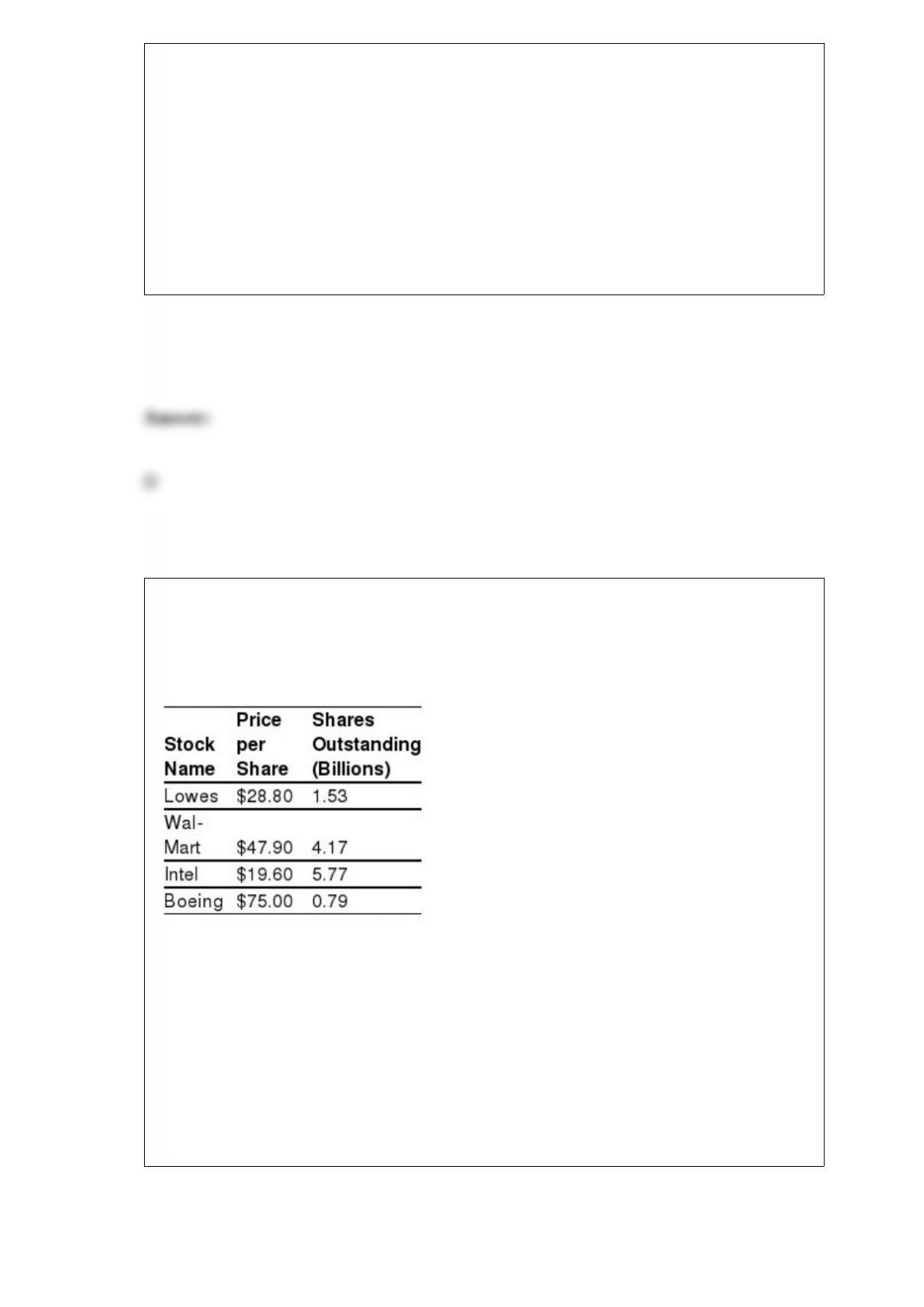
Use the table for the question(s) below.
Consider the following stock price and shares outstanding data:
The market capitalization for Wal-Mart is closest to:
A) $415 Billion
B) $276 Billion
C) $479 Billion
D) $200 Billion
The difference between the weighted-average cost of capital (WACC) and the pre-tax
(unlevered) WACC is
A) the weighted-average cost of capital is based on the after-tax cost of equity and the
pre-tax WACC is based on the after-tax cost of debt.
B) the weighted-average cost of capital multiplies the cost of equity and the cost of debt
by (1-tax rate) and the pre-tax WACC does not.
C) the weighted-average cost of capital multiplies the cost of debt by (1-tax rate) and
the pre-tax WACC does not.
D) the weighted-average cost of capital multiplies the component costs of equity and
debt by their weight in the capital structure, and the pre-tax WACC does not.

Which of the following statements is false?
A) Before the call date, investors anticipate the optimal strategy that the issuer will
follow, and the bond price reflects this strategy.
B) The yield to maturity of a callable bond is calculated as if the bond were called at the
earliest opportunity.
C) A callable bond will trade at a lower price (and therefore a higher yield) than an
otherwise equivalent non-callable bond.
D) The price of a callable bond can be low when yields are high, but does not rise
above the call value when the yield is low.
Which of the following statements is false?
A) As long as the firm’s choice of securities does not change the cash flows generated
by its assets, the capital structure decision will not change the total value of the firm or
the amount of capital it can raise.
B) If securities are fairly priced, then buying or selling securities has an NPV of zero
and, therefore, should not change the value of a firm.
C) The future repayments that the firm must make on its debt are equal in value to the
amount of the loan it receives up front.
D) An investor who would like more leverage than the firm has chosen can lend and
add leverage to his or her own portfolio.
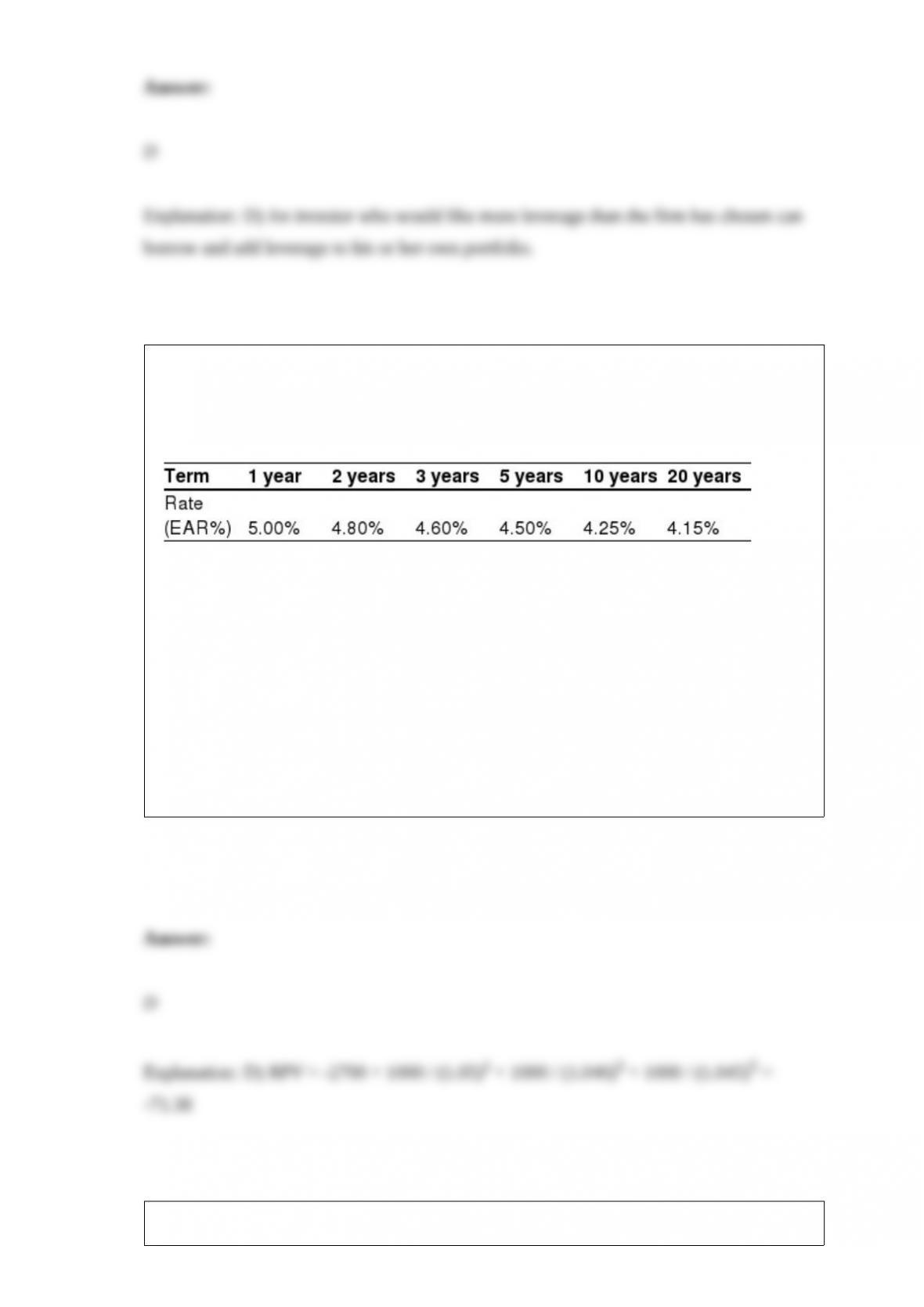
Use the table for the question(s) below.
Suppose the term structure of interest rates is shown below:
The NPV of an investment that costs $2700 and pays $1000 certain at the end of one,
three, and five years is closest to:
A) 21.47
B) $1665.62
C) -100.26
D) -71.38

Use the information for the question(s) below.
KD Industries has 30 million shares outstanding with a market price of $20 per share
and no debt. KD has had consistently stable earnings, and pays a 35% tax rate.
Management plans to borrow $200 million on a permanent basis through a leveraged
recapitalization in which they would use the borrowed funds to repurchase outstanding
shares.
The value of KD’s unlevered equity is closest to:
A) $600 million
B) $470 million
C) $390 million
D) $400 million
Which of the following statements is false?
A) The higher the firm’s leverage, the more the firm exploits the tax advantage of debt,
and the lower its WACC.
B) Corporate taxes lower the effective cost of debt financing, which translates into a
reduction in the weighted average cost of capital.
C) Because the firm’s free cash flow is computed without considering the firm’s
leverage, we account for the benefit of the interest tax shield by calculating the WACC
using the before tax cost of debt.
D) The reduction in the WACC increases with the amount of debt financing.

Use the equation for the question(s) below.
Consider the following regression model:
Rs – rf = as + (RF1 – rf) + (RF2 – rf) + e
The term ε is a(n)
A) measure of the expected percent change in the excess return of a security for a 1%
change in the excess return of the first factor portfolio.
B) error term that has an expectation of zero and is uncorrelated with either factor.
C) measure of the expected percent change in the excess return of a security for a 1%
change in the excess return of the second factor portfolio.
D) constant term.
Which of the following statements regarding auditors is false?
A) The Sarbanes-Oxley Act called on the SEC to force companies to have audit
committees that are dominated by outside directors and required that at least one
outside director have a financial background.
B) Whether information is material has been defined in the courts as referring to

whether the information would have been a significant factor in an investor’s decision
about the value of the security.
C) CEOs and CFOs must return bonuses or profits from the sale of stock or the exercise
of options during any period covered by statements that are later restated.
D) The law is especially strict with regard to takeover announcements, prohibiting any
insider with nonpublic information about a pending or ongoing tender offer from
trading on that information or revealing it to someone who is likely to trade on it.
Which of the following statements is false?
A) The imperfections in the CAPM may be critical in the context of capital budgeting
and corporate finance, where errors in estimating the cost of capital are likely to be far
more important than small discrepancies in the project cash flows.
B) To estimate the expected market risk premium we can look at the historical average
excess return of the market over the risk free interest rate.
C) The highest beta stocks have tended to under perform what the CAPM predicts.
D) Given an assessment of an index’s future cash flows, we can estimate the expected
return of the market by solving for the discount rate that is consistent with the current
level of the index.
Which of the following statements regarding the income statement is incorrect?
A) The income statement shows the earnings and expenses at a given point in time.
B) The income statement shows the flow of earnings and expenses generated by the
firm between two dates.
C) The last or “bottom” line of the income statement shows the firm’s net income.
D) The first line of an income statement lists the revenues from the sales of products or
services.
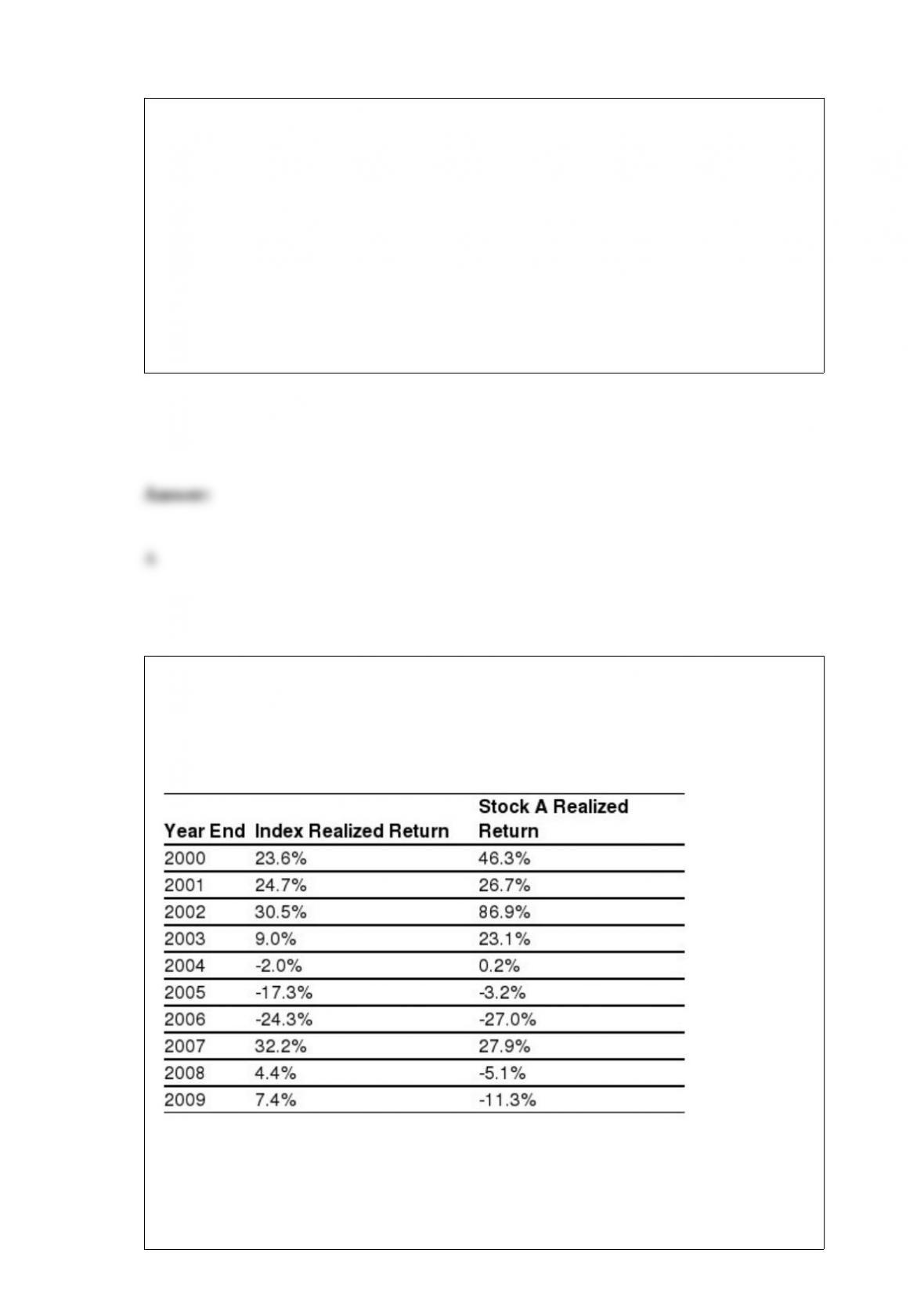
Use the table for the question(s) below.
Consider the following realized annual returns:
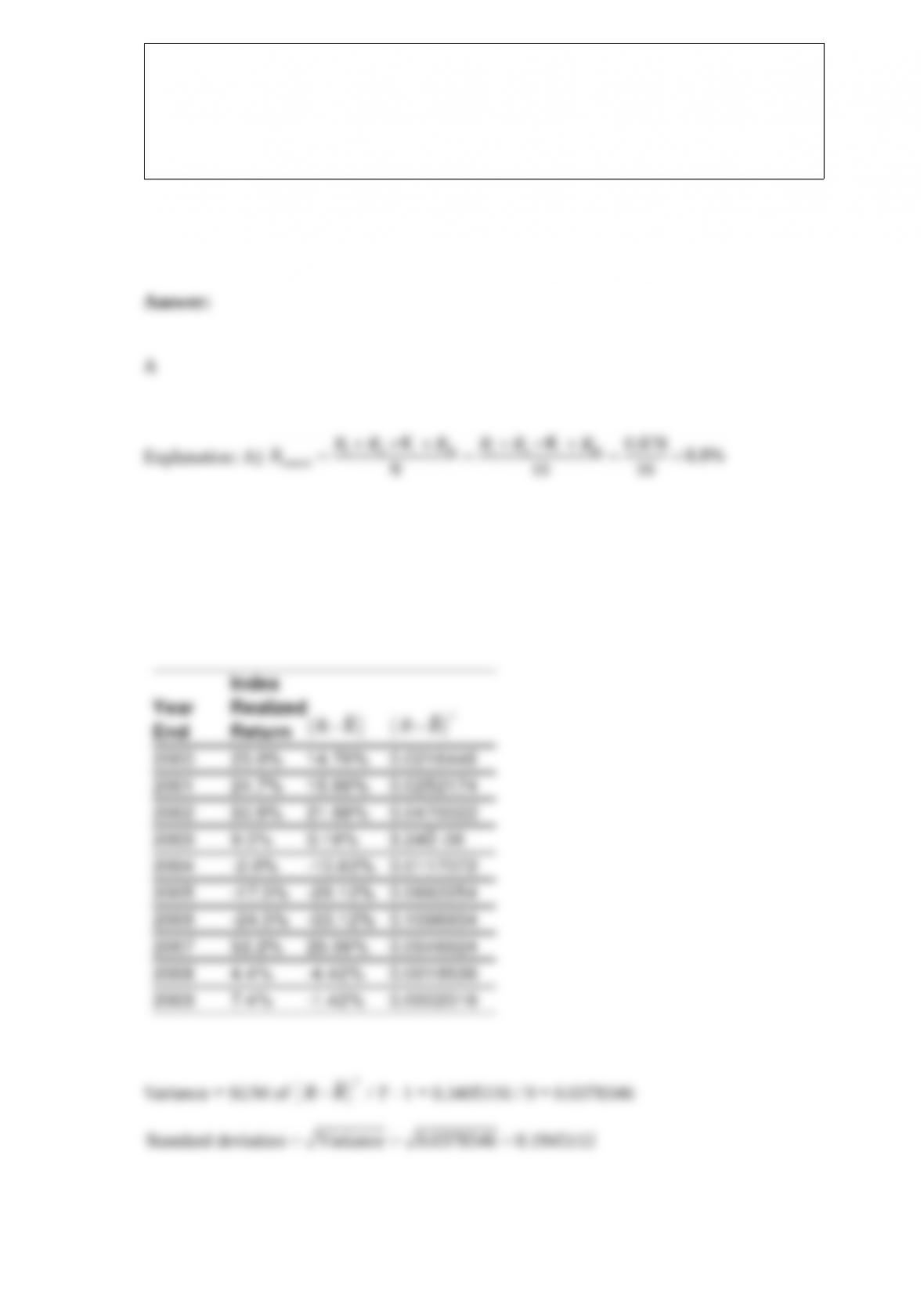
The standard deviation of the returns on the Index from 2000 to 2009 is closest to:
A) 19.5%
B) 20.5%
C) 3.8%
D) 8.8%

Which of the following statements is false?
A) Chief among the costs associated with size is that larger firms are more difficult to
manage.
B) For most investors an investment in the stock market is a zero-NPV investment.
C) Diversification benefits are by far the most common justification that bidders give
for the premium they pay for a target.
D) An acquirer might be able to add economic value, as a result of an acquisition, that
an individual investor cannot add.
Which of the following statements regarding operating leases is false?
A) They are also called a finance leases.
B) The leaseis viewed as a rental for accounting purposes.
C) The lessee reports the entire lease payment as an operating expense.
D) They are disclosed in the footnotes of the lessee’s financial statements.

Use the information for the question(s) below.
Kinston Industries has come up with a new mountain bike prototype and is ready to go
ahead with pilot production and test marketing. The pilot production and test marketing
phase will last for one year and cost $500,000. Your management team believes that
there is a 50% chance that the test marketing will be successful and that there will be
sufficient demand for the new mountain bike. If the test-marketing phase is successful,
then Kinston Industries will invest $3 million in year one to build a plant that will
generate expected annual after tax cash flows of $400,000 in perpetuity beginning in
year two. If the test marketing is not successful, Kinston can still go ahead and build the
new plant, but the expected annual after tax cash flows would be only $200,000 in
perpetuity beginning in year two. Kinston has the option to stop the project at any time
and sell the prototype mountain bike to an overseas competitor for $300,000. Kinston’s
cost of capital is 10%.
Assuming that Kinston does not have the ability to sell the prototype in year one for
$300,000, the NPV of the Kinston Industries Mountain Bike Project is closest to:
A) -$45,000
B) $455,000
C) $590,000
D) $90,000

Use the information for the question(s) below.
Food For Less (FFL), a grocery store, is considering offering one hour photo
developing in their store. The firm expects that sales from the new one hour machine
will be $150,000 per year. FFL currently offers overnight film processing with annual
sales of $100,000. While many of the one hour photo sales will be to new customers,
FFL estimates that 60% of their current overnight photo customers will switch and use
the one hour service.
Suppose that of the 60% of FFL’s current overnight photo customers, half would start
taking their film to a competitor that offers one hour photo processing if FFL fails to
offer the one hour service. The level of incremental sales in this case is closest to:
A) $60,000
B) $150,000
C) $90,000
D) $120,000

Use the table for the question(s) below.
Consider the following zero-coupon yields on default free securities:
The forward rate for year 4 (the forward rate quoted today for an investment that begins
in three years and matures in four years) is closest to:
A) 4.5%
B) 4.6%
C) 4.4%
D) 5.0%
Which of the following statements is false?
A) As interest rates change, the market values of the securities and cash flows in the
portfolio change as well, which in turn alters the weights used when computing the
duration as the value-weighted average maturity.
B) The duration of a portfolio of investments is the simple average of the durations of
each investment in the portfolio.
C) Adjusting a portfolio to make its duration neutral is sometimes referred to as
immunizingthe portfolio, a term that indicates it is being protected against interest rate
changes.
D) When the durations of a firm’s assets and liabilities are significantly different, the

firm has a duration mismatch.
Which of the following statements is false?
A) Given a forecast of future interest payments, we can determine the interest tax shield
and compute its present value by discounting it at a rate that corresponds to its risk.
B) The total value of the unlevered firm exceeds the value of the firm with leverage due
to the present value of the tax savings from debt.
C) To compute the increase in the firm’s total value associated with the interest tax
shield, we need to forecast how a firm’s debt and therefore its interest payments.
D) There is an important tax advantage to the use of debt financing.
Assuming you get 50% control of Associated Steel, then the price of the non-tendered
shares will be closest to:
A) $12.50
B) $15.00
C) $17.50
D) $20.00
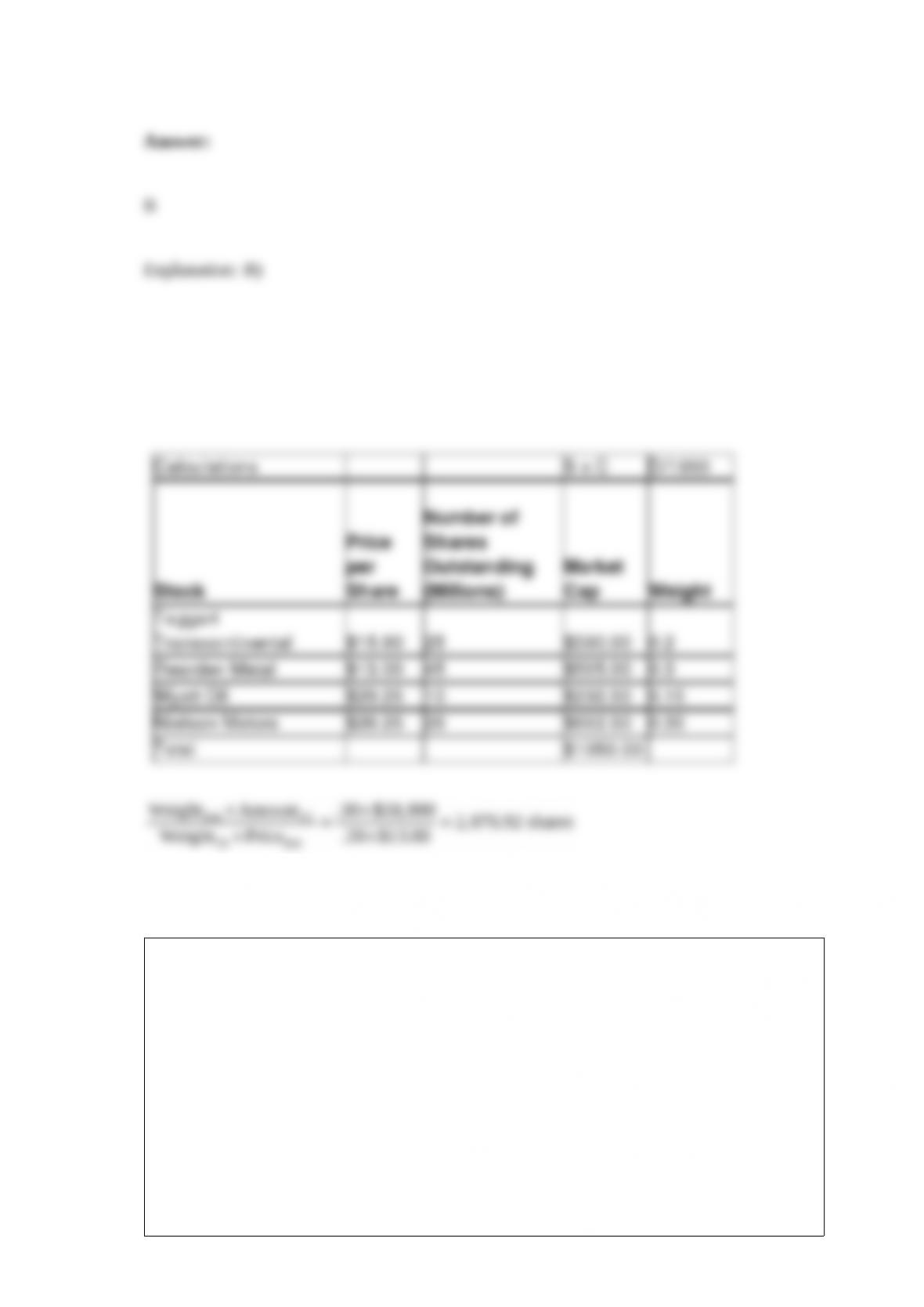
Suppose all possible investment opportunities in the world are limited to the four stocks
list in the table below:
Suppose that you are holding a market portfolio and you have invested $18,000 in
Taggart Transcontinental. The number of shares of Rearden Metal that you hold is
closest to:
A) 780 shares
B) 925 shares
C) 1,730 shares
D) 2,075 shares
Rearden Metal has no debt, and maintains a policy of holding $50 million in excess
cash reserves, invested in risk free treasury securities currently yielding 4%. If Rearden
is in the 40% marginal tax bracket, the cost of permanently maintaining this $50 million
reserve is closest to:
A) $0.8 million
B) $1.2 million
C) $20.0 million
D) $30.0 million

The expected return on your of your investment is closest to:
A) 18%
B) 20%
C) 12%
D) 24%
At an annual interest rate of 7%, the present value of $5,000 received in five years is
closest to:

A) $3,565
B) $6,750
C) $7,015
D) $7,035
Which of the following statements is false?
A) If the lease is deemed to be a true lease, the firm is assumed to have effective
ownership of the asset and the asset is protected against seizure.
B) Although the legal ownership of the asset resides with the lessor, in a non-tax
leasethe lessee receives the depreciation deductions.
C) The treatment of leased property in bankruptcy will depend on whether the lease is
classified as a security interest or a true lease by the bankruptcy judge.
D) In a non-tax lease, the interest portion of the lease payment is interest income for the
lessor.

Use the following information to answer the question(s) below.
Your great aunt Matilda put some money in an account for you on the day you were
born. This account pays 8% interest per year. On your 21st birthday the account balance
was $5,033.83.
The amount of money that your great aunt Matilda originally put in the account is
closest to:
A) $600
B) $800
C) $1,000
D) $1,200
Rylan Inc is considering a project that has an initial cost of $2 million. It is expected to
generate cash flows for the firm of $500,000 per year for 6 years. Assuming a discount
rate of 7%, what is the equivalent annual benefit?
A) $75,148
B) $80,408
C) $85,889
D) $91,901

Which of the following statements is false?
A) The risk premium of any marketable security can be written as the sum of the risk
premium of each factor multiplied by the sensitivity of the stock with that factor.
B) The factor betas measure the sensitivity of the stock to a particular factor.
C) If we use more than one portfolio as factors, then together these factors will capture
systematic risk, but each factor captures different components of the systematic risk.
D) When we use more than one portfolio to capture risk, the model is known as asingle
factor model.
This period is known as the conglomerate wave because firms typically acquired firms
in unrelated businesses:
A) 1960s
B) 1970s
C) 1980s
D) 1990s

The Grant Corporation is considering permanently adding $500 million of debt to its
capital structure. Grant’s corporate tax rate is 35% and investors pay a tax rate of 40%
on their interest income and 20% on their income from capital gains and dividends.
Calculate the present value of the interest tax shield provided by this new debt.
KT corporation has announced plans to acquire MJ corporation. KT is trading for $45
per share and MJ is trading for $25 per share, with a premerger value for MJ of $3
billion dollars. If the projected synergies from the merger are $750 million, what is the
maximum exchange ratio that KT could offer in a stock swap and still generate a
positive NPV?
Use the table for the question(s) below.
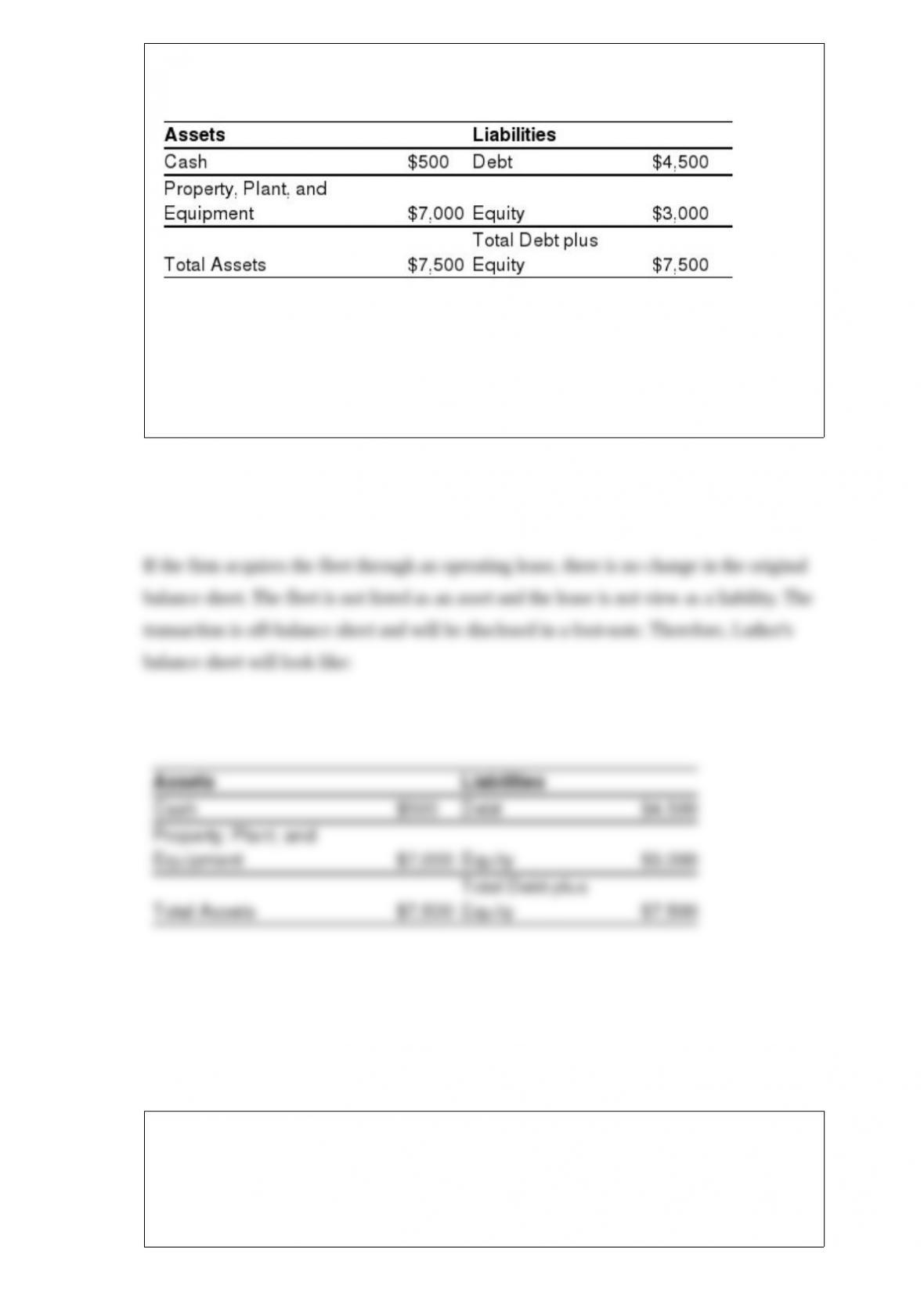
Luther Industries currently has the following balance sheet (in Thousands of dollars):
Luther is about to add a new fleet of delivery trucks. The price of the fleet is $1.5
million.
What will Luther’s balance sheet look like if they acquire the new fleet of delivery
trucks using an operating lease?
Use the information for the question(s) below.
Luther Industries is in the process of selling shares of stock in an auction IPO. At the
end of the bidding period, Luther’s investment bank has received the following bids:

What will the offer price of these shares be if Luther is selling 800,000 shares?

What is the efficient frontier and how does it change when more stocks are used to
construct portfolios?

Use the information for the question(s) below.
St. Martin’s Hospital plans to purchase or lease a $2 million dollar CT scanner. If
purchased, the CT scanner will be depreciated on a straight-line basis over five years,
after which it will be worthless. If leased, the annual lease payments will be $500,000
per year for five years. St. Martin’s borrowing cost is 8%, and its tax rate is 35%.
Is St. Martin’s better off leasing the CT scanner or financing the purchase of the CT
scanner with a lease-equivalent loan and by how much is St Martin’s better off?

Monsters Inc. is a utility company that recently paid a common stock dividend of $2.35
per share. Determine the current price of a share of Monsters’ common stock if its
divided growth rate is expected to remain at 7 percent per year indefinitely and its
equity cost of capital is 12 percent.
Do expected returns for individual stocks increase proportionately with volatility?

Consider the following two quotes for XYZ stock:
What are your net proceeds if you purchased 2500 shares of XYZ stock on November
11th and then sold them a week later on November 18th?
Raceway Products has a market debt-to-equity ratio of .60, a corporate tax rate of 40%,
and pays 8% interest on its debt. The interest tax shield on Raceway’s debt lowers its
WACC by what amount?
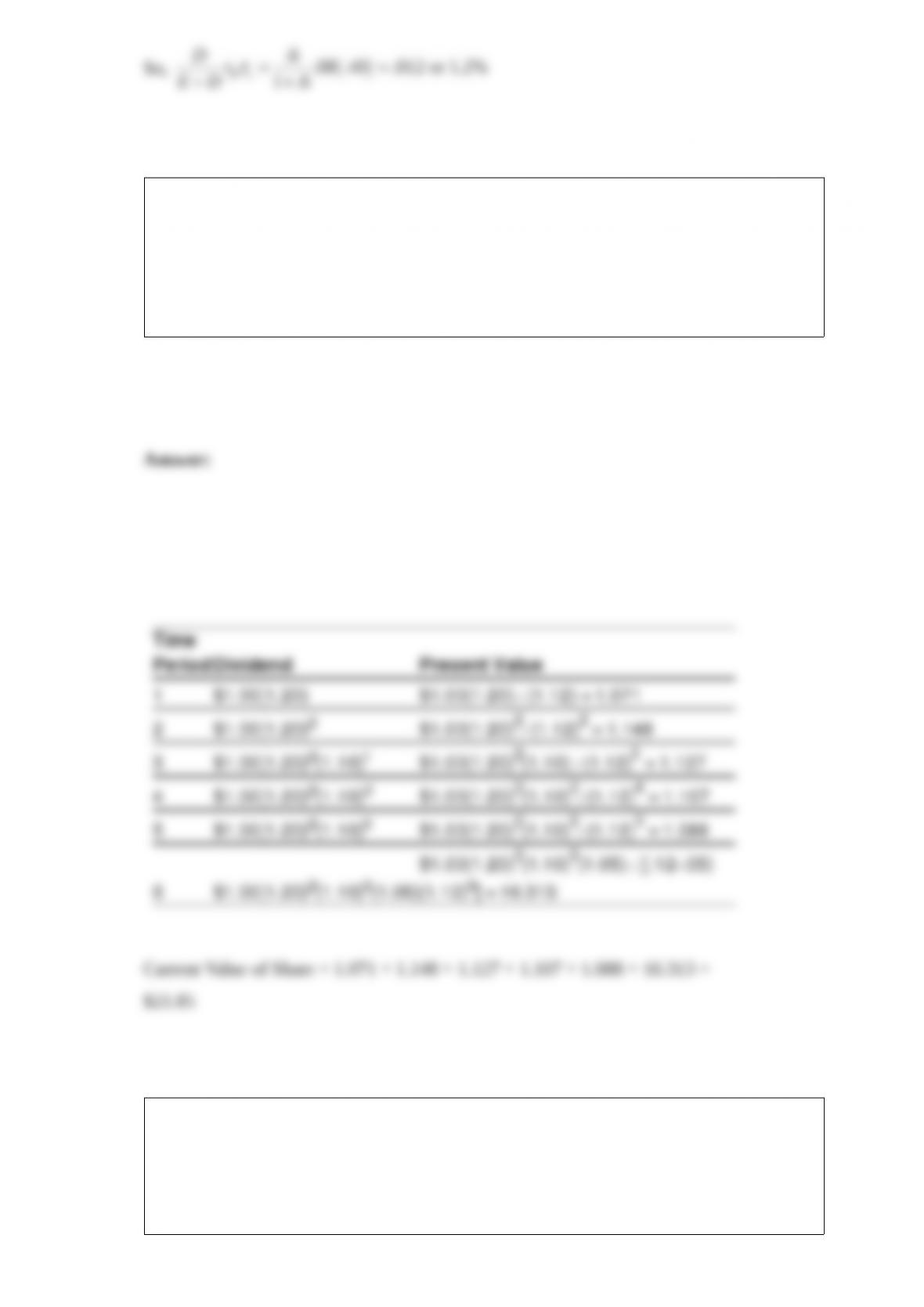
MJ LTD is expected to grow at various rates over the next five years. The company just
paid a $1.00 dividend. The company expects to grow at 20% for the next two years
(effecting D1 and D2), then the company expects to grow at 10% for three additional
years (D3, D4, D5) after which the company expects to grow at a constant rate of 5%
per year indefinitely. If the required rate of return on MJ’s common stock is 12%, then
what is a share of MJ’s stock worth?
Use the information for the question(s) below.
Luther Industries, a U.S. Corporation, is considering a new project located in Great
Britain. The expected free cash flows from the project are detailed below:

You know that the spot exchange rate is S = 1.8862/. In addition, the risk-free interest
rate on dollars and pounds is 5.4% and 4.6% respectively. Assume that these markets
are internationally integrated and the uncertainty in the free cash flow is not correlated
with uncertainty in the exchange rate. You have determined that the dollar WACC for
these cash flows is 10.2%.
What is the pound present value of the project?
Assume that capital markets are perfect except for the existence of corporate taxes and
that your firm pays 35% of earnings in taxes. If you want to maintain ownership of at
least a 50%, then calculate the minimum amount of debt that you must issue to fund the
expansion.