
The duration of a liability that does not pay interest must be equal to 0.
Answer:
The Internet has led to larger spreads for more standardized loan products.
Answer:
Periodic GAP analysis compares rate-sensitive assets and rate-sensitive liabilities across
each single “time bucket.”
Answer:
Mortgage origination is countercyclical to a bank’s net interest margin business.

Answer:
Most long-term municipal bonds are serial bonds.
Answer:
BMW bank has more financial leverage than its peers.
Answer:
Community banks tend to operate in a limited geographic region.
Answer:

Individuals, as a group, are not as interest-rate sensitive as wholesale customers.
Answer:
Today, most industrial loan companies are located in Indiana .
Answer:
A memorandum of understanding is a legal document that orders a firm to stop an
unfair practice.
Answer:

Mutual of Omaha’s business model is to combine insurance and banking activities.
Answer:
Goldman Sachs has converted from an investment bank to a bank holding company.
Answer:
The yield curve is generally inverted at the top of the business cycle.
Answer:
To help keep people in their homes, the SEC promoted loan modifications for troubled
home-loan borrowers.

Answer:
Mortgage defaults were greatest in geographic markets that had experienced the
greatest run-up in real estate prices.
Answer:
Regulatory capital ratios focus on the book value of equity.
Answer:
The McFadden Act of 1927 forbids national banks from underwriting equities.
Answer:

There is an inverse relationship between a bond’s duration and its price volatility.
Answer:
The quality of bank loans varies with the business cycle.
Answer:
A bank that holds only U.S. Treasury securities is not required to hold any capital since
all the assets are risk-less.
Answer:

Under the current risk-based capital requirements, banks must hold capital against
standby letters of credit they have issued as guarantees.
Answer:
Income statement GAP is also known as Omega GAP..
Answer:
A firm generally should not count on collateral as the primary source of payment.
Answer:
The best measure of bank asset liquidity is the core deposits to total asset ratio.

Answer:
Community banks relied more on investment banking, relative to larger banks, to
increase non-interest income.
Answer:
An independent bank operates a single organization that accepts deposits and makes
loans.
Answer:
Bank regulations can guarantee that bankers will make sound management decisions.
Answer:

Securitization refers to the process of splitting a single loan into several smaller loans.
Answer:
Super-regional banks typically have limited global operations.
Answer:
Smaller banks generally employee fewer people per dollar of assets than larger banks.
Answer:

Investment banks are prohibited from making a market in the stock of publically traded
companies.
Answer:
Using a 360-day year results in higher returns than using a 365-day year.
Answer:
There is no systematic link between a bank’s market value of equity and reported
expenses.
Answer:
Core deposits are affected by all of the following except:
a. location.

b. availability.
c. volatile liabilities.
d. service charges.
e. Core deposits are affected by all of the above.
Answer:
Macaulay’s duration:
a. is a weighted average of the time until cash flows are received.
b. is always greater than maturity.
c. is never equal to maturity.
d. directly indicates how much the price of a security will change given a change in
interest rates.
e. estimates when embedded options will be used.
Answer:
On Goldman Sachs’ balance sheet for 2007, Financial Instruments Owned consists of:

a. cash.
b. collateralized agreements.
c. derivative securities.
d. a. and b.
e. a. and c.
Answer:
Which of the following would be considered an unacceptable consumer loan?
a. A home improvement loan, secured by a first mortgage
b. A home improvement loan, secured by a second mortgage
c. A $10,000 loan on a new $30,000 boat, secured by the boat
d. A loan on for 80% of the value on a new automobile, secured by the automobile
e. A loan for 95% of the value of used skydiving equipment, secured by the equipment
Answer:
Bank assets fall into each of the following categories except:

a. loans.
b. investment securities.
c. demand deposits.
d. noninterest cash and due from banks.
e. other assets.
Answer:
Firms may need cash for all of the following except:
a. operating purposes.
b. pay taxes.
c. pay employee salaries.
d. pay overdue suppliers.
e. liquidate fixed assets.
Answer:
Bank regulations:

a. can prevent bank failures.
b. can eliminate economic risk for banks.
c. serve as guidelines for sound operating policies.
d. guarantee bankers will make sound management decisions.
e. guarantee bankers act in an ethical manner.
Answer:
_________ allowed any institution to “truncate” the paper check at any point in the
check clearing process.
a. Riegle-Neal Interstate Banking and Branching Efficiency Act
b. Fair and Accurate Credit Transactions Act
c. Troubled Asset Relief Program
d. Sarbanes-Oxley Act
e. Check 21 Act
Answer:
Which of the following Federal Reserve loans is to help with systematic new loan

demand?
a. Extended credit loans
b. Seasonal borrowing loans
c. Fed funds loans
d. Deposit insurance loans
e. Short-term adjustment loans
Answer:
The operating risk ratio measures:
a. cost controls versus fee generation.
b. fee income versus net interest margin.
c. non-interest expense versus non-interest income.
d. depositors versus employees.
e. depreciation versus required reserves.
Answer:

An example of a contra-asset account is:
a. the loan and lease loss allowance.
b. unearned income.
c. buildings and equipment.
d. revenue bonds.
e. the provision for loan loss.
Answer:
Many insurance companies have organized as a _____________ in order to own a
depository institution and bypass prohibitions in the Glass-Steagall Act and the Bank
Holding Company Act.
a. unitary thrift holding company
b. commercial bank
c. mortgage company
d. savings bank
e. credit union
Answer:

A bank anticipates it will need to borrow funds in the Eurodollar market in the future. It
hedges by selling futures contracts. If rates decline, which of the following is true?
a. The bank will profit on the futures contract.
b. The bank will profit in the cash market.
c. The bank will have locked in a low cost of borrowing.
d. The bank will lose in the cash market.
e. a. and d.
Answer:
A change in net interest income would occur when:
a. the composition of the assets of the bank change.
b. the average asset yield changes.
c. the volume of the assets of the bank change.
d. the average interest expense changes.
e. All of the above
Answer:

In general, _______________ are the major non-credit cost for commercial customers.
a. personnel expenses
b. check-processing costs
c. loan administration expenses
d. fraud costs
e. default costs
Answer:
Banks that emphasize lending to commercial customers are labeled:
a. wholesale banks.
b. retail banks.
c. personal banks.
d. non-bank banks.
e. regional banks.
Answer:
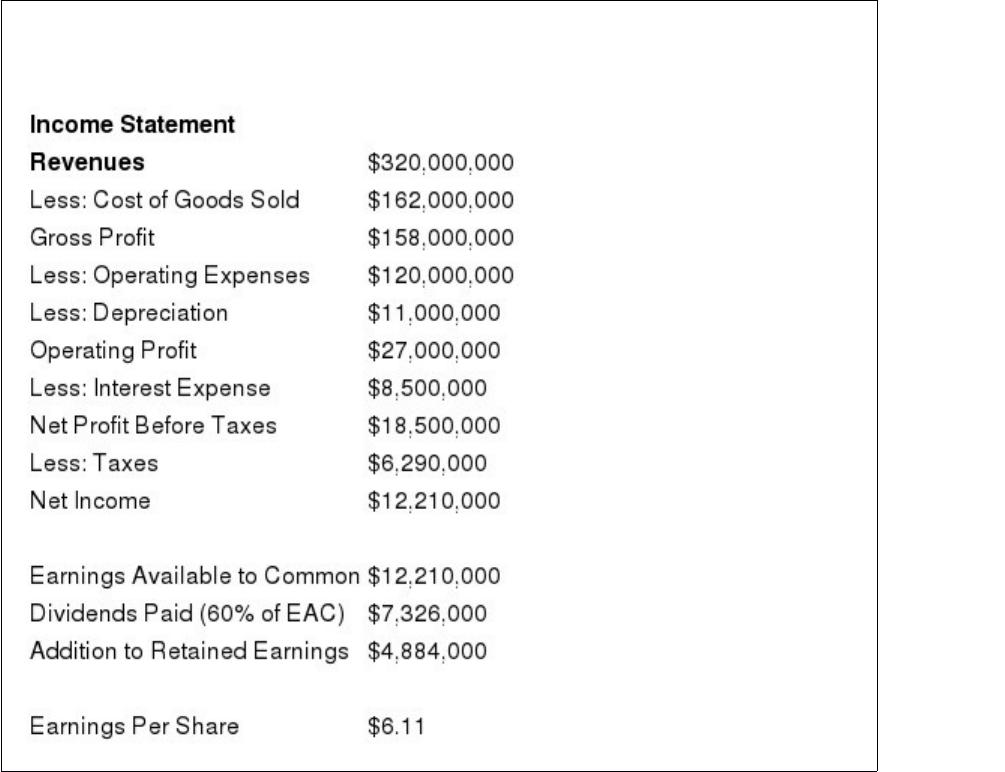
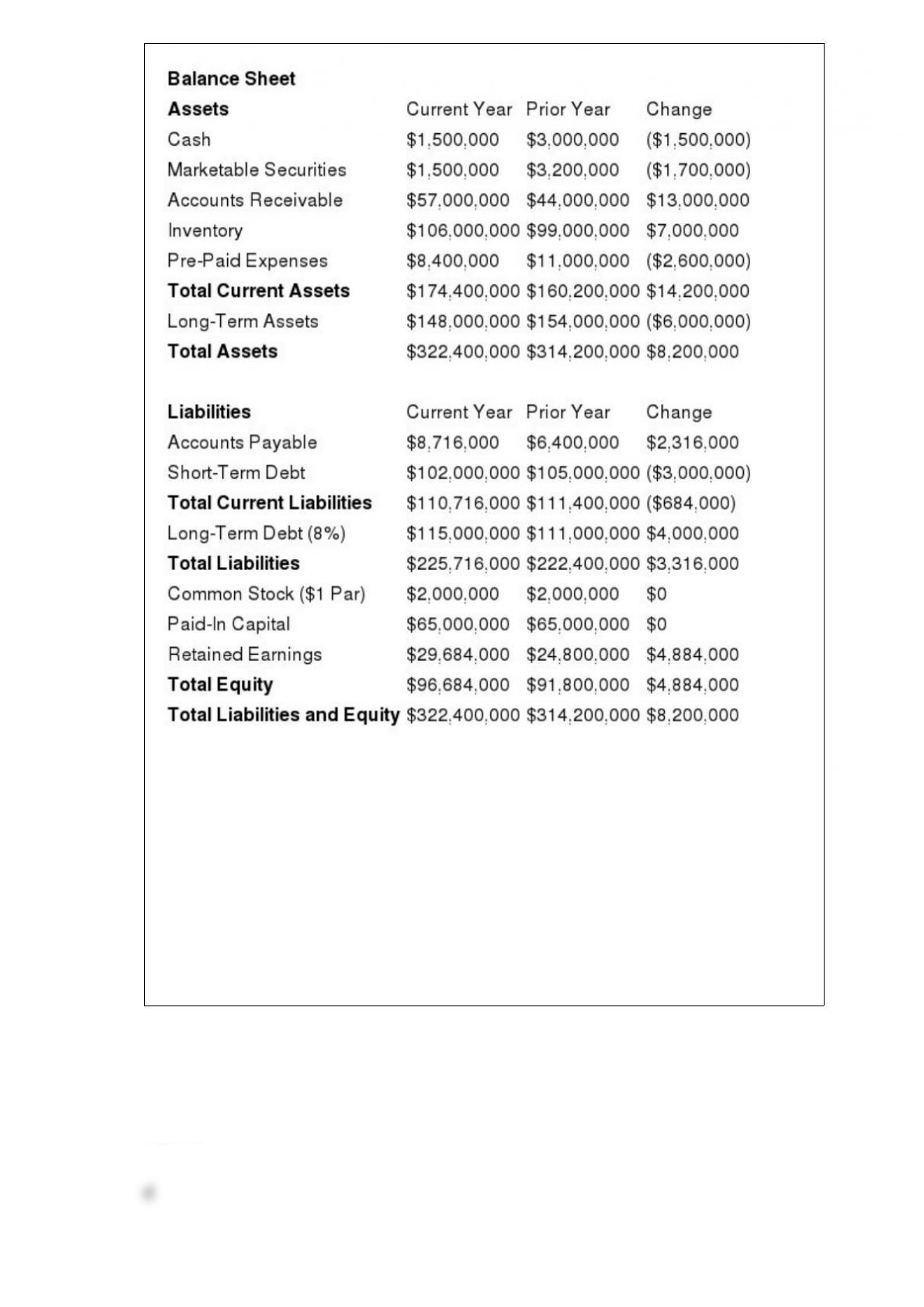
What is Dylan’s return on equity for the current year?
a. 3.8%
b. 5.1%
c. 5.4%
d. 12.6%
e. 13.3%
Answer:

Interest costs do not equal the effective cost of bank liabilities because:
a. reserve requirements increase the effective cost.
b. there may be substantial processing costs.
c. service charges may offset a portion of non-interest expense.
d. all of the above.
e. a. and c.
Answer:
What is the equity multiplier for a bank where equity is equal to 12% of total assets?
a. 83.33
b. 1.12
c. 0.88
d. 12.00
e. 8.33

Answer:
What is the equity multiplier for a bank where equity is equal to 10% of total assets?
a. 90.00
b. 10.00
c. 1.10
d. 110.00
e. 1.00
Answer:
A bank’s “burden” is defined as:
a. net interest income minus non-interest income.
b. non-interest income minus non-interest expense.
c. non-interest expense minus non-interest income.
d. net interest income plus non-interest income.

e. interest expense plus non-interest expense.
Answer:
Agricultural loans became problem loans in mid-1980s for all of the following reasons
except:
a. land values dropped dramatically.
b. there was a worldwide recession.
c. the U.S. dollar got stronger.
d. grain embargoes reduced demand for U.S. agricultural crops.
e. banks stressed cash flow too much when originating these loans.
Answer:
Which of the following has the lowest weight in determining a consumer’s FICO score?
a. Types of credit
b. Amounts owed
c. Payment history
d. Length of credit history

e. Number of delinquencies
Answer:
The “initial margin” on a futures contract:
a. is a cash deposit the buyer places with the seller as good faith money.
b. can be cash or U.S. government securities placed with an exchange member.
c. are U.S. government securities the buyer places with the seller for safekeeping.
d. are the first installment on the payment for a futures contract.
e. is the amount by which the futures contract is initially “in the money.”
Answer:
The _________ created the Office of Thrift Supervision.
a. Depository Institutions Act (Garn-St. Germain)
b. Competitive Equality Banking Act
c. Financial Institutions Reform, Recovery and Enforcement Act
d. Federal Deposit Insurance Corporation Improvement Act

e. Depository Institutions Deregulation and Monetary Control Act
Answer:
Which of the following is not true regarding the basis?
a. The basis systematically declines as expiration approaches.
b. The basis must equal zero at expiration.
c. The basis may not equal zero before expiration.
d. The basis may be positive or negative.
e. both b. and c. are not true regarding the basis.
Answer:
An asset would normally be classified as rate-sensitive if:
a. it matures during the examined time period.
b. it represents a partial principal payment.
c. the outstanding principal on a loan can be re-priced when the base rate changes.
d. All of the above.

e. a. and c. only
Answer:
Eurodollar:
a. deposits are dollar-denominated deposits issued outside the United States.
b. markets are less regulated than U.S. security markets.
c. rates generally are lower than comparable U.S. CD rates.
d. all of the above
e. a. and b. only
Answer:
A bank customer is granted credit for a $2,000 loan at 10% to be repaid in 12 equal
installments. If the loan is a discount loan, what is the monthly payment?
a. $200.00
b. $192.35
c. $184.20

d. $173.12
e. $166.67
Answer:
All of the following are basic functions of a bank’s trading activities except:
a. offering investment advice to customers.
b. maintaining an inventory of securities for possible sale to investors.
c. speculating on short-term interest rate movements.
d. All of the above are basic functions of a bank’s trading activities.
e. None of the above are basic functions of a bank’s trading activities.
Answer:
Which of the following is a non-discretionary factor that will increase a bank’s daily
reserves held at the Federal Reserve?
a. Federal funds sold.

b. Receiving a discount window loan
c. Remittances charged
d. Security sales
e. Deposits from the U.S. Treasury
Answer:
When an investment bank commits its own funds to take a risk position in an
underlying security, it is known as:
a. underwriting.
b. market making.
c. proprietary trading.
d. organizing a market.
e. brokering.
Answer:
A London based firm has a subsidiary located in New York. The subsidiary has $1,000
in assets, $750 in liabilities and $250 in equity. The current spot rate is $1.60/£.

What is the U.S. firm’s net exposure?
a. $250
b. £250
c. £1,000
d. $1,200
e. $1,600
Answer:
What is 1st State’s burden?
a. 2.5%
b. 17.5%
c. 25.0%
d. 75.5%
e. 82.5%
Answer:

Which of the following is not a component of the Farm Credit System?
a. Farm Credit Banks
b. Agricultural Credit Associations
c. Federal Land Credit Associations
d. Farm Credit Administration
e. Agricultural Lending Office
Answer: