
Recoveries refer to:
a. the dollar value of loans actually written off as uncollectible.
b. the dollar amount of loans that were previously charged-off but now collected.
c. net charge-offs.
d. loans not currently accruing interest.
e. loans that regulators have required the bank to “recover”.
Answer:
In the credit process, which of the following activities falls under Business
Development and Credit Analysis?
a. Loan committee reviews
b. Loan documentation review
c. Officer call programs
d. Perfect security interest
e. Process loan payments
Answer:

Which of the following U.S. government agency securities are backed by the full faith
and credit of the U.S. Government?
a. Government National Mortgage Association (Ginnie Mae)
b. Student Loan Marketing Association (Sallie Mae)
c. Small Business Administration (SBA)
d. all of the above
e. a. and c. only
Answer:
Which of the following statements is/are correct?
a. Higher capital requirements often result in a higher cost of capital for banks.
b. Small banks have greater access to the equity markets than large banks.
c. Higher capital requirements encourage small banks to consolidate into larger banks.
d. All of the above are correct.
e. Only a. and c. are correct.
Answer:

Banks rarely provide:
a. start-up capital loans.
b. mortgage loans.
c. automobile loans.
d. agricultural loans..
e. commercial loans.
Answer:
If a bank has a positive GAP, an increase in interest rates will cause interest income to
__________, interest expense to__________, and net interest income to __________.
a. increase, increase, increase
b. increase, decrease, increase
c. increase, increase, decrease
d. decrease, decrease, decrease
e. decrease, increase, increase
Answer:

Which of the following officially designates a bank as insolvent?
a. Office of the Comptroller of the Currency
b. Federal Reserve
c. Office of Thrift Supervision
d. Office of National Charters
e. Resolution Trust Corporation
Answer:
Everything else the same, financial leverage works to a bank’s advantage when:
a. the return on assets is positive.
b. the return on assets is negative.
c. fixed assets are high.
d. fixed assets are low.
e. a. and d.
Answer:

Which Act allowed the individual states to determine if a bank could branch within or
outside its home state?
a. Competitive Equality Banking Act
b. Federal Reserve Act
c. McFadden Act
d. Glass-Steagall Act
e. Riegle-Neal Interstate Banking and Branching Efficiency Act
Answer:
Which of the following is a hybrid form of equity that effectively pays dividends that
are tax deductible and is considered Tier 1 capital?
a. Common stock
b. Preferred stock
c. Trust preferred stock
d. Leases
e. Trust subordinated debt
Answer:

To perfectly immunize a bank’s economic value of equity from changes in interest rate
risk, it should:
a. adjust assets and liabilities such that its duration gap is equal to one.
b. adjust assets and liabilities such that its duration gap is greater than zero.
c. adjust assets and liabilities such that its duration gap is equal to zero.
d. adjust assets and liabilities such that its GAP is equal to zero.
e. adjust assets and liabilities such that its GAP is less than one.
Answer:
How does bank capital reduce bank risk?
a. It provides a cushion for firms to absorb losses.
b. It creates unlimited growth opportunities.
c. It limits access to the financial markets.
d. All of the above.
e. a. and b.
Answer:

Under FASB 157, Level _______ assets valuation are based on observable market
prices for similar assets or liabilities.
a. 1
b. 2
c. 3
d. 4
e. 5
Answer:
Interest income includes:
a. interest earned on all of the bank’s assets.
b. fees earned on all of the bank’s assets.
c. fees earned on all of the bank’s deposit accounts.
d. all of the above.
e. a. and b. only
Answer:

If a bank has a negative GAP, an increase in interest rates will cause interest income to
__________, interest expense to__________, and net interest income to __________.
a. increase, increase, increase
b. increase, decrease, increase
c. increase, increase, decrease
d. decrease, decrease, decrease
e. decrease, increase, increase
Answer:
Non-performing international loans do not completely reflect potential losses because:
a. foreign governments have never defaulted on their debts.
b. banks often loan borrowers funds to make payments on existing loans.
c. U.S. banks can easily recover the funds in foreign courts.
d. the U.S. government has strongly discouraged U.S. banks from making international
loans.
e. all of the above
Answer:

Which of the following is not a historical problem with deposit insurance?
a. Deposit insurance is a substitute for some functions of bank capital.
b. Some banks are considered Too-Big-To-Fail.
c. Historically, deposit insurance premium levels have been insufficient to cover
potential payouts.
d. Historically, deposit insurance premiums were not assessed against all of a bank’s
insured liabilities.
e. All of the above are historical problems with deposit insurance.
Answer:
Net interest income is the difference between:
a. gross interest income and net interest expense.
b. gross interest income and non-interest income.
c. the burden and realized gains or losses.
d. non-interest income and net interest expense.
e. gross interest income and gross interest expense.
Answer:

The risk of potential loss of interest and principal on international loans due to
borrowers in a country refusing to make timely payments, as per the loan agreement is
known as what type of risk?
a. International risk
b. Foreign risk
c. Continent risk
d. Country risk
e. Government risk
Answer:
Securities with embedded options:
a. often have higher yields than comparable Treasury securities.
b. generally have no prepayment risk.
c. are always free of default risk.
d. all of the above.
e. a. and b. only
Answer:

A bank buys a $10,000 Treasury bill with a maturity of 1 year. Current market rates are
8%. If interest rates rise to 8.25%, what is the approximate change in the price of the
T-bill?
a. -0.02%
b. -0.23%
c. -2.31%
d. -23.15%
e. -231.15%
Answer:
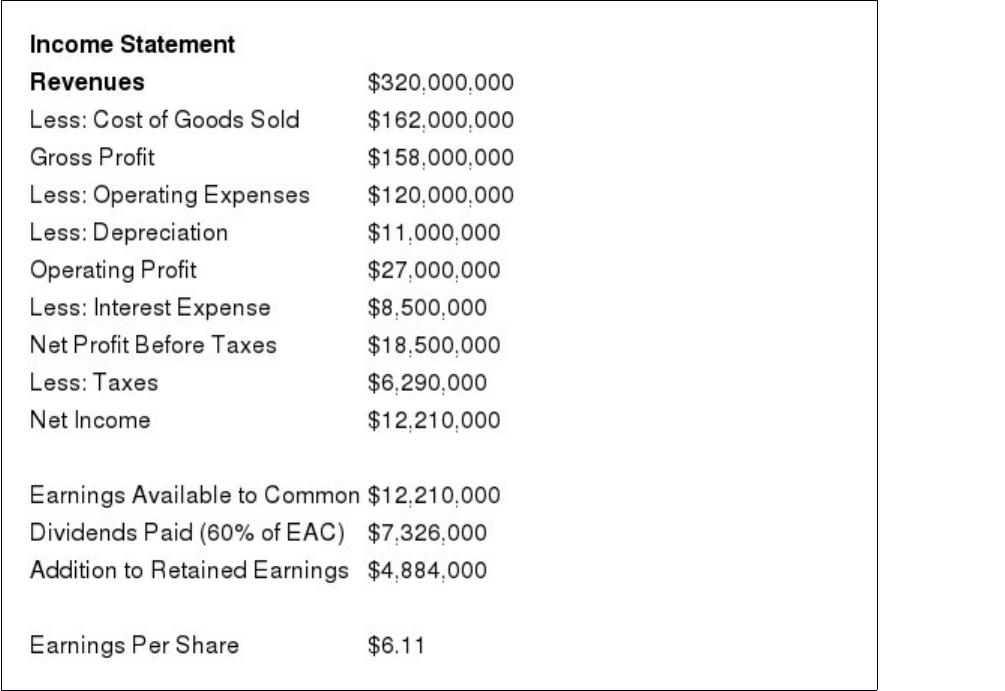
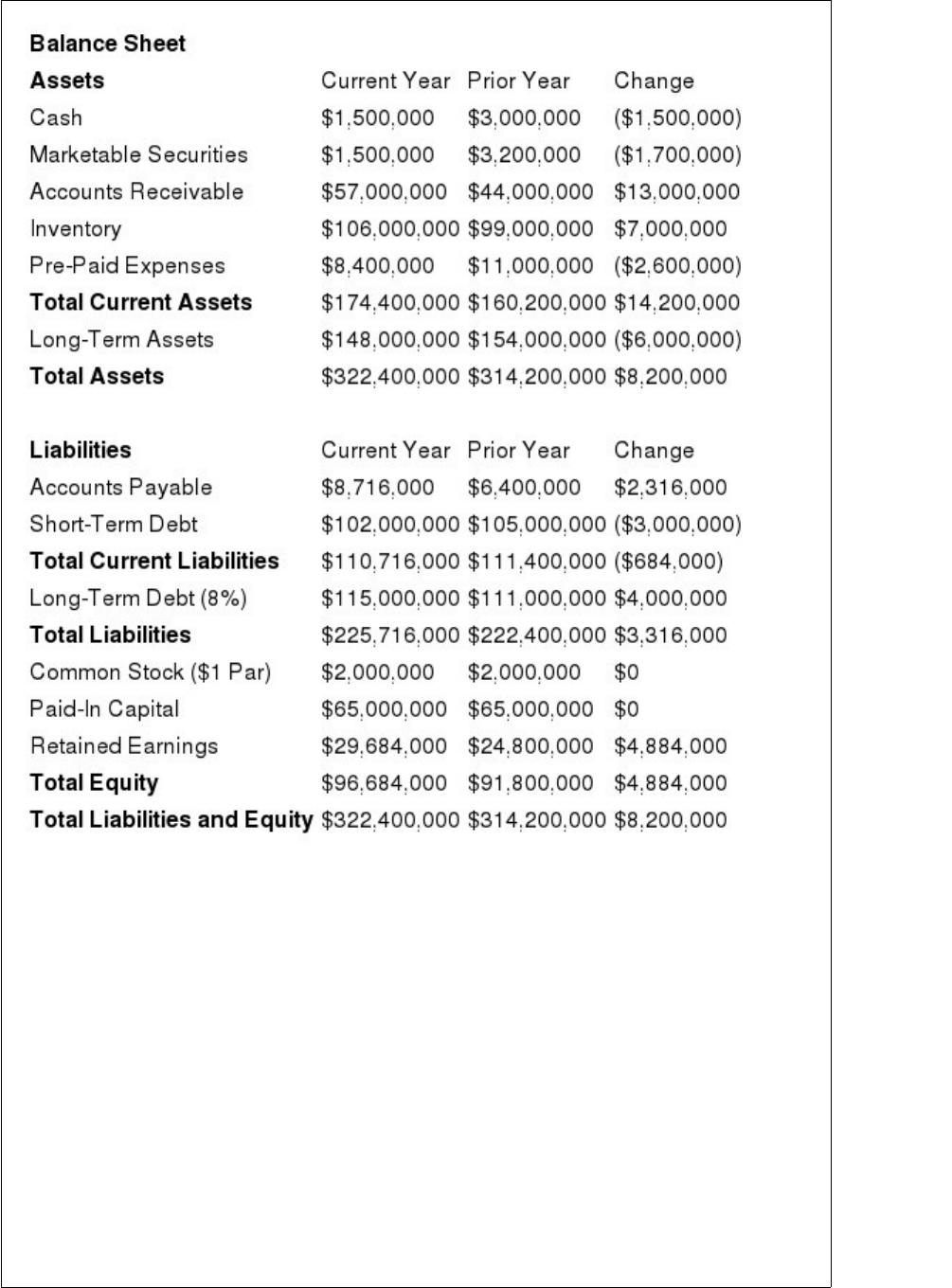
Next year, sales at Dylan are expected to increase by 10%. Also next year, the dividend
payout ratio will not change, while gross profit, operating profit, net income, current
assets and current liabilities will be the same percentage of sales as the current year. If
the firm issues no new common stock, what will be the addition to retained earnings
next year?
a. $1,112,000
b. $2,746,200
c. $3,200,000
d. $4,884,000
e. $5,372,400
Answer:

The _________ established to Public Company Oversight Board to regulate public
accounting firms that audit publicly-traded companies.
a. Riegle-Neal Interstate Banking and Branching Efficiency Act
b. Competitive Equality Banking Act
c. Financial Institutions Reform, Recovery and Enforcement Act
d. Sarbanes-Oxley Act
e. Depository Institutions Deregulation and Monetary Control Act
Answer:
When two banks that merge have a significant duplication of bank offices such that the
merger leads to the elimination of branches and personnel, this is known as a(n):
a. out-of-market merger.
b. in-market merger.
c. new-market merger.
d. reduced-branch merger.
e. goodwill merger.

Answer:
The primary federal regulator of state banks that are members of the Fed is the:
a. Resolution Trust Corporation
b. Federal Reserve
c. Office of the Comptroller of the Currency
d. State Banking Authorities.
e. Federal Deposit Insurance Corporation.
Answer:
In 2008, the U.S. Treasury financial supported financial institutions by:
a. purchasing troubled assets.
b. buying preferred stock in some financial institutions.
c. issuing guarantees on money market funds.
d. increasing the deposit insurance limit.
e. all of the above.

Answer:
The section of a contingency plan that assesses the impact of potential adverse events
on the bank’s balance sheet is known as the _________ section?
a. narrative
b. qualitative
c. quantitative
d. summary
e. descriptive
Answer:
Which of the following refers to a lender’s tendency to ignore circumstances in which a
loan might default?
a. Complacency
b. Contention
c. Contingencies
d. Competition
e. Carelessness

Answer:
Which regulation requires out-of-state-banks that acquire local banks to commit to
continued lending in the area and not use the acquired banks simply as deposit
gatherers?
a. Equal Credit Opportunity Act
b. National Bank Act
c. Federal Lending Act
d. Fair Credit Reporting Act
e. Community Reinvestment Act
Answer:
Trust preferred stock:
a. does not pay any dividends
b. has priority over all other claims.
c. is issued through a “preferred” bank subsidiary.
d. effectively allows banks to pay dividends that are tax deductible.
e. All of the above.

Answer:
An instrument that derives its value from another underlying asset is known as a(n):
a. hedge.
b. derivative.
c. basis.
d. backdate agreement.
e. original document.
Answer:
In January, you purchased a 14% semi-annual coupon bond ($1,0000 par) that had a
remaining maturity of five years for $827.95. Six months later, immediately following
an interest payment, you sold the bond. At the time of the sale, interest rates were 10%.
What was your return?
a. 7.1%
b. 38.2%
c. 46.4%
d. 146.4%
e. 296.3%
Answer:
If rate-sensitive assets equal $600 million and rate-sensitive liabilities equals $800
million, what is the expected change in net interest income if rates increase by 1%?
a. Net interest income will increase by $2 million.
b. Net interest income will fall by $2 million.
c. Net interest income will increase by $20 million.
d. Net interest income will fall by $20 million.

e. Net interest income will be unchanged.
Answer:
Banks can increase their operating efficiencies by:
a. reducing costs and maintaining the existing level of products and services.
b. reducing costs and reducing the existing level of products and services.
c. decreasing the level of output while maintaining the current level of expenses.
d. increasing the level of output while increasing the level of expenses.
e. decreasing workflow.
Answer: