
1) Higher the value of the times interest earned ratio, higher is the proportion of the
firm’s interest income compared to its contractual interest payments.
2) A call option is an option to sell a specified number of shares of a stock on or before
some future date at a stated price.
3) Too much investment in current assets reduces firm’s profitability, whereas too little
investment in current assets increases the risk of not being able to pay debts as they
come due.
4) Since preferred stock is a form of ownership, it has no maturity date.
5) The risk of a portfolio containing international stocks generally contains less
nondiversifiable risk than one that contains only domestic stocks.
6) The liquidity of a firm is measured by its ability to satisfy its short-term obligations
as they come due.
7) A firm’s credit selection procedures must be established on a sound economic basis
that considers the costs of investigating the creditworthiness of a customer and the
expected size of its credit purchases.

8) For assets traded in an efficient market, the diversifiable risk can be eliminated
through diversification.
9) The motive for divestiture is often to get rid of a poorly performing operation in
order to generate cash for expansion of other product lines.
10) Net present value profiles are most useful when selecting among mutually exclusive
projects.
11) Spontaneous liabilities such as accounts payable and accruals represent a use of
financing that arise from the normal course of business.
12) The yield to maturity on a bond with a current price equal to its par or face value,
will always be equal to the coupon interest rate.
13) The cost of capital reflects the cost of funds ________.
A) that makes the net present value of a project equal zero
B) at a given point in time
C) over a long-run time period
D) at current book values
14) A firm has determined it can issue preferred stock at $115 per share par value. The
stock will pay a $12 annual dividend. The cost of issuing and selling the stock is $3 per
share. The cost of the preferred stock is ________.
A) 6.4 percent
B) 10.4 percent
C) 10.7 percent
D) 12 percent
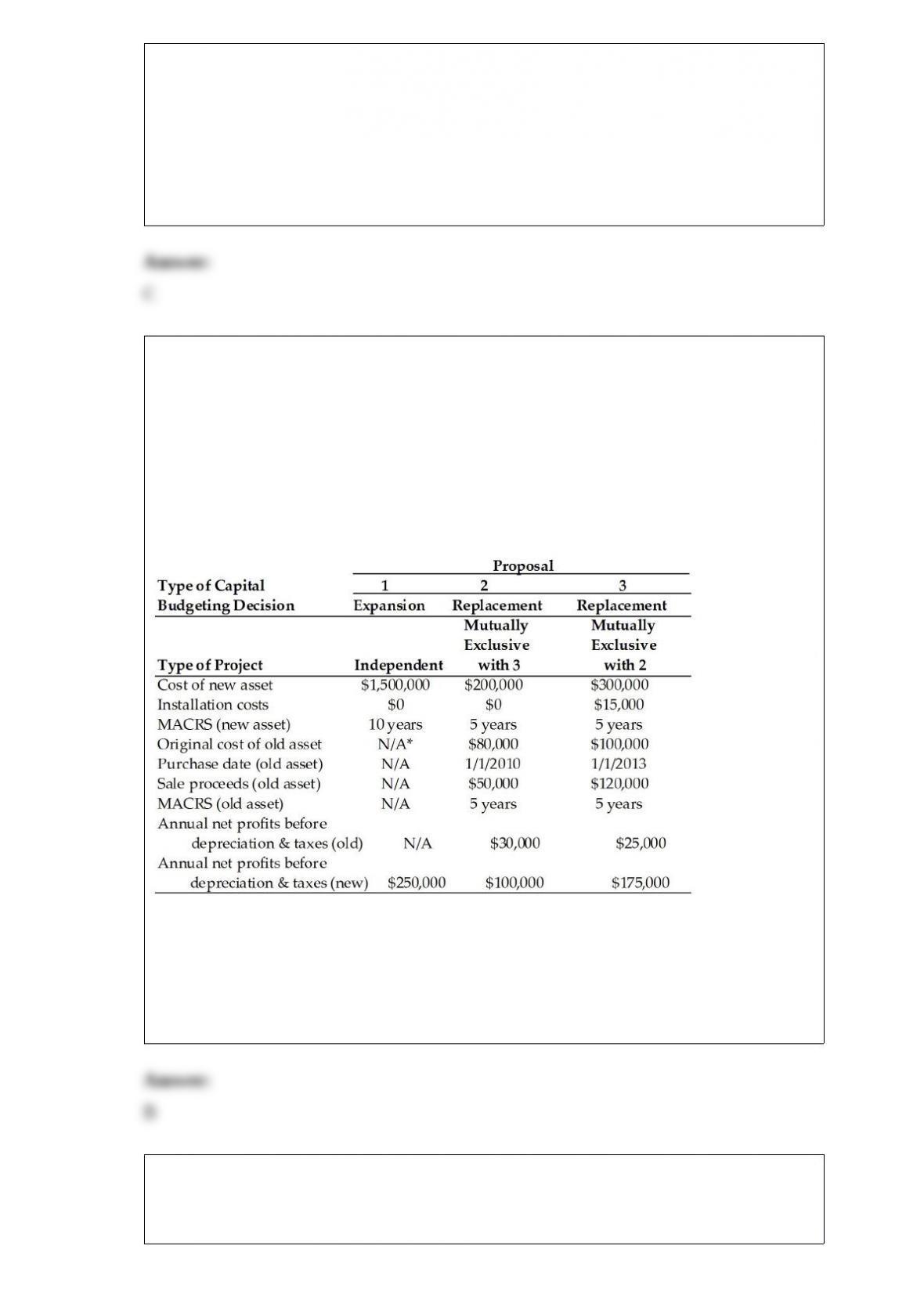
15) Table 11.2
Computer Disk Duplicators, Inc. has been considering several capital investment
proposals for the year beginning in 2014. For each investment proposal, the relevant
cash flows and other relevant financial data are summarized in the table below. In the
case of a replacement decision, the total installed cost of the equipment will be partially
offset by the sale of existing equipment. The firm is subject to a 40 percent tax rate on
ordinary income and on long-term capital gains. The firm’s cost of capital is 15 percent.
________________________________________________________
*Not applicable
For Proposal 2, the initial outlay equals ________. (See Table 11.2)
A) $120,720 cash outflow
B) $164,560 cash outflow
C) $150,000 cash outflow
D) $167,520 cash outflow
16) Utilizing past cost and expense ratios (percent-of-sales method) when preparing pro
forma financial statements will tend to ________.
A) understate profits when sales are decreasing and overstate profits when sales are

increasing
B) understate profits, no matter what the change in sales, as long as fixed costs are
present
C) understate profits when sales are increasing and overstate profits when sales are
decreasing
D) overstate profits, no matter what the change in sales, as long as fixed costs are
present
17) Find the solution to the following questions regarding convertible bonds.
(a)Calculate the conversion price for each of the following bonds.
A $1,000-par-value bond convertible into 25 shares of common stock.
A $1,000-par value bond convertible into 100 shares of common stock.
(b)Calculate the conversion ratio for each of the following bonds. A $1,000 par-value
bond convertible into common stock at $50 per share.
A $1,000 par-value bond convertible into common stock at $40 per share.
(c)Calculate the stock value for each of the following convertible bonds.
A $1,000 par-value bond convertible into common stock at $25 per share. The current
market price of the stock is $30 per share.
A $1,000 par-value bond convertible into 100 shares of common stock. The current
market price of the stock is $12 per share.
18) In calculating the cost of common stock equity, the model which describes the
relationship between the required return and the nondiversifiable risk of the firm is
________.
A) the constant-growth model
B) the NPV model
C) the variable growth model
D) the capital asset pricing model
19) Which of the following is true of common stock ?
A) It is often considered quasi-debt due to fixed payment obligation
B) It has less restrictive covenants than debt
C) It gives the holder voting rights which permit selection of the firm’s directors
D) Its holders have priority over preferred stockholders in the event of liquidation of
assets

20) Which of the following ratios is difficult for the creditors of a firm to analyze from
the published financial statements?
A) debt equity ratio
B) average payment period
C) quick ratio
D) total asset turnover
21) At year end, Tangshan China Company balance sheet showed total assets of $60
million, total liabilities (including preferred stock) of $45 million, and 1,000,000 shares
of common stock outstanding. Next year, Tangshan is projecting that it will have net
income of $1.5 million. If the average P/E multiple in Tangshan’s industry is 15, what
should be the price of Tangshan’s stock?
A) $15.00
B) $22.50
C) $52.50
D) $75.00
22) FASB Standard No. 13 requires explicit disclosure of ________ obligation on the
firm’s balance sheet.
A) an operating lease
B) a leveraged lease
C) a sale-leaseback
D) a capital lease
23) How long would it take for you to save an adequate amount for retirement if you
deposit $40,000 per year into an account beginning today that pays 12 percent per year
if you wish to have a total of $1,000,000 at retirement?
A) 12.2 years
B) 10.5 years
C) 14.8 years
D) 11.5 years
24) A wealthy art collector has decided to endow her favorite art museum by
establishing funds for an endowment which would provide the museum with
$1,000,000 per year for acquisitions into perpetuity. The art collector will give the
endowment upon her fiftieth birthday 10 years from today. She plans to accumulate the
endowment by making annual end-of-year deposits into an account. The rate of interest
is expected to be 6 percent in all future periods. How much must the art collector
deposit each year to accumulate to the required amount?
A) $1,575,333
B) $ 736,000
C) $1,264,466
D) $ 943,396
25) Which of the following would be the least likely to utilize a cash budget?
A) top management
B) middle management
C) public investors
D) lenders
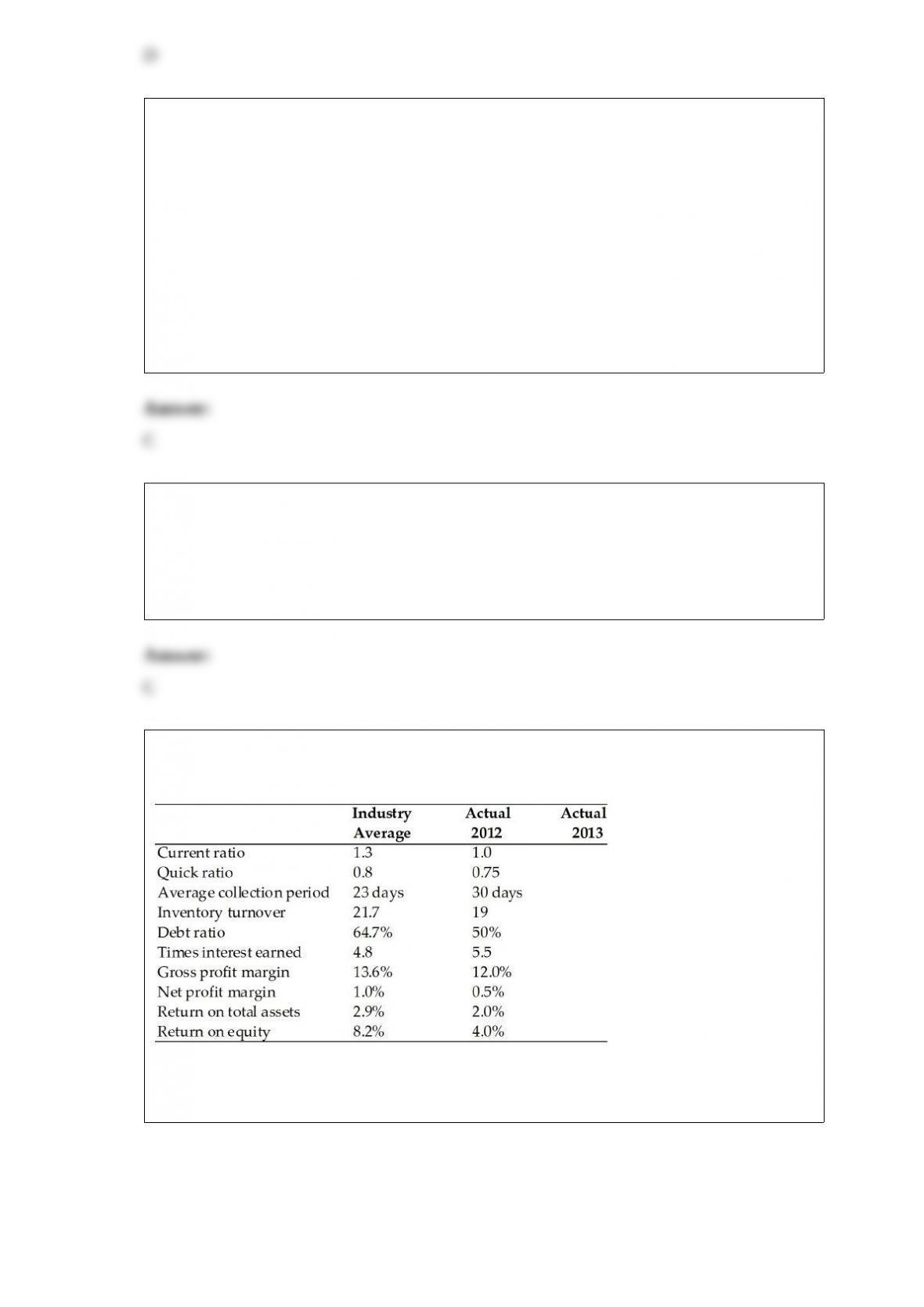
26) Table 3.2
Dana Dairy Products Key Ratios
Income Statement
Dana Dairy Products
For the Year Ended December 31, 2013
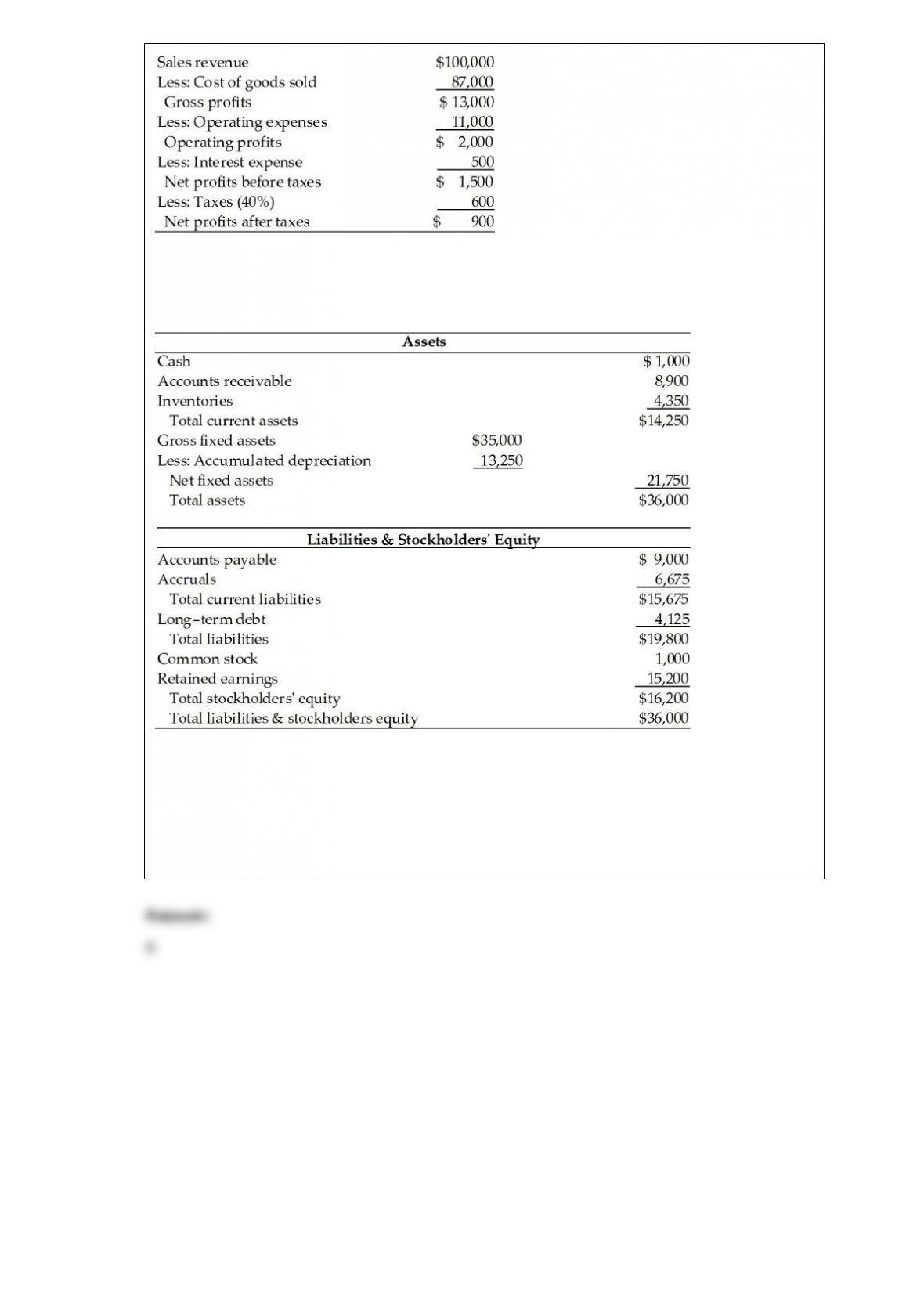
Balance Sheet
Dana Dairy Products
December 31, 2013
The gross profit margin and net profit margin for Dana Dairy Products in 2013 were
________. (See Table 3.2)
A) 13 percent and 0.9 percent, respectively
B) 13 percent and 1.5 percent, respectively
C) 2 percent and 0.9 percent, respectively
D) 2 percent and 1.5 percent, respectively