
1) Variable costs change in direct proportion to a change in the activity level.
2) Mismatched time periods isnot an issue in the collection of data for cost estimation.
3) Efficient or inefficient use of a specific component of variable overhead (e.g.,
electricity) will cause the firm to have a variable-overhead efficiency variance.
4) The relevant range is that range of activity where a company achieves its maximum
efficiency.
5) Controlling involves the coordination of daily business functions within an
organization.
6) Controlling involves the coordination of daily business functions within an
organization.
7) The extent to which an organization uses fixed costs in its cost structure is measured
by financial leverage.
8) Under- or overapplied manufacturing overhead at year-end is most commonly
charged or credited to Work-in-Process Inventory.
9) Mismatched time periods isnot an issue in the collection of data for cost estimation.
10) Measuring the performance of managers and subunits is not an objective of
managerial accounting.
11) Which of the following inventories would a discount retailer such as Wal-Mart
report as an asset?
A.Raw materials
B.Work in process
C.Finished goods
D.Merchandise inventory
E.All of the other answers are correct
12) Which of the following statements is true?
A.Product costs affect only the balance sheet
B.Product costs affect only the income statement
C.Period costs affect only the balance sheet
D.Neither product costs nor period costs affect the Statement of Retained Earnings.
This can also be a true statement if the period costs were prepaid (i.e., prepaid
advertising, depreciation)
13) Tri-County, Inc. is studying whether to expand operations by adding a new product
line. Which of the following choices correctly denotes the costs that should be
considered in this decision?

A.Choice A
B.Choice B
C.Choice C
D.Choice D
E.Choice E
14) The following data relate to product no. 33 of La Quinta Corporation:
Direct labor standard: 5 hours at $14 per hour
Direct labor used in production: 45,000 hours at a cost of $639,000
Manufacturing activity: 8,900 units completed
The direct-labor efficiency variance is:
A.$7,000F
B.$7,000U
C.$7,100F
D.$7,100U
E.None of the other answers are correct
15) The Sarbanes-Oxley Act:
A.arose because of several accounting scandals that rocked the public’s confidence in
published financial statements
B.was enacted, in part, to bring about reform in companies’ financial reporting
processes
C.has distinct guidelines for reporting on an organization’s internal control practices
D.contains provisions whereby the chief executive officer (CEO) and chief financial
officer (CFO) can be held criminally responsible if their firm’s financial statements are
found to be fraudulent in nature
E.all of the other answers are correct

16) When graphed, a typical fixed cost appears as:
A.a horizontal line
B.a vertical line
C.a u-shaped line
D.a diagonal line that slopes downward to the right
E.a diagonal line that slopes upward to the right
17) The book value of equipment currently owned by a company is an example of a (n):
A.future cost
B.differential cost
C.comparative cost
D.opportunity cost
E.sunk cost
18) Consider the following statements about companies that are involved with
international operations:
I. Budgeting for these firms is often very involved because of fluctuating values in
foreign currencies.
II. Multinational firms may encounter hyperinflationary economies.
III. Such organizations often face changing laws and political climates that affect
business activity.
Which of the above statements is (are) true?
A.I only
B.III only
C.I and II
D.II and III
E.I, II, and III
19) Scott, Inc., manufactures two products, Regular and Deluxe, and applies overhead
on the basis of direct labor hours. Anticipated overhead and direct labor time for the
upcoming accounting period are $1,600,000 and 25,000 hours, respectively.
Information about the company’s products follows.
Regular
Estimated production volume: 3,000 units
Direct materials cost: $28 per unit
Direct labor per unit: 3 hours at $15 per hour
Deluxe
Estimated production volume: 4,000 units
Direct materials cost: $42 per unit
Direct labor per unit: 4 hours at $15 per hour
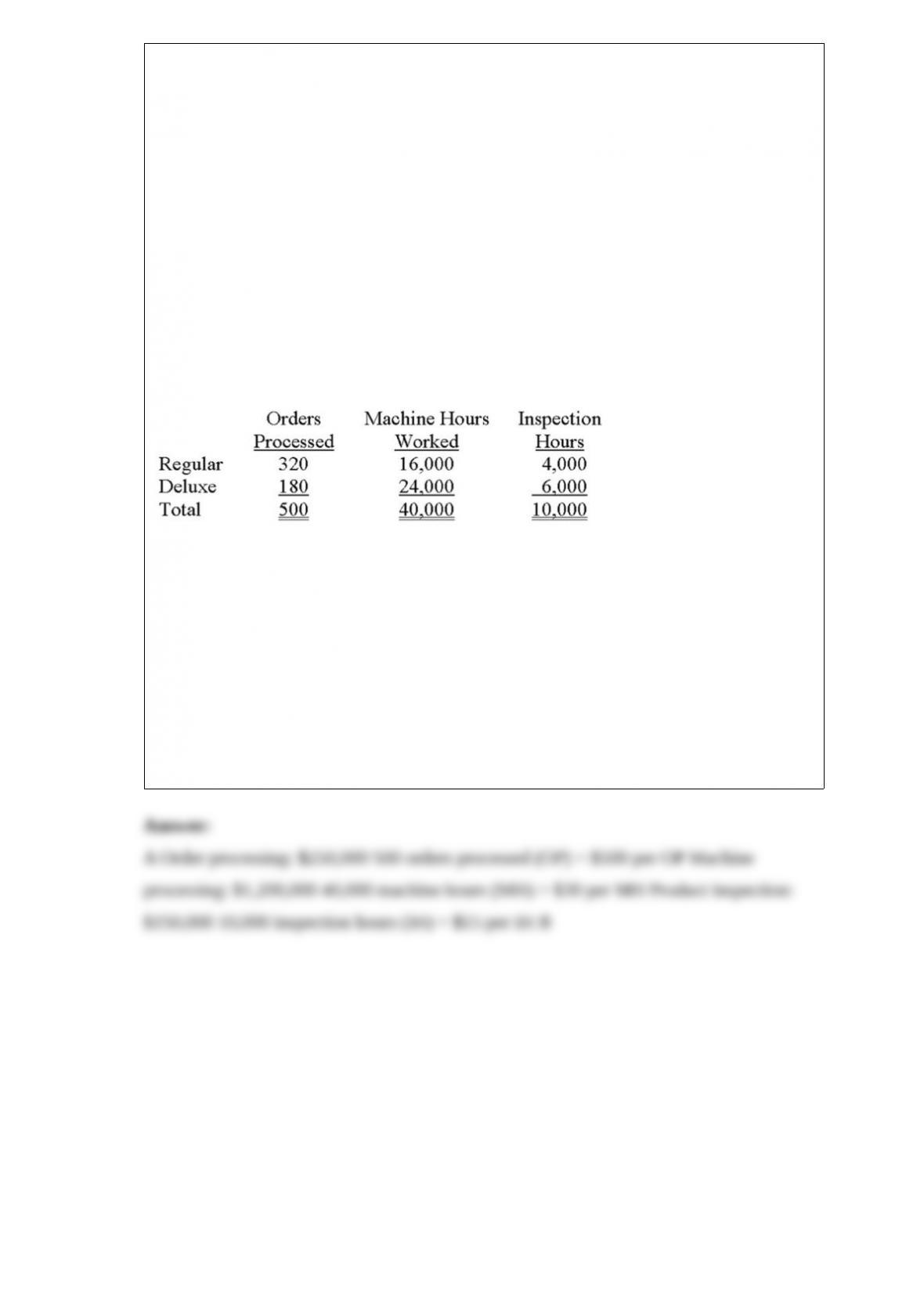
Scott’s overhead of $1,600,000 can be identified with three major activities: order
processing ($250,000), machine processing ($1,200,000), and product inspection
($150,000). These activities are driven by number of orders processed, machine hours
worked, and inspection hours, respectively. Data relevant to these activities follow.
Required:
A. Compute the pool rates that would be used for order processing, machine processing,
and product inspection in an activity-based costing system.
B. Assuming use of activity-based costing, compute the unit manufacturing costs of
Regular and Deluxe if the expected manufacturing volume is attained.
C. How much overhead would be applied to a unit of Regular and Deluxe if the
company used traditional costing and applied overhead solely on the basis of direct
labor hours? Which of the two products would be undercosted by this procedure?
Overcosted?
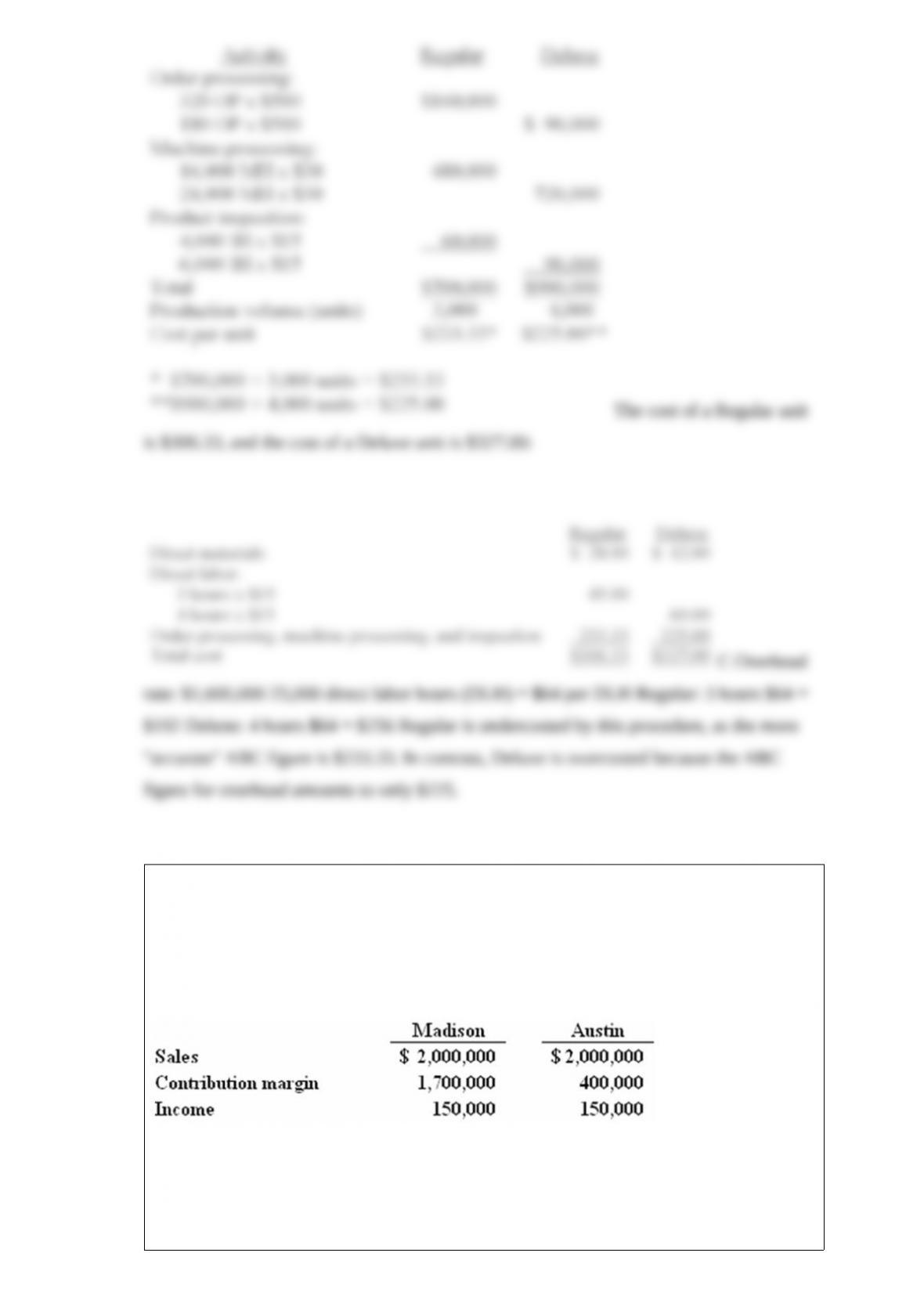
20) Once upon a time, two brothers (Barry and Larry) dreamt about owning and
operating companies in the same line of business. Barry believed in maintaining a very
large, highly efficient manual labor force; Larry, on the other hand, favored
automated-production processes. One business was located in Madison and the other
was located in Austin. Recent data follow.
Required:
A. Which of the two businesses, Madison or Austin, has the higher level of (1) variable
cost and (2) higher level of fixed cost? Explain how you determined your answer.

B. Determine the probable owner of the firm located in (1) Madison and (2) Austin.
Briefly explain your logic.
C. Compute the operating leverage factor for Madison and Austin.
D. Suppose that both Madison and Austin had the opportunity to increase sales by 10%.
Which of the two locations would experience a larger percentage change in net income?
Why?
21) Griswold, Inc., which uses a process-costing system, transfers completed
production from Department no. 1 to Department no. 2 for further work. Which of the
following best describes the account that would be debited to record this transfer?
A.Cost of Goods Transferred
B.Finished-Goods Inventory: Department no. 1
C.Finished-Goods Inventory: Department no. 2
D.Work-in-Process Inventory: Department no. 1
E.Work-in-Process Inventory: Department no. 2
22) Brooklyn sells a single product to wholesalers. The company’s budget for the
upcoming year revealed anticipated unit sales of 31,600, a selling price of $20, variable
cost per unit of $8, and total fixed costs of $360,000. If Brooklyn’s unit sales are 300
units more than anticipated, its break-even point will:
A.increase by $12 per unit sold
B.decrease by $12 per unit sold
C.increase by $8 per unit sold
D.decrease by $8 per unit sold
E.not change
23) Hunters, Inc. uses a standard cost system when accounting for its sole product.
Manufacturing overhead is applied to production on the basis of process hours. Planned
activity is 60,000 process hours per month, which gives rise to the following per-unit
standards:
Variable overhead: 13 hours at $15 per hour
Fixed overhead: 13 hours at $7 per hour
During September, 5,100 units were produced and the company incurred the following
overhead costs: variable, $942,500; fixed, $429,000. Actual process hours totaled
65,000 .
Required:
A. Calculate the spending and efficiency variances for variable overhead.
B. Calculate the budget and volume variances for fixed overhead.
24) Romano Corporation allocates administrative costs on the basis of staff hours.
Short-run monthly usage and anticipated long-run monthly usage of staff hours for
Operating Departments 1 and 2 follow.
If Romano uses dual-cost accounting procedures and fixed administrative costs total
$1,000,000, the amount of fixed administrative cost to allocate to Department 1 would
be:
A.$400,000
B.$450,000
C.$500,000
D.$850,000
E.None of the other answers are correct
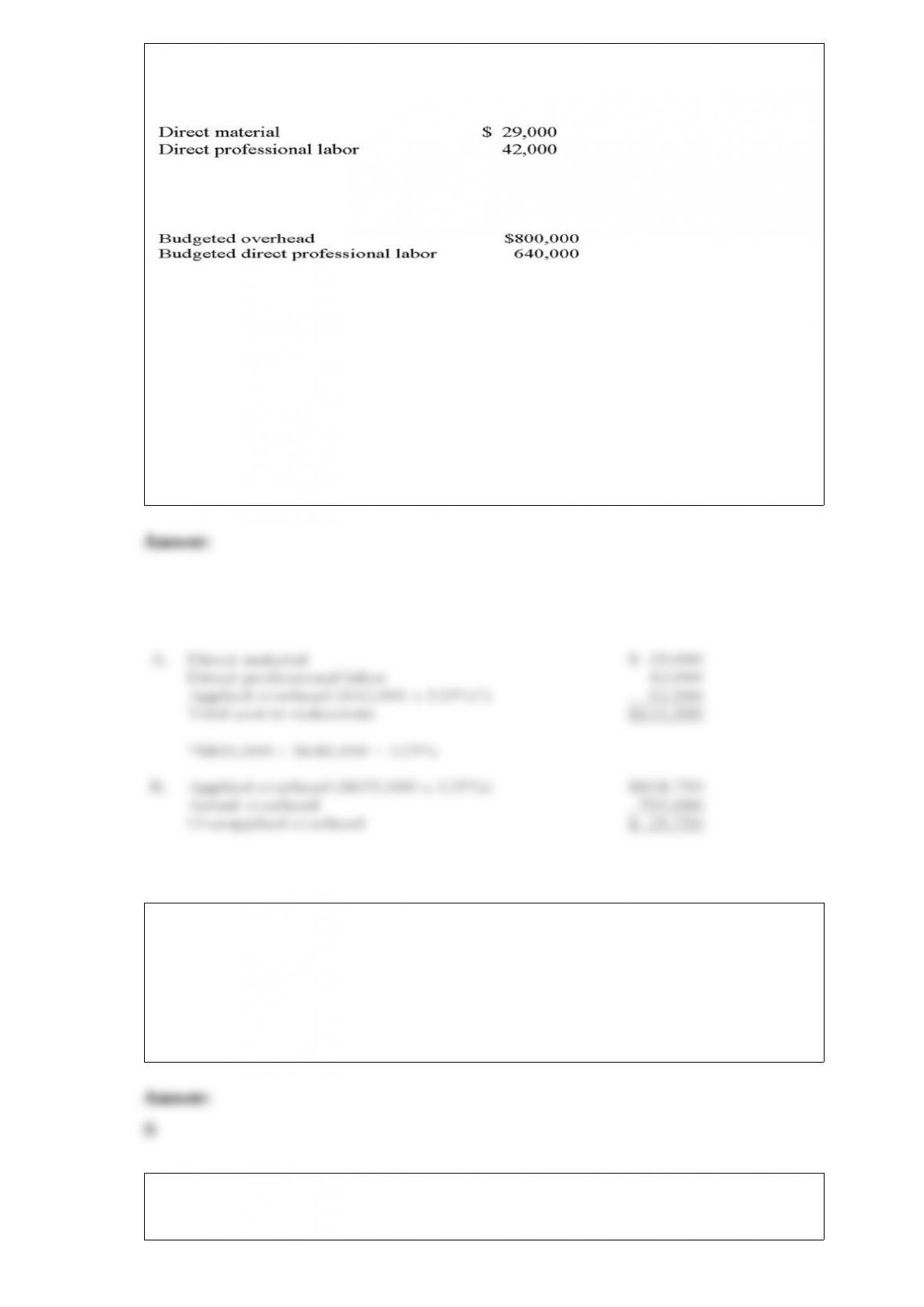
25) Finney & Associates is an interior decorating firm in Tucson. The following costs
were incurred in a project to redecorate the mayor’s offices:
The firm’s budget for the year included the following estimates:
Overhead is applied to contracts by using a predetermined overhead rate that is based
on direct professional labor cost. Actual professional labor during the year was
$655,000 and actual overhead was $793,000.
Required:
A. Determine the total cost to redecorate the mayor’s offices.
B. Calculate the under- or overapplied overhead for the year. Be sure to label your
answer.
26) Product costs are:
A.expensed when incurred
B.inventoried
C.treated in the same manner as period costs
D.treated in the same manner as advertising costs
E.subtracted from cost of goods sold
27) The primary difference between normalized and actual costing methods lies in the
determination of a job’s:
A.direct material costs
B.direct labor costs
C.manufacturing overhead costs
D.selling costs
E.administrative costs
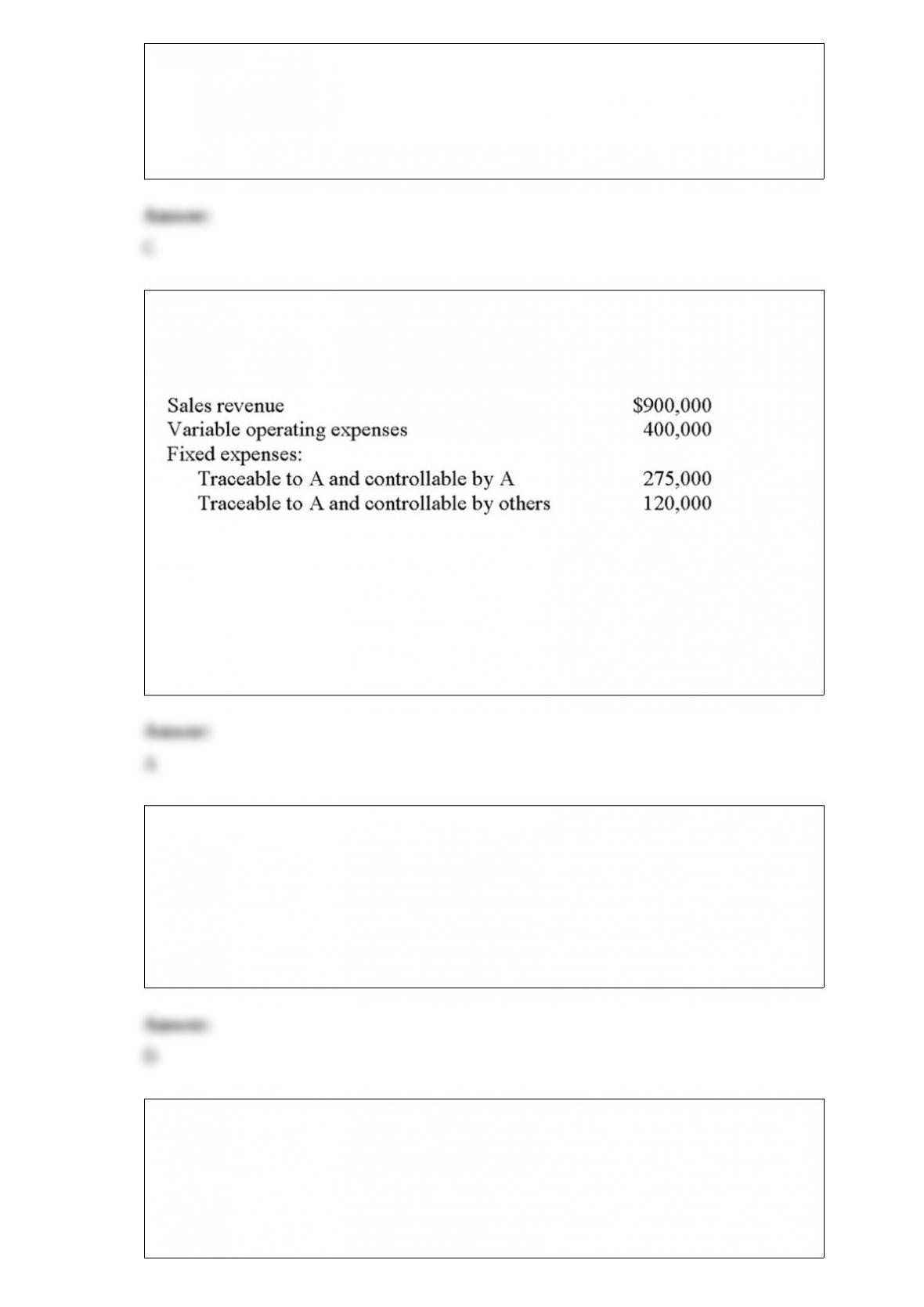
28) Tom’s Thumb Corporation operates two garden supply stores: A and B. The
following information relates to store A:
A’s segment profit margin is:
A.$105,000
B.$225,000
C.$380,000
D.$500,000
E.$505,000
29) When the quantity of materials purchased is not equal to the quantity of material
used, most companies base the calculation of the material quantity variance on the:
A.quantity of direct materials purchased
B.quantity of direct materials spoiled
C.quantity of direct materials that should have been used in achieving actual production
D.quantity of direct materials actually used
E.none of the other answers are correct
30) Which of the following statements about operation costing is(are) true?
I. Conversion costs are accumulated by department.
II. Direct material costs are accumulated by batch.
III. Operation costing is a hybrid product-costing system.
A.I only

B.I and II
C.I and III
D.II and III
E.I, II, and III
31) Dana, Inc. recently completed 56,000 units of a product that was expected to
consume four pounds of direct material per finished unit. The standard price of the
direct material was $8.50 per pound. If the firm purchased and consumed 228,000
pounds in manufacturing (cost = $1,881,000), the direct-material quantity variance
would be figured as:
A.$34,000U
B.$34,000F
C.$57,000U
D.$57,000F
E.none of the other answers are correct
32) At a volume of 20,000 units, Dries reported sales revenues of $1,000,000, variable
costs of $300,000, and fixed costs of $260,000. The company’s contribution margin per
unit is:
A.$22
B.$28
C.$35
D.$37
E.None of the other answers is correct
33) Shortly after being hired as an analyst with Harbor Rentals in upstate New York,
Raul Gomez was asked to prepare a report that focused on the company’s order
processing costsa cost driven largely by the number of rental invoices written. Raul
knew that he could use several different tools to analyze cost behavior, including scatter
diagrams, least-squares regression, and the high-low method. In addition, he knew that
he could present the results of his analysis in the form of algebraic equations. Those
equations follow.
Scatter diagram: OP = $56,000 + $6.80RI
Least-squares regression: OP = $59,000 + $6.75RI
High-low method: OP = $53,500 + $7.25RI
where OP = total order processing costs and RI = number of rental invoices written
Raul had analyzed data over the past 12 months and built equations based on these data,
purposely including the slowest month of the year and the busiest month so that things
would ” tend to even out.” He observed that February was especially slow because of a
paralyzing blizzard, one that forced the company to close for four days.
Required:
A. Will scatter diagrams, least-squares regression, and the high-low method normally
result in the same equation? Why?
B. Assuming the use of least-squares regression, explain what the $59,000 and $6.75
figures represent.
C. Assuming the use of a scatter diagram, predict the order processing cost of an
upcoming month when Harbor expects to write 2,500 rental invoices.
D. Did Raul err in constructing the equations on data of the past 12 months? Briefly
discuss. If “yes,” determine which of the three tools is likely to be affected the most and
explain why.
34) Consider the following statements about budgetary slack:
I. Managers build slack into a budget so that they stand a greater chance of receiving
favorable performance evaluations.
II. Budgetary slack is used by managers to guard against uncertainty and unforeseen
events.
III. Budgetary slack is used by managers to guard against dollar cuts by top
management in the resource allocation process.
Which of the above statements is (are) true?
A.I only
B.II only
C.I and II
D.II and III
E.I, II, and III
35) Holbrook Corporation is developing departmental overhead rates based on direct
labor hours for its two production departments, Molding and Assembly. The Molding
Department worked 20,000 hours during the period just ended, and the Assembly
Department worked 40,000 hours. The overhead costs incurred by Molding and
Assembly were $151,250 and $440,750, respectively.
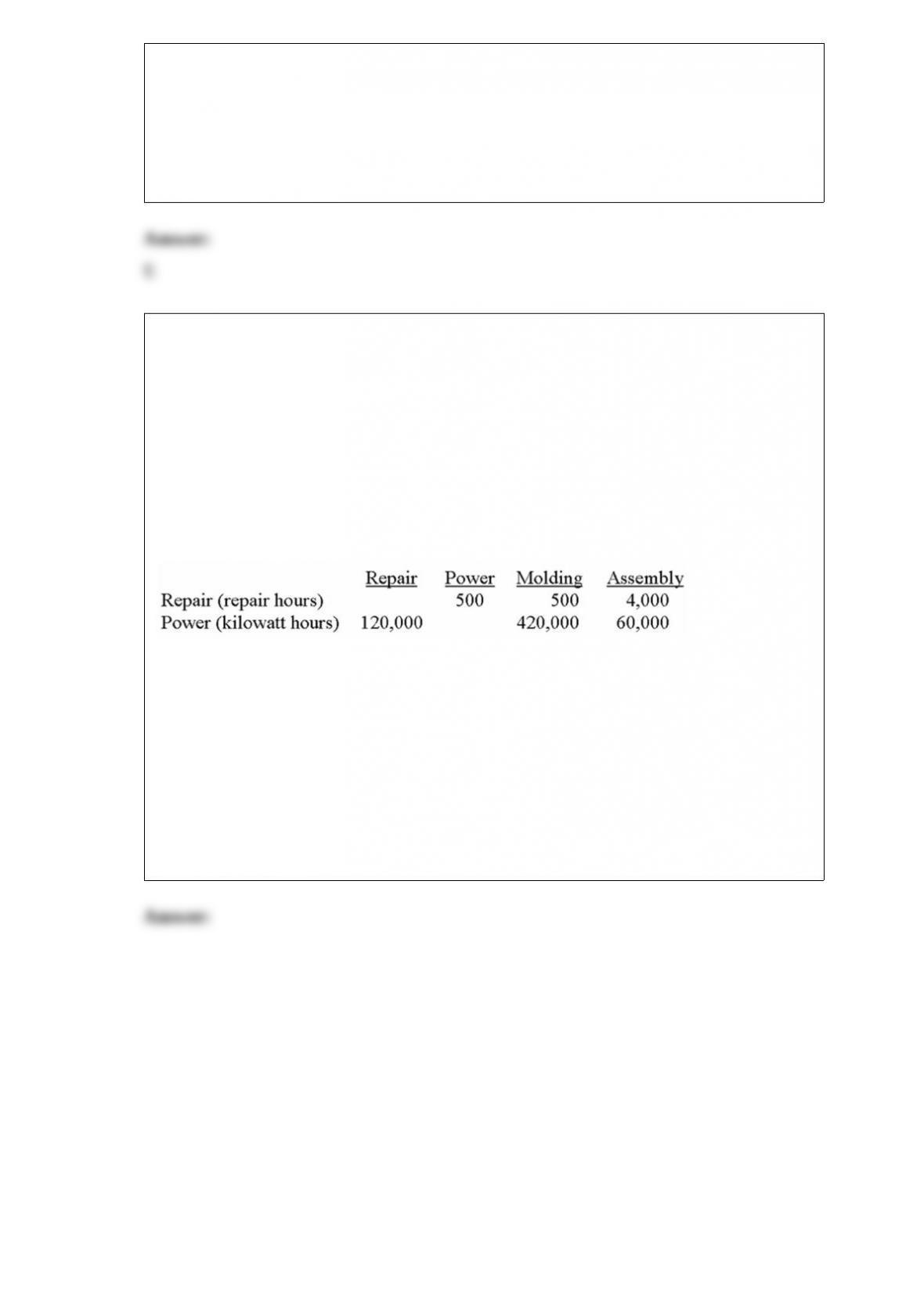
Two service departments, Repair and Power, directly support the two production
departments. These service departments have costs of $90,000 and $250,000,
respectively. The following schedule reflects the use of Repair and Power’s output by
the various departments:
Required:
A. Allocate the company’s service department costs to production departments by using
the direct method.
B. Calculate the overhead application rates of the production departments. Hint:
Consider both directly traceable and allocated overhead when deriving your answer.
C. Allocate the company’s service department costs to production departments by using
the step-down method. Begin with the Power Department, and round calculations to the
nearest dollar.
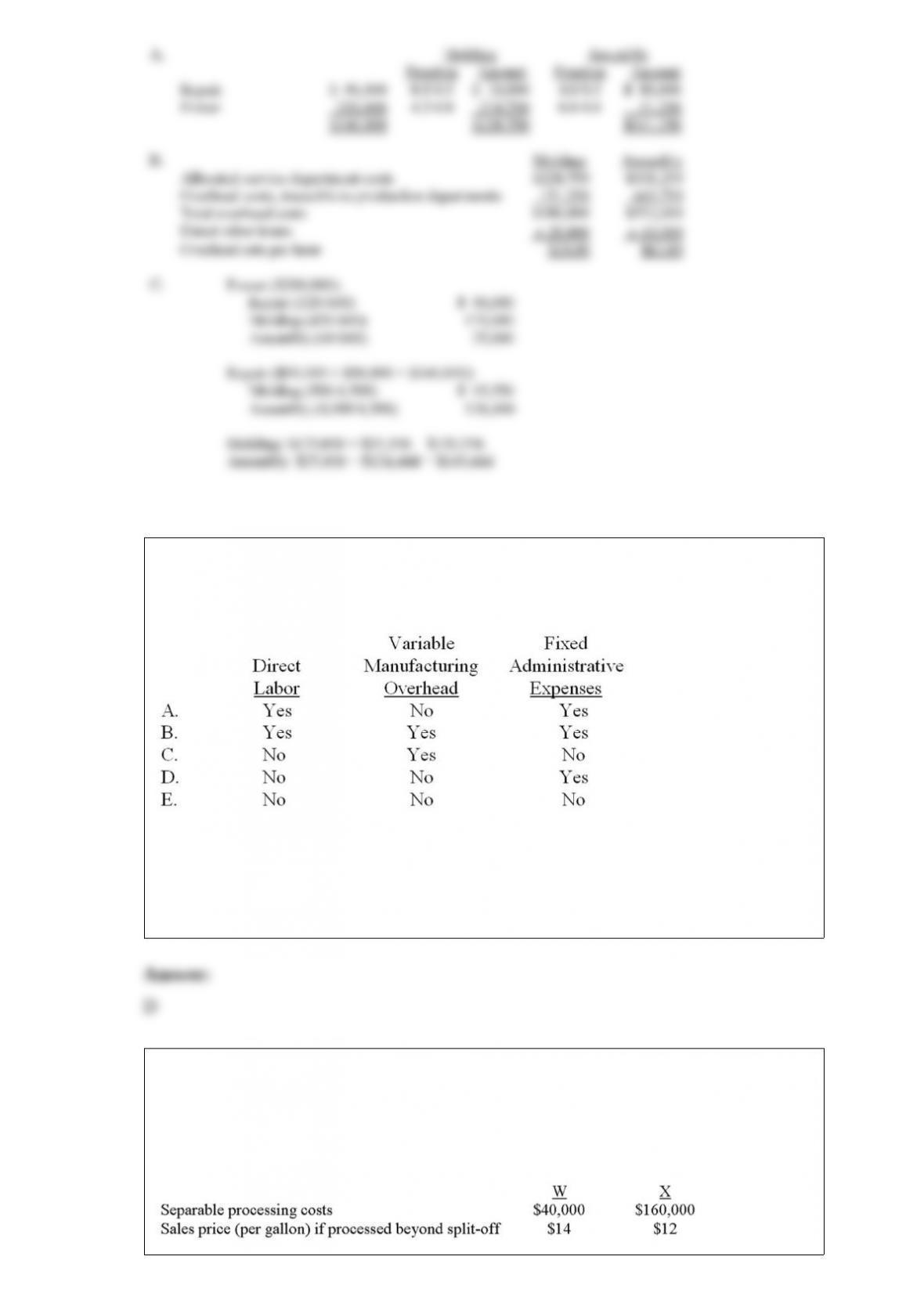
36) Which of the following costs would be treated differently under absorption costing
and variable costing?
A.Choice A
B.Choice B
C.Choice C
D.Choice D
E.Choice E
37) Christiansen Corporation manufactures joint products W and X. During a recent
period, joint costs amounted to $300,000 in the production of 20,000 gallons of W and
60,000 gallons of X. Both products will be processed beyond the split-off point, giving
rise to the following data:
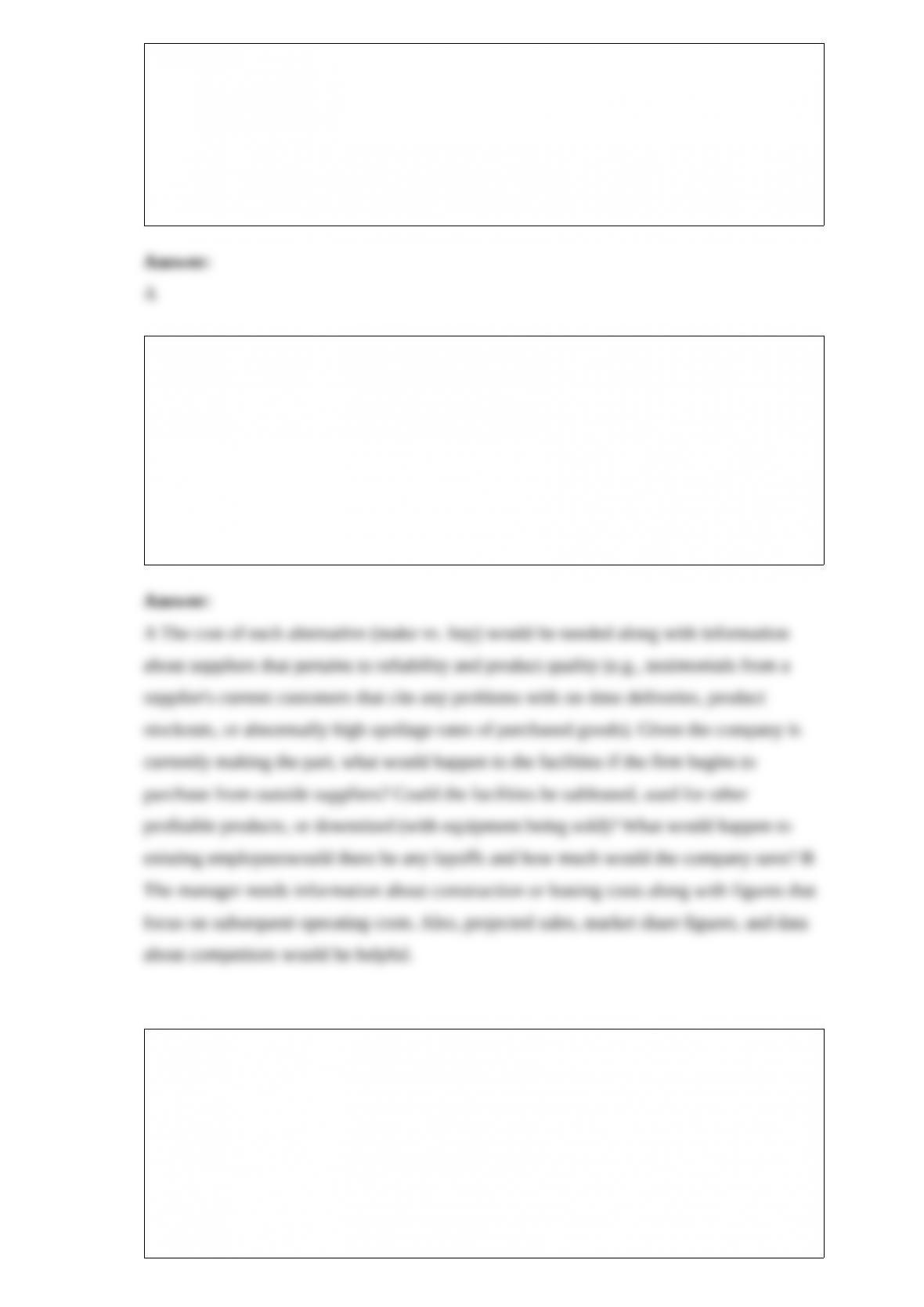
The joint cost allocated to X under the net-realizable-value method would be:
A.$210,000
B.$180,000
C.$184,000
D.$190,000
E.None of the other answers are correct
38) Present several examples of managerial accounting information that could help a
manager make each of the following decisions:
A. A manufacturing company is currently making a part that is a production headache.
The firm is deciding whether to abandon production and buy the part from an outside
supplier.
B. An operator of fast-food restaurants is deciding whether to open a new store in
Dallas.
Note: Many correct answers are possible.
39) A review of a company’s Work-in-Process Inventory account found a debit for
materials of $67,000. If all procedures were performed in the correct manner, this
means that the firm:
A.also recorded a credit to Raw-Material Inventory
B.also recorded a credit to Manufacturing Supplies Inventory
C.was accounting for the usage of direct materials
D.was accounting for the usage of indirect materials
E.also recorded a credit to Raw-Material Inventory and was accounting for the usage of
direct materials

40) Which of the following methods recognizes some (but not all) of the services that
occur between service departments?
A.Direct method
B.Step-down method
C.Indirect method
D.Reciprocal method
E.Dual-cost allocation method
41) Consider the following statements about the accounting for inflation in a capital
budgeting analysis:
I. An analyst can use nominal dollars in conjunction with a nominal interest rate.
II. An analyst can use real dollars in conjunction with a real interest rate.
III. An analyst can use nominal dollars in conjunction with a real interest rate.
Which of the above statements is (are) correct?
A.I only
B.II only
C.III only
D.I and II
E.II and III
42) Wilmar Corporation is budgeting its equipment needs on an on-going basis, with a
new quarter being added to the budget as the current quarter is completed. This type of
budget is most commonly known as a:
A.capital budget
B.rolling budget
C.revised budget
D.pro-forma budget
E.financial budget
43) One element of the general transfer-pricing rule is opportunity cost. Briefly define
the term “opportunity cost” and then explain how it is computed for (1) companies that
have excess capacity and (2) companies that have no excess capacity.
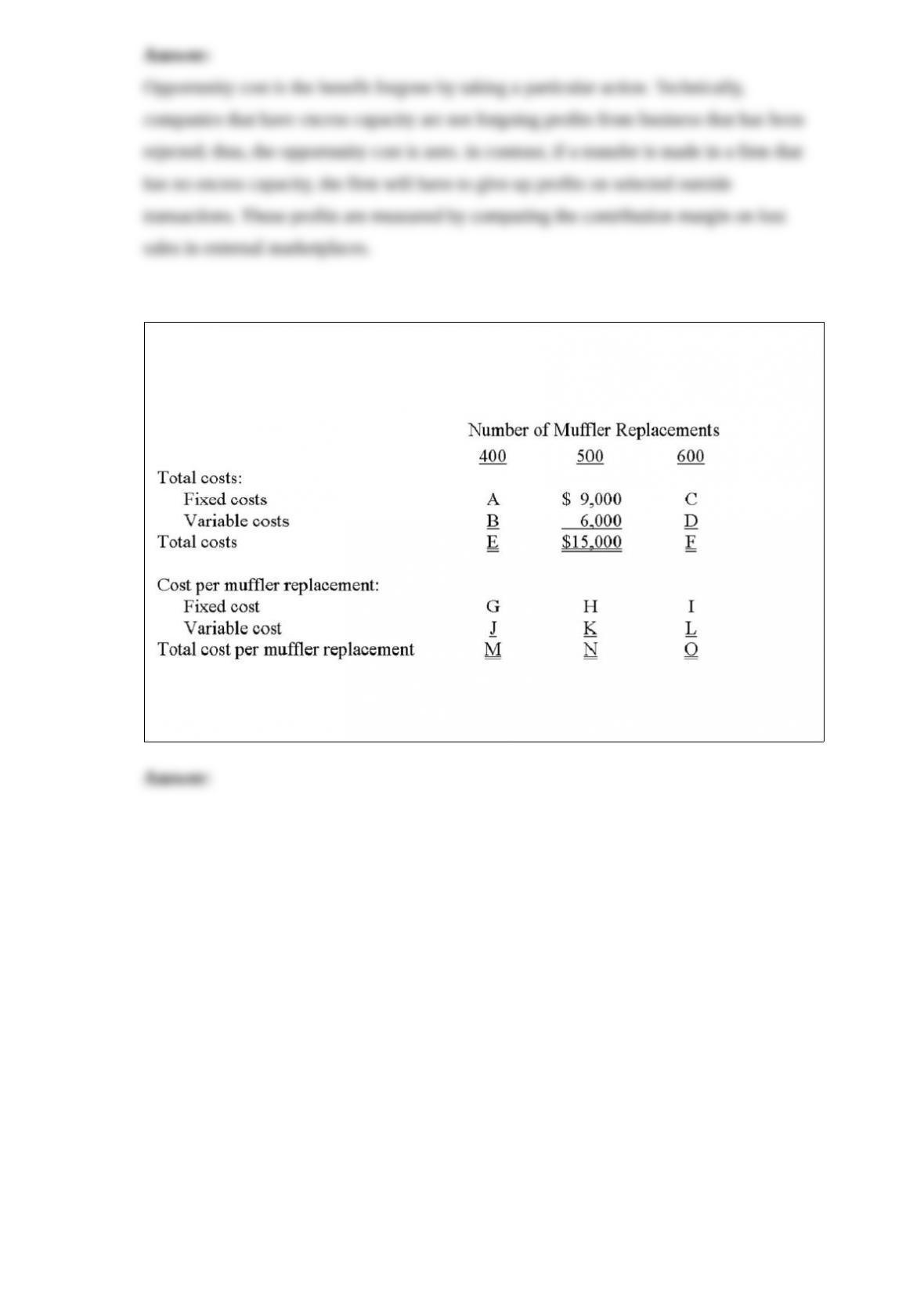
44) Aurora Muffler, Inc. operates an automobile service facility. The table below shows
the cost incurred during a month when 500 mufflers were replaced.
Required:
Fill in the missing amounts, labeled A through O, in the table above.
45) Goldstone Company is studying the impact of the following:
1> An increase in sales price on the break-even point.
2> A decrease in fixed costs on the contribution margin.
3> An increase in the contribution margin on the break-even point.
4> A decrease in the variable cost per unit on the sales volume needed to achieve
Goldstone’s $68,000 target profit.
5> An increase in sales commissions on the contribution margin and the break-even
point.
6> A decrease in anticipated advertising outlays on fixed cost and the break-even point.
Required:
Determine the impact of these operating changes (increase, decrease, no effect) on the
item(s) noted.
46) Both the visual-fit and high-low methods of cost estimation have inherent
limitations. Briefly identify the major deficiency associated with each method.
47) You are reviewing some material that deals with investment analysis, preparing for
your first day on the job at Giambelluca Enterprises. Consider the cash flows that
follow.
1> The immediate payment required to purchase a $600,000 milling machine.
2> Straight-line depreciation of $20,000 in year 2 of a long-term investment.
3> Annual savings in cash operating costs of $50,000 over the next eight years.
4> Sale of a machine for $35,000 at the end of its six-year service life. The machine has
a book value of $25,000.
5> A $6,000 equipment overhaul in year 5 that is fully deductible for income tax
purposes.
Required:
Calculate the discounted cash flow that is appropriate for each of the preceding items.
Assume a 10% after-tax hurdle rate and a 30% income tax rate, and round to the nearest
dollar.