
The dividend yield on a stock will increase if the:
A. dividend growth rate decreases.
B. stock price decreases.
C. capital gains rate decreases.
D. stock price increases.
E. tax rate on dividends increases.
Leisure Products has sales of $738,800, cost of goods sold of $598,200, and accounts
receivable of $86,700. How long on average does it take the firm’s customers to pay for
their purchases? Assume a 365-day year.
A. 8.65 days
B. 11.28 days
C. 25.01 days
D. 42.83 days
E. 45.33 days
The tax rate that determines the amount of tax that will be due on the next dollar of
taxable income earned is called the:
A. average tax rate.
B. variable tax rate.
C. marginal tax rate.
D. fixed tax rate.
E. ordinary tax rate.
A portfolio is comprised of 35 securities with varying betas. The lowest beta for an
individual security is .74 and the highest of the security betas of 1.51. Given this
information, you know that the portfolio beta:
A. must be 1.0 because of the large number of securities in the portfolio.
B. is the geometric average of the individual security betas.
C. must be less than the market beta.
D. will be between 0 and 1.0.
E. will be greater than or equal to .74 but less than or equal to 1.51.

Weston Mines has a cost of equity of 14.9 percent, a pretax cost of debt of 7.3 percent,
and a return on assets of 12.6 percent. Ignore taxes. What is the debt-equity ratio?
A. .52
B. .84
C. .43
D. .77
E. .56
Suenette plans to save $600 at the end of Year 1, $800 at the end of Year 2, and $1,000
at the end of Year 3. If she earns 3.4 percent on her savings, how much money will she
have saved at the end of Year 3?
A. $2,200.00
B. $2,238.47
C. $2,468.69
D. $2,309.16
E. $2,402.19
S&W has 21,000 shares of common stock outstanding at a price of $29 a share. It also
has 2,000 shares of preferred stock outstanding at a price of $71 a share. The firm has 7
percent, 12-year bonds outstanding with a total market value of $386,000. The bonds
are currently quoted at 100.6 percent of face and pay interest semiannually. What is the
capital structure weight of the firm’s preferred stock if the tax rate is 34 percent?
A. 12.49 percent
B. 9.00 percent
C. 8.24 percent
D. 11.84 percent
E. 13.63 percent
Suppose the Swiss franc exchange rate is SF.9703 = $1, and the euro exchange rate is
€.8024 = $1. What is the cross-rate in terms of Swiss francs per euro?
A. SF.7692/€1
B. SF.7786/€1
C. SF1.1054/€1
D. SF1.1832/€1
E. SF1.2092/€1
For a risky security to have a positive expected return but less risk than the overall
market, the security must have a beta:
A. of zero.
B. that is > 0 but < 1.
C. of one.
D. that is > 1.
E. that is infinite.
A private placement is most apt to involve:
A. a large number of private investors.
B. only foreign investors.
C. a life-insurance company.
D. several private securities dealers.
E. the U.S. Treasury department.

Scenario analysis asks questions such as:
A. How will changing the number of units sold affect the outcome of this project?
B. What is the best outcome that should reasonably be expected?
C. How much will a $1 increase in the variable cost per unit change the net present
value?
D. Will the net present value increase or decrease if the quantity sold increases by 100
units?
E. How will the operating cash flow change if the depreciation method is changed?
Julie wants to create a $5,000 portfolio. She also wants to invest as much as possible in
a high risk stock with the hope of earning a high rate of return. However, she wants her
portfolio to have no more risk than the overall market. Which one of the following
portfolios is most apt to meet all of her objectives?
A. Invest the entire $5,000 in a stock with a beta of 1.0
B. Invest $2,500 in a stock with a beta of 1.98 and $2,500 in a stock with a beta of 1.0
C. Invest $2,500 in a risk-free asset and $2,500 in a stock with a beta of 2.0
D. Invest $2,500 in a stock with a beta of 1.0, $1,250 in a risk-free asset, and $1,250 in
a stock with a beta of 2.0
E. Invest $2,000 in a stock with a beta of 3, $2,000 in a risk-free asset, and $1,000 in a
stock with a beta of 1.0
Which one of the following reduces the number of shares outstanding but does not
decrease the value of owners’ equity?
A. Stock repurchase
B. Stock split
C. Reverse stock split
D. Cash distribution
E. Liquidating dividend

A sole proprietorship:
A. provides limited financial liability for its owner.
B. involves significant legal costs during the formation process.
C. has an unlimited life.
D. has its profits taxed as personal income.
E. can generally raise significant capital from non-owner sources.
Bermuda Cruises issues only common stock and coupon bonds. The firm has a
debt-equity ratio of .45. The cost of equity is 17.6 percent and the pretax cost of debt is
8.9 percent. What is the capital structure weight of the firm’s equity if the firm’s tax rate
is 35 percent?
A. 66.75 percent
B. 49.97 percent
C. 52.93 percent
D. 59.08 percent
E. 68.97 percent
EKG, Inc. is considering a new project that will require an initial cash investment of
$419,000. The project will produce no cash flows for the first two years. The projected
cash flows for Years 3 through 7 are $69,000, $98,000, $109,000, $145,000, and
$165,000, respectively. How long will it take the firm to recover its initial investment in
this project?
A. 3.81 years
B. 3.98 years
C. 5.57 years
D. 5.99 years
E. The project never pays back.
You are considering an equipment purchase costing $167,000. This equipment will be
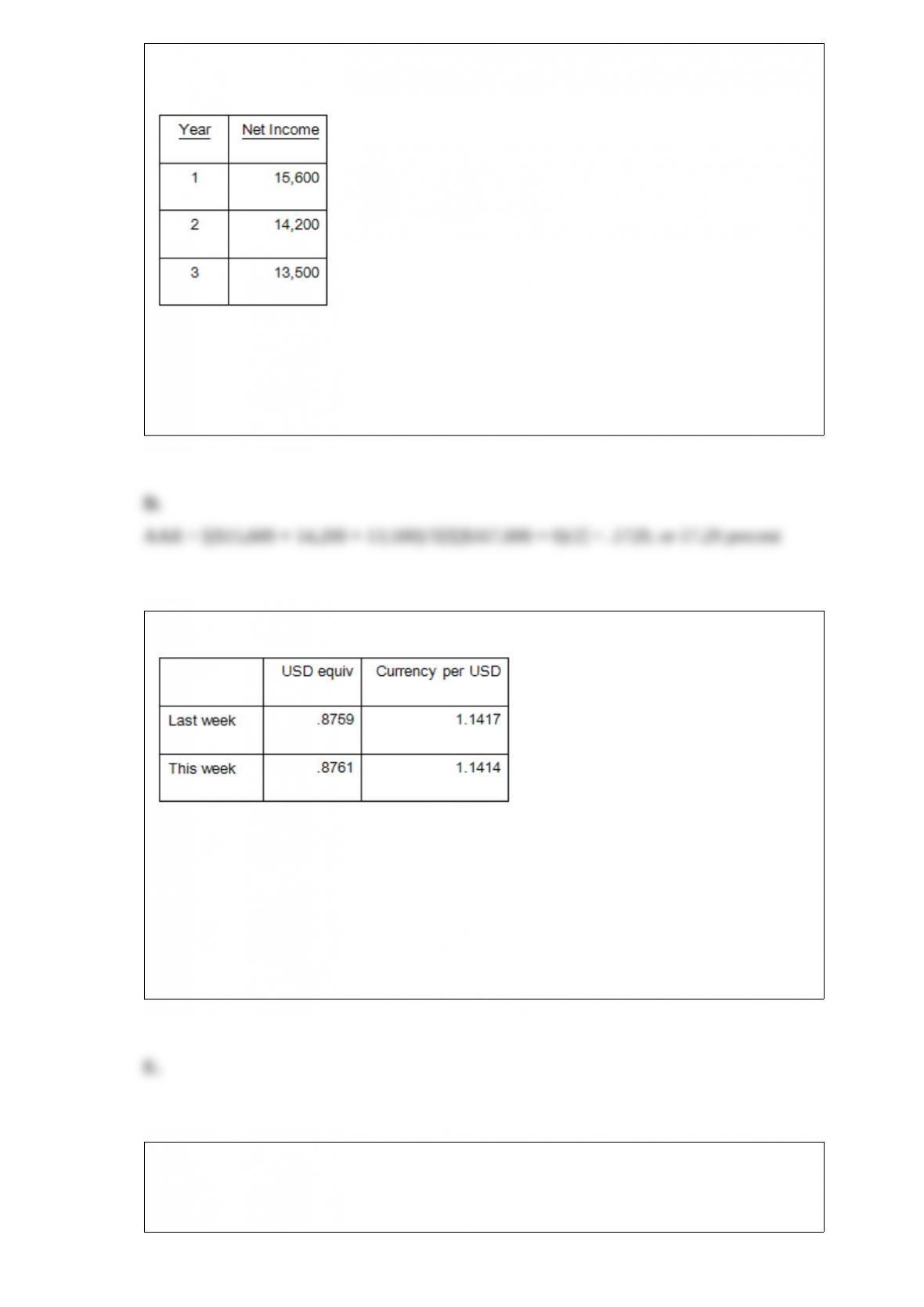
depreciated straight-line to zero over its three-year life. What is the average accounting
return if this equipment produces the following net income?
A. 18.29 percent
B. 18.38 percent
C. 15.67 percent
D. 17.29 percent
E. 16.67 percent
Assume the exchange rates for the Canadian dollar versus the U.S. dollar are:
Which statement is correct given this information?
A. Last week, it took C$.8759 to purchase $1.
B. This week you can exchange C$1 for $1.1414.
C. It is cheaper for an American to travel in Canada this week than it was last week.
D. The Canadian dollar depreciated from last week to this week.
E. You would have made a profit if you had invested $100 in Canadian dollars last
week and then converted your money back to U.S. dollars this week. Ignore any interest
earnings.
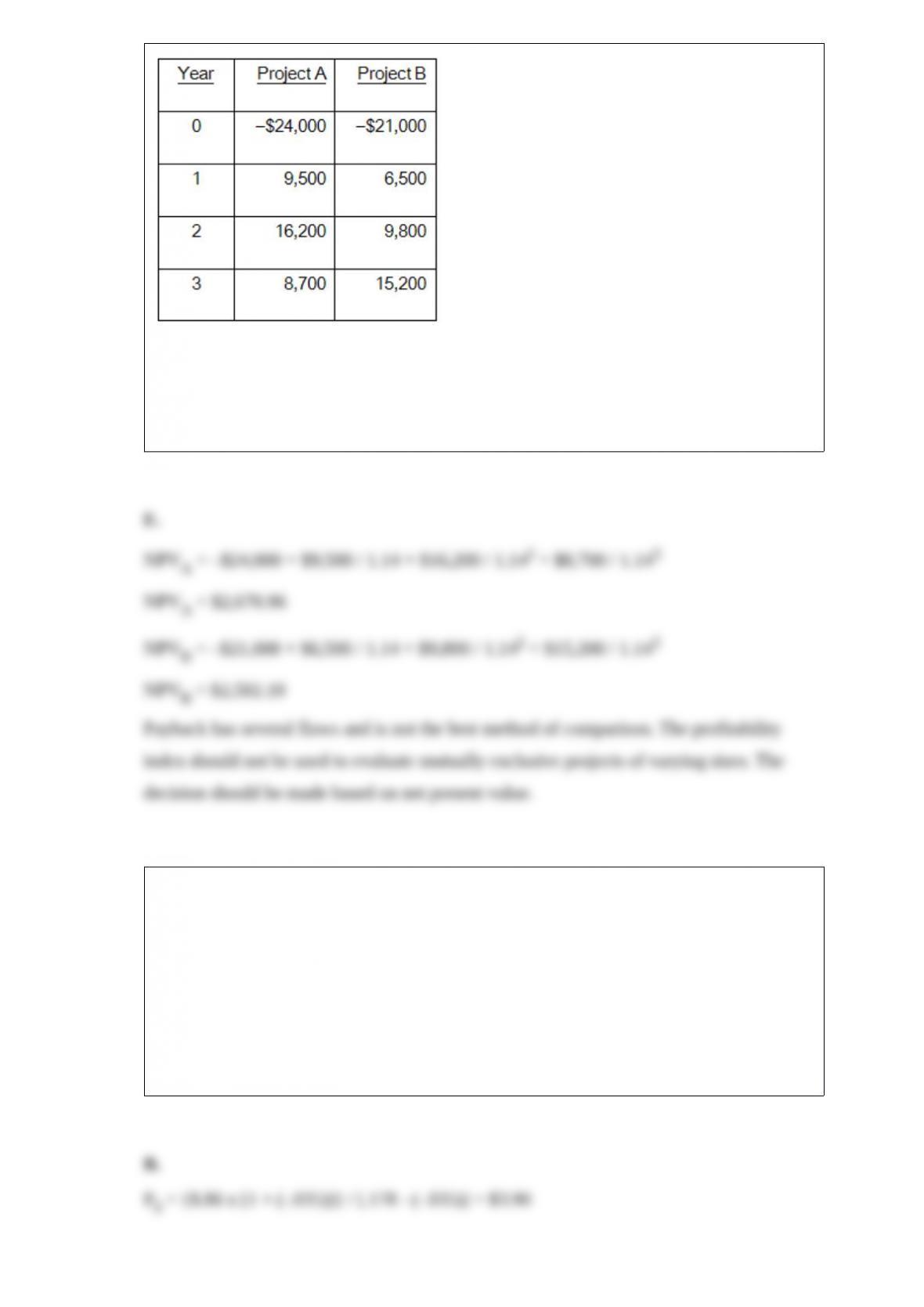
You are considering the following two mutually exclusive projects. The required return
on each project is 14 percent. Which project should you accept and what is the best
reason for that decision?
A. Project A; because it pays back faster
B. Project A; because it has the higher profitability index
C. Project B; because it has the higher profitability index
D. Project B; because it has the higher net present value
E. Project A; because it has the higher net present value
Horseshoe Stables is losing significant market share and thus its managers have decided
to decrease the firm’s annual dividend. The last annual dividend was $.86 a share but all
future dividends will be decreased by 3.5 percent annually. What is a share of this stock
worth today at a required return of 17.8 percent?
A. $3.06
B. $3.90
C. $3.41
D. $3.59
E. $3.95

There are two open seats on the board of directors. If two separate votes occur to elect
the new directors, the firm is using a type of voting that is best described as _____
voting.
A. simultaneous
B. straight
C. proxy
D. cumulative
E. sequential
Which one of the following is an implication of M&M Proposition II without taxes?
A. A firm’s optimal capital structure is 100 percent debt.
B. WACC is unaffected by the capital structure of a firm.
C. WACC decreases as the debt-equity ratio increases.
D. A firm’s capital structure is irrelevant.
E. The risk of equity is affected by both financial and operating leverage.
During the past year, ABC stock has sold for as little as $19 a share and a much as $33
a share. Which one of the following terms applies to these prices?
A. Benchmark values
B. Price splits
C. Price dividers
D. Split range
E. Trading range
Glass Growers has a cost of capital of 11.1 percent. The company is considering
converting to a debt-equity ratio of .46. The interest rate on debt is7.3 percent. What
would be the company’s new cost of equity? Ignore taxes.
A. 12.85 percent
B. 11.13 percent
C. 12.36 percent
D. 12.44 percent
E. 11.61 percent
The expected return on a security is not affected by the:
A. security’s unique risks.
B. risk-free rate.
C. security’s risk premium.
D. security’s beta.
E. market rate of return.
A debt-free firm has net income of $107,400, taxes of $38,700, and depreciation of
$19,300. What is the operating cash flow?
A. $88,000
B. $123,500
C. $127,100
D. $126,700
E. $118,900
M&M Proposition II, without taxes, states that the:
A. capital structure of a firm is highly relevant.
B. weighted average cost of capital decreases as the debt-equity ratio decreases.
C. cost of equity increases as a firm increases its debt-equity ratio.
D. return on equity is equal to the return on assets multiplied by the debt-equity ratio.
E. return on equity remains constant as the debt-equity ratio increases.
Which one of the following is a capital structure decision?

A. Determining the optimal inventory level
B. Establishing the preferred debt-equity level
C. Selecting new equipment to purchase
D. Setting the terms of sale for credit sales
E. Determining when suppliers should be paid
A pro forma financial statement is a financial statement that:
A. expresses all values as a percentage of either total assets or total sales.
B. compares actual results to the budgeted amounts.
C. compares the performance of a firm to its industry.
D. projects future years’ operating results.
E. values all assets based on their current market values.
Tower Pharmacy pays out a fixed percentage of its net income to its shareholders in the
form of annual dividends. Given this, the percentage shown on a common-size income
statement for the dividend account will:
A. remain constant over time.
B. be equal to the dividend amount divided by the net income.
C. vary in direct relation to the net profit percentage.
D. vary in direct relation to changes in the sales level.
E. vary but not in direct relation to any other variable.
Which one of the following is the primary advantage of payback analysis?
A. Incorporation of the time value of money concept
B. Ease of use
C. Research and development bias
D. Arbitrary cutoff point
E. Long-term bias
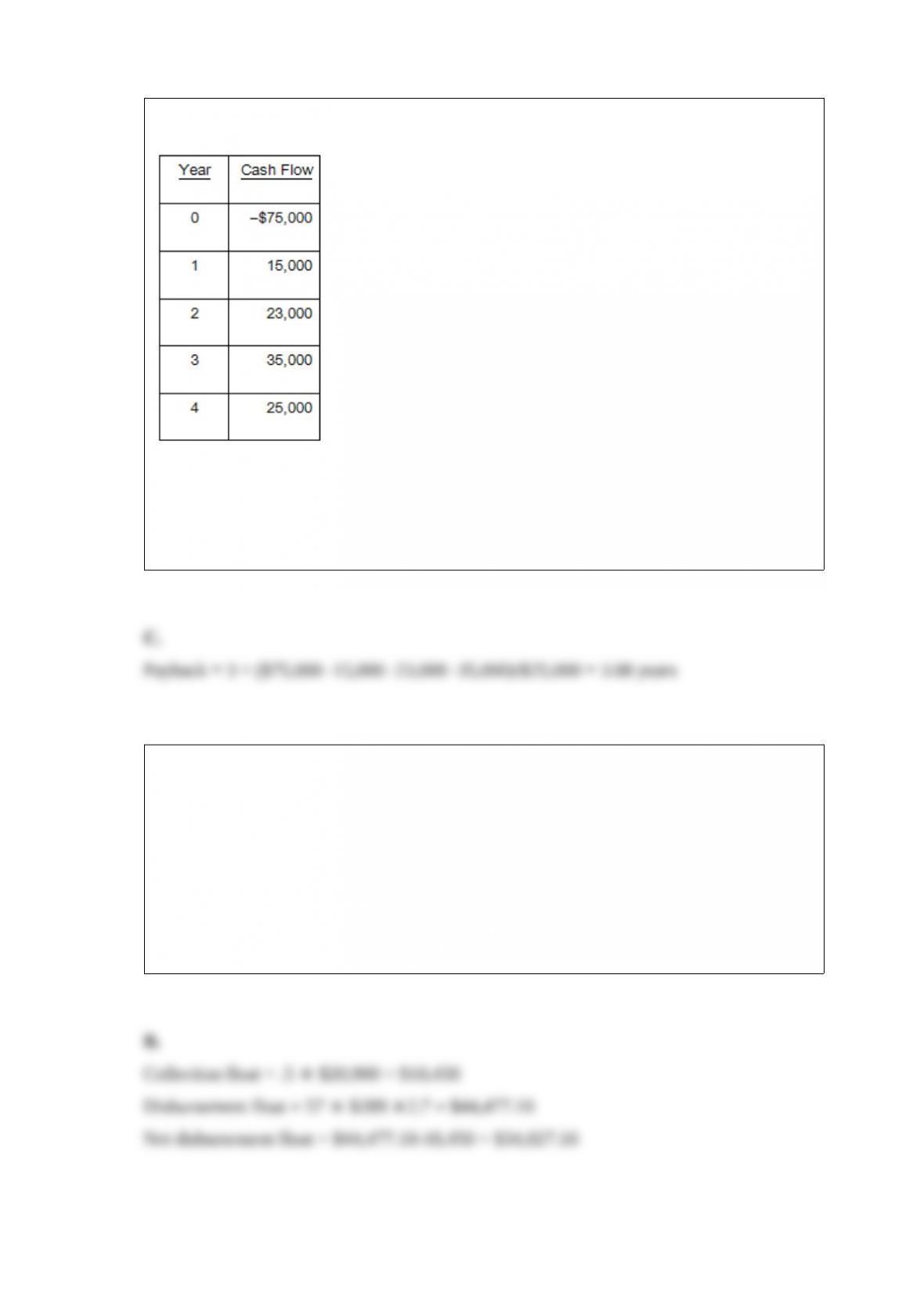
What is the payback period for a project with the following cash flows?
A. 2.56 years
B. 2.89 years
C. 3.08 years
D. 3.24 years
E. Never
Spice it Up! writes 57 checks a day with an average amount of $289 each. These checks
generally clear the bank in 2.7 days. In addition, the firm generally receives an average
of $20,900 a day in checks that are deposited immediately. Deposited funds are
available in an average of .5 days. What is the firm’s net float?
A. Net disbursement float of $36,318
B. Net disbursement float of $34,027.10
C. Net disbursement float of $34,750.30
D. Net collection float of $36,318
E. Net collection float of $34,027.10