
Which of the following statements is FALSE?
A) The tax deductibility of interest lowers the effective cost of debt financing for the
firm.
B) When a firm uses debt financing, the cost of the interest it must pay is offset to some
extent by the tax savings from the interest tax shield.
C) With tax-deductible interest, the effective after-tax borrowing rate is r(Ï„C).
D) The WACC represents the cost of capital for the free cash flow generated by the
firm’s assets.
Which of the following statements is FALSE?
A) Forward rates tend not to be good predictors of future spot rates.
B) Given the risk associated with interest rate changes, corporate managers require
tools to help manage this risk.
C) One of the most important tools to manage the risk of interest rate changes are
interest rate forward contracts.
D) A spot rate is an interest rate that we can guarantee today for a loan or investment
that will occur in the future.
Which of the following equations is INCORRECT?

A) E[Rxp] = rf+ x(E[Rp] – rf)
B) E[Rxp] = (1 – x)rf+ xE[Rp]
C) Sharpe ratio =
D) SD( Rxp) = xSD(Rp)
Which of the following statements is FALSE?
A) Given a 35% corporate tax rate, for every $1 in new permanent debt that the firm
issues, the value of the firm increases by $0.65.
B) The firm’s marginal tax rate may fluctuate due to changes in the tax code and
changes in the firm’s income bracket.
C) Many large firms have a policy of maintaining a certain amount of debt on their
balance sheets.
D) Typically, the level of future interest payments varies due to changes the firm makes
in the amount of debt outstanding, changes in the interest rate on that debt, and the risk
that the firm may default and fail to make an interest payment.
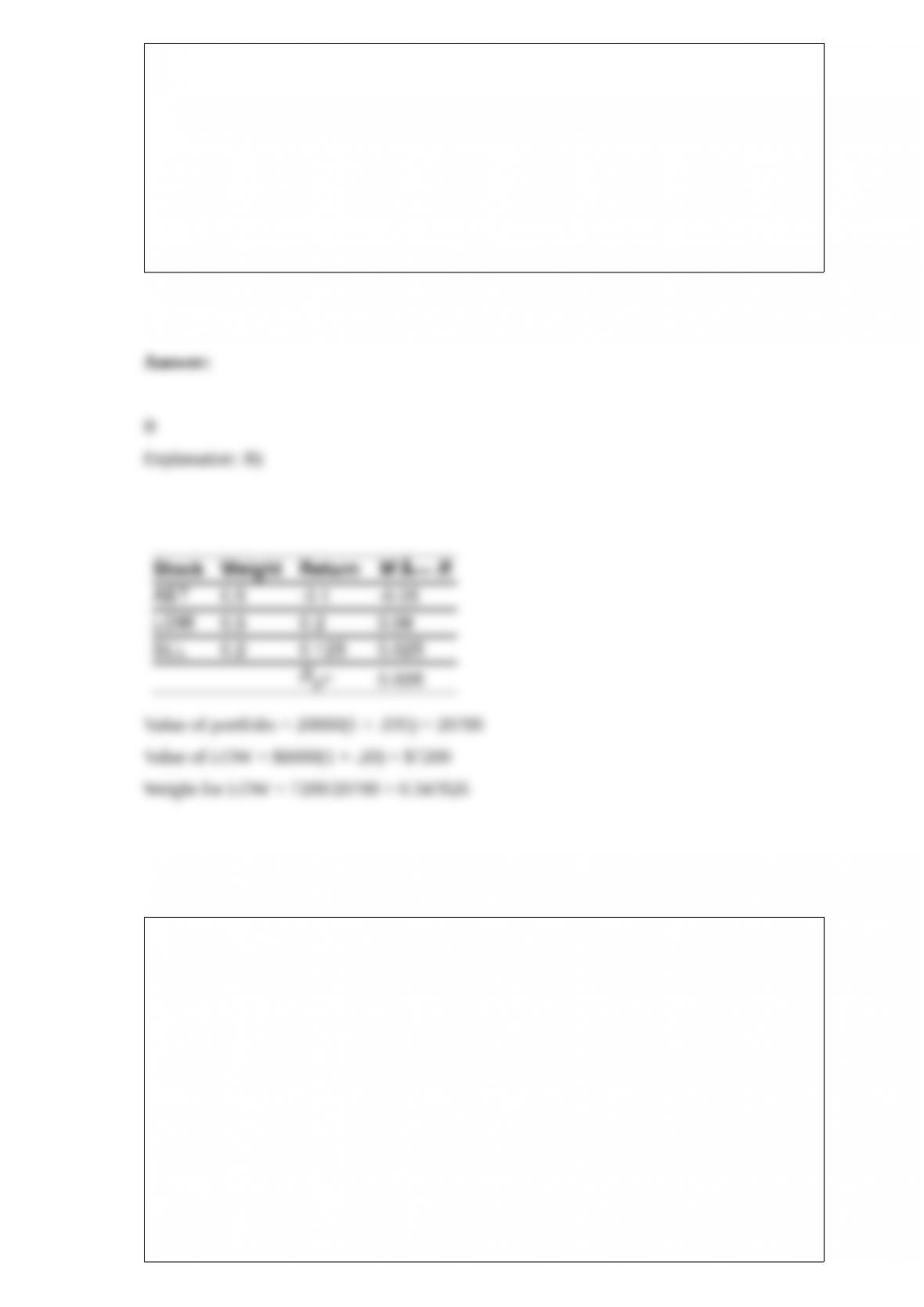
Suppose you invest $20,000 by purchasing 200 shares of Abbott Labs (ABT) at $50 per
share, 200 shares of Lowes (LOW) at $30 per share, and 100 shares of Ball Corporation
(BLL) at $40 per share.Suppose over the next year Ball has a return of 12.5%, Lowes
has a return of 20%, and Abbott Labs has a return of -10%. The weight on Lowes in
your portfolio after one year is closest to:
A) 20.0%
B) 34.8%
C) 30.0%
D) 36.0%
Which of the following statements is FALSE?
A) To determine the benefit of leverage for the value of the firm, we must compute the
present value of the stream of future interest tax shields the firm will receive.
B) Because the cash flows of the levered firm are equal to the sum of the cash flows
from the unlevered firm plus the interest tax shield, by the Law of One Price the same
must be true for the present values of these cash flows.
C) By increasing the amount paid to debt holders through interest payments, the amount
of the pre-tax cash flows that must be paid as taxes increases.
D) When a firm uses debt, the interest tax shield provides a corporate tax benefit each
year.

Flagstaff Enterprises expected to have free cash flow in the coming year of $8 million,
and this free cash flow is expected to grow at a rate of 3% per year thereafter. Flagstaff
has an equity cost of capital of 13%, a debt cost of capital of 7%, and it is in the 35%
corporate tax bracket.
If Flagstaff currently maintains a debt to equity ratio of 1, then Flagstaff’s after-tax
WACC is closest to:
A) 10.25%
B) 10.00%
C) 9.50%
D) 8.75%
Luther Industries currently has 5 million shares outstanding and it stock is currently
trading at $40 per share.Assuming Luther issues a 25% stock dividend, then Luther’s
new share price is closest to:

A) $24.00
B) $30.00
C) $16.00
D) $32.00
The idea that when a seller has private information about the value of good, buyers will
discount the price they are willing to pay due to adverse selection is known as the:
A) pecking order hypothesis.
B) signaling theory of debt.
C) lemons principle.
D) credibility principle.
Rearden Metal is evaluating a project that requires an investment of $150 million today
and provides a single cash flow of $180 million for sure one year from now. Rearden
decides to use 100% debt financing for this investment. The risk-free rate is 5% and
Rearden’s corporate tax rate is 40%. Assume that the investment is fully depreciated at
the end of the year.The NPV of this project using the WACC method is closest to:

A) $10 million
B) $13 million
C) $42 million
D) $71 million
Which of the following statements is FALSE?
A) To determine the project’s debt capacity for the interest tax shield calculation, we
need to know the value of the project.
B) To compute the present value of the interest tax shield, we need to determine the
appropriate cost of capital.
C) Because we don’t value the tax shield separately, with the APV method we need to
include the benefit of the tax shield in the discount rate as we do in the WACC method.
D) A target leverage ratio means that the firm adjusts its debt proportionally to the
project’s value or its cash flows.

Which of the following statements is FALSE?
A) In exchange for bearing systematic risk, investors want to be compensated by
earning a higher return.
B) A key step to measuring systematic risk is finding a portfolio that contains only
unsystematic risk.
C) When evaluating the risk of an investment, an investor will care about its systematic
risk, which cannot be eliminated through diversification.
D) To measure the systematic risk of a stock, we must determine how much of the
variability of its return is due to systematic, market-wide risks versus diversifiable, firm
specific risks.
The Sisyphean Corporation is considering investing in a new cane manufacturing
machine that has an estimated life of three years. The cost of the machine is $30,000
and the machine will be depreciated straight line over its three-year life to a residual
value of $0.
The cane manufacturing machine will result in sales of 2,000 canes in year 1. Sales are
estimated to grow by 10% per year each year through year three. The price per cane that
Sisyphean will charge its customers is $18 each and is to remain constant. The canes
have a cost per unit to manufacture of $9 each.
Installation of the machine and the resulting increase in manufacturing capacity will
require an increase in various net working capital accounts. It is estimated that the
Sisyphean Corporation needs to hold 2% of its annual sales in cash, 4% of its annual
sales in accounts receivable, 9% of its annual sales in inventory, and 6% of its annual
sales in accounts payable. The firm is in the 35% tax bracket, and has a cost of capital
of 10%.
The amount of incremental income taxes that the Sisyphean Company will pay in the
first year on this new project is closest to:
A) $6,300
B) $5,200
C) $3,500
D) $2,800
Which of the following statements is FALSE?
A) Without trading, the portfolio weights will decrease for the stocks in the portfolio
whose returns are above the overall portfolio return.
B) The expected return of a portfolio is simply the weighted average of the expected
returns of the investments within the portfolio.
C) Portfolio weights add up to 1 so that they represent the way we have divided our
money between the different individual investments in the portfolio.
D) A portfolio weight is the fraction of the total investment in the portfolio held in an
individual investment in the portfolio.
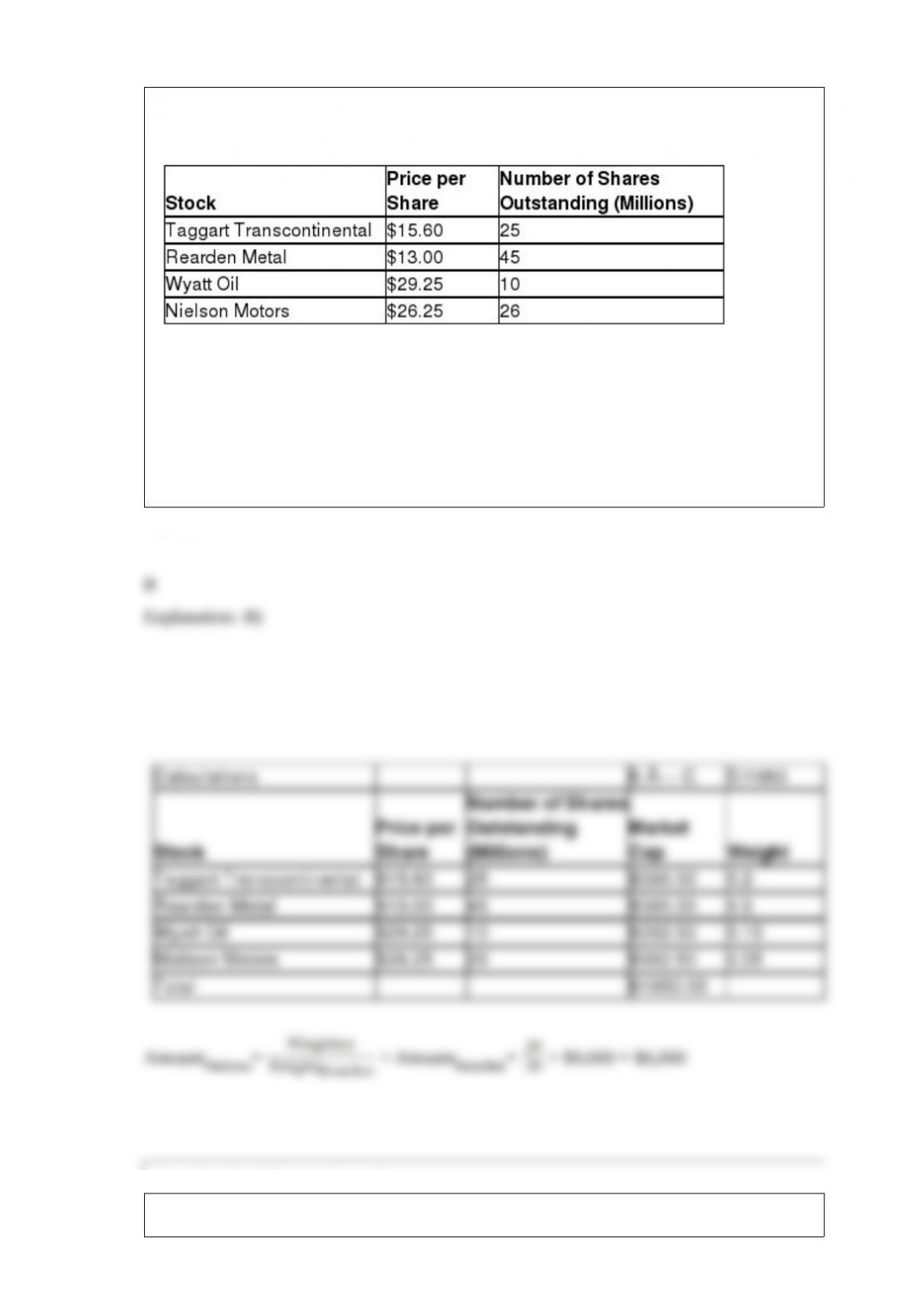
Suppose all possible investment opportunities in the world are limited to the four stocks
list in the table below:
Suppose that you are holding a market portfolio and you have invested $9,000 in
Rearden Metal. The amount that you have invested in Taggart Transcontinental is
closest to:
A) $4,500
B) $6,000
C) $7,715
D) $9,000
Consider the following formula:

Ï„* =
The term Ï„* is:
A) the effective tax advantage of debt.
B) the effective personal tax rate on interest income.
C) the effective personal tax rate on equity.
D) the effective corporate tax rate on income.
Which of the following statements is FALSE?
A) When we relax the assumption of a constant debt-equity ratio, the FTE method is
relatively straightforward to use and is therefore the preferred method with alternative
leverage policies.
B) When debt levels are set according to a fixed schedule, we can discount the
predetermined interest tax shields using the debt cost of capital, rD.
C) With a constant interest coverage policy, the value of the interest tax shield is
proportional to the project’s unlevered value.
D) When the firm keeps its interest payments to a target fraction of its FCF, we say it
has a constant interest coverage ratio.
Which of the following statements is FALSE?
A) A stock’s return is perfectly positively correlated with itself.
B) When the covariance equals 0, the stocks have no tendency to move either together
or in opposition of one another.
C) The closer the correlation is to -1, the more the returns tend to move in opposite
directions.
D) The variance of a portfolio depends only on the variance of the individual stocks.

If the current inflation rate is 4% and you have an investment opportunity that pays
10%, then the real rate of interest on your investment is closest to:
A) 10.0%
B) 14.0%
C) 6.0%
D) 5.8%
Suppose that in the coming year, you expect Exxon-Mobil stick to have a volatility of
42% and a beta of 0.9, and Merck’s stock to have a volatility of 24% and a beta of 1.1.
The risk free interest rate is 4% and the market’s expected return is 12%.
Which stock has the highest total risk?
A) Merck since it has a lower volatility
B) Merck since it has a higher Beta
C) Exxon-Mobil since it has a higher volatility
D) Exxon-Mobil since it has a lower beta
A type of agency problem that results in shareholders gaining from decisions that
increase the risk of the firm sufficiently, even if they have negative NPV is:
A) asset substitution.

B) debt overhang.
C) underinvestment.
D) cashing out.
Suppose that all capital gains are taxed at a 20% rate, and that the dividend tax rate is
40%. Rearden Metal is currently trading for $40 per share, and is about to pay a $5
special dividend.Absent any other trading frictions or news, Rearden’s share price just
after the dividend is paid will be closest to:
A) $35
B) $36
C) $37
D) $40
Suppose that the market portfolio is equally likely to increase by 24% or decrease by
8%. Security “X” goes up on average by 29% when the market goes up and goes down
by 11% when the market goes down. Security “Y” goes down on average by 16% when
the market goes up and goes up by 16% when the market goes down. Security “Z” goes
up on average by 4% when the market goes up and goes up by 4% when the market
goes down.
The beta for security “Y” is closest to:
A) -1.00
B) -0.25
C) 0.00

D) 0.25