
1) suppose that the offshore assembly provisions (oap) of a country a are extended to a
final good x that is imported as well as produced domestically. this action will most
likely
a. stimulate production in country a of components to final good x
b. stimulate production in country a of final good x
c. raise the price of imports of final good x to consumers in country a
d. cause foreign assemblers of final good x to use relatively more components of x that
are supplied by countries other than country a
2) suppose that, using a system of multiple exchange rates, india wishes to discourage
investors from sending their funds abroad relative to employing the funds in production
for export. if the exchange rate for exports were set at 33 indian rupees = $1.00, then
which one of the following exchange rates for capital transactions would potentially be
appropriate for implementing the strategy?
a. 20 indian rupees = $1.00
b. 1 indian rupee = $0.03
c. 1 indian rupee = $0.02
d. 1 indian rupee = $0.06
3) the globalization of finance in relatively recent years
a. is an entirely new phenomenon in the world economy
b. is not an entirely new phenomenon because a similar expansion of financial flows
occurred in the world economy in the 1930s
c. is not an entirely new phenomenon because a similar expansion of financial flows
occurred in the world economy in the 1870-1914 period
d. has been primarily associated with the flow of foreign direct investment across
country borders rather than with growth in financial flows such as international bank
lending
4) in the analysis of growth and trade, growth in the labor force (coupled with no
growth in the capital stock) in a relatively capital-abundant country would lead to what
type of production effect in the country?
a. ultra-antitrade production effect
b. antitrade production effect
c. protrade production effect
d. ultra-protrade production effect
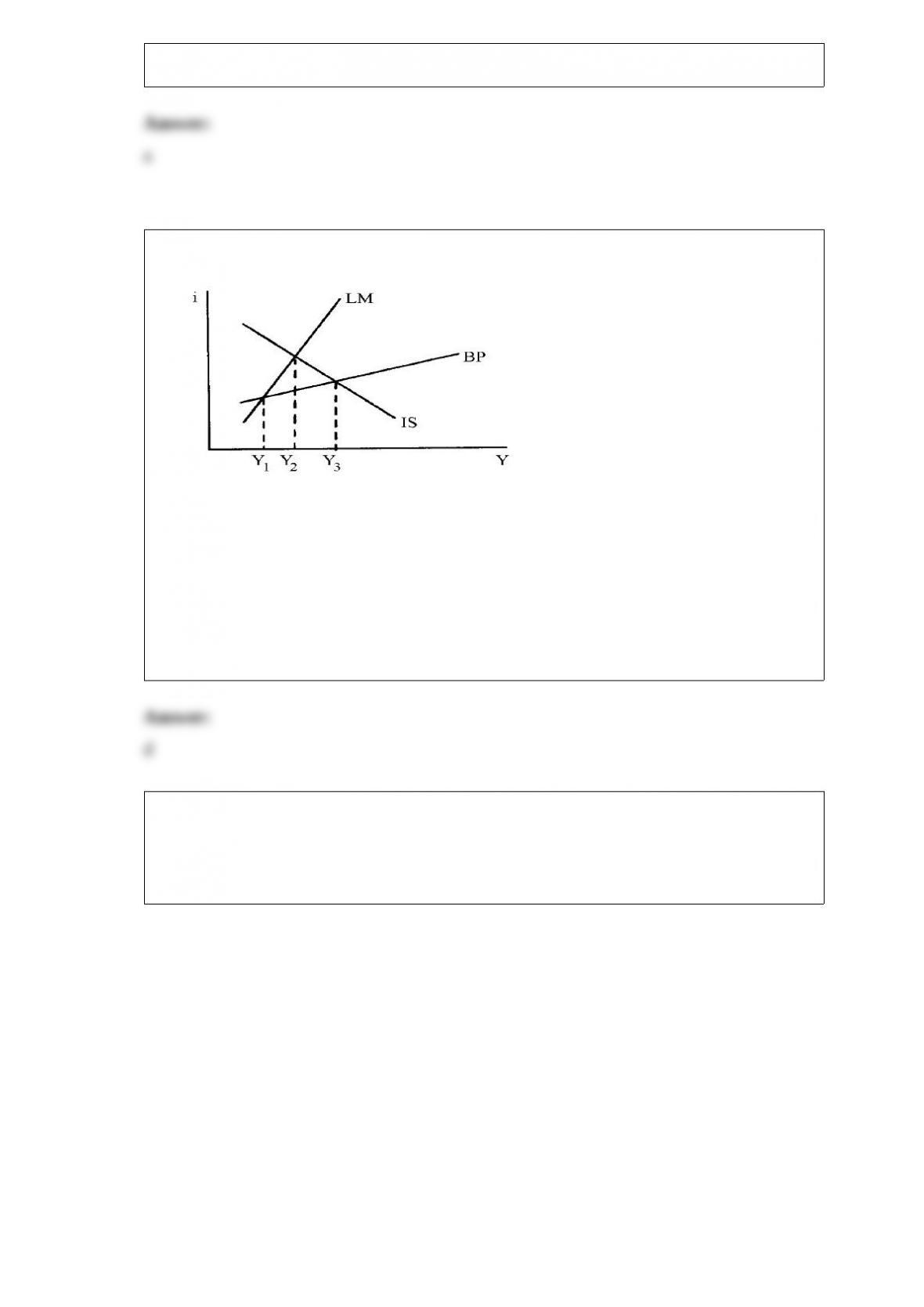
5) given the following diagram, with flexible exchange rates:
assume that the economy is in domestic equilibrium. in this situation, there will be
__________ in the countrys balance of payments (official reserve transactions balance),
with the consequence that the countrys currency will __________ in the foreign
exchange markets.
a. an incipient deficit; depreciate
b. an incipient deficit; appreciate
c. an incipient surplus; depreciate
d. an incipient surplus; appreciate
6) consider the labor situation in countries i and ii in a two-country world with the
marginal physical product schedules mppli (= demand for labor schedule di) for country
i and marginal physical product schedule mpplii (= demand for labor schedule dii) for
country ii shown in the graph below (where the vertical axes also represent real wages):
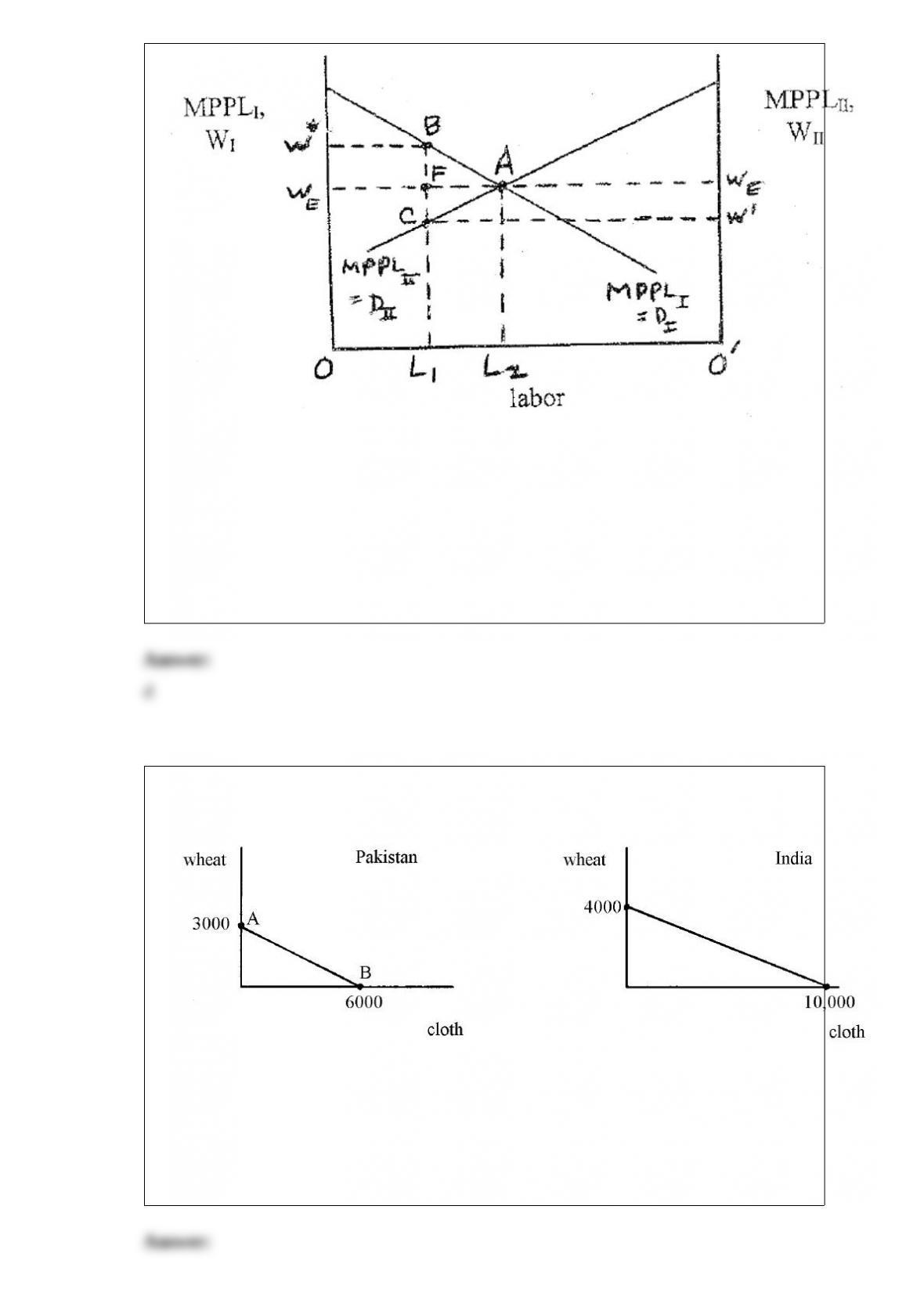
without any migration of labor between the two countries, the labor force is 0l1 in
country i and (in the leftward direction) 0l1 in country ii. if labor is now allowed to
flow freely between the two countries, labor would migrate __________. as a result of
the migration, world output would increase by the amount of triangle __________.
a. from country i to country ii; cba
b. from country i to country ii; fba
c. from country ii to country i; cfa
d. from country ii to country i; cba
7) given the following constant-cost production-possibilities frontiers for pakistan and
india:
pakistan has an autarky relative price of __________; if trade begins with india, then
pakistan would produce at point __________, assuming complete specialization.
a. 1 cloth:0.5 wheat (i.e., pcloth/pwheat = 0.5); a
b. 1 cloth:0.5 wheat (i.e., pcloth/pwheat = 0.5); b
c. 1 cloth:2 wheat (i.e., pcloth/pwheat = 2); a
d. 1 cloth:2 wheat (i.e., pcloth/pwheat = 2); b

8) in a ricardo-type model, if portuguese workers can produce three times as much wine
per day as english workers but only twice as much cloth per day as english workers,
then, if portuguese wages are 30 euros per day, the upper limit to english wages per day
is __________. (assume 1 euro = £1.)
a. £10
b. £15
c. £60
d. £90
9) which one of the following sequences of specifications of relative preferences for
bundles of goods a, b, and c by a consumer indicates the property of transitivity (where
“>” indicates that the preferred bundle is on the left, “<” indicates that the preferred
bundle is on the right, and “=” means indifference between the bundles)?
a. a > b; b > c; c > a
b. a > b; b = c; c = a
c. a < b; c < a; b > c
d. a = c; b > c; a > b
10) the country that claims to have a greater number of economic integration trade
agreements in place than any other country is
a. chile
b. the dominican republic
c. mexico
d. the united states
11) the shape of the curve that shows the effect of currency depreciation upon a
countrys current account balance over time, with the curve itself being known as the
__________, reflects the fact that short-run demand elasticities are sufficiently
__________ than long-run elasticities to generate this particular shape. (ignore the
negative sign on the elasticities.)
a. j curve; lower
b. j curve; higher
c. supply curve of foreign exchange; lower
d. supply curve of foreign exchange; higher
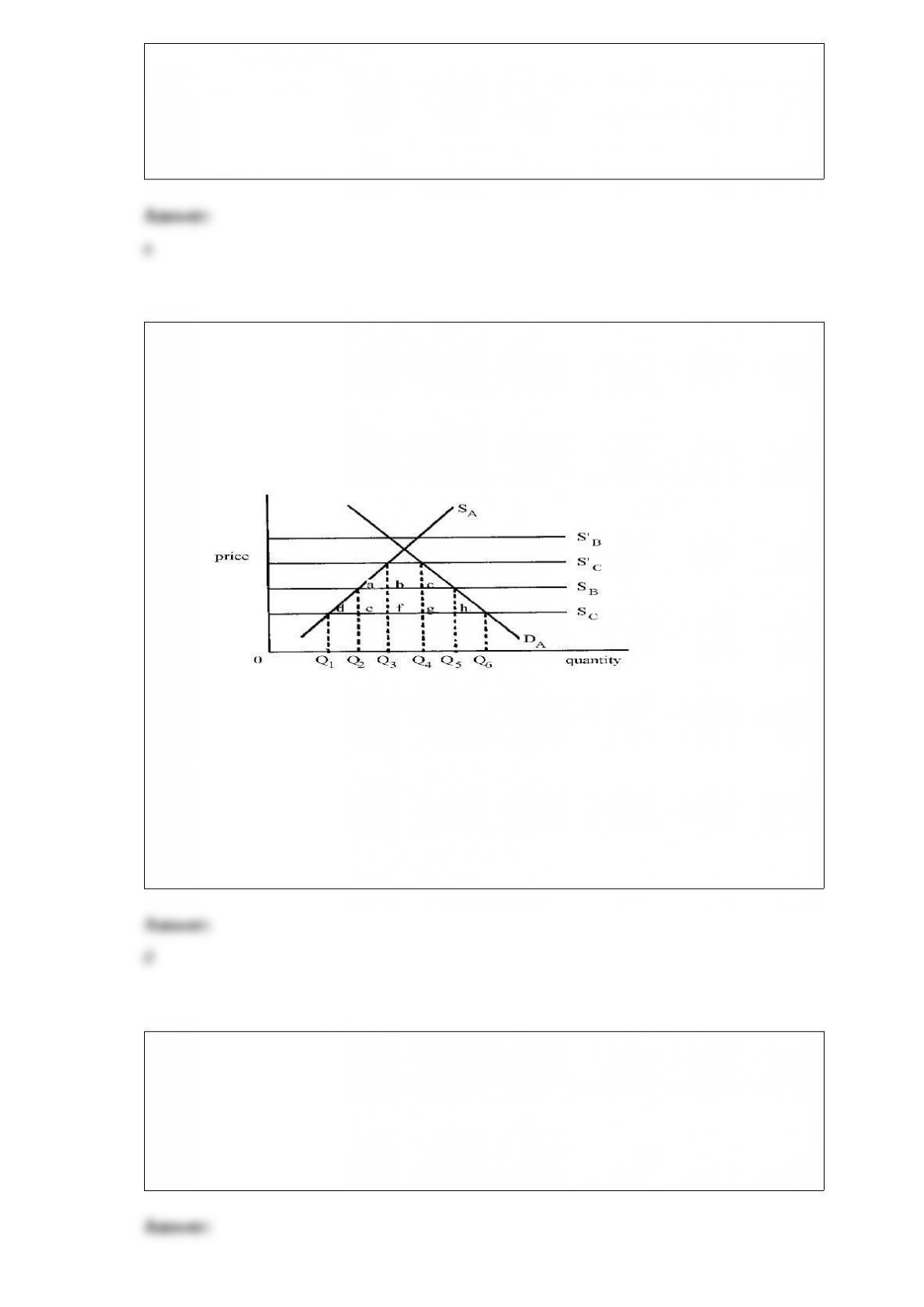
12) the following diagram pertains to good x for country a, where da is the demand for
x by a’s consumers, sa is the supply curve of x from a’s home producers, sb is the
horizontal supply curve of x to country a from country b, sc is the horizontal supply
curve of x to country a from country c, and sb and sc are the horizontal supply curves
from b and c, respectively, with a tariff in place.
in the diagram bove, suppose that country a, from this initial situation
where its tariff is applied to both countries b and c, now forms a customs union with
country c. the net welfare effect on country a from the formation of this customs union
with country c would be __________.
a. areas (a + c) minus area f
b. areas (a + c + e + g) minus area f
c. areas (a + c + d + e + g + h) minus areas (b + f)
d. a gain of areas (a + c + d + e + g + h)
13) with economic growth, a countrys offer curve (with the export good on the
horizontal axis)
a. will always shift or pivot outward
b. will always shift or pivot inward
c. will shift or pivot inward in the case ultra-antitrade growth
d. will not shift or pivot in the case of neutral growth
14) developing countries often claim that their commodity terms of trade have fallen
over the long run. this means that (with px = export price index, pm = import price
index, qx = export quantity index, and qm = import quantity index) the developing
countries think that there has been a decline in their __________.
a. (pm/px)qm
b. pm/px
c. px/pm
d. (px/pm)qx
15) the heavy export of a product by developing countries is most likely to occur in
which of the following stages of the product cycle theory?
a. new product stage
b. maturing product stage
c. standardized product stage
d. cannot be determined a priori equally likely to occur in the new product,
maturing product, and standardized product stages
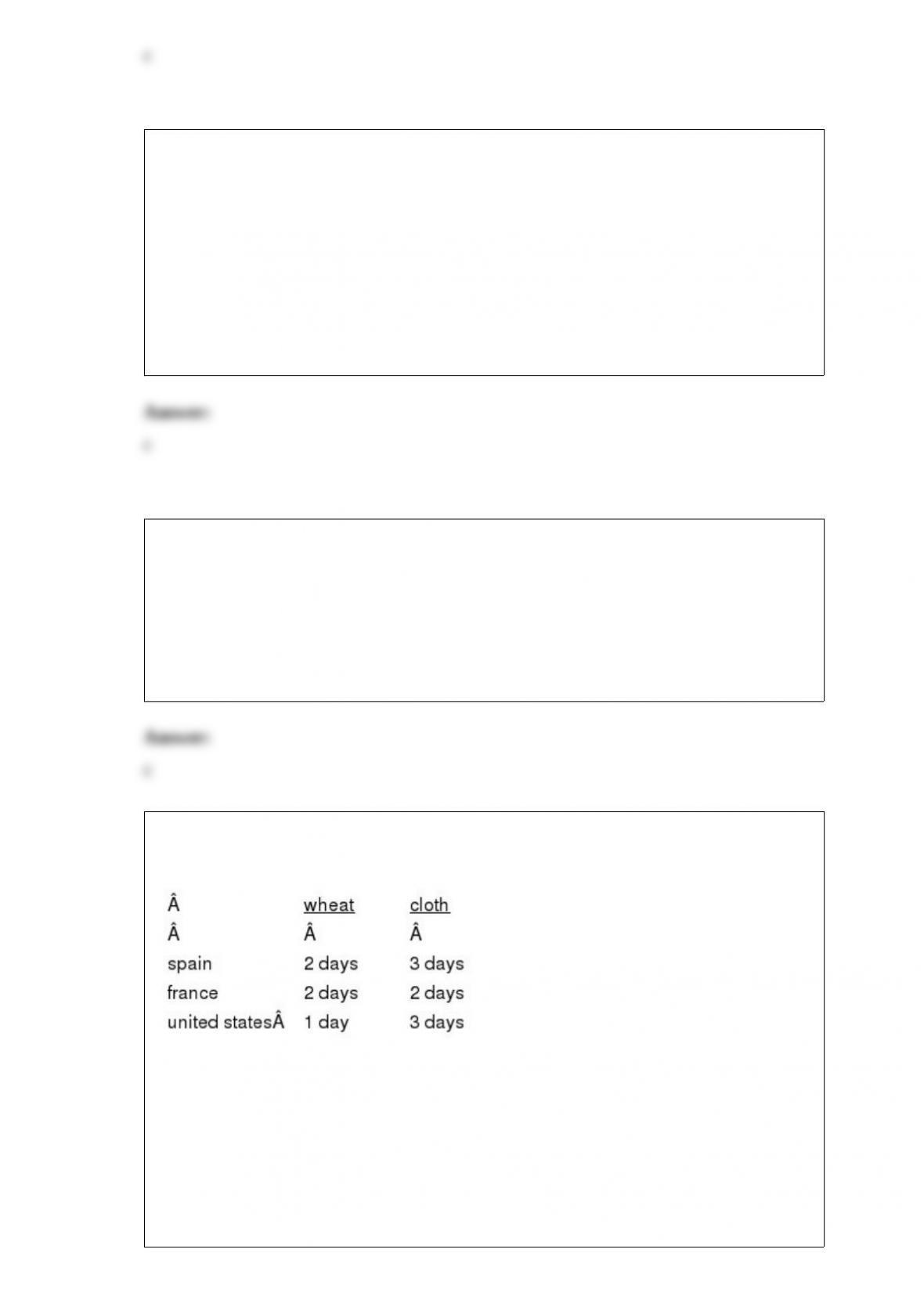
16) suppose that the labor requirements per unit of output in each of the two industries
in each of three countries are as follows:
in this situation, with an international terms of trade of 1 cloth:2 wheat (or 1 wheat: 1/2
cloth), __________ would export cloth and import wheat; if the terms of trade were,
instead, 1 wheat: 3/4 cloth (or 1 cloth:11/2 wheat), __________ would export cloth and
import wheat.
a. france and the united states; spain
b. spain and france; france
c. france and the united states; spain and the united states
d. spain and france; spain and the united states

17) suppose that a u.s. exporter sells goods to a foreign firm and receives payment by
the foreign firm drawing down its new york bank account and transferring the funds to
the u.s. exporters new york bank account. in this situation, the debit entry in the u.s.
balance of payments account is __________.
a. exports of goods
b. increase in foreign short-term private assets in the united states
c. decrease in foreign short-term private assets in the united states
d. increase in u.s. short-term private foreign assets abroad