1) Highly liquid assets:
A.increase the probability a firm will face financial distress
B.appear on the right side of a balance sheet
C.generally produce a high rate of return
D.can be sold quickly at close to full value
E.include all intangible assets
2) A project has an initial requirement of $698,700 for fixed assets and $61,000 for net
working capital. The fixed assets will be depreciated to a zero book value over the
4-year life of the project and will be worthless at the end of the project. All of the net
working capital will be recouped after 4 years. The expected annual operating cash flow
is $218,000. What is the project’s internal rate of return if the tax rate is 35 percent?
A.7.72 percent
B.8.41 percent
C.8.69 percent
D.9.11 percent
E.9.97 percent
3) An investment has an initial cost of $410,000 and will generate the net income
amounts shown below. This investment will be depreciated straight line to zero over the
4-year life of the project. Should this project be accepted based on the average
accounting rate of return if the required rate is 16 percent? Why or why not?
A.Yes; because the AAR is equal to 16 percent
B.Yes; because the AAR is greater than 16 percent
C.Yes; because the AAR is less than 16 percent
D.No; because the AAR is greater than 16 percent
E.No; because the AAR is less than 16 percent

4) The stock of Billingsley United has a beta of 0.92. The market risk premium is 8.4
percent and the risk-free rate is 3.2 percent. What is the expected return on this stock?
A.8.87 percent
B.9.69 percent
C.10.93 percent
D.11.52 percent
E.12.01 percent
5) Handy Hardware sells its inventory in 85 days, on average. Costs of goods sold for
the year are $631,800. What is the average value of the firm’s inventory?
A.$114,706
B.$123,506
C.$147,132
D.$161,096
E.$182,513
6) Which one of the following terms is defined as the total tax paid divided by the total
taxable income?
A.Average tax rate
B.Variable tax rate
C.Marginal tax rate
D.Absolute tax rate
E.Contingent tax rate
7) Tom is planning to invest the following amounts at 4 percent interest. How much
money will he have saved at the end of year 3?
A.$2,200.00
B.$2,238.47
C.$2,272.80
D.$2,309.16
E.$2,363.71
8) Float is defined as the difference between which of the following?
A.Beginning cash balance and the ending cash balance as shown on a cash budget
B.Ledger balance and the available balance
C.Book balance and the ledger balance
D.Collections and disbursements for any given period of time
E.Available balance and the collected balance
9) The spot rate on the Norwegian kroner is 6.689. The exchange rate one year from
now is expected to be 6.745 assuming that relative interest rate parity exists. Interest
rates in Norway are 3.7 percent. What is the interest rate in the U.S.?
A.2.86 percent
B.3.02 percent
C.3.59 percent
D.4.54 percent
E.4.68 percent
10) Which one of the following is the equity risk arising from the daily operations of a
firm?
A.Strategic risk
B.Financial risk
C.Liquidity risk
D.Industry risk
E.Business risk
11) Consider the following two mutually exclusive projects:
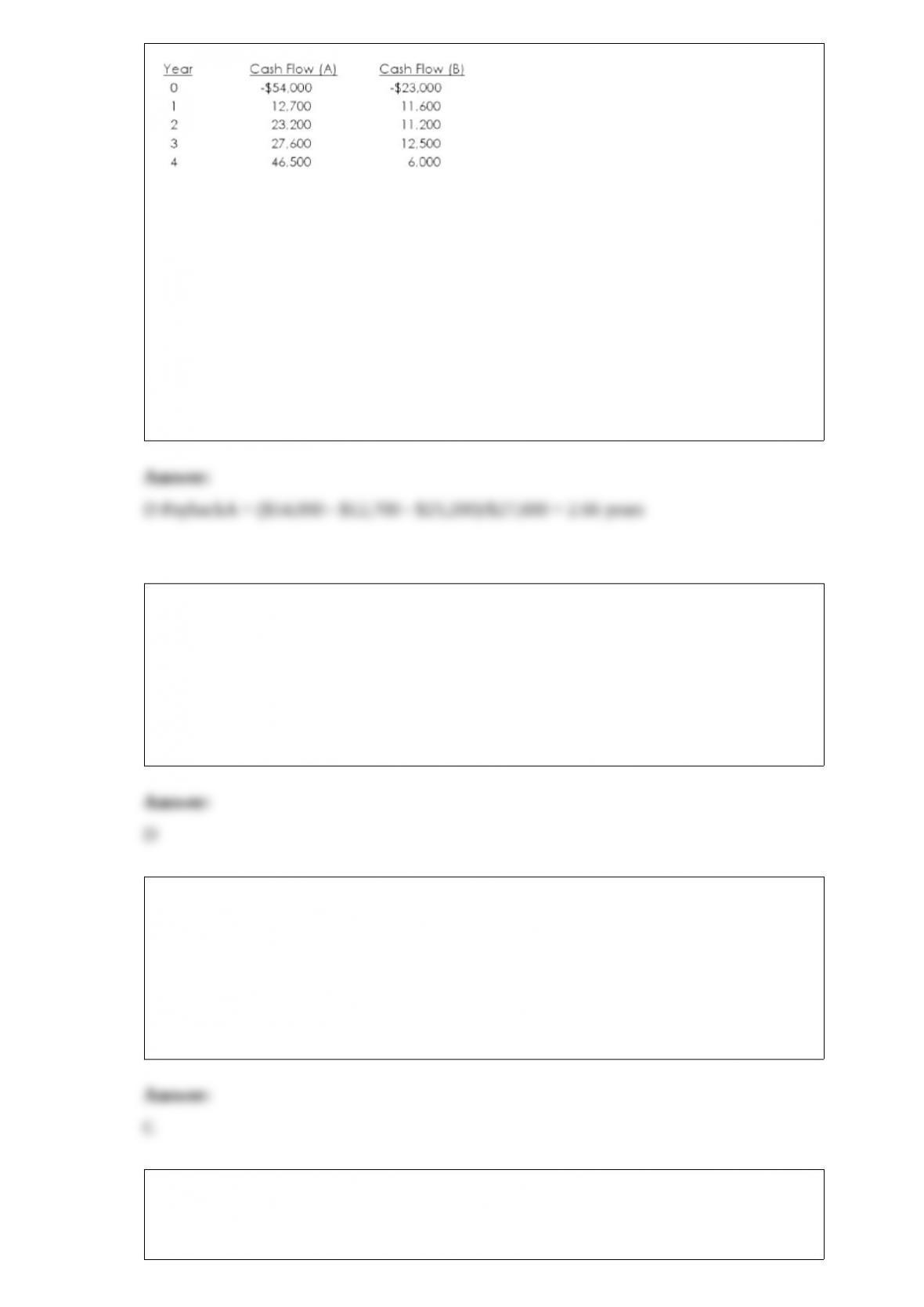
Whichever project you choose, if any, you require a 14 percent return on your
investment. If you apply the payback criterion, you will choose investment _____, if
you apply the NPV criterion, you will choose investment _____; if you apply the IRR
criterion, you will choose investment ____; if you choose the profitability index
criterion, you will choose investment ____. Based on your first four answers, which
project will you finally choose?
A.A; B; A; A; B
B.A; A; B; B; A
C.A; A; B; B; B
D.B; A; B; A; A
E.B; A; B; B; A
12) A person who executes customer orders to buy and sell securities on the floor of the
NYSE is called a:
A.floor trader
B.specialist
C.runner
D.commission broker
E.market maker
13) Which one of the following is a primary benefit of implementing zero-balance
accounts into a cash management system?
A.Increased disbursements float
B.Total elimination of all safety stocks
C.Additional cash availability
D.Decreased collection float
E.Elimination of all float
14) Ruff Wear expects sales of $560, $650, $670, and $610 for the months of May
through August, respectively. The firm collects 20 percent of sales in the month of sale,
70 percent in the month following the month of sale, and 8 percent in the second month
following the month of sale. The remaining 2 percent of sales is never collected. How
much money does the firm expect to collect in the month of August?
A.$621
B.$628
C.$633
D.$639
E.$643
15) You just won a contest! You will receive $100,000 a year for 20 years, starting
today. If you can earn 12 percent on your investments, what are your winnings worth
today?
A.$750,000.00
B.$833,333.33
C.$836,577.69
D.$850,000.00
E.$887,450.72
16) A project requires $336,000 of equipment that is classified as 7-year property. What
is the depreciation expense in year 3 given the following MACRS depreciation
allowances, starting with year one: 14.29, 24.49, 17.49, 12.49, 8.93, 8.92, 8.93, and
4.46 percent?
A.$38,033
B.$41,267
C.$48,509
D.$58,766
E.$61,322
17) The General Store has a cost of equity of 15.8 percent, a pre-tax cost of debt of 7.7
percent, and a tax rate of 32 percent. What is the firm’s weighted average cost of capital
if the debt-equity ratio is 0.40?
A.10.18 percent
B.11.72 percent
C.12.78 percent
D.13.30 percent
E.14.93 percent
18) The period 1926-2008 illustrates that U.S. Treasury bills:
A.outperform inflation by approximately 1 percent every year
B.have a zero standard deviation
C.can either outperform or underperform inflation on an annual basis
D.produce a rate of return roughly equivalent to the rate of return on long-term
government bonds
E.routinely have negative annual returns
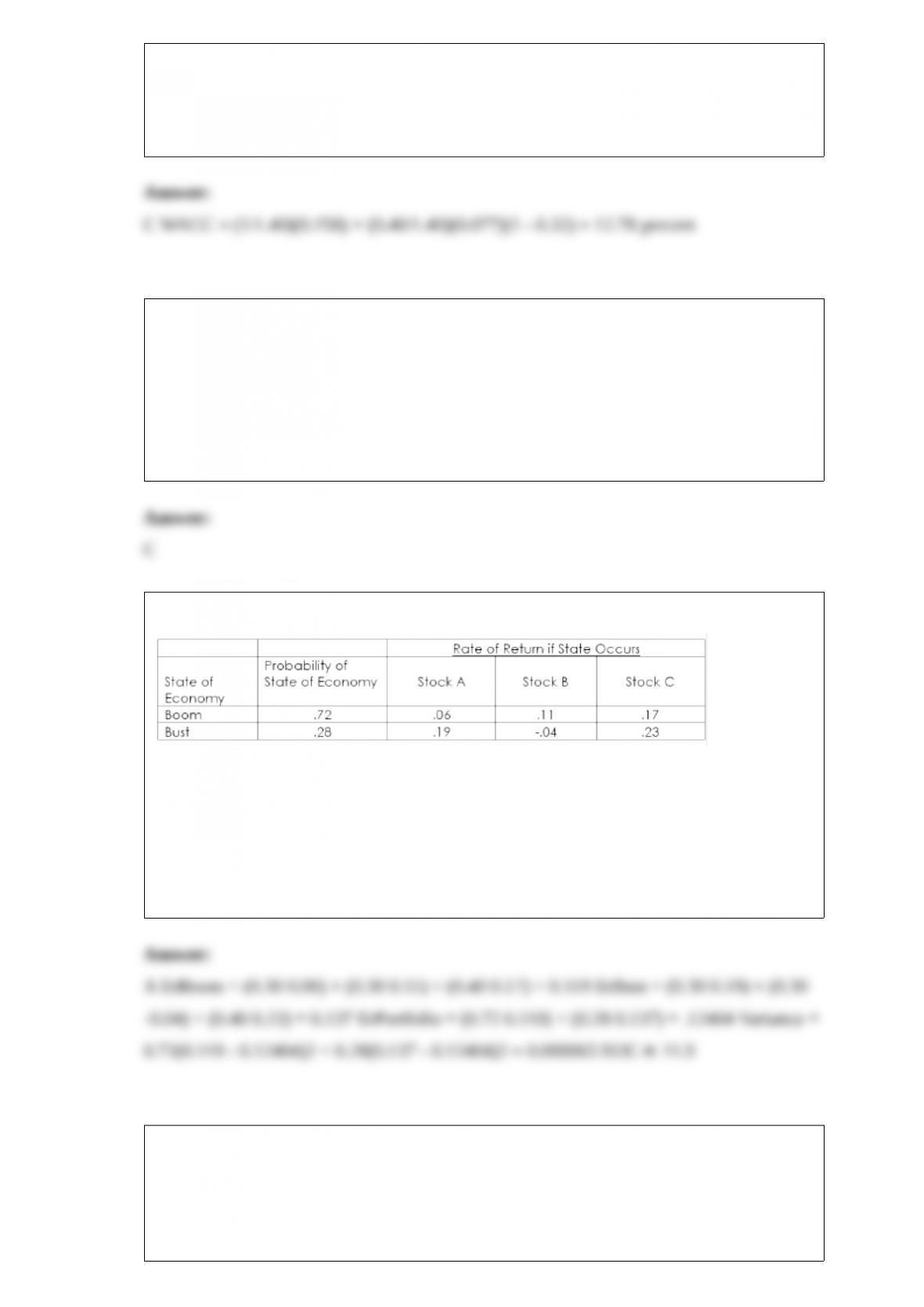
19) Consider the following information:
What is the variance of a portfolio invested 30 percent each in A and B and 40 percent
in C?
A.0.000065
B.0.000163
C.0.000289
D.0.000528
E.0.001740
20) Which of the following will increase the future value of a lump sum investment?
I. Decreasing the interest rate
II. Increasing the interest rate
III. Increasing the time period
IV. Decreasing the amount of the lump sum investment

A.I and III only
B.I and IV only
C.II and III only
D.II and IV only
E.II, III, and IV only
21) The Inside Door has total debt of $78,600, total equity of $214,000, and a return on
equity of 14.5 percent. What is the return on assets?
A.9.14 percent
B.10.61 percent
C.21.45 percent
D.34.61 percent
E.39.48 percent
22) Newton Industries is considering a project and has developed the following
estimates: unit sales = 7,300, price per unit = $149, variable cost per unit = $91, fixed
costs = $216,400. The depreciation is $94,700 a year and the tax rate is 35 percent.
What effect would an increase of $1 in the selling price have on the operating cash
flow?
A.$4,745
B.$4,823
C.$5,316
D.$5,448
E.$5,565
23) Phil and Terry started a new business three years ago. Two years ago, they
incorporated the business and issued themselves each 20,000 shares of stock. Last year,
they took the company public in an initial public offering (IPO) and issued an additional
100,000 shares of stock at that time. The offer price was $14 a share, the spread was 8
percent, and the lockup period was six months. The stock closed at $17 a share at the
end of the first day of trading. During the first six months of trading, the stock had a
price range of $13 to $23 per share. During the second six months of trading, the stock
sold between $15 and $21 per share. Both Tracie and Amy purchased 100 shares at the
offer price. Given this, which one of the following statements is correct? Ignore trading
costs and taxes.

A.Tracie could have earned a maximum profit of 100($23 – 17) on her investment
B.Phil could have sold 5,000 shares at $23 per share
C.The underwriters earned a spread equal to 8 percent of $17
D.The maximum price at which Terry could have sold shares is $21
E.Amy paid 108 percent of $14 per share to purchase her 100 shares
24) The risk premium for an individual security is based on which one of the following
types of risk?
A.Total
B.Surprise
C.Diversifiable
D.Systematic
E.Unsystematic
25) Which one of the following statements is correct regarding mortgage backed
securities (MBSs)?
A.There is a separate MBS for each individual mortgage processed by a mortgage
broker
B.A MBS is a type of a debenture
C.The originating bank is the seller of MBSs to investors
D.Investors in MBSs are protected from default
E.Investors in MBSs are subject to real estate deflation risk
26) Which one of the following represents the amount of compensation an investor
should expect to receive for accepting the unsystematic risk associated with an
individual security?
A.Security beta multiplied by the market rate of return
B.Market risk premium
C.Security beta multiplied by the market risk premium
D.Risk-free rate of return
E.Zero