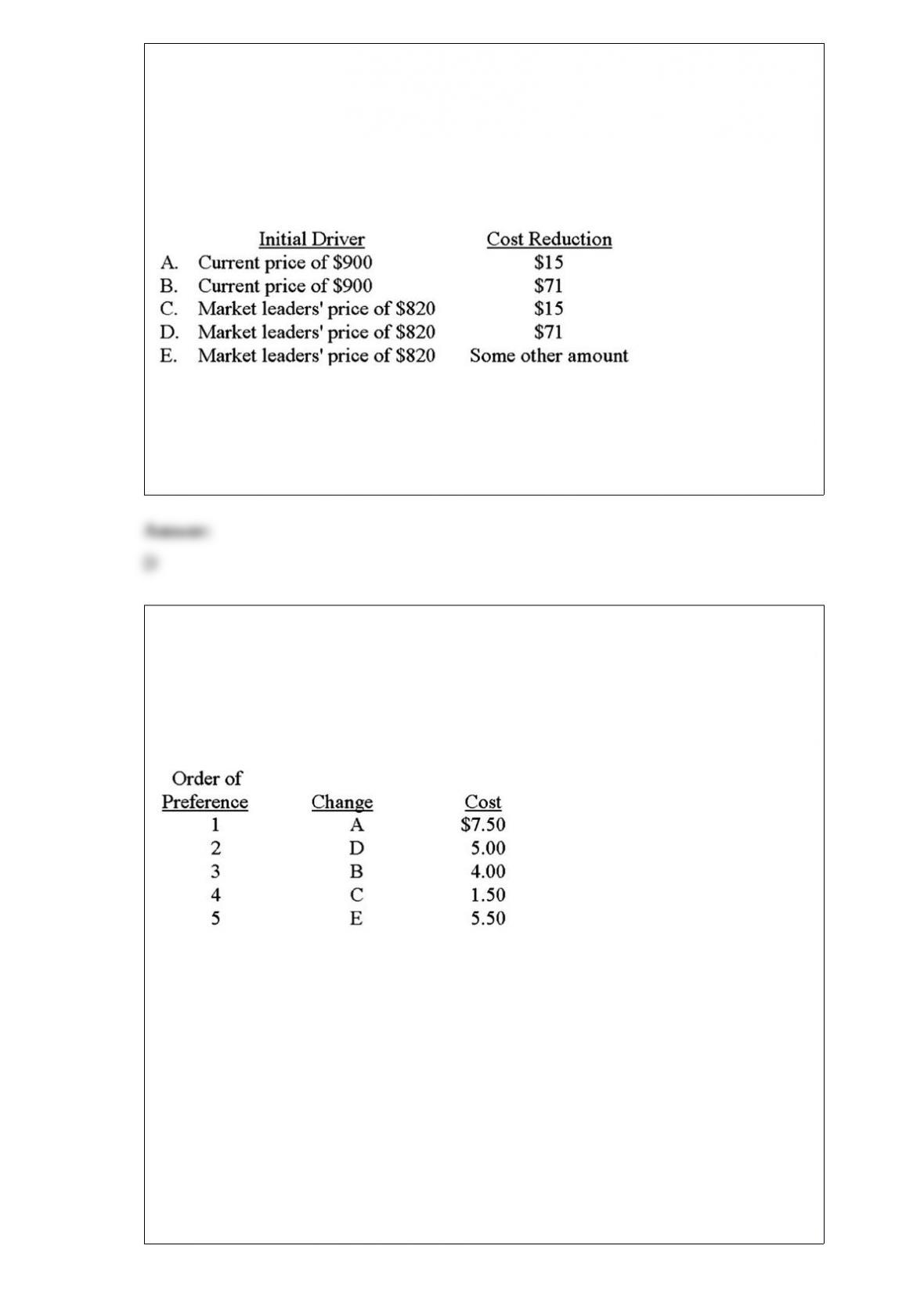
1) Lyman currently sells an industrial mixer for $900 that market leaders sell for $820.
The current costs to manufacture and distribute the mixer total $645, and the company
has a profit goal of 30% of sales. Lyman uses target costing in its efforts to be a leader
in the marketplace. On the basis of this information, (1) what should Lyman consider to
be the initial driver of the target-costing process and (2) what amount of cost reduction
is needed for the company to achieve its goals?
A.Choice A
B.Choice B
C.Choice C
D.Choice D
E.Choice E
2) Wagner Furniture manufactures easy-to-assemble wooden furniture for home and
office. The firm is considering modification of a bookcase, and the company’s
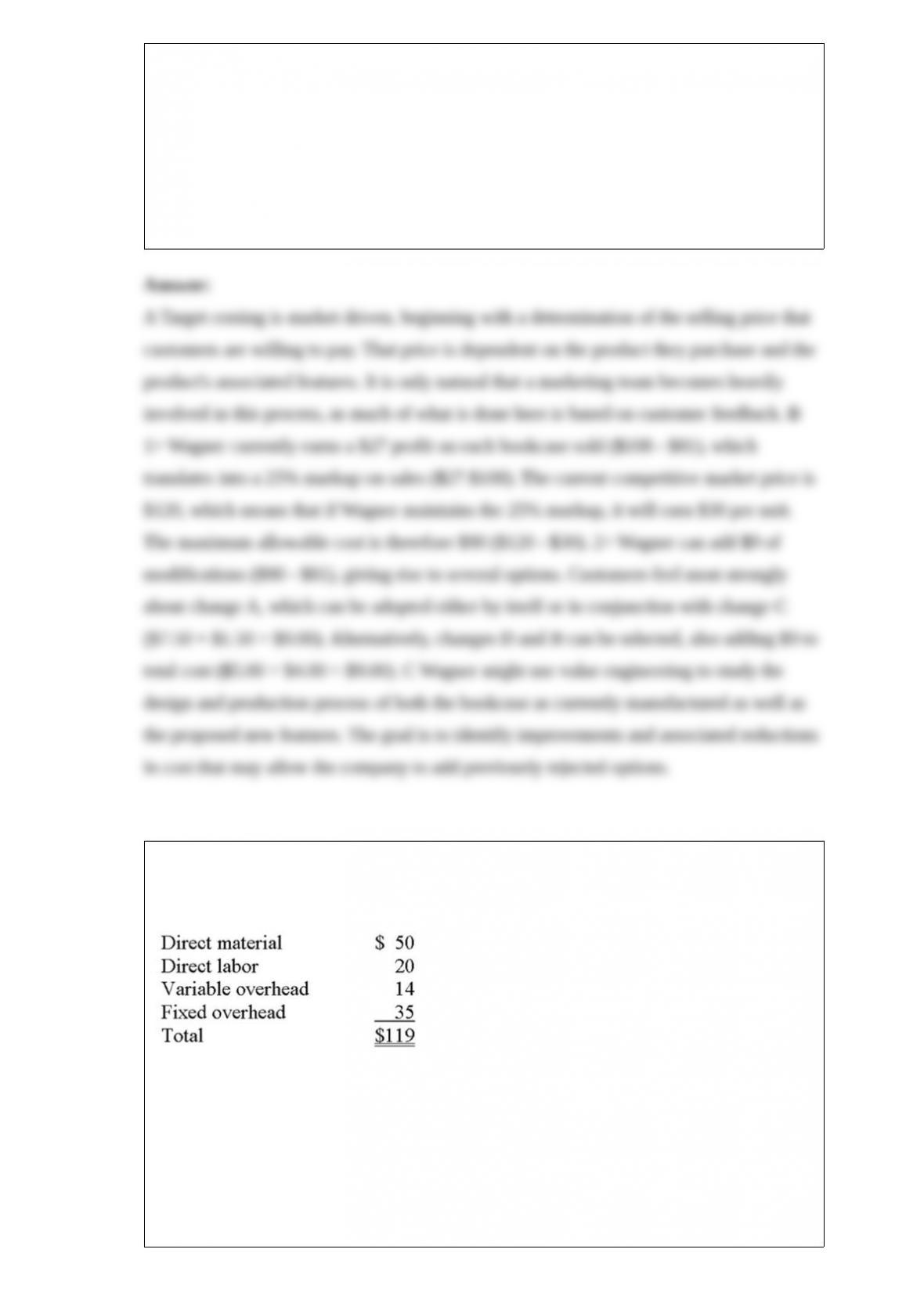
marketing department surveyed potential buyers regarding five proposed changes
(A-E). The buyers’ responses, in order of preference, along with Wagner’s related unit
costs for the modifications, follow.
The bookcase currently costs $81 to produce and distribute, and Wagner’s selling price
for this unit averages $108. An analysis of competitive products in the marketplace
revealed a variety of features, with some models having all of the changes that Wagner
is considering and other models having only a few. The current manufacturers’ selling
prices on these bookcases average $120.
Required:
A. Why is there a need in target costing to (a) focus on the customer and (b) have a
marketing team become involved with product design?
B. Management desires to earn approximately the same rate of profit on sales that is
being earned with the current design.
1> If Wagner uses target costing and desires to meet the current competitive selling
price, what is the maximum cost of the modified bookcase?
2> Which of the modifications should Wagner consider?
C. Assume that Wagner wanted to add a modification or two that you excluded in your
answer to requirement “B2.” What process might management adopt to allow the
company to make its target profit for the bookcase? Briefly explain.
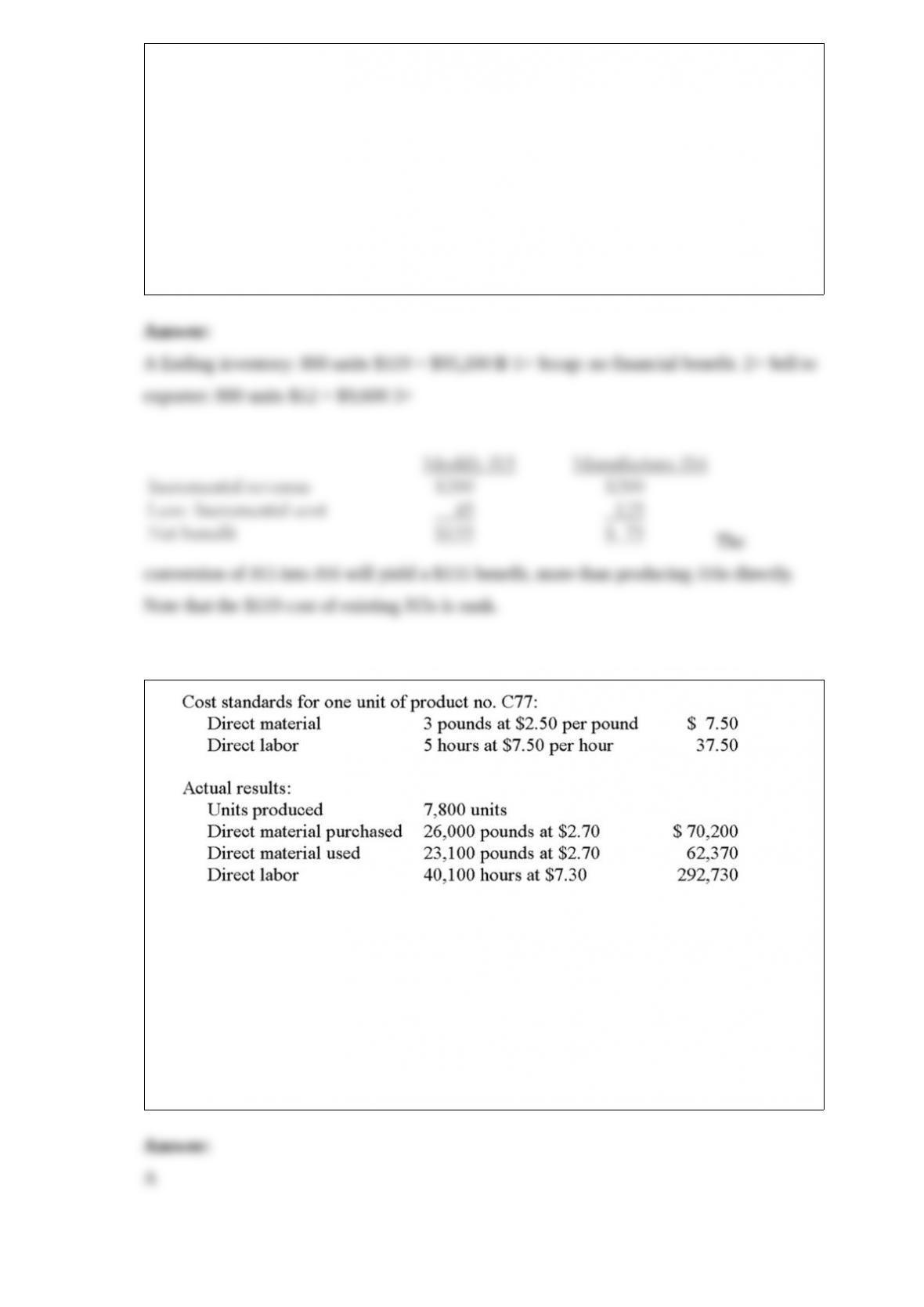
3) Waltherboro Company recently discontinued the manufacture of product J15. The
standard costs for this product were:
There are 800 units of this product in finished-goods inventory. The units are
technologically obsolete, and the following alternatives are being considered:
1> Dispose of as scrap. The proceeds from the sale will equal the cost of transportation
to the disposal site.
2> Sell to an exporter for sale in a developing country. The sales price to the exporter
would be $12 per unit.
3> Remanufacture the products to convert them into model J16, a model that normally
sells for $200. The additional cost to convert the J15 units would be $45; the standard
cost to manufacture J16 is $125. Presently, there is sufficient capacity to manufacture
product J16 directly or to do the necessary conversion work on J15 .
Required:
A. Determine the current carrying value of the J15 inventory.
B. Evaluate each alternative and determine the financial benefit to Waltherboro if the
alternative is pursued.
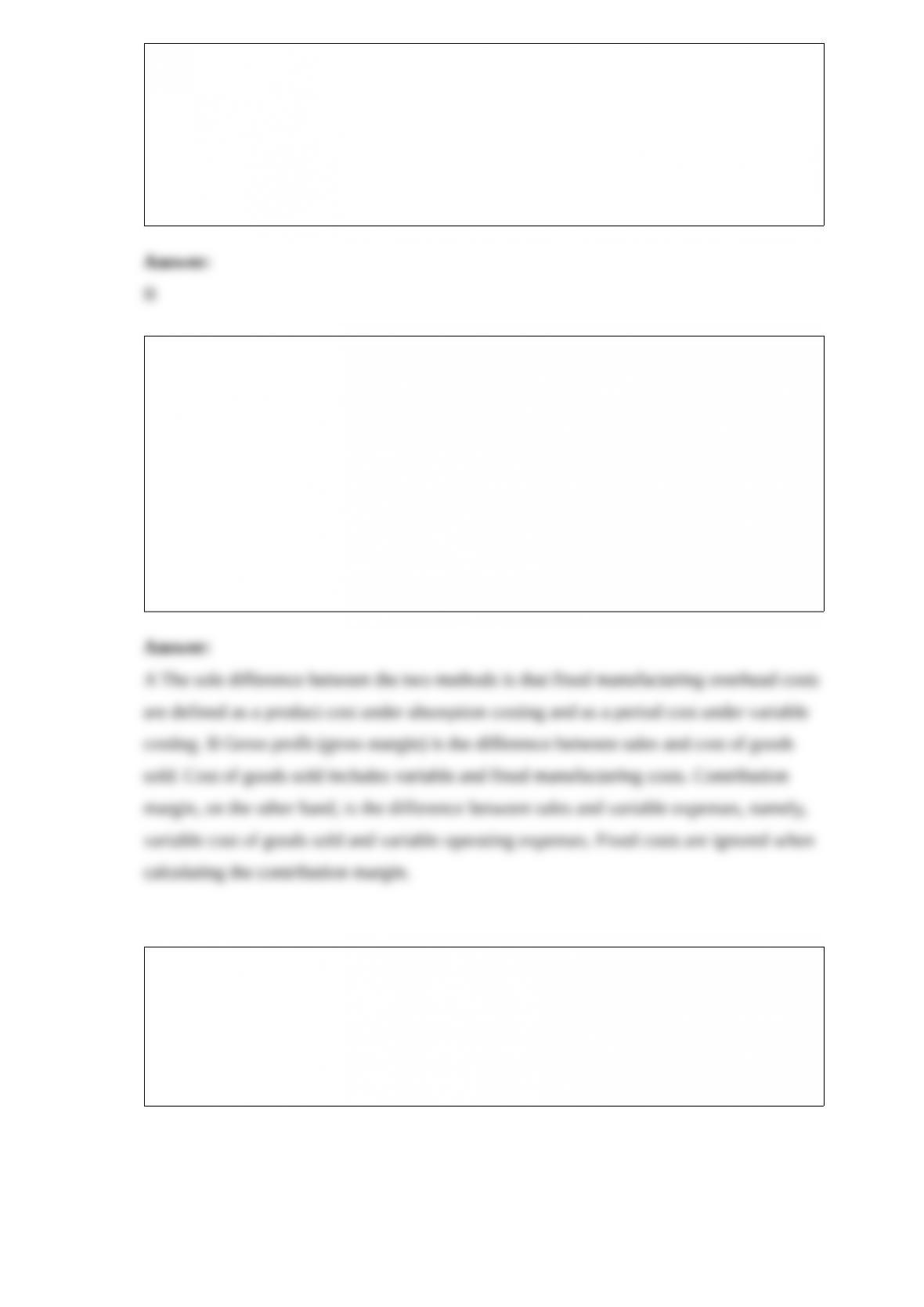
4)
Assume that the company computes variances at the earliest point in time.
The direct-material quantity variance is:
A.$750F
B.$750U
C.$6,500U
D.$7,250U
E.none of the other answers are correct
5) When 5,000 units are produced variable costs are $35 per unit and total costs are
$200,000. What are the total costs when 8,000 units are produced?
A.$200,000
B.$305,000
C.$240,000
D.None of the other answers are correct
E.Total costs cannot be calculated based on the information presented
6) Absorption and variable costing are two different methods of measuring income and
costing inventory.
Required:
A. Product costs are defined as costs associated with the manufacturing process. How
does the operational definition of product cost differ between absorption costing and
variable costing?
B. An absorption-costing income statement will report gross profit or gross margin
whereas a variable-costing income statement will report contribution margin. What is
the difference between these terms?
7) Southern Lake Chemical manufactures a product called Zubek. Direct materials are
added at the beginning of the process, and conversion activity occurs uniformly
throughout production. The beginning work-in-process inventory is 60% complete with
respect to conversion; the ending work-in-process inventory is 20% complete. The
following data pertain to May:
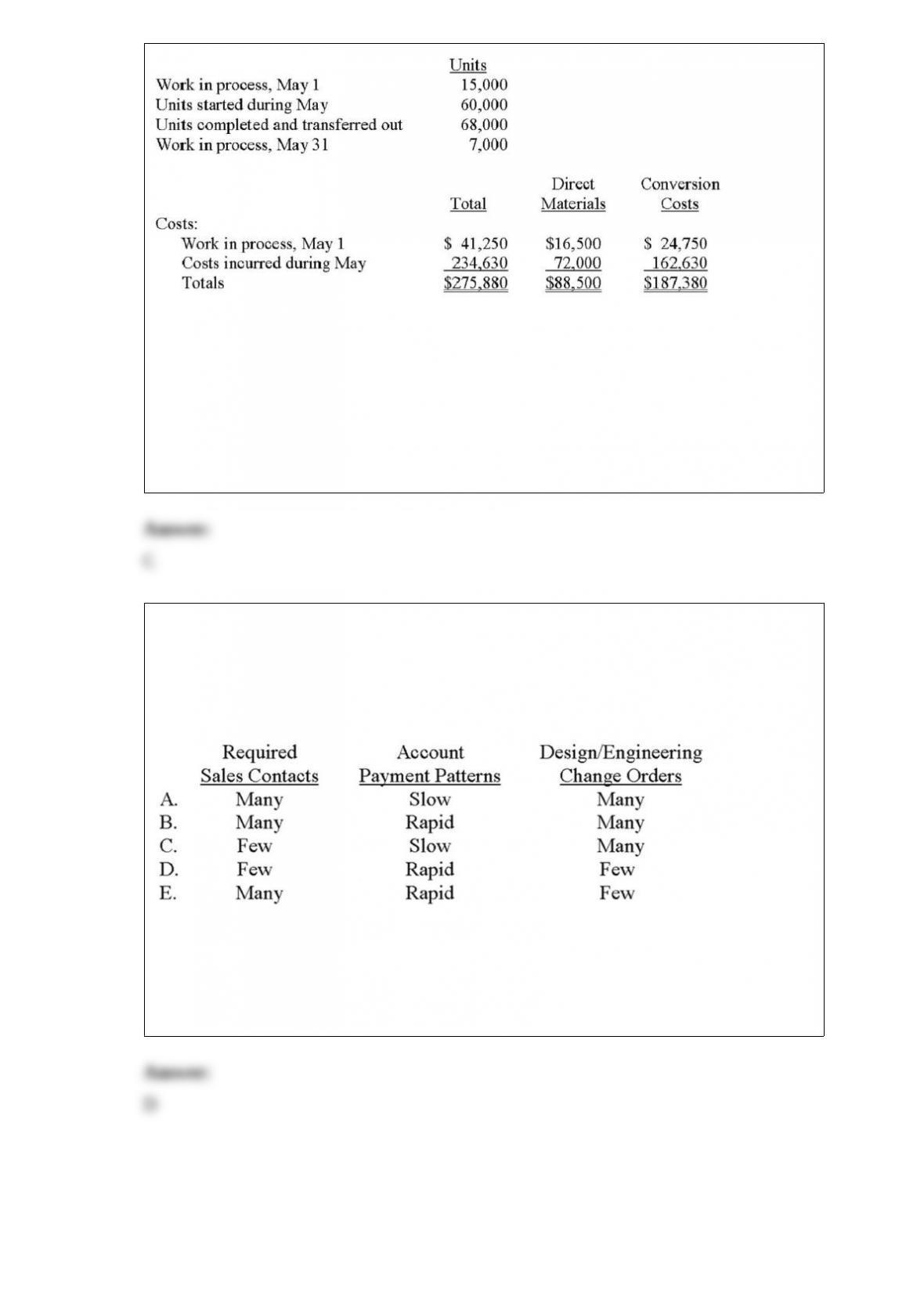
Using the weighted-average method of process costing, the equivalent units of
conversion activity total:
A.60,400
B.68,000
C.69,400
D.74,000
E.None of the answers is correct
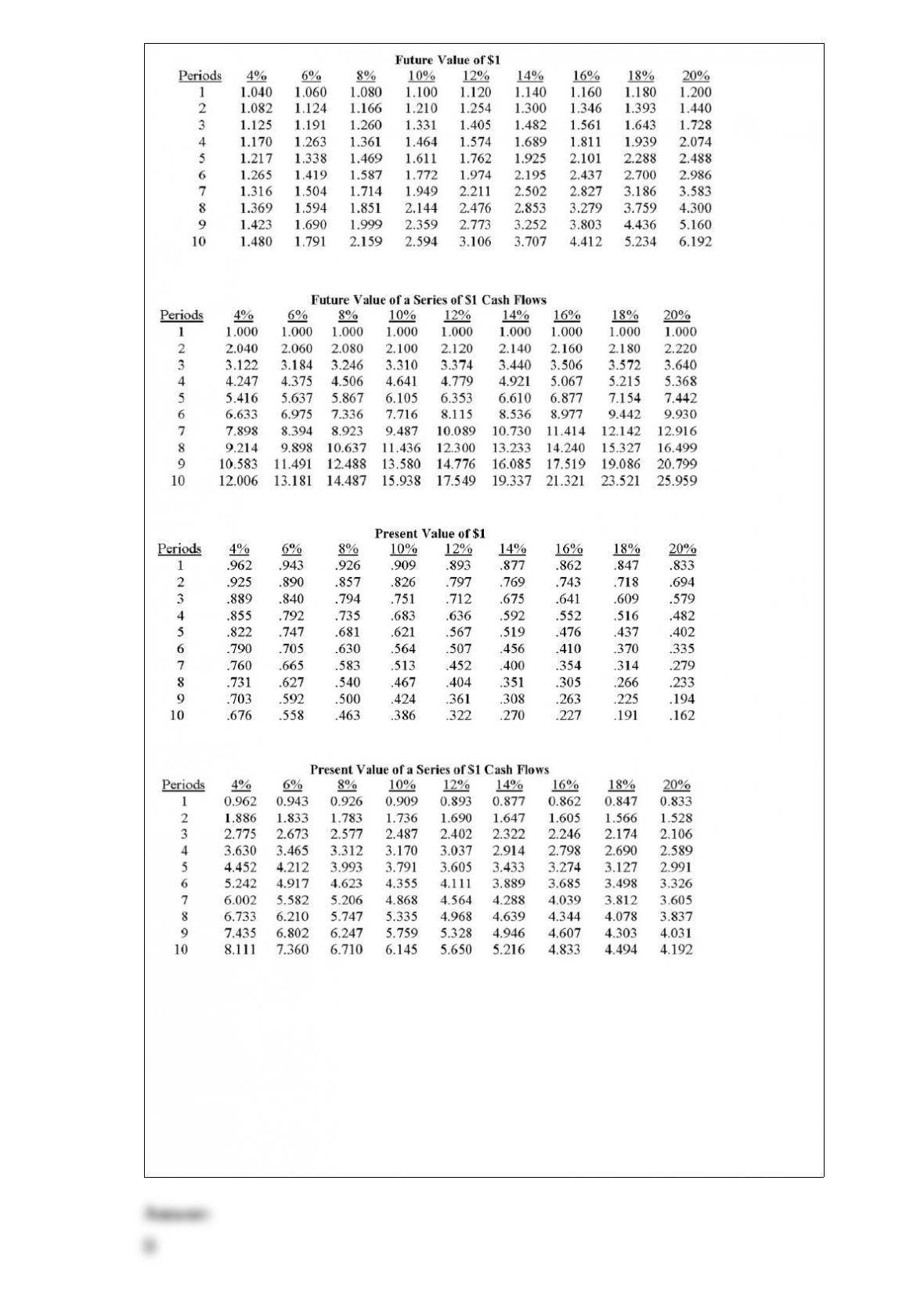
8) Hilton Corporation’s customers differ greatly with respect to number of required
sales contacts (e.g., phone calls and sales visits), account payment patterns, and
design/engineering change orders. Which of the following choices likely denotes an
ideal customer from Hilton’s perspective?
A.Choice A
B.Choice B
C.Choice C
D.Choice D
E.Choice E
9)
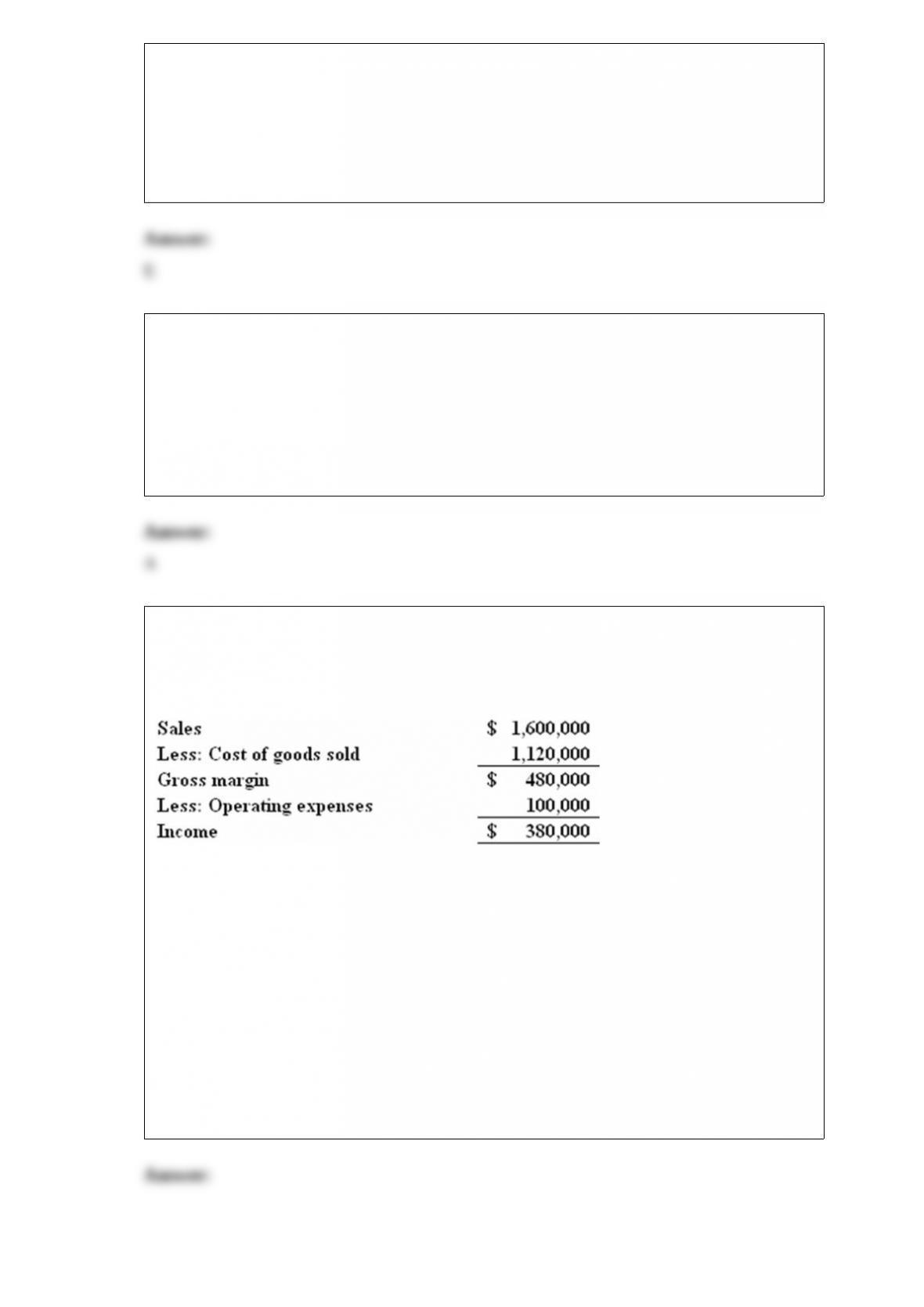
A new machine is expected to produce a MACRS deduction in three years of $50,000.
If the company has a 12% after-tax hurdle rate and is subject to a 30% income tax rate,
the correct discounted net cash flow to include in an acquisition analysis would be:
A.$0
B.$10,680
C.$24,920
D.$46,280
E.None of the other answers are correct
10) Which of the following entities would not likely be a user of job-costing systems?
A.Custom-furniture manufacturers
B.Repair shops
C.Hospitals
D.Accounting firms
E.None of these, because all are likely users
11) For external-reporting purposes, generally accepted accounting principles require
that net income be based on:
A.absorption costing
B.variable costing
C.direct costing
D.semivariable costing
E.activity-based costing
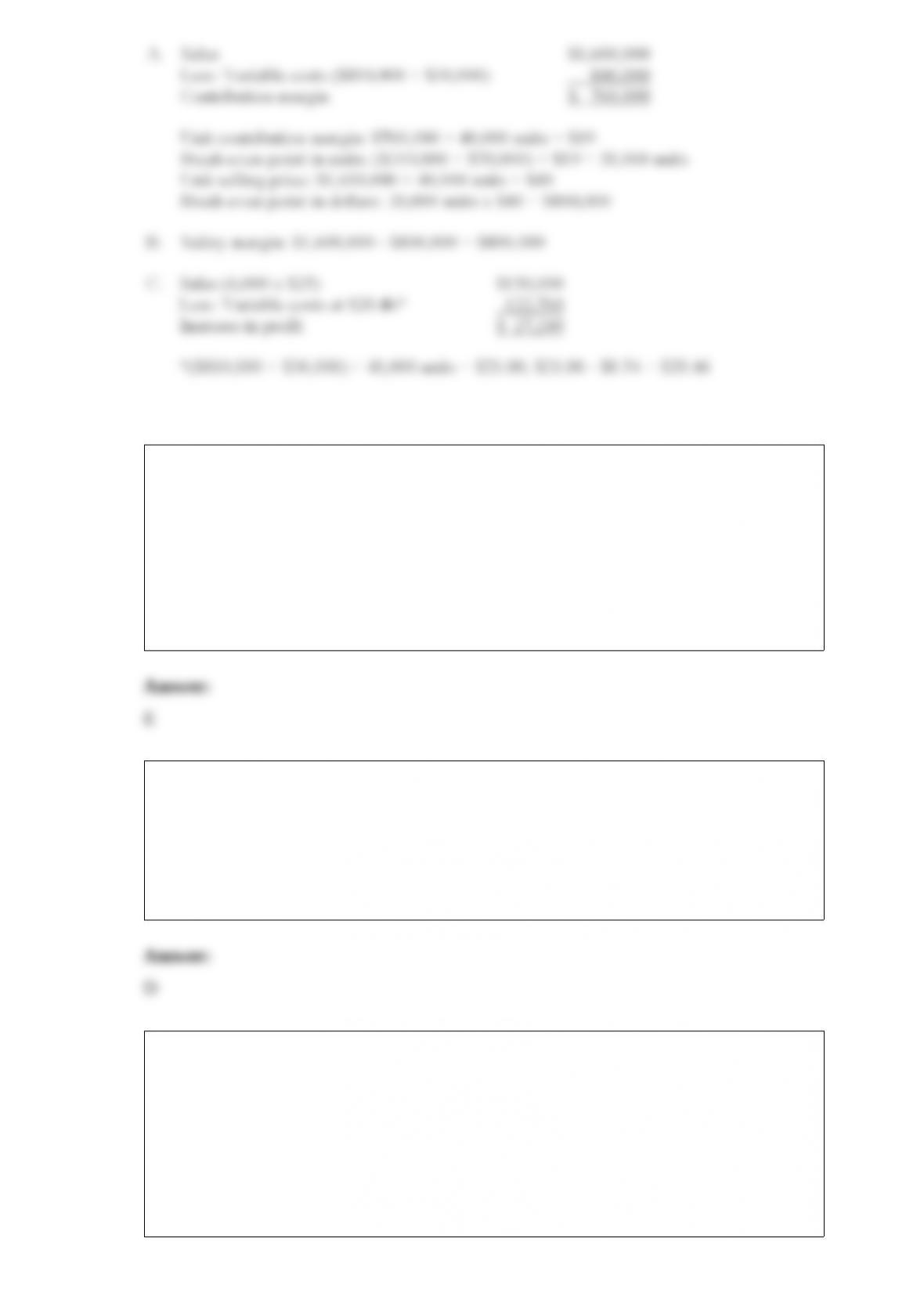
12) The Braggs & Strutting’ Company manufactures an engine for carpet cleaners
called the “Snooper.” Budgeted cost and revenue data for the “Snooper” are given
below, based on sales of 40,000 units.
Cost of goods sold consists of $810,000 of variable costs and $310,000 of fixed costs.
Operating expenses consist of $30,000 of variable costs and $70,000 of fixed costs.
Required:
A. Calculate the break-even point in units and sales dollars.
B. Calculate the safety margin (in dollars).
C. Braggs &Struttin’ received an order for 6,000 units at a price of $25.00. There will
be no increase in fixed costs, but variable costs will be reduced by $0.54 per unit
because of cheaper packaging. Determine the projected increase or decrease in profit
from the order, assuming there is no opportunity costs.
13) Which of the following outcomes is (are) sometimes associated with participative
budgeting?
A.Employees make little effort to achieve budgetary goals
B.Budget preparation time can be somewhat lengthy
C.The problem of budget padding may arise
D.Financial modeling becomes much more difficult to undertake
E.Budget preparation time can be somewhat lengthy and the problem of budget padding
may arise
14) Which of the following is not an element of competency?
A.To develop appropriate knowledge about a particular subject
B.To perform duties in accordance with relevant laws
C.To perform duties in accordance with relevant technical standards
D.To refrain from engaging in an activity that would discredit the accounting profession
E.To prepare clear reports after an analysis of relevant and reliable information
15) Othello Manufacturing incurred $106,000 of direct labor and $11,000 of indirect
labor. The proper journal entry to record these events would include a debit to Work in
Process for:
A.$0 because Work in Process should be credited
B.$0 because Work in Process is not affected
C.$11,000
D.$106,000
E.$117,000
16) A company’s hurdle rate is generally influenced by:
A.the cost of capital
B.the firm’s depreciable assets
C.whether management uses the net-present-value method or the internal-rate-of-return
method
D.project risk
E.Both the cost of capital and project risk
17) A restaurant’s value chain includes:
A.only the restaurant
B.only upstream contributors
C.only downstream contributors
D.all of the other answers
E.both up and downstream contributors
18) The Pro Division of Custom Industries is in need of a particular service. The service
can be obtained from another division of Custom at “cost,” with cost defined as the
summation of variable cost ($9) and fixed cost ($3). Alternatively, Pro can secure the
service from a source external to Custom for $10. Which of the following statements is
true?
A.Pro should compare $10 versus $3 in deciding where to acquire the service
B.Pro should compare $10 versus $9 in deciding where to acquire the service
C.Pro should compare $10 versus $12 in deciding where to acquire the service
D.From Custom’s perspective, the proper decision is reached by comparing $10 versus
$9
E.Pro should both compare $10 versus $12 in deciding where to acquire the service and
from Custom’s perspective; the proper decision is reached by comparing $10 versus $9
19) Narchie sells a single product for $50. Variable costs are 60% of the selling price,
and the company has fixed costs that amount to $400,000. Current sales total 16,000
units.
Narchie:
A.will break-even by selling 8,000 units
B.will break-even by selling 13,333 units
C.will break-even by selling 20,000 units
D.will break-even by selling 1,000,000 units
E.cannot break-even because it loses money on every unit sold
20) At the end of the accounting period, most companies close variance accounts to:
A.Raw-Material Inventory
B.Work-in-Process Inventory
C.Finished-Goods Inventory
D.Cost of Goods Sold
E.Income Summary
21) West Coast Electronics (WCE) operates 87 stores and has three divisions:
California, Oregon, and Washington. Which of the following costs would not appear on
Oregon’s portion of WCE’s segmented income statement?
A.Costs related to statewide advertising contracts, negotiated by Oregon’s divisional
manager
B.Variable sales commissions paid to Oregon’s salespeople
C.Compensation paid to Oregon’s chief operating officer, as determined by WCE’s
management
D.Oregon’s allocated share of general WCE corporate overhead
E.Compensation paid to Oregon’s chief operating officer, as determined by WCE’s
management and Oregon’s allocated share of general WCE corporate overhead
22) Heartfelt Bank & Trust operates in a very competitive marketplace, using a
traditional labor-hour-based system to determine the cost of processing its mortgage
loans. Recently, the firm explored a switch to activity-based costing to determine the
wisdom of its previous ways. The following information is available:
Two loan applications, among many others, were originated and closed during the year.
No. 7439 consumed 3.5 hours in loan underwriting and 1.5 hours in loan closure, for a
total of 5.0 hours. No. 7809 also required 5.0 hours of time, subdivided as follows: 2.0
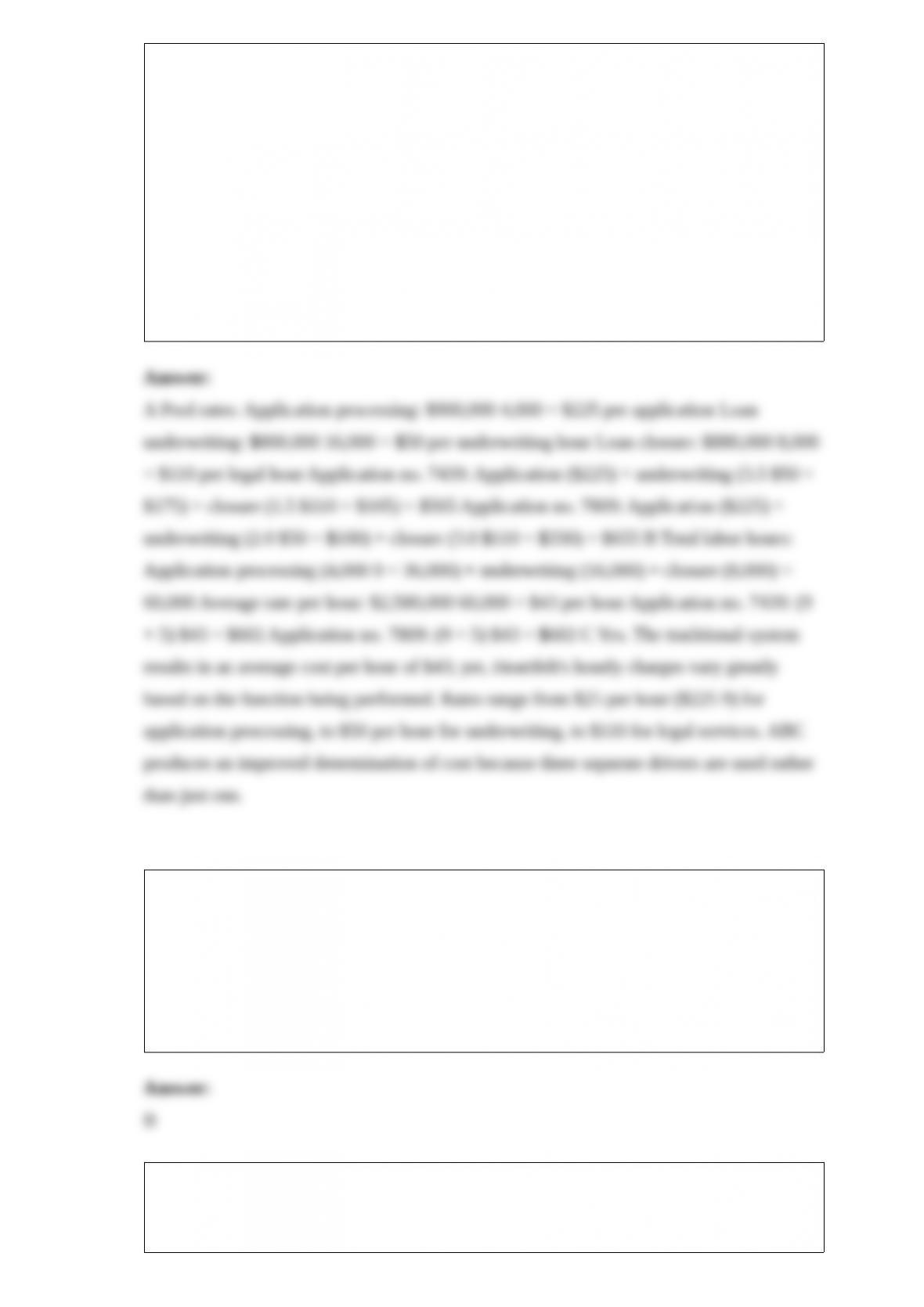
hours in loan underwriting and 3.0 hours in loan closure.
Required:
A. Use an activity-based-costing system and determine the cost of processing,
underwriting, and closing the two loan applications.
B. Determine the cost of processing the two loans if Heartfelt uses the traditional
labor-hour-based system. Conversations with management found that, on average, each
application took nine labor hours of processing time, excluding underwriting and
closure.
C. Is Heartfelt making a mistake by continuing to use a traditional system that is based
on an average labor cost per hour? Why?
23) The manufacturing overhead applied to Work-in-Process Inventory by a company
that uses standard costing would be computed as:
A.actual hours times a predetermined (standard) overhead rate
B.standard hours times a predetermined (standard) overhead rate
C.actual hours times an actual overhead rate
D.standard hours times an actual overhead rate
E.$0, because users of standard costing do not apply overhead to work in process
24) In an effort to reduce record-keeping, companies that sell perishable goods will
often enter the standard cost of direct material, direct labor, and manufacturing
overhead directly into what account?
A.Work-in-Process Inventory
B.Finished-Goods Inventory
C.Cost of Goods Sold
D.Cost of Goods Manufactured
E.Sales Revenue
25) Denver Enterprises recently used 14,000 labor hours to produce 7,500 completed
units. According to manufacturing specifications, each unit is anticipated to take two
hours to complete. The company’s actual payroll cost amounted to $158,200. If the
standard labor cost per hour is $11, Denver’s labor efficiency variance is:
A.$11,000U
B.$11,000F
C.$11,300U
D.$11,300F
E.none of the other answers are correct
26) Which of the following statements is false?
A.In job-order costing, costs are accumulated by job order
B.In process costing, costs are accumulated by department
C.In process costing, the cost per unit in a department is found by spreading the period’s
manufacturing costs over the production activity
D.In process costing, the total cost of each unit is found by dividing the total factory
costs by the number of units completed
E.In job-order costing, the unit cost is found by dividing the job’s total cost by the job’s
total units
27) Chesley Corporation, which uses least-squares regression analysis, has derived the
following regression equation for estimates of manufacturing overhead: Y = 495,000 +
5.65X. Which of the following statements is true if the primary cost driver is machine
hours?
A.Total manufacturing overhead is represented by the variable “X”
B.The company anticipates $495,000 of fixed manufacturing overhead
C.”X” is commonly known as the dependent variable
D.”X” represents the number of machine hours
E.The company anticipates $495,000 of fixed manufacturing overhead and “X”
represents the number of machine hours
28) Lido manufactures A and B from a joint process (cost = $80,000). Ten thousand
pounds of B can be sold at split-off for $15 per pound or processed further at an
additional cost of $20,000 and later sold for $16. If Lido decides to process B beyond
the split-off point, operating income will:
A.increase by $10,000
B.increase by $20,000
C.decrease by $10,000
D.decrease by $20,000
E.decrease by $58,000
29) Kelly and Logan, an accounting firm, provides consulting and tax planning
services. For many years, the firm’s total administrative cost (currently $250,000) has
been allocated to services on the basis of billable hours to clients. A recent analysis
found that 65% of the firm’s billable hours to clients resulted from tax planning
services, while 35% resulted from consulting services.
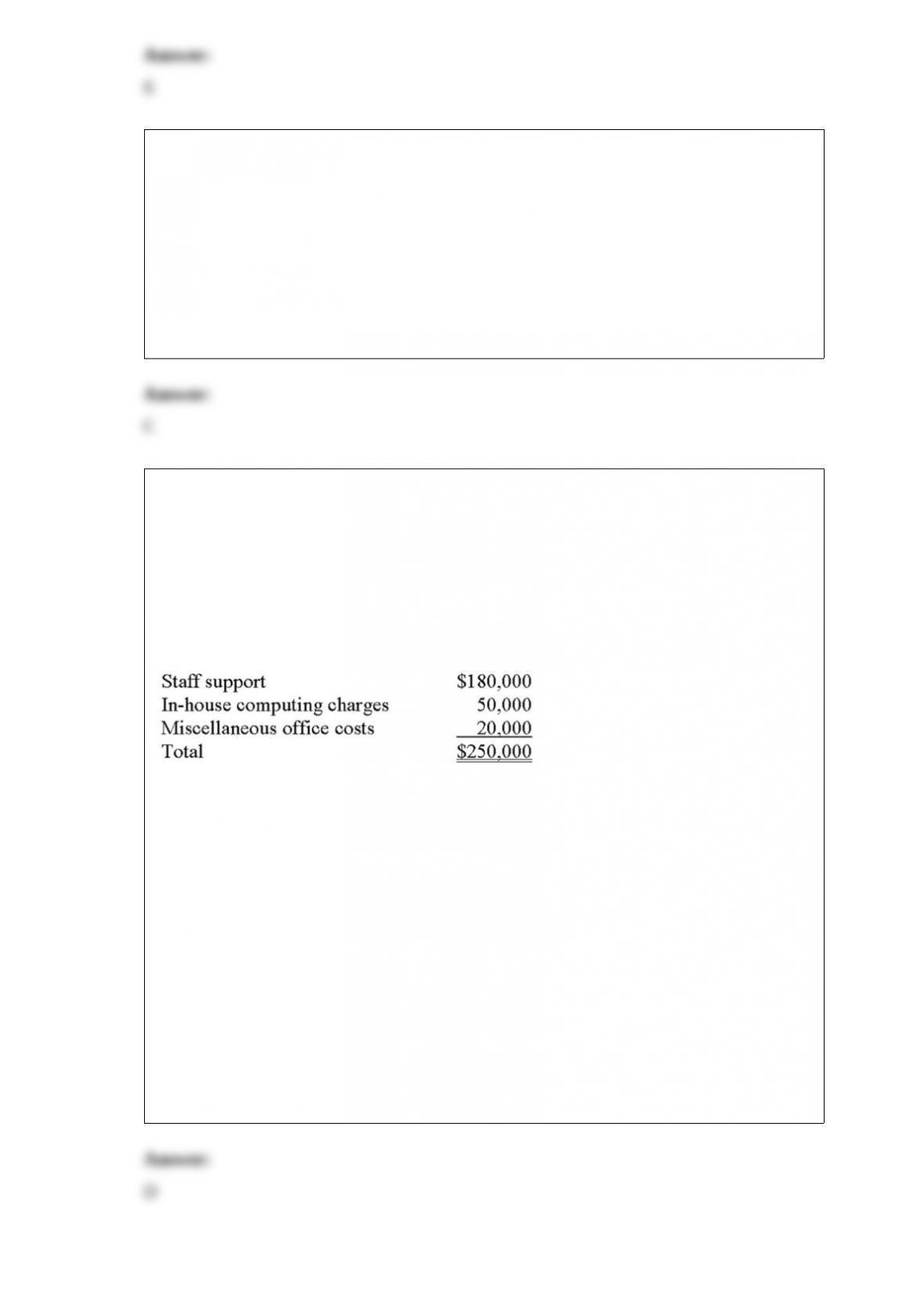
The firm, contemplating a change to activity-based costing, has identified three
components of administrative cost, as follows:
A recent analysis of staff support found a strong correlation between the number of staff
personnel and the number of clients served (consulting, 20; tax planning, 60). In
contrast, in-house computing and miscellaneous office cost varied directly with the
number of computer hours logged and number of client transactions, respectively.
Consulting consumed 30% of the firm’s computer hours and had 20% of the total client
transactions.
Assuming the use of activity-based costing, the proper percentage to use in allocating
staff support costs to tax planning services is:
A.20%
B.60%
C.65%
D.75%
E.80%
30) In an activity-based costing system, materials receiving would typically be
classified as a:
A.unit-level activity
B.batch-level activity
C.product-sustaining activity
D.facility-level activity
E.period-level activity
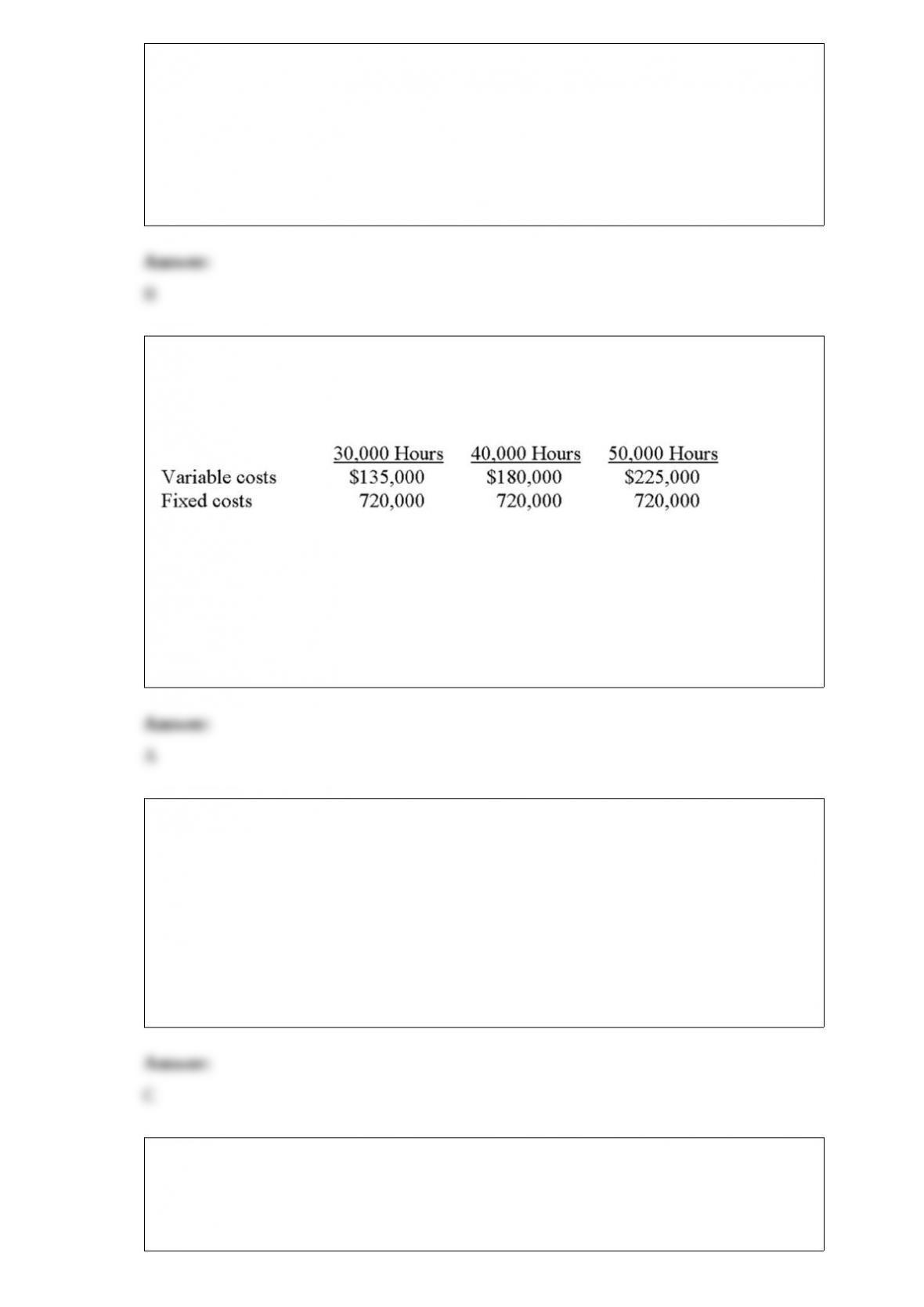
31) Young Corporation has a high probability of operating at 40,000 activity hours
during the upcoming period, and lower probabilities of operating at 30,000 hours and
50,000 hours. The company’s flexible budget revealed the following:
If Young operated at 35,000 hours, its total budgeted cost would be:
A.$877,500
B.$945,000
C.$787,500
D.$997,500
E.$810,000
32) Yang Corporation recently computed total product costs of $567,000 and total
period costs of $420,000, excluding $35,000 of sales commissions that were overlooked
by the company’s administrative assistant. On the basis of this information, Yang’s
income statement should reveal operating expenses of:
A.$35,000
B.$420,000
C.$455,000
D.$567,000
E.$602,000
33) In a process-costing system, manufacturing costs are accumulated by:
A.batch
B.batch and time period
C.department
D.department and time period
E.department or process, and time period
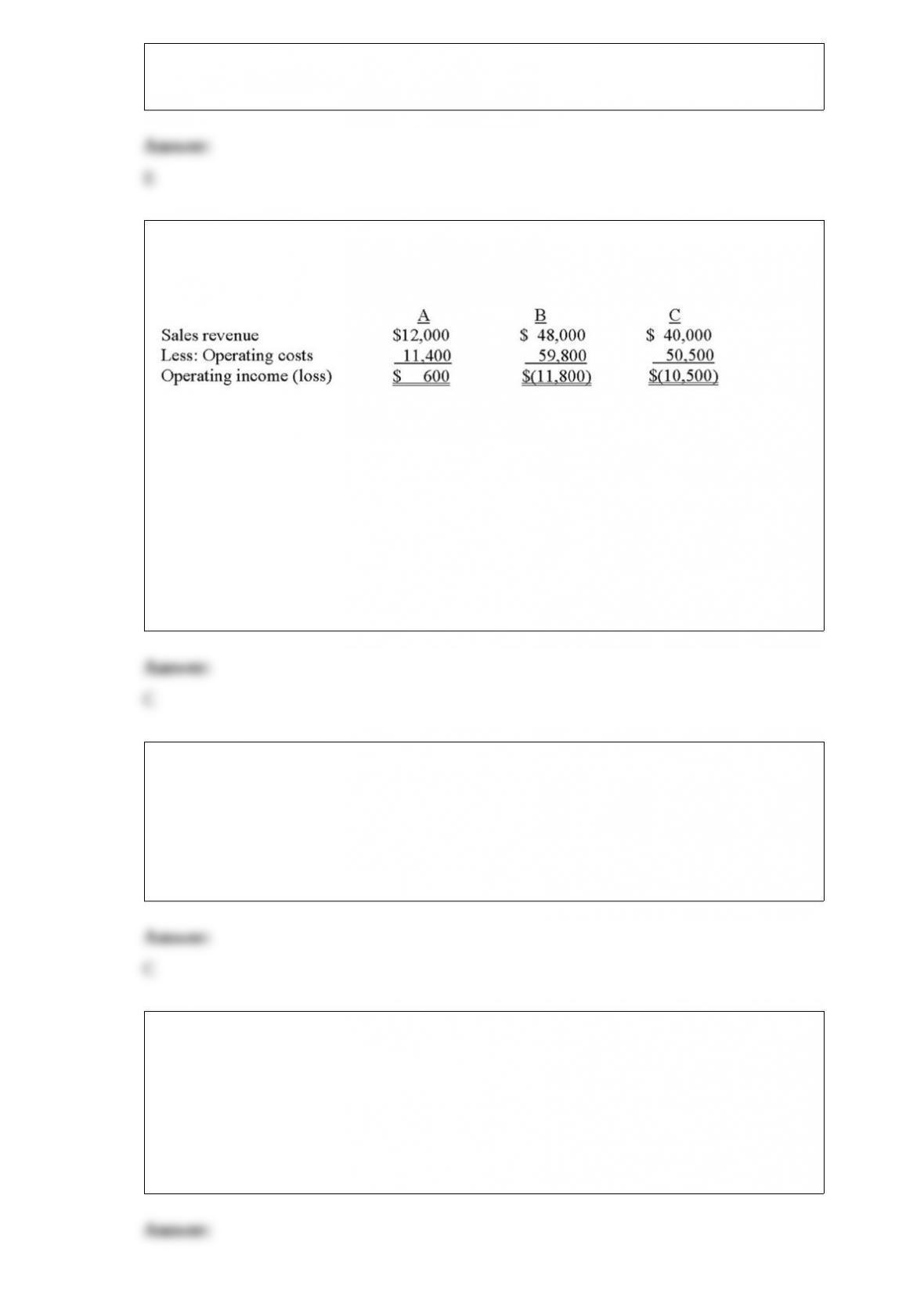
34) Klein Enterprises, which has three departments, recently reported the following
results:
The company incurred variable operating costs as well as $25,000 of fixed operating
costs. The $25,000 amount was allocated to A, B, and C on the basis of sales revenue
and is included in the cost figures noted above. Which department(s), if any, should be
closed if none of the fixed operating costs can be avoided?
A.Department A
B.Department B
C.Department C
D.Departments B and C
E.None of the departments should be closed
35) The cost of resources supplied but unused is known as:
A.practical capacity costs
B.the cost of theoretical capacity
C.the cost of unused capacity
D.the cost of resources supplied
E.capacity cost
36) The provisions of section 302 of the Sarbanes-Oxley Act (as originally enacted)
require the signing officers of a company to do all of the following except:
A.Audit the internal controls over financial reporting
B.Establish the internal controls over financial reporting
C.Maintain the internal controls over financial reporting
D.Evaluate the internal controls over financial reporting
E.Disclose material weaknesses in the internal controls over financial reporting