1) due to fewer regulations domestic banks are able to offer a narrower spread than
eurobanks.
2) pegging exchange rates at fixed levels by buying and selling to maintain the fixed
rate by the central bank means that domestic and foreign currency interest rates will
have to adjust to parity levels.
3) under the fixed exchange rate, inflation from one country can be transmitted to the
other country.
4) forward-looking market instruments are used to reduce traders currency risk.
5) the risk present in all investment opportunities is known as systematic risk.
6) assume perfect capital mobility and floating exchange rates. then, if the central bank
increases money supply, the domestic currency will _______ and cause the is curve to
________.
a.appreciate, shift to the right
b.appreciate, shift to the left
c.depreciate, shift to the right
d.depreciate, shift to the left
7) a u.s. importer has to pay skr1 million to a swedish firm in 60 days. the current spot
rate is $0.5 per swedish krona, and the 60-day forward rate is $0.65. bob forecasts that
the spot rate in 60 days will be $0.45. jane forecasts that the spot rate will be $0.85 in
60 days. the actual spot rate in 60 days turns out to be $0.68. if the u.s. importer
believes janes forecast, it would:
a.buy skr in the forward market at $0.65
b.wait and buy skr 60 days later at $0.68
c.buy skr now at $0.68 and let it sit in the companys safe
d.wait and buy skr in the forward market 60 days later at $0.65
8) exposure from the uncertain currency value of a foreign-denominated transaction to
be completed at some future date describes:
a.information exposure
b.translation exposure
c.transaction exposure
d.economic exposure
9) typically, a financial crisis tends to happen after:
a.massive influx of capital flows
b.chronic balance of trade deficits
c.a large depreciation causing a sudden increase in the local currency value of
international debts denominated in other currencies
d.all of the above
10) assume a nominal interest rate on one-year u.s. treasury bills of 5.30% and a real
rate of interest of 1.50%. using the fisher effect equation, what is the approximate
expected rate of inflation in the u.s. over the next year?
a. 3.80%
b.3.53%
c.3.80%
d.6.80%
11) the exchange rate can overshoot its long-run value because the ________ are
sluggish in the short run, whereas the __________ adjust instantaneously to a shock.
a.prices in goods and services markets; prices in assets markets
b.foreign exchange markets; prices in assets markets
c.prices in assets markets; prices in goods and services markets
d.prices in bond markets; money balance markets
12) the u.s. dollar is called a ________ because it is often used as a medium of
exchange in international markets.
a.transit currency
b.main currency
c.reserve currency
d.target currency
13) assume that the expected returns of the four portfolios are the same but their
variances are as follows. which of these four portfolios is the most risky?
a.0.015
b.0.020
c.0.150
d.0.095
14) the equivalence of the percentage change in the exchange rate to the inflation
differential between countries is referred to as the:
a.absolute ppp
b.relative ppp
c.interest rate parity
d.none of the above
15) table 6-2: spot and forward exchange rates on may 5, 2012
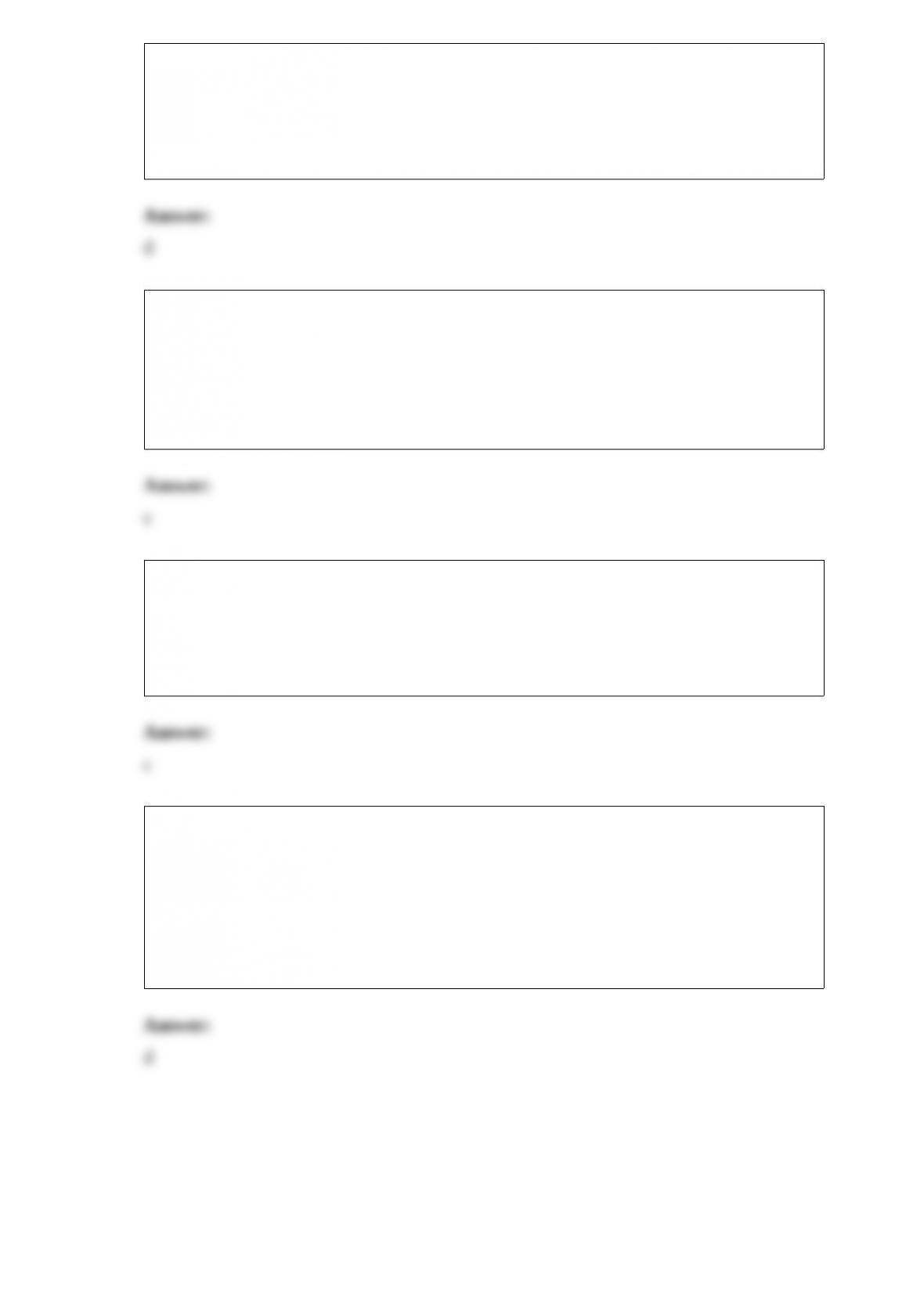
refer to table 6-2. on may 5, 2012, the 3-month forward yen was selling at a:
a.13.10% premium per annum against the dollar
b.52.40% premium per annum against the dollar
c.13.10% discount per annum against the dollar
d.52.40% discount per annum against the dollar
16) divisions in u.s. banks that are permitted to engage in eurocurrency type banking in
dollars with foreign residents are called ________.
a.foreign advisories
b.offshore banking centers
c.international banking facilities
d.foreign currency specialists
17) a forward flat occurs when:
a.the forward rate is greater than the spot rate
b.the spot rate is greater than the forward rate
c.the forward and spot rates are equal
d.none of the above
18) suppose the dollar price of thai baht (thb) is $0.025/thb. thai airways purchases a
$10 million airplane from boeing. this airplane would cost ___________ thai baht to
thai airways.
a.0.25 million
b.2.5 million
c.40 million
d.400 million