Show Place Decor has estimated quarterly sales for next year, starting with Quarter 1,
of $38,600, $53,400, $48,900, and $69,800. Purchases are equal to 62 percent of the
following quarter’s sales and the accounts payable period is 30 days. Assume each
month has 30 days. What is the estimated accounts payable balance at the end of
Quarter 2?
A. $10,106
B. $9,520
C. $11,624
D. $14,425
E. $14,200
A portfolio has an expected return of 13.4 percent. This portfolio contains two stocks
and one risk-free security. The expected return on Stock X is 12.2 percent and on Stock
Y it is 19.3 percent. The risk-free rate is 4.1 percent. The portfolio value is $48,000 of
which $10,000 is the risk-free security. How much is invested in Stock X?
A. $21,548.19
B. $19,514.14
C. $18,478.87
D. $22,200.14
E. $16,904.72
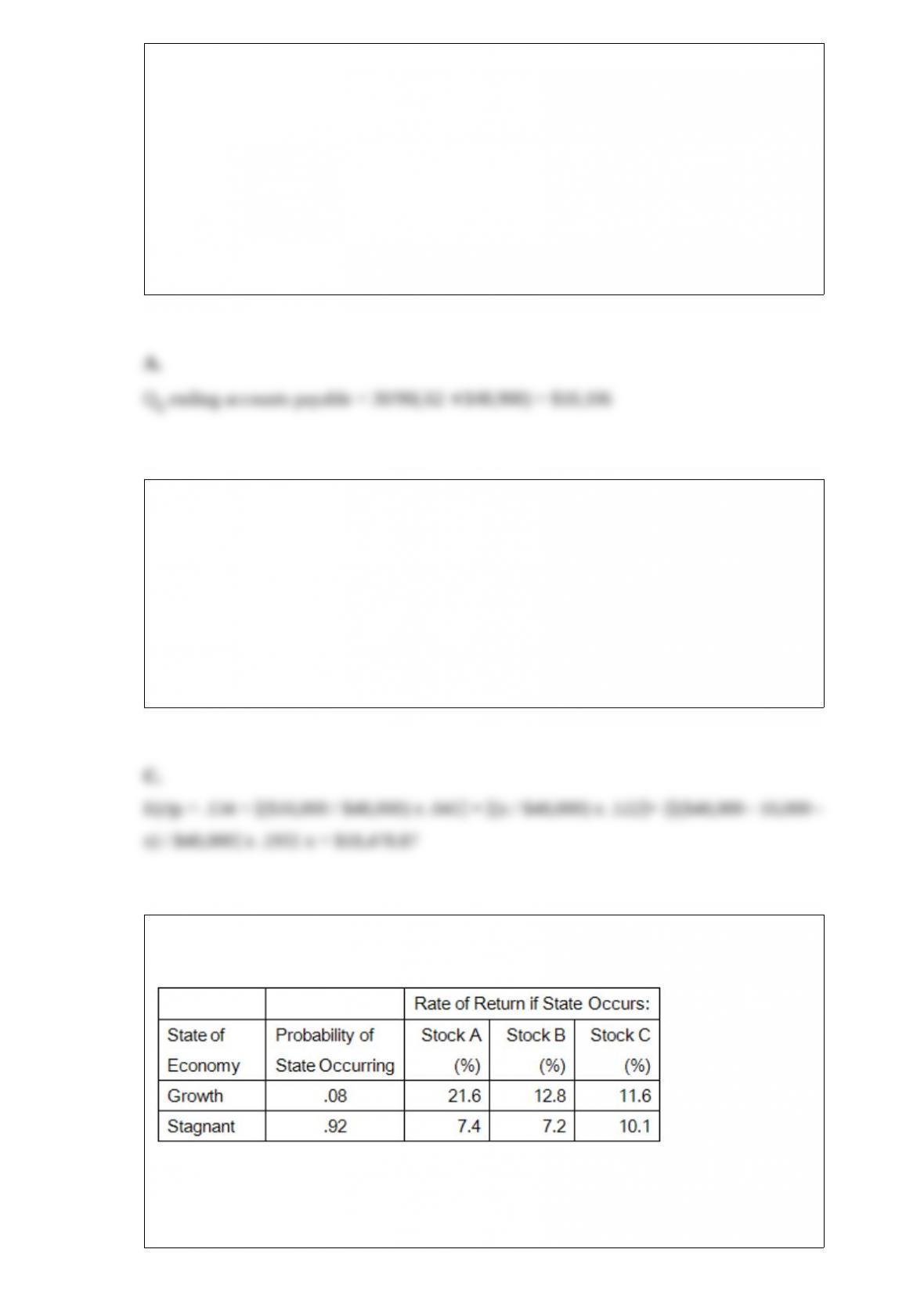
Given the following information, what is the standard deviation of the returns on a
portfolio that is invested 35 percent in both Stocks A and C, and 30 percent in Stock B?
A. 1.95 percent
B. 1.13 percent
C. 3.67 percent
D. 2.91 percent

E. 2.36 percent
Currently, you own 1.2 percent of the outstanding shares of Home Security. The firm
has decided to issue additional shares of stock and has given you the first option to
purchase 1.2 percent of those additional shares. What type of offer is this?
A. Rights offer
B. Red herring offer
C. Private placement
D. IPO
E. General cash offer
Which one of the following is least apt to limit the amount of cash dividends a firm can
pay?
A. Lack of retained earnings
B. A bankruptcy proceeding
C. A bond indenture covenant
D. State laws
E. Increasing stock price
Which statement is correct?
A. Bond markets have less daily trading volume than equity markets.
B. There are fewer bond issues outstanding than there are equity issues.
C. Municipal bond prices are highly transparent.
D. Bond markets are dealer based.
E. Most bond trades occur on the NYSE.

Stephen claims that he invested $6,000 six years ago and that this investment is worth
$28,700 today. For this to be true, what annual rate of return did he have to earn?
Assume the interest compounded annually.
A. 28.87 percent
B. 31.39 percent
C. 29.80 percent
D. 26.01 percent
E. 27.87 percent
Assume $1 = €.8036 = A$1.1757. What is the cross-rate for Australian dollars in terms
of euros?
A. A$1.1066/€1
B. A$1.2908/€1
C. A$1.3929/€1
D. A$1.4630/€1
E. A$1.5042/€1
Deep Water Marina has 12,000 shares of stock outstanding that were sold to the general
public last year. The firm has just decided to issue an additional 4,000 shares and will
make these shares available to the firm’s current shareholders before making any offer
to the general public. Which type of offer is this?
A. General cash offer
B. Rights offer
C. In-house offering
D. Private placement
E. Initial public offering

Generally speaking, bonds issued in the U.S. pay interest on a(n) _____ basis.
A. annual
B. semiannual
C. quarterly
D. monthly
E. daily
Assume the SEC approved the registration statement for a new securities issue this
morning. Which one of the following statements must be true about this issue?
A. The red herrings can finally be distributed as their distribution was awaiting SEC
approval.
B. The waiting period started when the approval was received this morning.
C. The SEC believes the issue will be a profitable investment for all purchases made at
the offer price.
D. The issuer is following all the required rules and regulations in regard to this issue.
E. The final prospectuses have all been delivered or the SEC would not have approved
the issue.
When you were born, your parents opened an investment account in your name and
deposited $1,500 into the account. The account has earned an average annual rate of
return of 5.3percent. Today, the account is valued at $42,856. How old are you?
A. 71.47 years
B. 70.67 years
C. 61.08 years
D. 67.33 years
E. 64.91 years
Phil and Terry started a new business three years ago. Two years ago, they incorporated
the business and issued themselves each 20,000 shares of stock. Last year, they took the
company public in an IPO and issued an additional 100,000 shares of stock at that time.
The offer price was $14 a share, the spread was 8 percent, and the lockup period was
six months. The stock closed at $17 a share at the end of the first day of trading. During

the first six months of trading, the stock had a price range of $13 to $23 per share.
During the second six months of trading, the stock sold between $15 and $21 per share.
Both Tracie and Amy purchased 100 shares at the offer price. Given this, which one of
the following statements is correct? Ignore trading costs and taxes.
A. Tracie could have earned a maximum profit of 100($23 – 17) on her investment.
B. Phil could have sold 5,000 shares at $23 per share.
C. The underwriters earned a spread per share equal to 8 percent of $17.
D. The maximum price at which Terry could have sold his shares is $21.
E. Amy paid 108 percent of $14 per share to purchase her 100 shares.
Systematic risk is defined as:
A. any risk that affects a large number of assets.
B. the total risk of an individual security.
C. diversifiable risk.
D. asset-specific risk.
E. the risk unique to a firm’s management.
Suppose a U.S. firm builds a factory in China, staffs it with Chinese workers, uses
materials supplied by Chinese companies, and finances the entire operation with a loan
from a Chinese bank located in the same town as the factory. This firm is most likely
trying to greatly reduce, or eliminate, which one of the following?
A. Interest rate disparities
B. Short-run exposure to exchange rate risk
C. Long-run exposure to exchange rate risk
D. Political risk associated with the foreign operations
E. Translation exposure to exchange rate risk
A firm’s float management policy is most apt to include which one of the following
statements?
A. All invoices are to be paid the same day they are received.
B. All outgoing checks are to be delivered by the fastest means possible.
C. The depository bank needs to process all deposits in accordance with the Check
Clearing Act for the 21<sup>st</sup> Century.
D. Any check received is to be held until the customer’s account has been updated to
record the payment.
E. Accounts payable processing should be given priority over accounts receivable
processing.
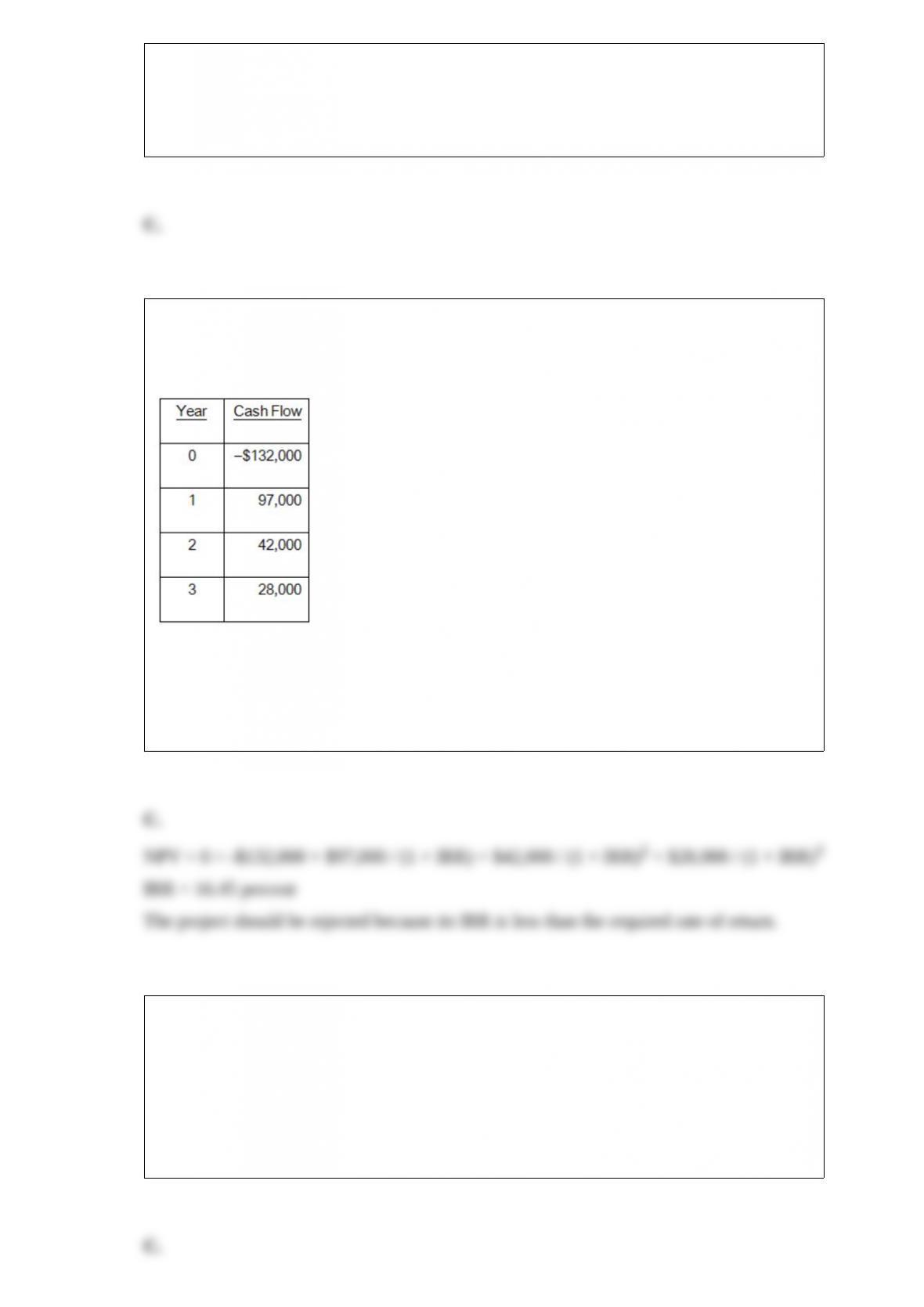
Soft and Cuddly is considering a new toy that will produce the following cash flows.
Should the company produce this toy based on IRR if the firm requires a rate of return
of 17.5 percent?
A. Yes, because the project’s rate of return is 16.45 percent
B. Yes, because the project’s rate of return is 11.47 percent
C. No, because the project’s rate of return is 16.45 percent
D. No, because the project’s rate of return is 11.47 percent
E. No, because the internal rate of return is zero percent
Which one of the following is an indicator that an investment is acceptable? Assume
cash flows are conventional.
A. Modified internal rate of return that is equal to zero
B. Profitability index of zero
C. Internal rate of return that exceeds the required return
D. Payback period that exceeds the required period
E. Negative average accounting return
Caitlyn is interested in purchasing 1,500 shares of ABC, Inc., when the shares are
issued. Her broker just gave her a preliminary prospectus to review as she waits for the
shares to be cleared for sale. What is the name of this prospectus?
A. Green Shoe
B. Rights offer
C. Red herring
D. Spread
E. Tombstone
Assume you can currently exchange $1 for ¥100. Also assume the inflation rate
will be 2.5 percent annually in the U.S. and 2 percent in Japan. Given these
assumptions, how many yen should you expect in exchange for $1 next year?
A. More than 100
B. Either 100 or more than 100
C. Exactly 100
D. Either 100 or less than 100
E. Less than 100
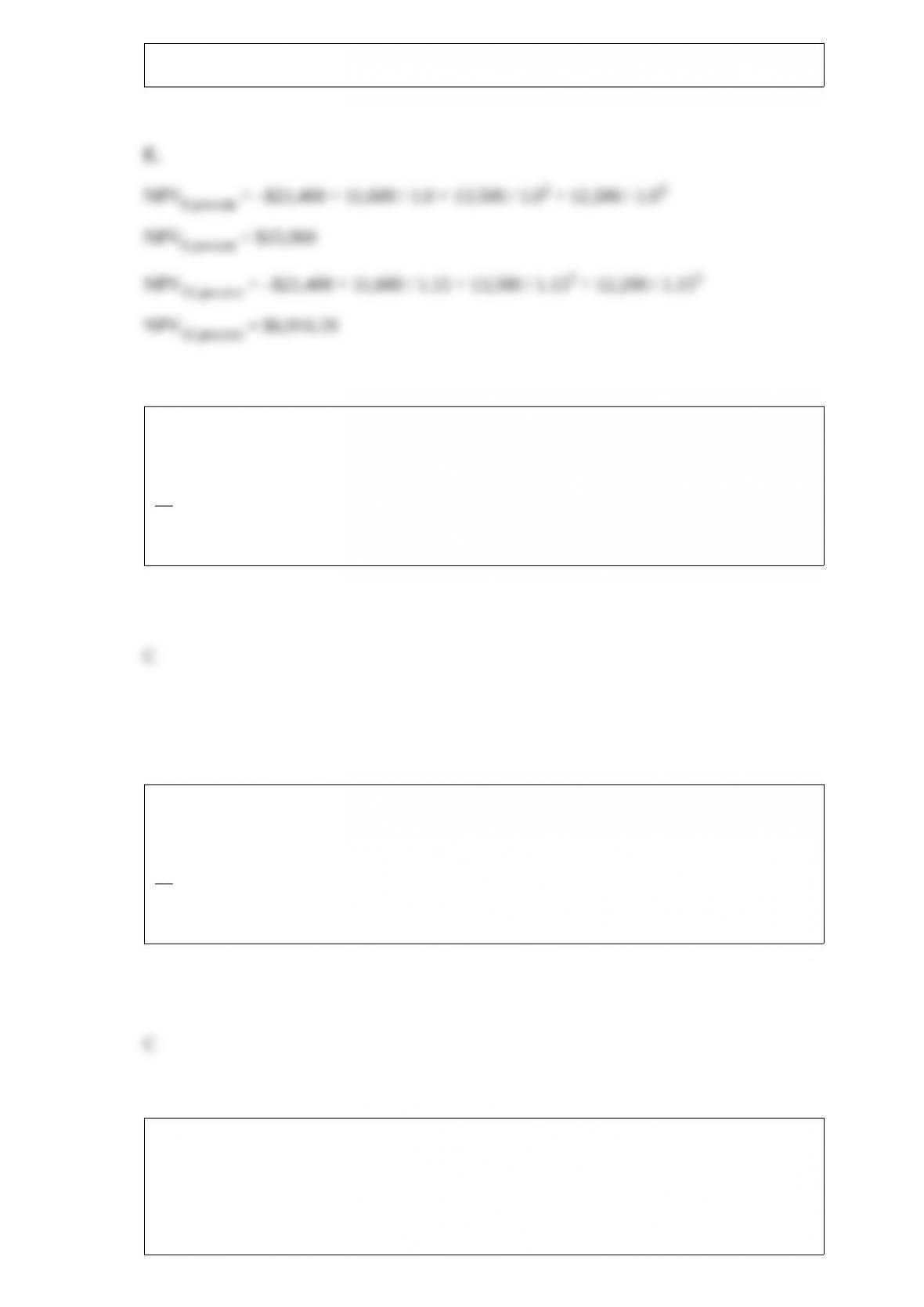
What is the NPV of the following set of cash flows at a discount rate of zero percent?
What if the discount rate is 15 percent?
A. $0; -$665.07
B. $0; $6,916.59
C. $0; $7,208.19
D. $15,900; $7,208.19
E. $15,900; $6,916.59
Which one of the following statements about a limited partnership is correct?
A. All partners have their losses limited to their capital investment in the partnership.
B. All partners are treated equally.
C. There must be at least one general partner.
D. Equity financing is easy to obtain and unlimited.
E. Any partner can transfer his or her ownership interest without ending the partnership.
Working capital management includes which one of the following?
A. Deciding which new projects to accept
B. Deciding whether to purchase a new machine or fix a currently owned machine
C. Determining which customers will be granted credit
D. Determining how many new shares of stock should be issued
E. Establishing the target debt-equity ratio
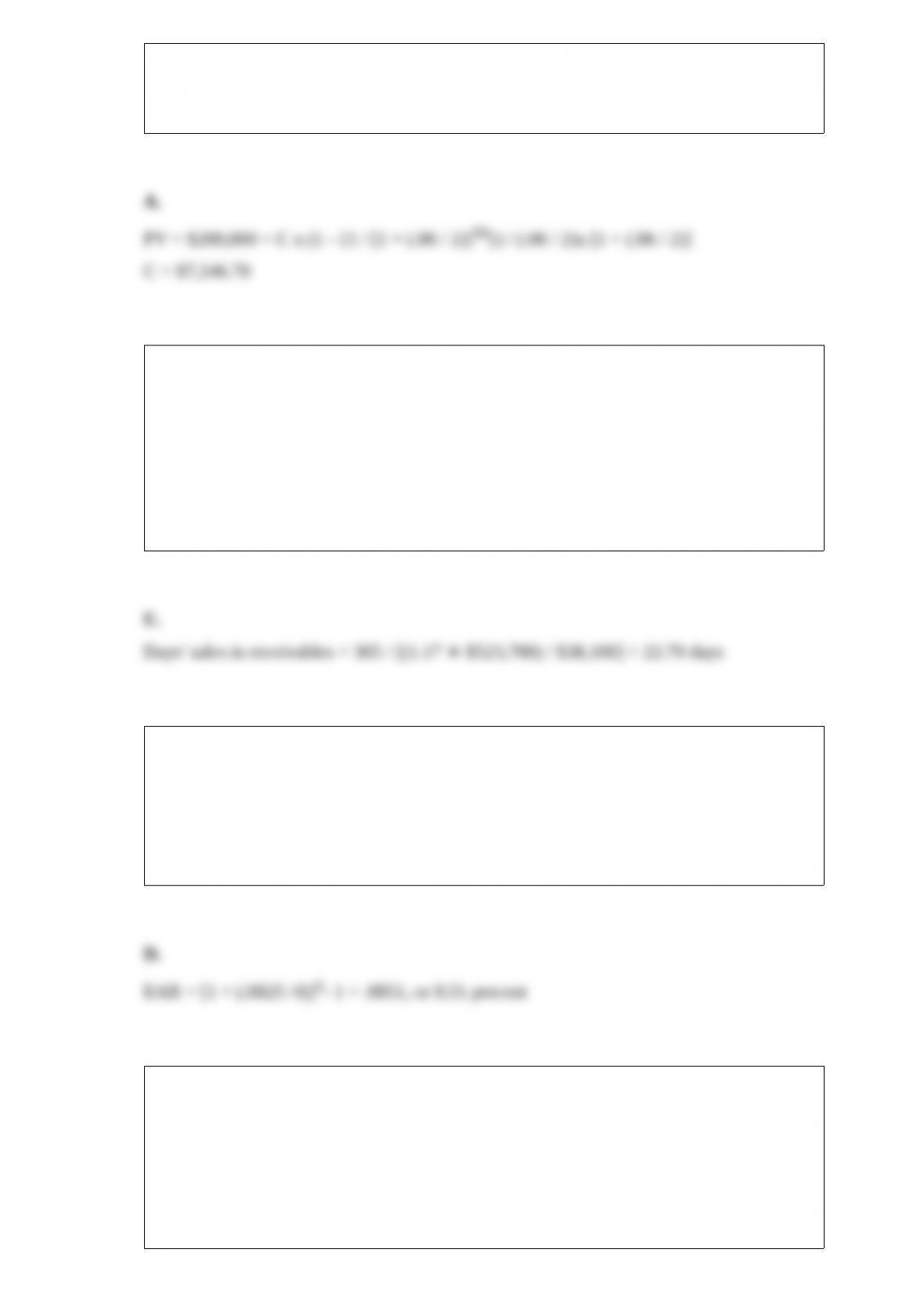
Uptown Insurance offers an annuity due with semiannual payments for 25 years at 6
percent interest. The annuity costs $200,000 today. What is the amount of each annuity
payment?
A. $7,546.70
B. $7,600.00
C. $7,773.10
D. $7,800.00
E. $7,856.25
Jessica’s Sports Wear has $38,100 in receivables and $523,700 in total assets. The total
asset turnover rate is 1.17 and the profit margin is 7.3 percent. How long on average
does it take to collect the receivables? Assume a 365-day year.
A. 26.91 days
B. 19.45 days
C. 11.68 days
D. 31.07 days
E. 22.70 days
What is the effective annual rate of 8.25 percent compounded quarterly?
A. 8.25 percent
B. 8.49 percent
C. 8.38 percent
D. 8.51 percent
E. 8.56 percent
A U.S. Treasury bond pays 3.05 percent interest. You are in the 28 percent marginal tax
bracket. What is your after tax yield on this bond?
A. 3.05 percent
B. 2.30 percent
C. 2.20 percent
D. 2.11 percent
E. 2.38 percent
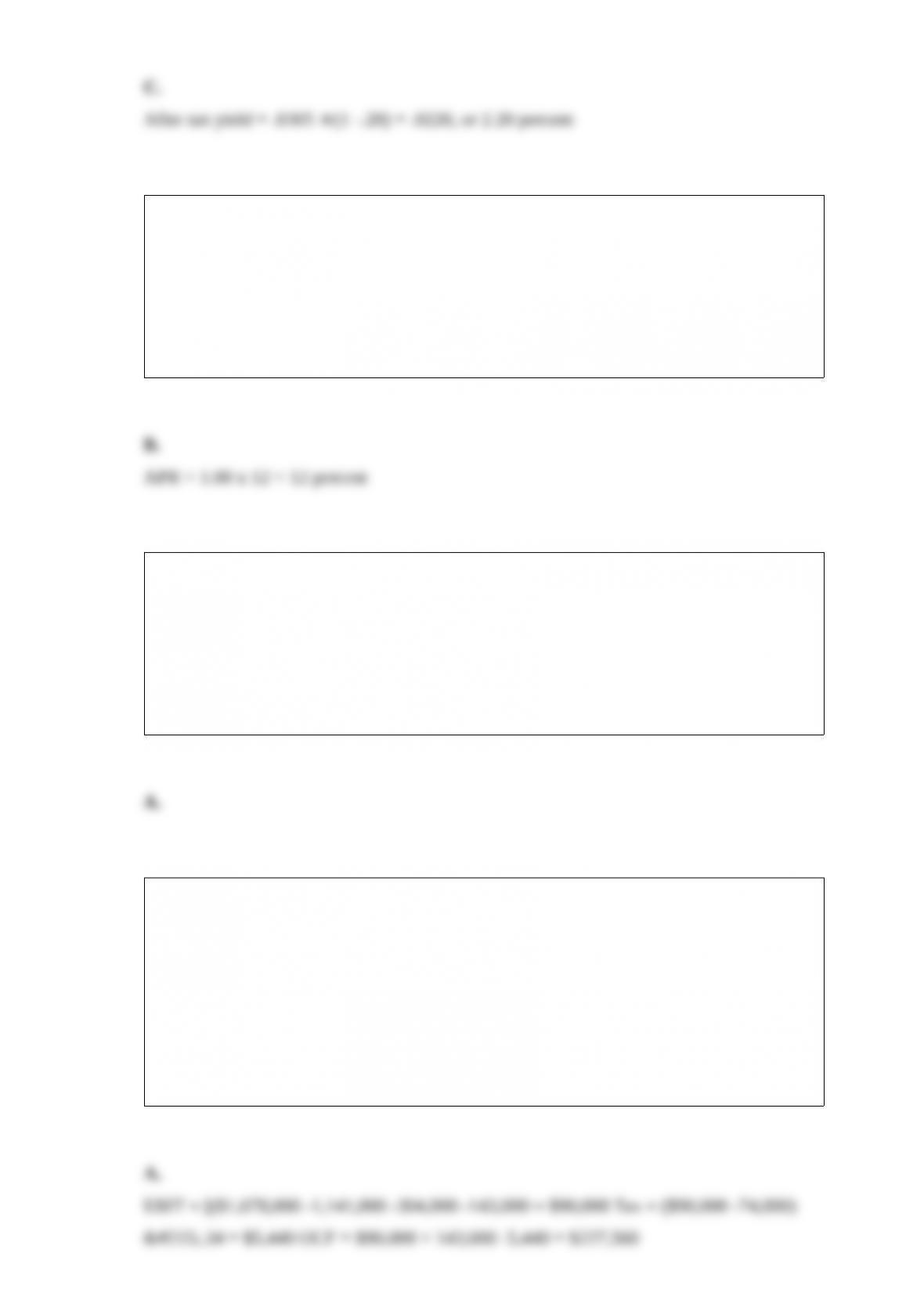
Your aunt loaned you money at 1.00 percent interest per month. What is the APR of this
loan?
A. 11.88 percent
B. 12.00 percent
C. 12.16 percent
D. 16.00 percent
E. 16.28 percent
The net present value:
A. decreases as the required rate of return increases.
B. is equal to the initial investment when the internal rate of return is equal to the
required return.
C. method of analysis cannot be applied to mutually exclusive projects.
D. ignores cash flows that are distant in the future.
E. is unaffected by the timing of an investment’s cash flows.
Dixie’s sales for the year were $1,678,000. Cost of goods sold, administrative and
selling expenses, and depreciation expenses were $1,141,000, $304,000, and $143,000,
respectively. In addition, the company had an interest expense of $74,000 and a tax rate
of 34 percent. What is the operating cash flow for the year?
A. $227,560
B. $271,420
C. $223,330
D. $285,400
E. $217,700
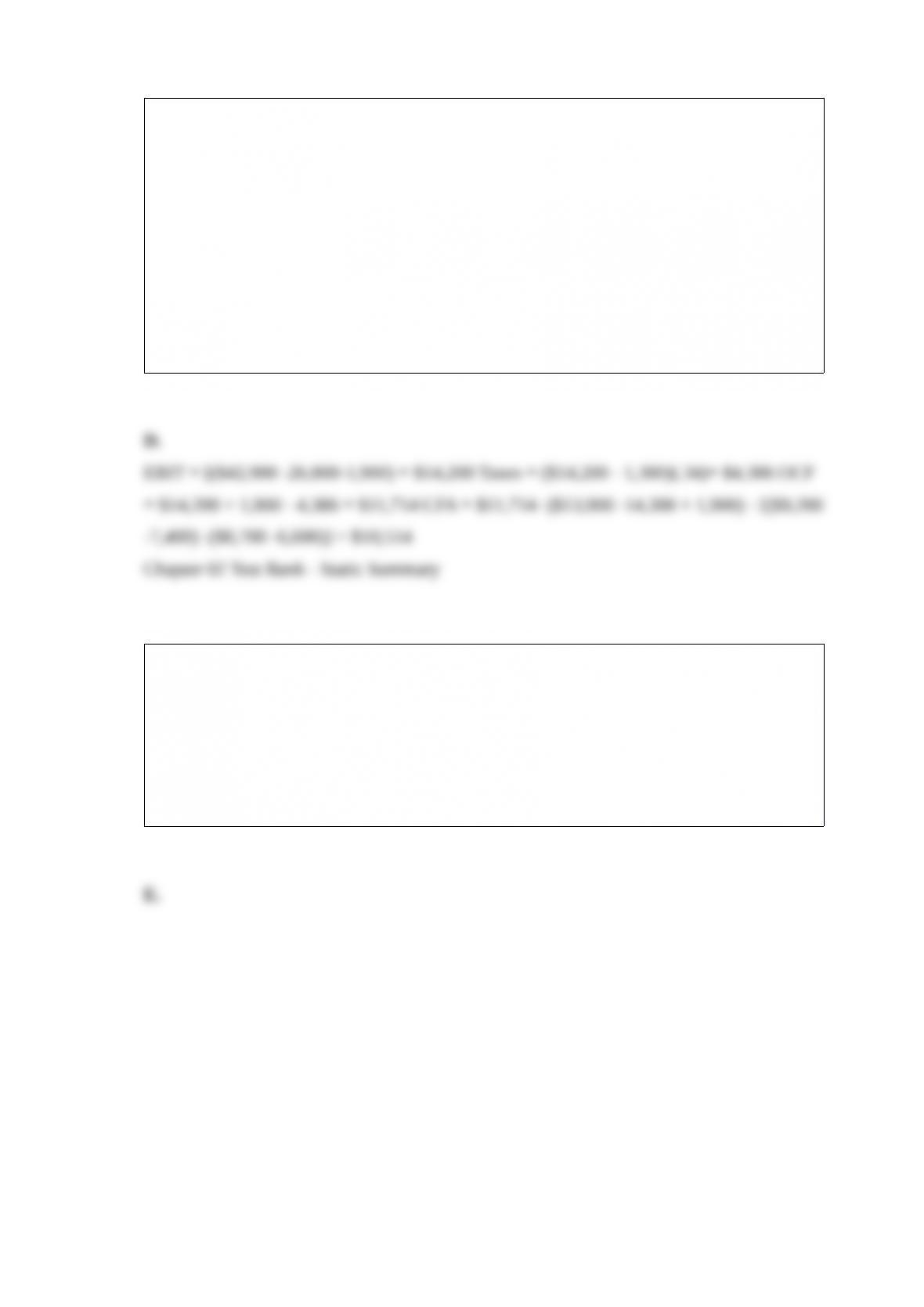
For Year 2016, Precision Masters had sales of $42,900, cost of goods sold of $26,800,
depreciation expense of $1,900, interest expense of $1,300, and dividends paid of
$1,000. At the beginning of the year, net fixed assets were $14,300, current assets were
$8,700, and current liabilities were $6,600. At the end of the year, net fixed assets were
$13,900, current assets were $9,200, and current liabilities were $7,400. The tax rate
was 34 percent. What is the cash flow from assets for 2016?
A. $9,914
B. $11,114
C. $9,360
D. $10,514
E. $11,970
One year ago, you purchased 600 shares of a stock. This morning you sold those shares
and realized a total return of 3.1 percent. Given this information, you know for sure the:
A. stock price increased by 3.1 percent over the last year.
B. stock increased in value over the past year.
C. stock paid a dividend.
D. dividend yield is greater than zero.
E. sum of the dividend yield and the capital gains yield is 3.1 percent.