
1) Eurodollars are U.S. dollars held on deposit by foreign banks.
2) Even though one project may have superior cash flows, top management may
sometimes choose a project that inflates earnings instead of cash flow.
3) At historically low interest rate levels, compensating balances increase.
4) Synergy is the greatest and most easily measured nonfinancial benefit in a merger.
5) Although ADRs are traded in the U.S. in dollars, foreign currency risk for the U. S.
investor remains.
6) A self-liquidating loan is preferable to a bank because it generally provides them
with a higher return.
7) In general, the average size of convertible issues is small compared to normal bond
issues.
8) Although the LIBOR has remained competitive and comparable to the U.S. prime

rate, it has remained slightly higher than the prime rate for over a decade.
9) A key variable of market efficiency is the certainty of the income stream. The most
efficient market is for corporate securities.
10) The 5 Cs of credit include “character, capital, capacity, conditions, and collateral.”
11) The future of the NYSE is uncertain due to their unwillingness to adapt to the
increase in internationalization and electronic trading in the markets.
12) Stability of dividends is not important to stockholders.
13) Assume that two companies both have a net income of $100,000. The firm with the
highest depreciation expense will have the highest cash flow, assuming all other
adjustments are equal.
14) Leveraged buyouts are restricted to “outside” tender offers.

15) The P/E ratio is strongly related to the past performance of the firm.
16) Working capital management is relatively unimportant for a small business.
17) Retained earnings represent an internal source of funds that is raised without the
payment of interest or cost to the firm’s stockholders.
18) Operating income is not the same thing as EBIT.
19) Satisfactory return on assets may be achieved through high profit margins or rapid
turnover of assets, but not a combination of both.
20) Match the following with the items below:
1>money market deposit account
2>5 Cs of credit
3>carrying cost
4>average collection period
5>electronic funds transfer
6>aging of accounts receivable
7>cash flow cycle
8>economic ordering quantity
9>money market fund

10>commercial paper
11>credit terms
12>passbook savings account
13>just-in-time (JIT)
14>safety stock
A. Allows the firm to minimize the total ordering and carrying costs associated with
inventory.
B. A system in which funds are moved between banks and other participating
corporations by use of a computer.
C. An unsecured promissory note issued by large corporations to investors.
D. Analyzing accounts based on the amount of time they have been on the books.
E. These assets reduce the risk of losing business to competitors because of low
inventory levels.
F. The repayment provisions associated with a credit arrangement.
G. The cost of holding an asset.
H. The amount of time that accounts receivable remains on our books.
I. Because it pays a low interest rate at a bank, this is an unattractive investment for
most investors.
J.Due to federal deregulation, commercial banks, savings and loans, and credit unions
are now allowed to offer these investment opportunities modeled from money market
funds.
K. The various factors that influence a company’s ability to borrow money.
L. A lean total production concept that produces quality products that minimize the
level of inventory by maintaining close ties with suppliers and distributors.
M. A process of generating cash which, although it remains continuous, is subject to
fluctuations in levels.
N. Investing opportunity that allows small investors to place funds into short-term
securities which they may not be able to buy directly because of the high funds
required.
21) When using the economic order quantity model
A.ordering costs increase as the level of inventory increases
B.carrying costs decrease as the level of inventory increases
C.costs are minimized when total carrying costs and total ordering costs are equal
D.None of the options
22) The principle device used by the corporation to force conversion
A.is setting the conversion price above the current market price
B.is reducing the amount of interest payments
C.is buying bonds back at below par value

D.is a call provision
23) Accounts receivable may be used as a source of financing by
A.pledging the receivables as loan collateral
B.”factoring” the receivables to a finance company
C.selling securities backed by the receivables
D.All of these options
24) Which of the following is NOT a method for controlling pledged inventory?
A.Blanket inventory liens
B.Floor planning
C.Public warehousing
D.Each of the above is an inventory control method
25) Firm X is considering the replacement of an old machine with one that has a
purchase price of $70,000. The current market value of the old machine is $18,000 but
the book value is $32,000. The firm’s tax rate for ordinary income is 30%. What is the
net cash outflow for the new machine after considering the sale of the old machine?
Disregard the effect of depreciation of the new machine if acquired.
A.$47,800
B.$38,000
C.$45,000
D.$40,100

26) Krager Foods Corp. has 650,000 shares outstanding. General Grocery, one of its
subsidiaries, is disgusted with current management practices and is trying to get some
of its own people elected to the board of directors. There are 12 directors, and General
Grocery owns 60,000 shares.
a) Under cumulative voting, how many directors can General Grocery elect?
b) How many shares will General Grocery have to acquire in order to elect seven
directors?
27) Kantorovich Company normally takes 30 days to pay for its average daily credit
purchases of $2,000. Its average daily sales are $3,000, and it collects accounts in 25
days. What is its net credit position?
A.$15,000
B.$1,000
C.($1,000)
D.($15,000)
28) A conservative financing plan involves
A.heavy reliance on debt
B.heavy reliance on equity

C.a high degree of financial leverage
D.a high degree of combined leverage
29) The percent-of-sales method of financial forecasting
A.is more detailed than a cash budget approach
B.requires more time than a cash budget approach
C.assumes that balance sheet accounts maintain a constant relationship to sales
D.provides a month-to-month breakdown of data
30) Assuming a tax rate of 40%, the after-tax cost of interest expense of $1,000,000 is
A.$1,000,000
B.$140,000
C.$600,000
D.$400,000
31) Corporate restructuring has been one result of more institutional ownership.
Restructuring can cause
A.changes in the assets and liabilities of the firm
B.the sale of low-profit margin divisions
C.the removal of current management and/or large reductions in the workforce
D.All of the options
32) Which of the following statements about the International Finance Corporation is
false?
A.The decision to assist a venture depends on both the profitability of the project and
the potential benefit to the host country’s economy
B.The IFC assumes no managerial responsibility and exercises no voting rights
C.The IFC may either buy equity shares or provide long-term loans
D.All of these options are true
33) When using the percent-of-sales method in forecasting the funds needed, which of
the following is not true?
A.As the dividend payout ratio increases, the required new funds also increase
B.Required new funds decrease as profit margin increases
C.Required new funds increase as the dividend payout decreases
D.As the tax rate increases, the required new funds increase
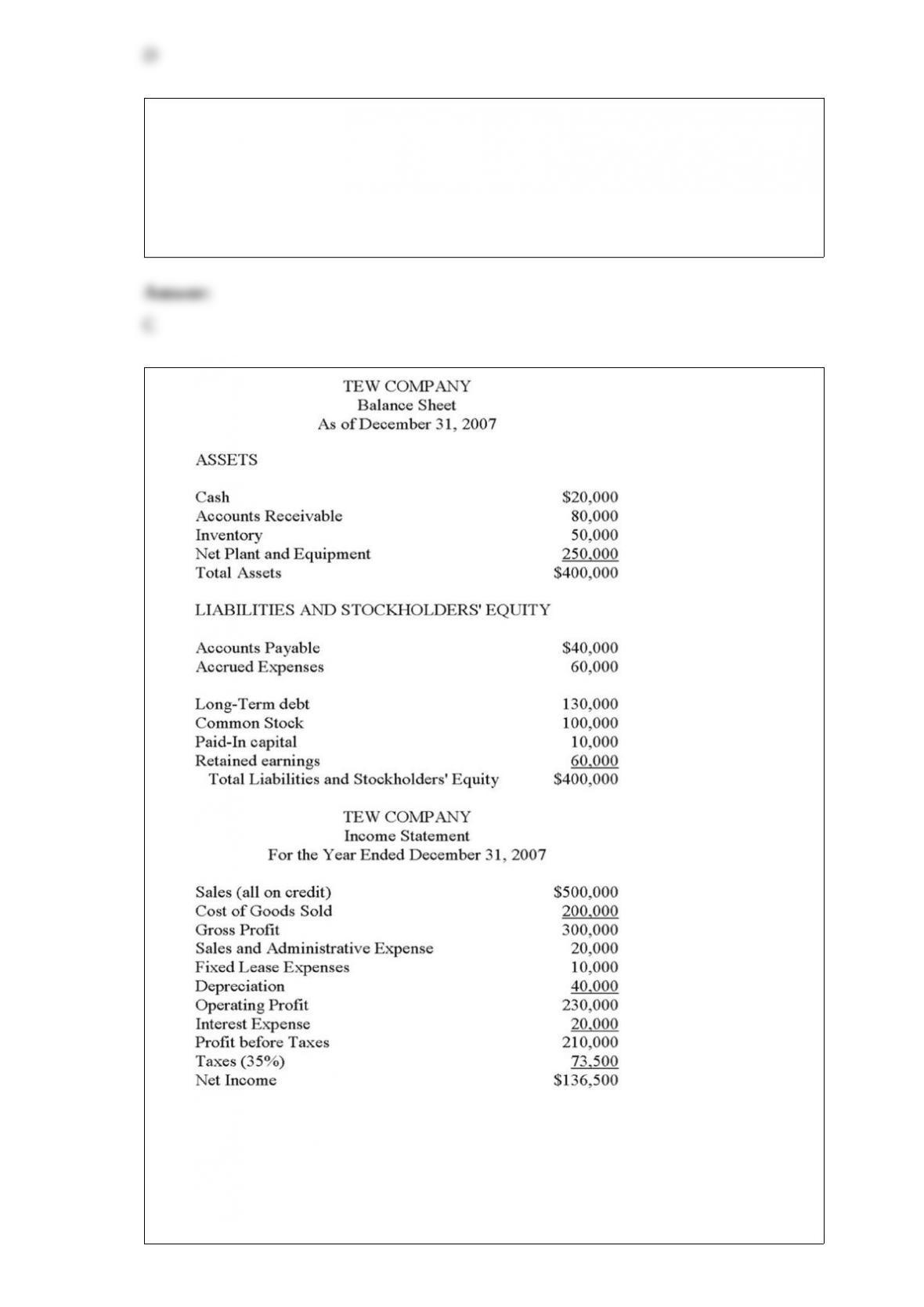
34)
Refer to the figure above. Times interest earned forTew Company is ____.
A.6.8x
B.10.5x
C.25x
D.11.5x

35) The interest factor (IF) for the future value of an ordinary annuity is 4.641 at 10%
for four years. If we wish to accumulate $8,000 by the end of four years, how much
should the annual payments be?
A.$2,500
B.$2,000
C.$1,724
D.None of these options
36) If a firm has a price of $6.00, a variable cost per unit of $4.00, and a break-even
point of 40,000 units, fixed costs are equal to _____.
A.$27,000
B.$90,000
C.$80,000
D.$50,000
37) Match the following with the items below:
1>residual dividends
2>stock repurchase
3>life-cycle curve
4>ex-dividend date
5>marginal principle of retained earnings
6>stock split
7>dividend payment date
8>stock dividends
9>dividend reinvestment plan

A. A division of shares by a ratio set by the board of directors.
B. Dividends paid in additional shares rather than in cash.
C. Dividends remaining after a portion of earnings has been reinvested.
D. States that the corporation must be able to earn a higher return on retained earnings
than stockholders could receive for themselves after paying taxes on the distributed
dividends.
E. On this date the purchase of stock no longer carries with it the right to receive the
dividend previously declared.
F. A method of utilizing excess cash that is occasionally made in lieu of additional
dividends.
G. A curve illustrating growth phases of a firm.
H. A plan that provides the investor with an opportunity to buy additional shares of
stock with cash dividends paid by the company.
I. The day a stockholder will receive a dividend.
38) XYZ Co. has forecasted June sales of 400 units and July sales of 700 units. The
company maintains ending inventory equal to 125% of next month’s sales. June
beginning inventory reflects this policy. What is June’s required production?
A.750 units
B.0 units
C.775 units
D.425 units
39) As a bond approaches its maturity date, its price approaches
A.the price of comparable bonds
B.U.S. Treasury bond prices
C.the par value
D.the par adjusted for yield to maturity
40) The internationalization of the financial markets has
A.allowed firms such as McDonald’s to raise capital around the world
B.raised the cost of capital
C.forced companies to price everything in U.S. dollars
D.All of the options

41) Which of the following is false regarding decimalization?
A.Bid-ask spreads have decreased
B.Decimalization makes trading easier for the common investor
C.It’s difficult for trading screens to adjust to decimals
D.Professional traders complain that trading profits have declined
42) Some of the services provided around the clock by SWIFT are
A.international payments between banks
B.foreign exchange
C.trade finance transactions
D.All of the options
43) A major desire of stockholders regarding dividend policy is
A.frequent stock dividends
B.dividend stability
C.high payouts when earnings are up, and lower payouts when earnings are down
D.the payment of dividends at frequent intervals
44) Which of the following are advantages of being privately placed?
A.Lower costs
B.Basic registration with the SEC
C.More investors to purchase shares
D.Two of the options
45) With respect to Finance in Action: Global, which of the following is NOT true:
A.International Accounting Standards and United States GAAP are now in full
agreement
B.LIFO is forbidden under International Financial Reporting Standards
C.International Financial Reporting Standards are “rules-based”
D.Under United States GAAP the method of depreciating long-term assets is at the
discretion of the company’s management
46) The belief that investors require a higher return to entice them into holding
long-term securities is the viewpoint of the
A.expectations hypothesis
B.market segmentation theory
C.liquidity premium theory
D.market credit crunch theory
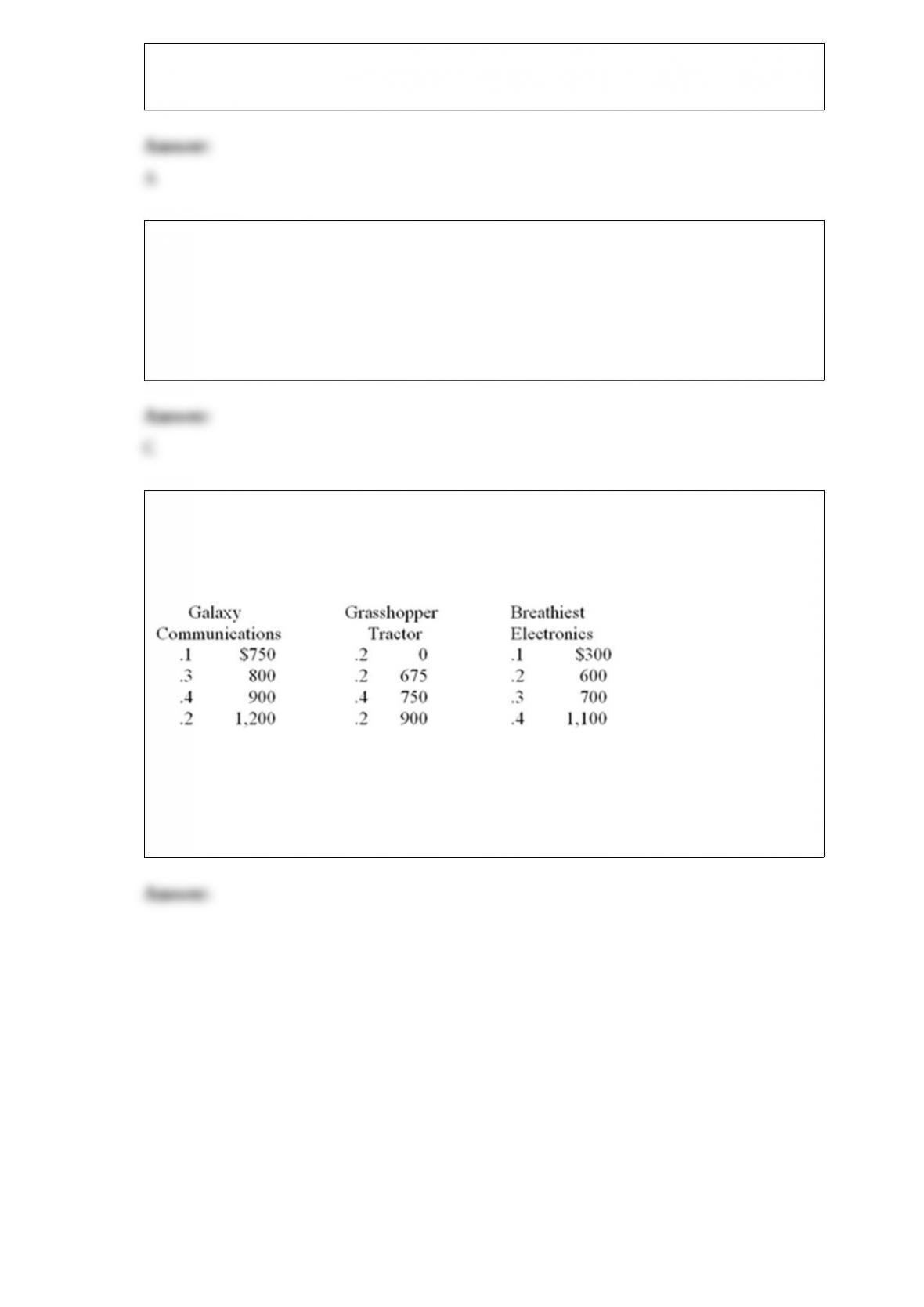
47) Bill Broodiest, star quarterback for the Spring Bay Smashers, would like to invest a
small portion of his earnings in stocks in one of three firms. His estimated returns and
the probabilities of their occurrence follow.
a) Calculate the expected return for each stock.
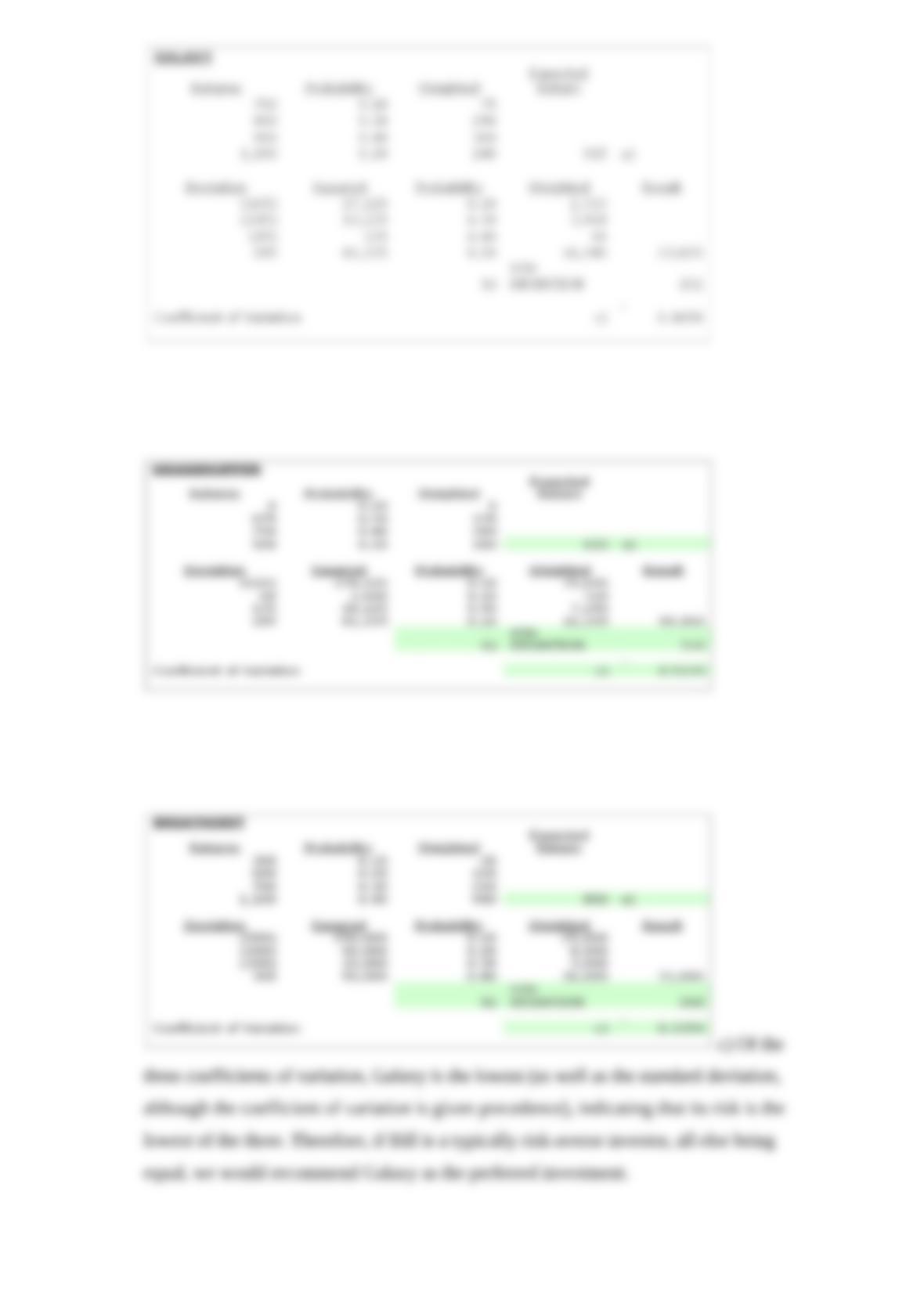
b) Calculate the coefficient of variation for each stock.
c) Rank the three from the least risky to the most risky.
d) Which stock would you recommend to Bill?

48) The following benefits occur to the corporation after forced conversion of a
convertible bond except for which one?
A.Lower times interest earned ratio
B.Lower debt-to-asset ratio
C.Higher earnings after taxes
D.All of these options are benefits
49) For many firms, the cheapest and most important source of equity capital is in the
form of
A.debt
B.common stock
C.preferred stock
D.retained earnings